Being Nutritious

  • All Posts
  • About
  • Services
  • Media
  • Contact
menu icon
go to homepage
  • Nutrition Needs
  • Recipe Index
  • About
  • Services
  • Media
subscribe
search icon
Homepage link
  • Nutrition Needs
  • Recipe Index
  • About
  • Services
  • Media
×
Home

Mulled Grape Juice

December 1, 2020 by Laura Yautz Leave a Comment

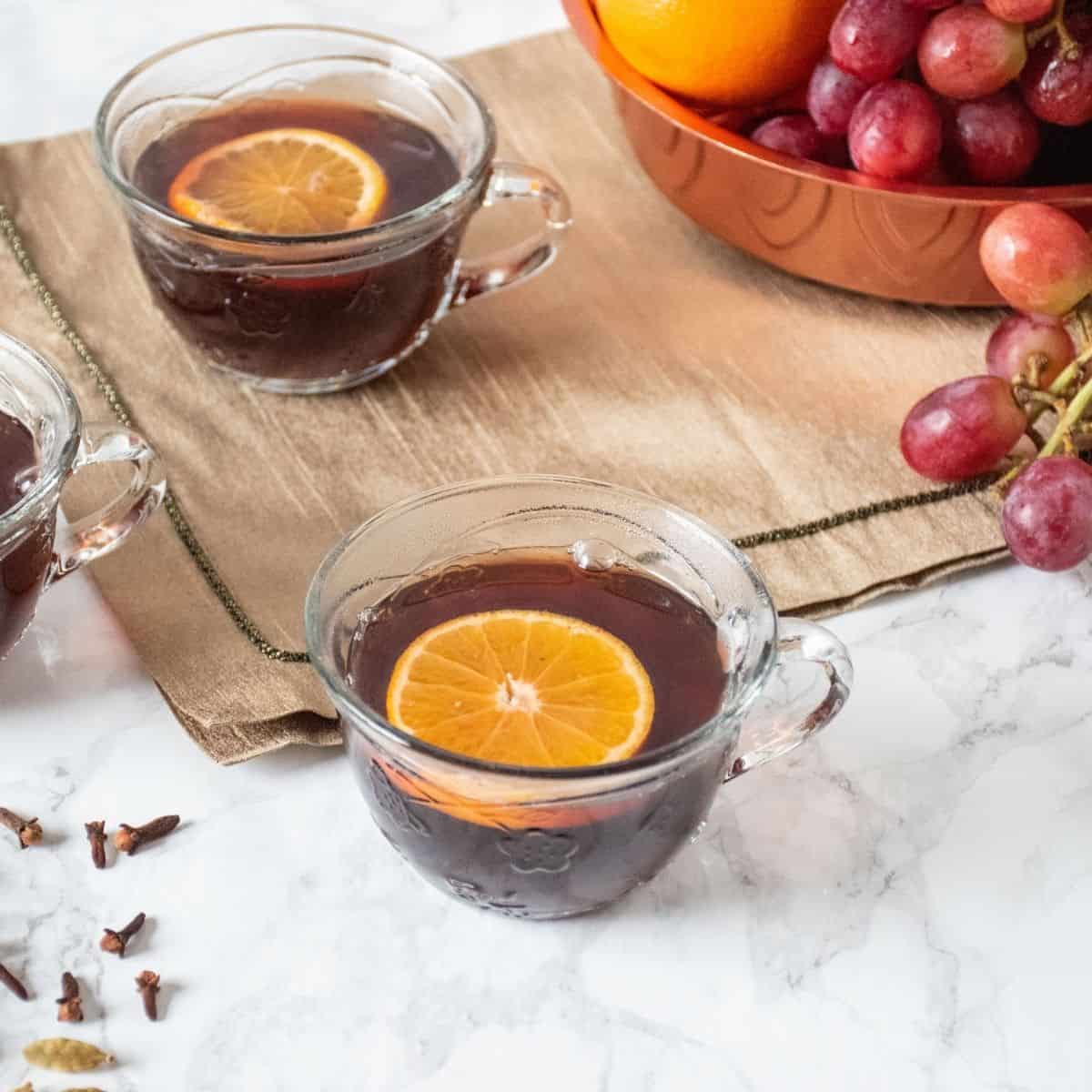
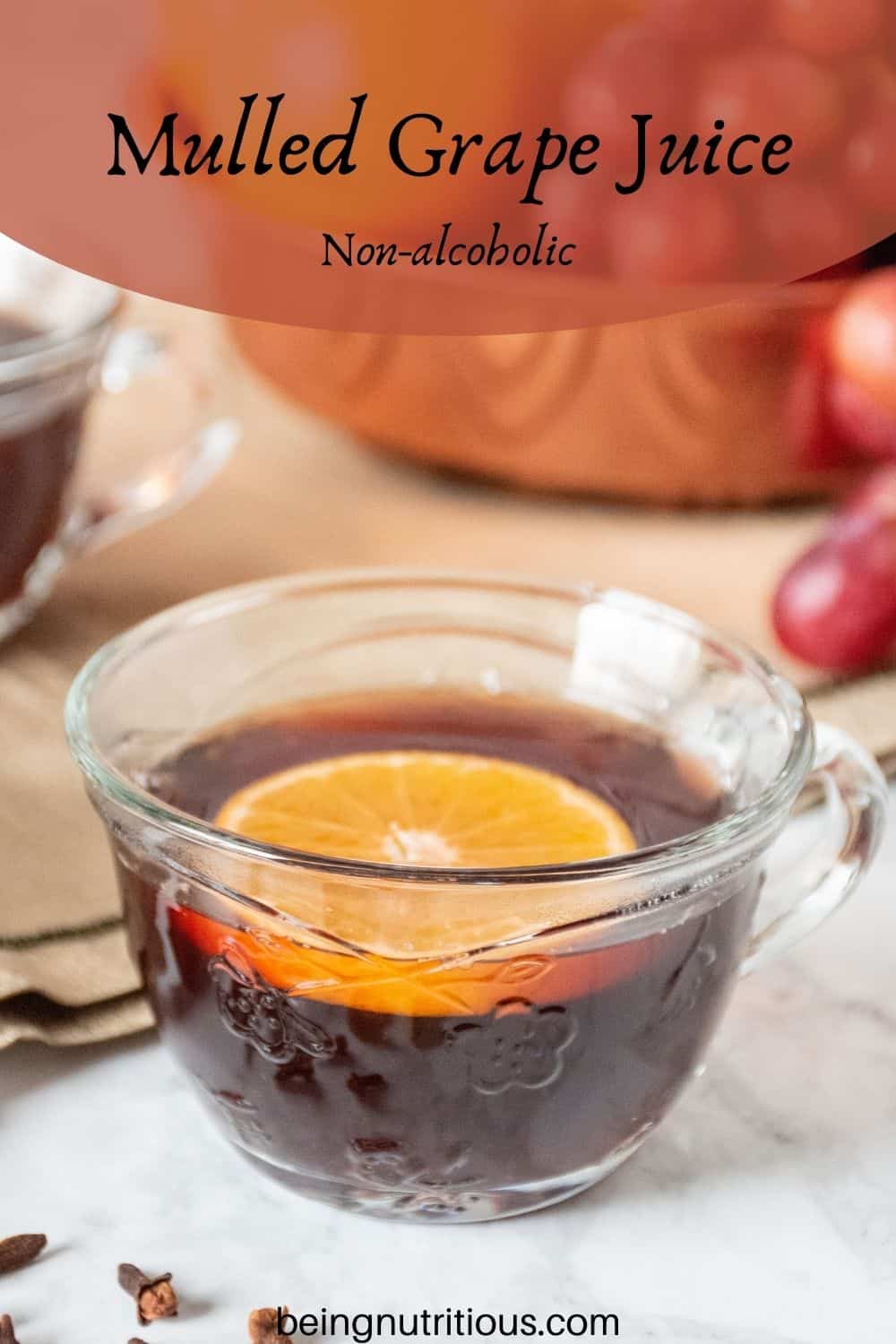
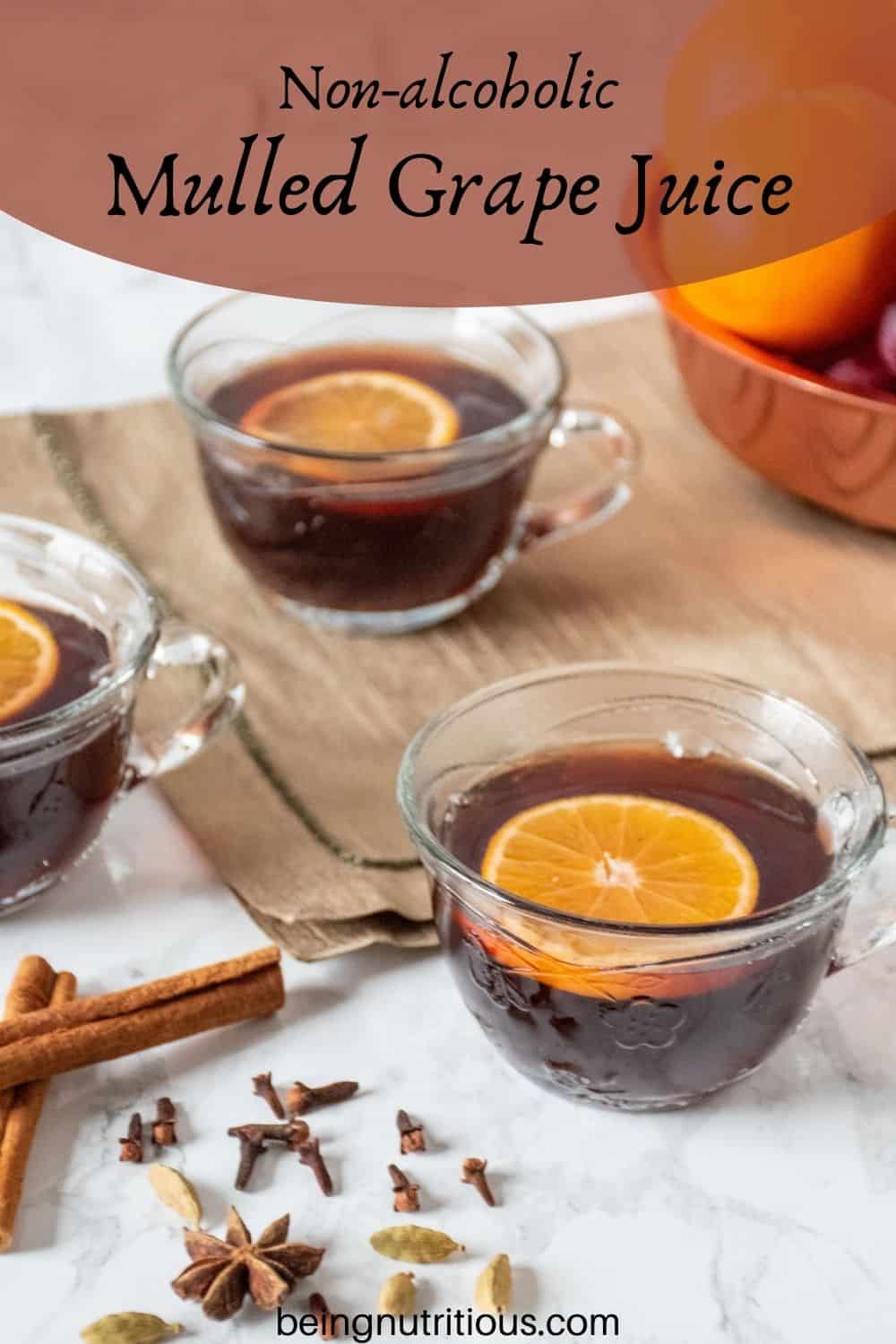
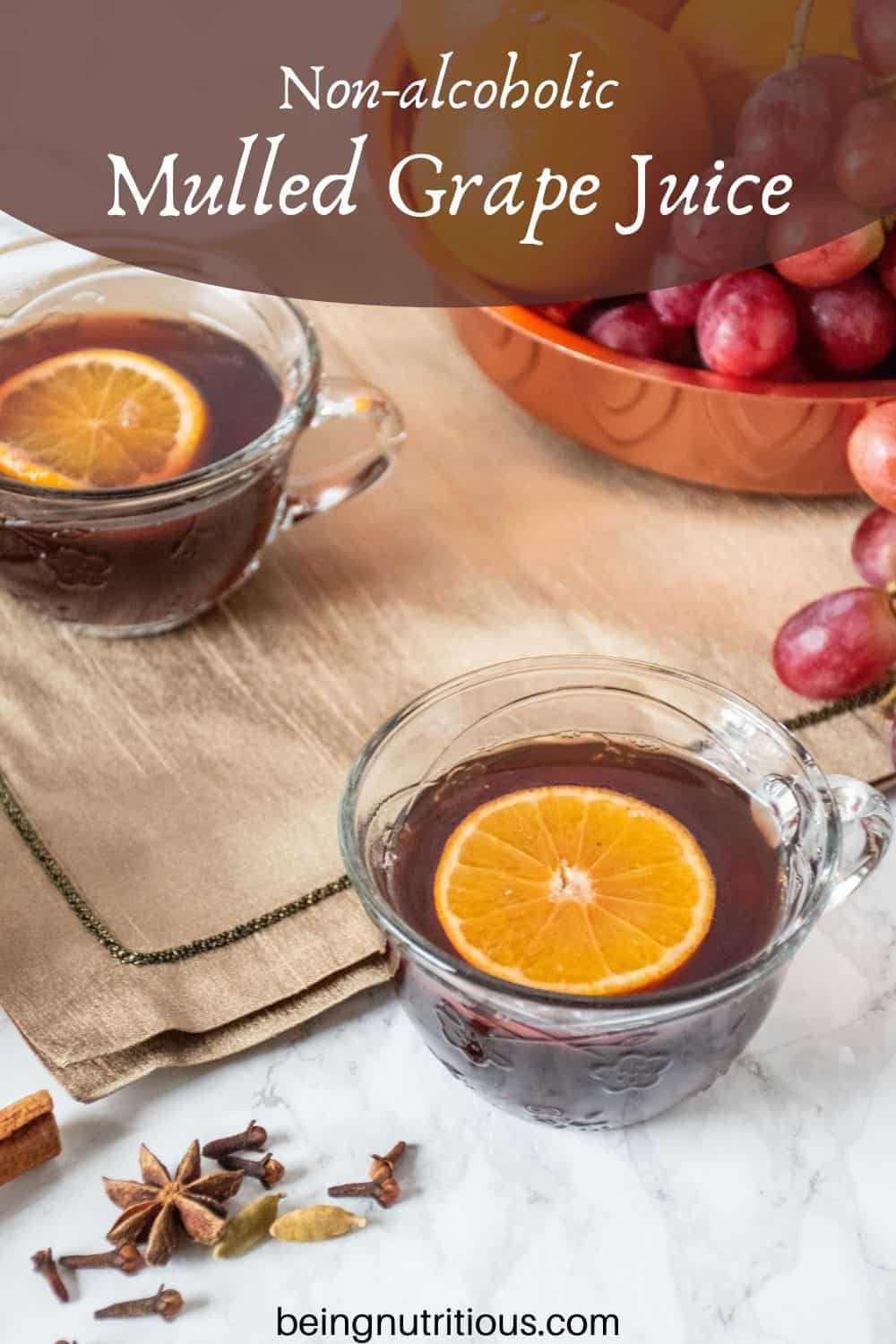
Small glass mugs filled with mulled grape juice, each with a slice of orange in them. Fresh grapes and oranges in background.

What a great way to celebrate! Mulled Grape Juice is a delicious addition to any party, or quiet evening at home. Served hot or cold, you can add a little spice to your night without the hangover the next day. This is easy to make too, friends! Just a handful of spices and a 20 minute simmer and you've got a fantastic, warming drink for any occasion or none at all!

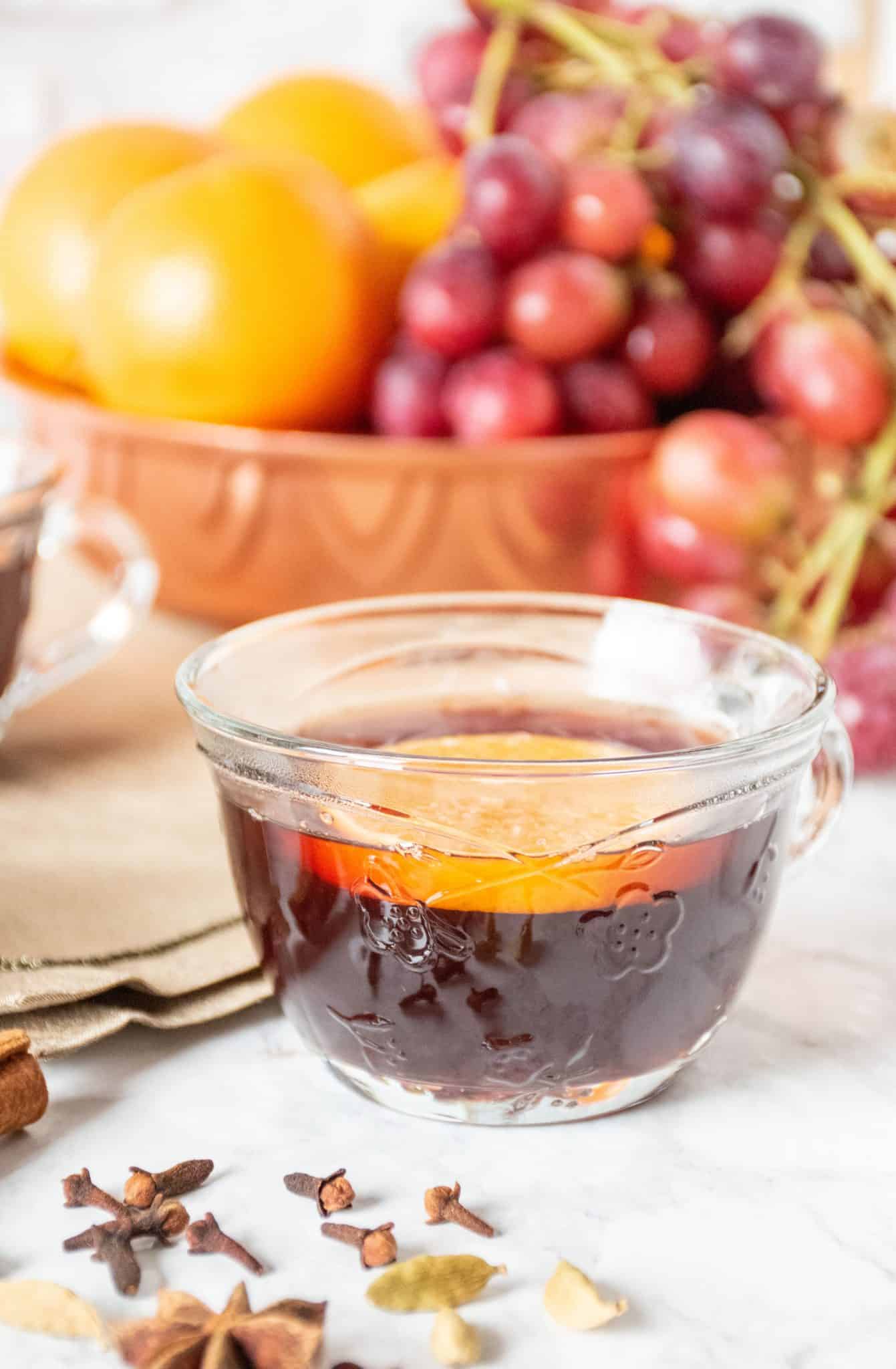
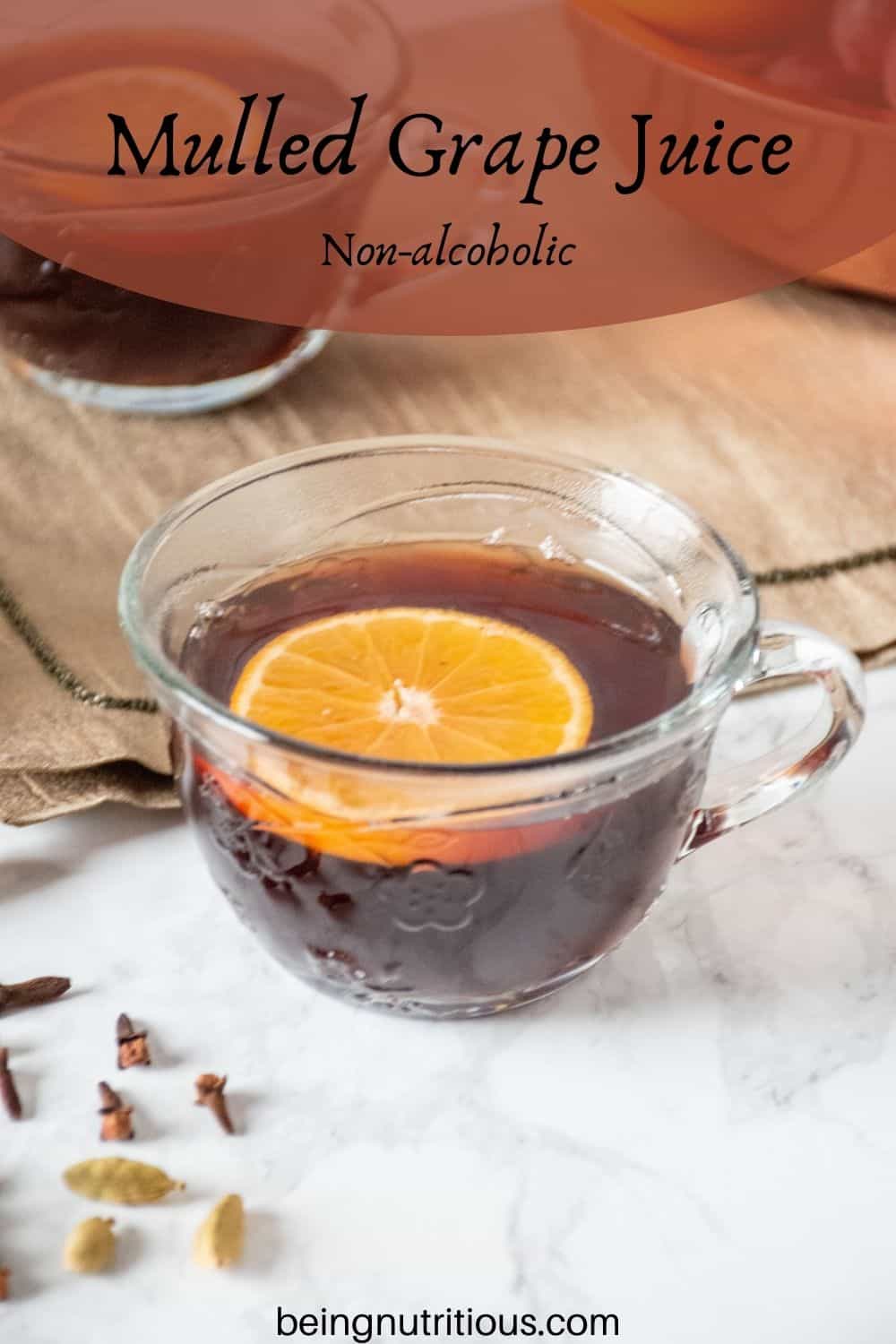
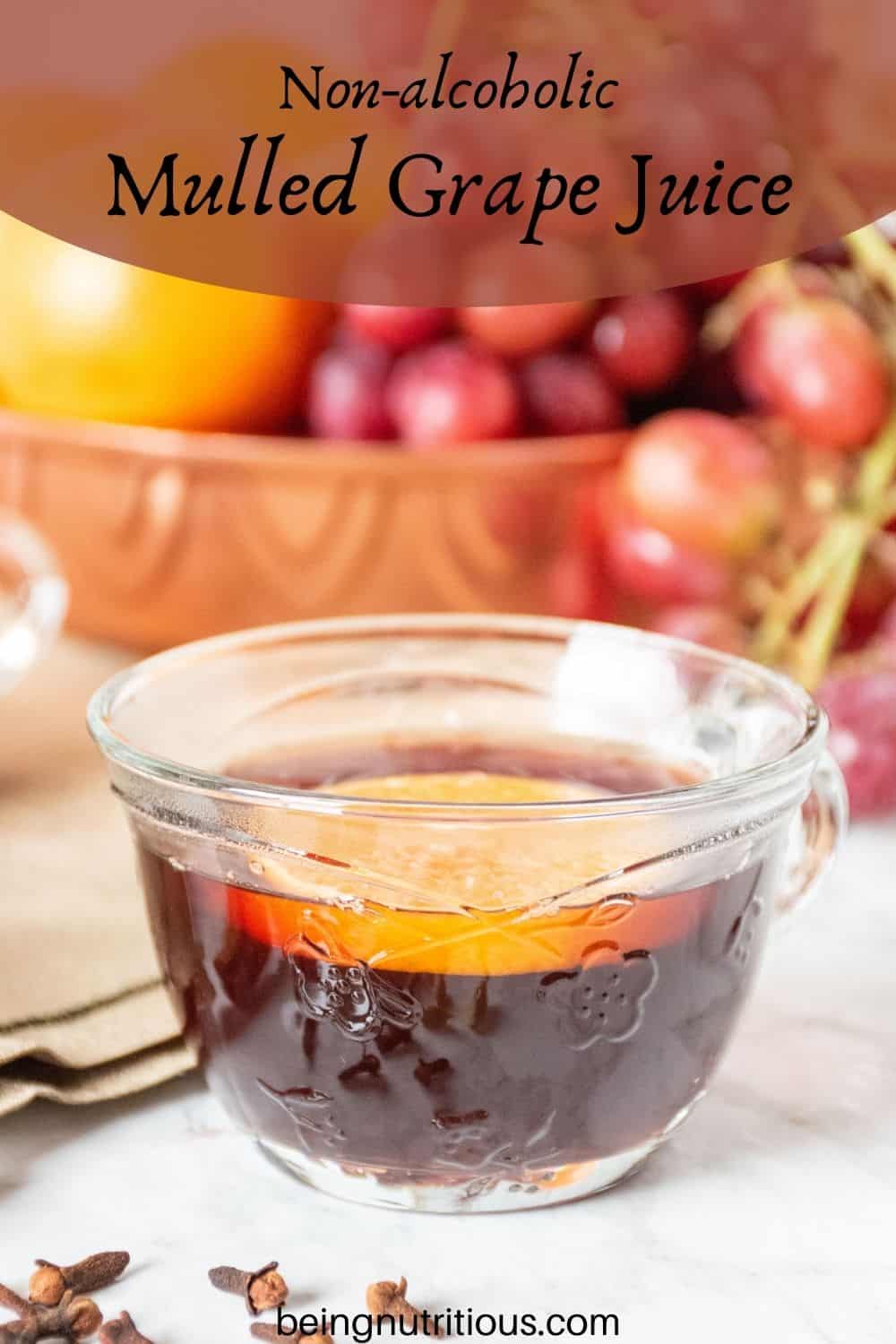
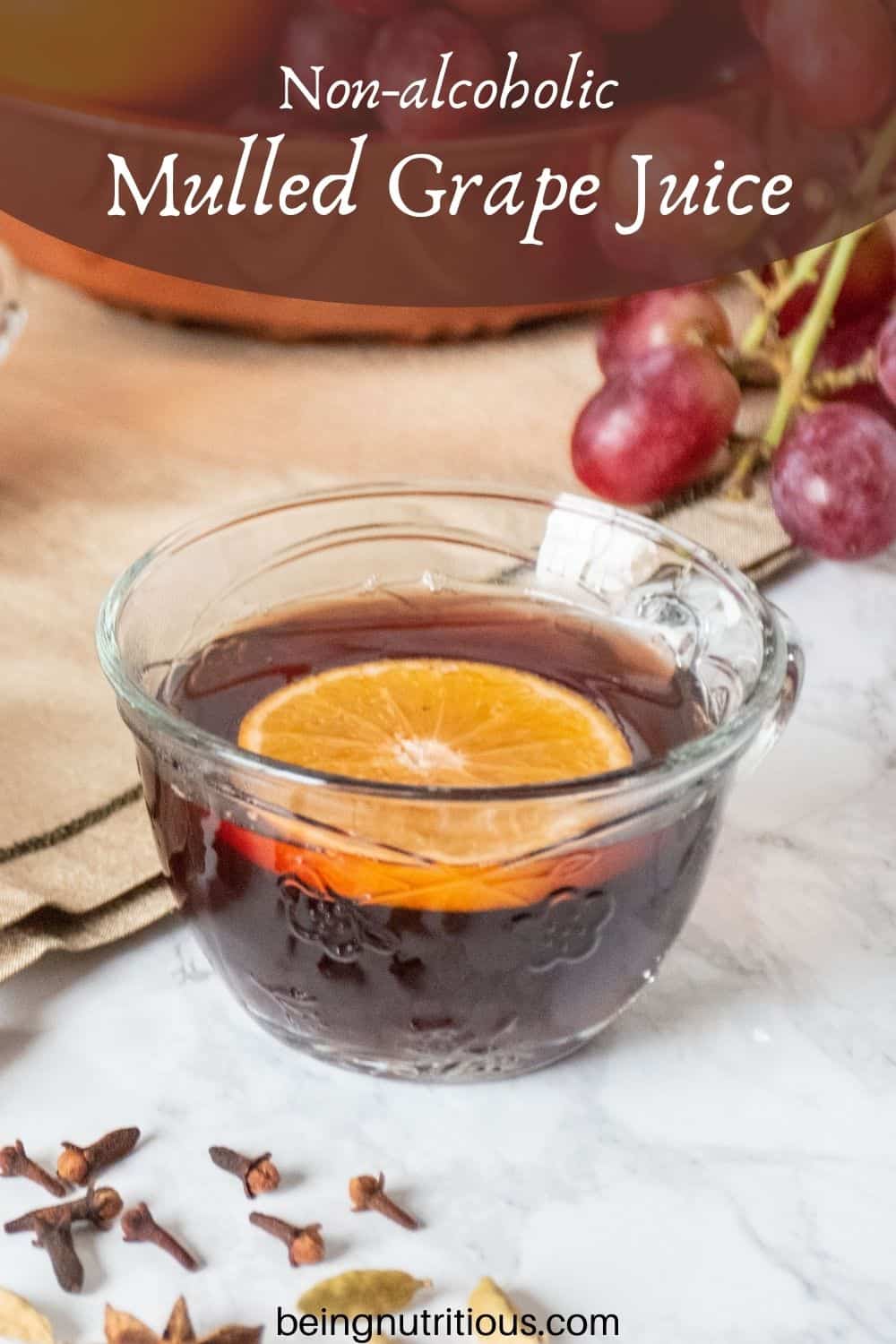
Close up of a small glass mug, filled with mulled grape juice, with an orange slice in it.

Grape Juice and Heart Health

The most well known effect of grape juice on heart health is its potential improving endothelial function and inhibiting platelet aggregation (1). The endothelium is the lining inside the heart and blood vessels that controls vessel contraction and relaxation, blood clotting, and platelet function. If you take blood thinners (or even if you don't), you might remember that platelets also drive blood clotting. The more they stick together (aggregate), the more the blood clots.

Grape juice is high in flavonoids and antioxidants, so there is great interest in how it might effect both health and health conditions like heart disease. To date, though, there is sparse evidence that grape juice has a dramatic impact. Studies show grape juice can increase circulating antioxidants, and lower DNA damage (2), and that it may be able to slightly reduce blood pressure (3). It's perfectly fine to include as part of your everyday diet, in moderation (a glass or two a day).

What we do know is that whole grapes are fantastic for heart health; improving blood vessel function (4), lowering blood pressure (5), and reducing inflammation (6). This is very likely due to the fact that the majority of antioxidants are found in grape skins, seeds, and other edible parts. Whole grapes also contain fiber, which surely contributes to the healthful effects of grapes.

Bottom line: Grape juice may be good for your heart in moderation, but whole grapes are even better.

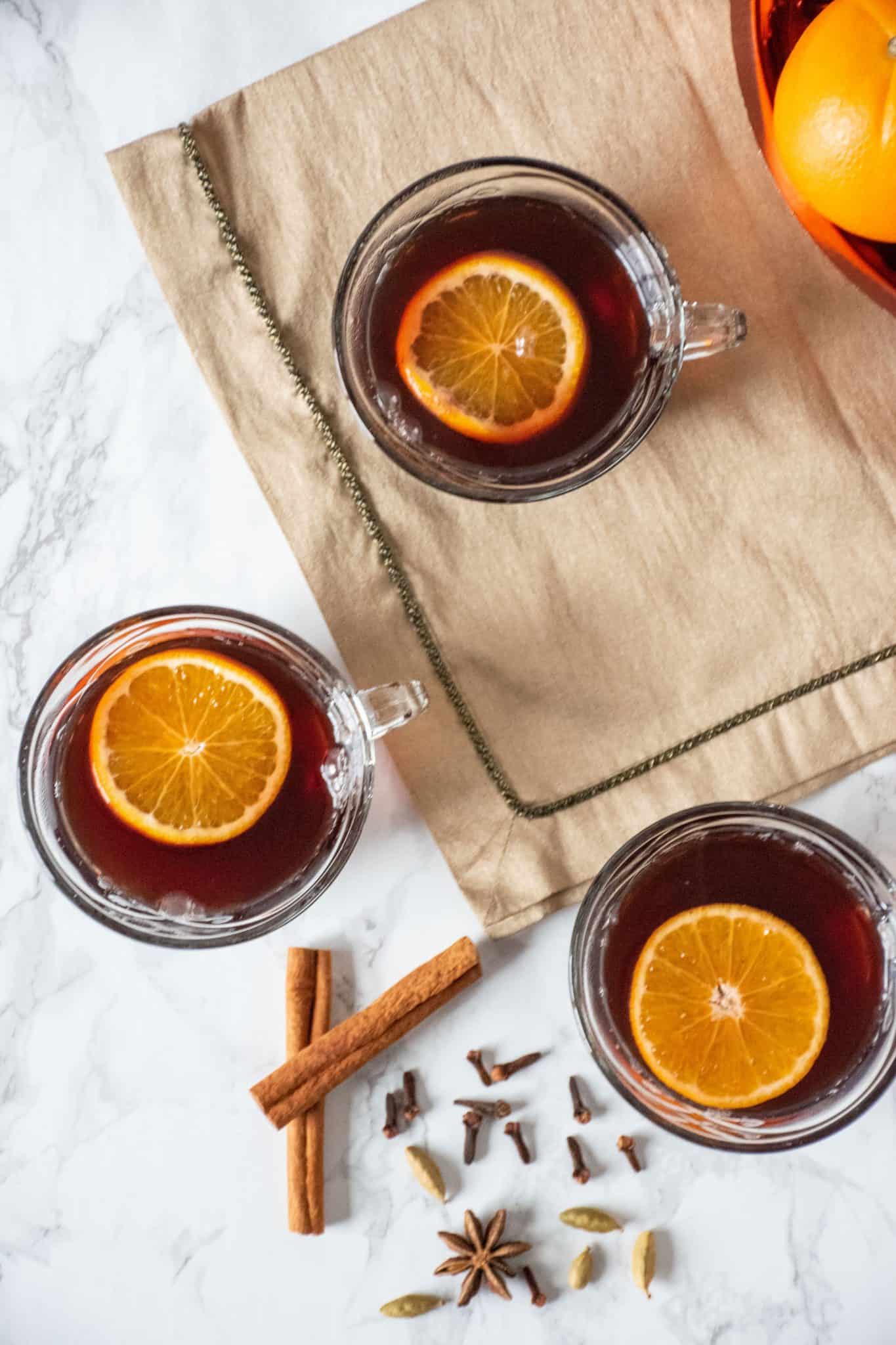
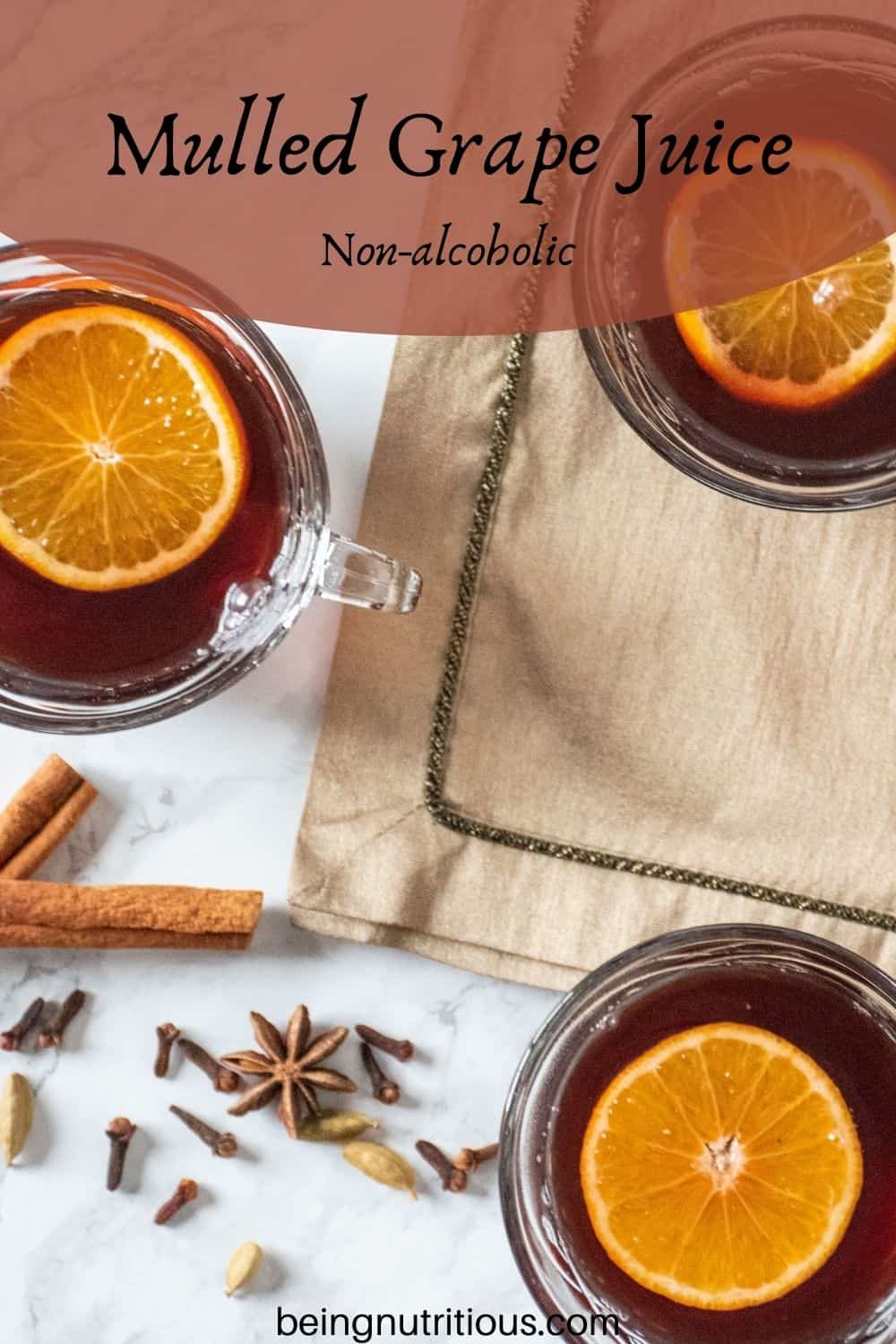
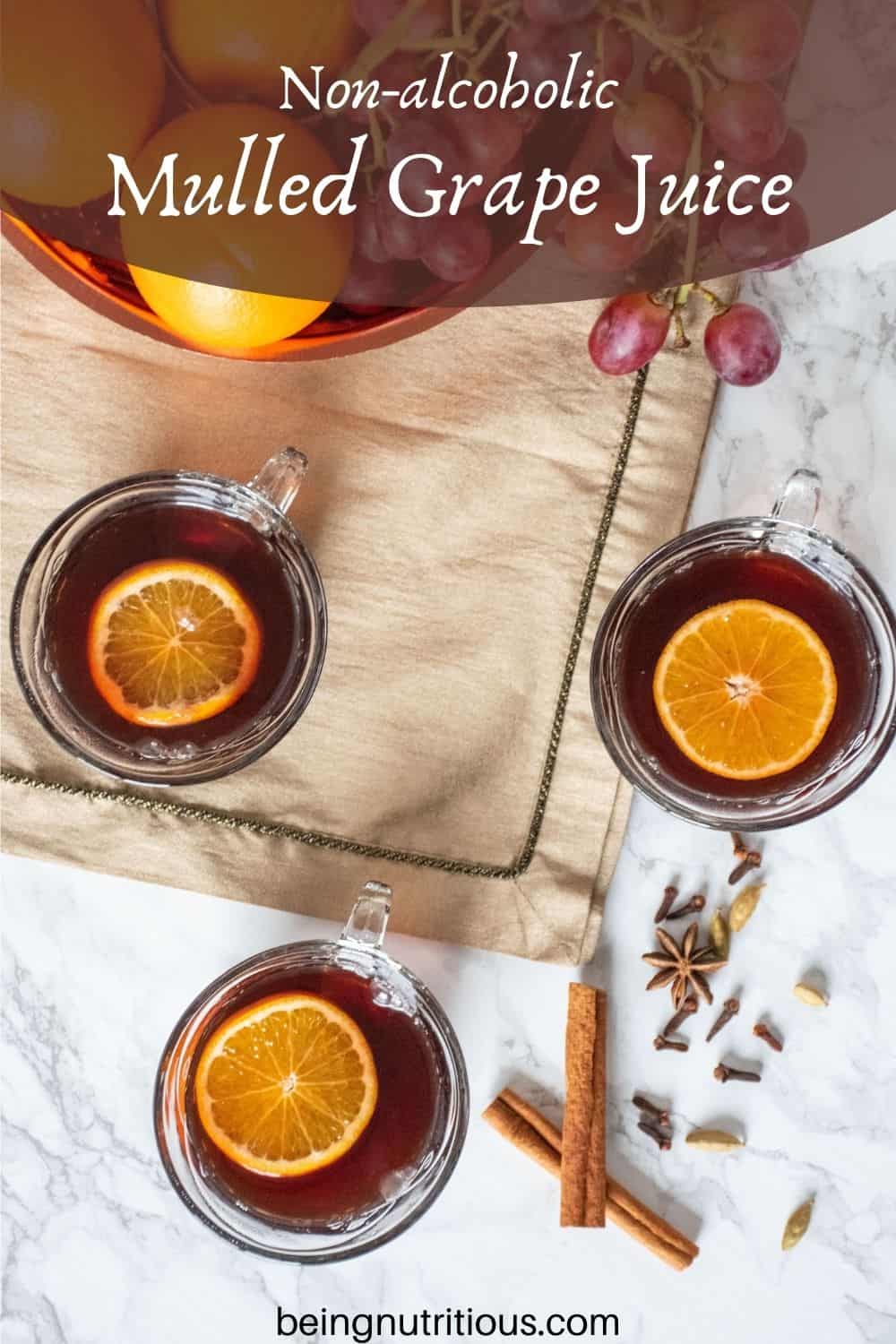
Overhead shot of 3 small glass mugs filled with mulled grape juice, each with an orange slice in them.

Tips and substitutions for this recipe

These are some delicious ways to modify this recipe:

  • Don't like grape juice? Try using pomegranate juice or blueberry juice.
  • Hate licorice flavor? Leave out the star anise.
  • Want to make it alcoholic? Add ½ cup of spiced rum.
  • Garnish your beverage with orange slices and/or a cinnamon stick to make it fancy!

If you try mulled grape juice, don't forget to let me know in the comments!

You might also like to try Pomegranate Mocktail and Gingerbread Hot Cocoa!

📖 Recipe

Small glass mugs filled with mulled grape juice, each with a slice of orange in them. Fresh grapes and oranges in background.

Mulled Grape Juice

Laura Yautz
Include everyone in the celebration this season with delicious non-alcoholic Mulled Grape Juice!
No ratings yet
Prevent your screen from going dark
Print Recipe Pin Recipe Save Recipe Saved Recipe!
Prep Time 5 minutes mins
Cook Time 20 minutes mins
Total Time 25 minutes mins
Course Drinks
Cuisine American
Servings 8
Calories 170 kcal

Ingredients
  

  • ½ gallon 100% Grape Juice
  • Peel of 1 Orange
  • 3 Cinnamon Sticks
  • 2 Star Anise
  • 4 Whole Cardamom Pods
  • 1 teaspoon Whole Cloves

Instructions
 

For stovetop

  • Add all ingredients to a large pot, and bring to a simmer.
  • Simmer on low for at least 2 minutes.
  • Serve hot, or chill to serve as punch.

For slow cooker

  • Add all ingredients to the slow cooker and turn on high for at least 1 hour.
  • Serve directly from slow cooker.

Nutrition

Calories: 170kcal (9%)Carbohydrates: 41.9g (14%)Protein: 1.4g (3%)Fat: 0.6g (1%)Saturated Fat: 0.1g (1%)Polyunsaturated Fat: 0.1gMonounsaturated Fat: 0.1gSodium: 13.9mg (1%)Potassium: 323mg (9%)Fiber: 1.9g (8%)Sugar: 37.7g (42%)Vitamin A: 2.7IUVitamin C: 12.8mg (16%)Calcium: 55.3mg (6%)Iron: 1.1mg (6%)

*Nutrition information is an estimate, and will change based on the brand and individual ingredients and amounts you use. This is provided for your convenience only.

Keyword healthy party drinks, healthy punch recipes, non alcoholic party drink
Tried this recipe?Let us know how it was!
3 small glass mugs filled with mulled grape juice, each with an orange slice in them. Text overlay: Mulled Grape juice; festive; non-alcoholic.
Close up of a small glass mug, filled with mulled grape juice, with an orange slice in it. Text overlay: mulled grape juice; non-alcoholic.
Overhead shot of 3 small glass mugs filled with mulled grape juice, each with an orange slice in them. Text overlay: Mulled Grape Juice; non-alcoholic.
Close up of a small glass mug, filled with mulled grape juice, with an orange slice in it. Text overlay: mulled grape juice; non-alcoholic.
3 small glass mugs filled with mulled grape juice, each with an orange slice in them. Text overlay: Non-alcoholic Mulled Grape juice.
Close up of a small glass mug, filled with mulled grape juice, with an orange slice in it. Text overlay: non-alcoholic mulled grape juice.
Overhead shot of 3 small glass mugs filled with mulled grape juice, each with an orange slice in them. Text overlay: Non-alcoholic Mulled Grape Juice.
Close up of a small glass mug, filled with mulled grape juice, with an orange slice in it. Text overlay: non-alcoholic mulled grape juice.
2 small glass mugs filled with mulled grape juice, each with an orange slice in them. Text overlay: Non-alcoholic Mulled Grape juice.

Twelve Realistic Tips for a Healthy Thanksgiving

November 25, 2020 by Laura Yautz Leave a Comment

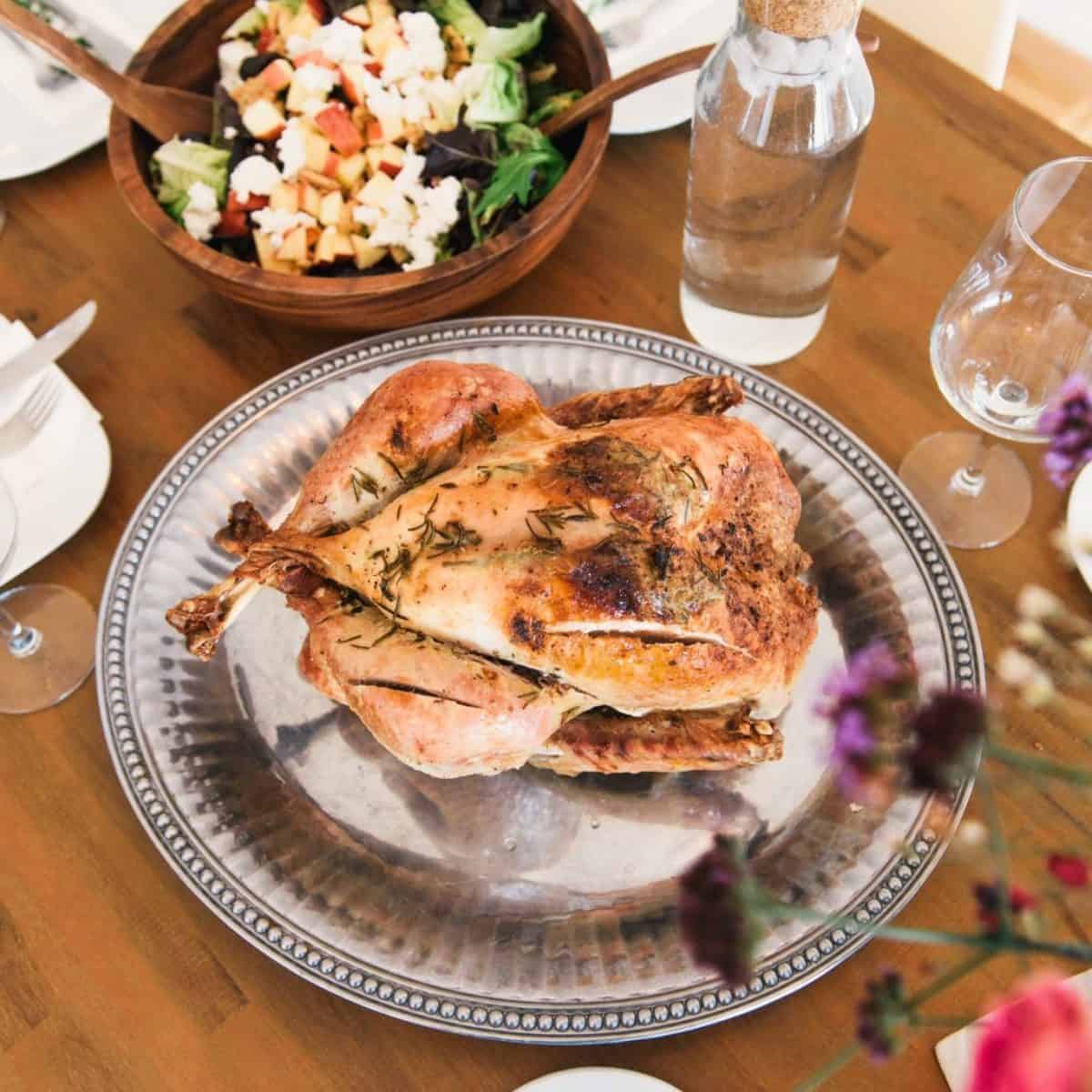
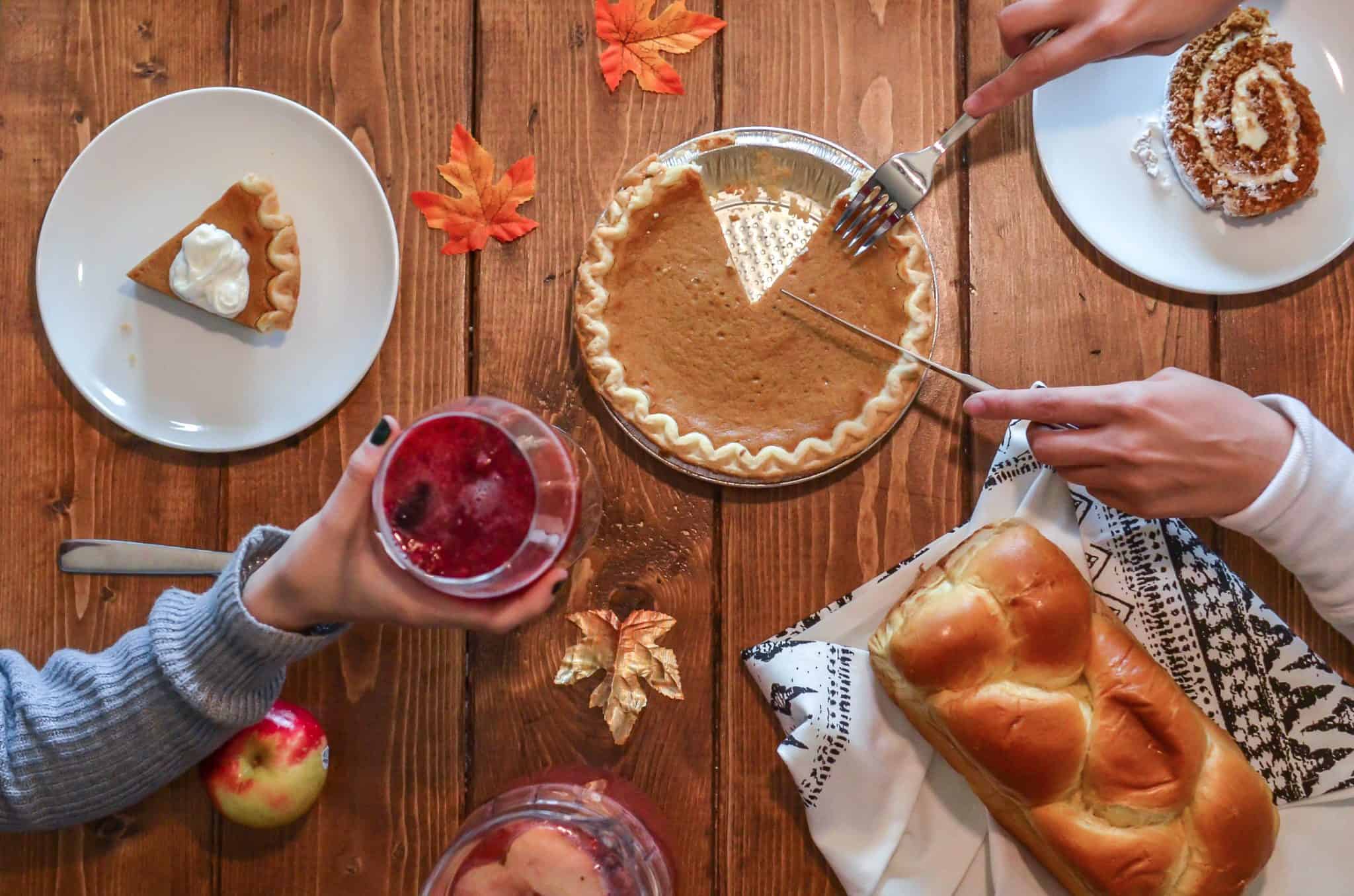
Thanksgiving dinner

When you've got a health goal you're trying to reach or maintain, the holidays can be tricky! And Thanksgiving is really all about the food isn't it? Most people will find themselves overeating on Thanksgiving Day; it's really hard not to! But this year can be different! Here are some tips to mitigate the damage and help you enjoy the holiday with a little less guilt!

Healthy Thanksgiving tips

Start the day with some exercise. Go for a walk, run, or swim. Whatever you like to do. While it may not burn off enough calories for your upcoming meal, it helps you start the day off with your health goals in mind!

Allow yourself to indulge in one meal. This is more of a mental rule to set for yourself. By telling yourself you have a big meal coming up that you may indulge in, it can help you avoid overindulging in the upcoming week.

Eat normally or a little less the day of the holiday meal. Many people have traditions of certain breakfasts they make on holiday mornings. These often come with loads of calories that could undo your day before it even starts. Try either modifying the recipe to be healthier, or just have a normal breakfast with the knowledge that the holiday meal will be big enough.

Manage holiday stress in healthy ways. Holidays are often loaded with stress. Practice healthy stress management strategies so you don't find yourself eating and drinking because of it. Try these: deep breathing, walking away, meditation, listening to music, and positive self-talk. There are many more, but those should get you started!

Plan what you'll eat for the holiday meal in advance. You know what will be there: turkey, gravy, mashed potatoes, stuffing, cranberry sauce, pumpkin pie, etc. Think about it beforehand and have a plan for how you'll handle it. You're way more likely to be successful with a solid plan. Decide what foods are special enough for you that you absolutely want to eat. Then think about the foods that aren't so special that you can have anytime. Focus on the special foods in reasonable amounts, and have less of (or none) of the less special foods. 

Fill half of your plate with vegetables. Okay, I know the vegetables on a Thanksgiving table aren't usually very healthy, but they're still loaded with fiber that will help fill you up with fewer calories.

Bring a healthier dish. No one will tell you 'no' to bringing a dish to a big meal! Bring a healthier dish that you know you can fill up on if there are few other options.

Make a beverage plan. Beer, wine, apple cider, hot toddies... They all add an awful lot of calories to an already indulent day. Decide ahead of time what your plan will be to keep it in check. Will it be drinking water? Keeping it to one other beverage? Plan for what's realistic for you, and follow through.

Watch the seconds! You know how this goes. You finish your plate of food, and you're pretty full but you're still looking forward to dessert. You're sitting at the table chatting, and other people start taking seconds of what's left. Before you know it, you're having another spoonful of potatoes or stuffing, another forkful of turkey, etc. All it does is make you feel more uncomfortable, and THEN you're still having dessert. Consider a 'no seconds' rule for yourself. Get up from the table when you're done.

Pick one dessert. Which dessert item are you most excited about? Pick that one, have one serving of it, and be done. At this point in the day, most people are thousands of calories in the hole, and unbuttoning their pants! Try something different this year. (Also, stuffing yourself like that increases your chances of a heart attack immediately following the meal!)

Don't take home leftovers. What will you do with unhealthy leftovers? Eat them of course. Avoid continuing the overindulgence into the next day and week by leaving leftovers to someone else.

Get back on track at the very next meal! Even if you overdid it on Thanksgiving, start the next day anew. Have a healthy breakfast and go for a walk. Get back on track immediately.

Remember that being nutritious isn't about never eating 'not-so-good-for-you foods.' It's about eating those less often and with intention, rather than regularly and mindlessly. Overdoing one meal won't undo your goals for getting and staying healthy. Staying off track will, though! Make a plan, and a contingency plan. You've got this!

HAPPY THANKSGIVING FROM BEING NUTRITIOUS!

Creamy Braised Beet Greens

November 19, 2020 by Laura Yautz Leave a Comment

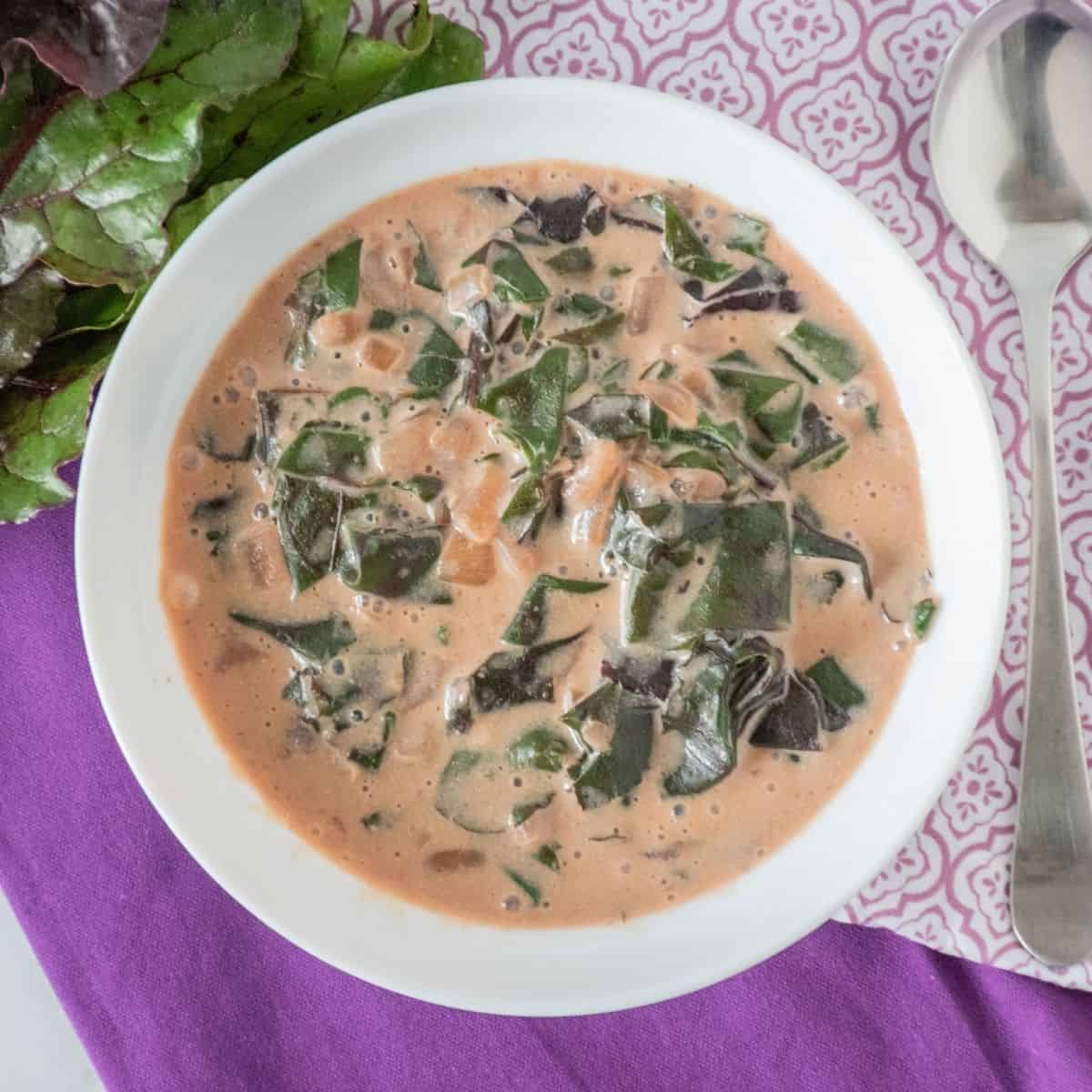
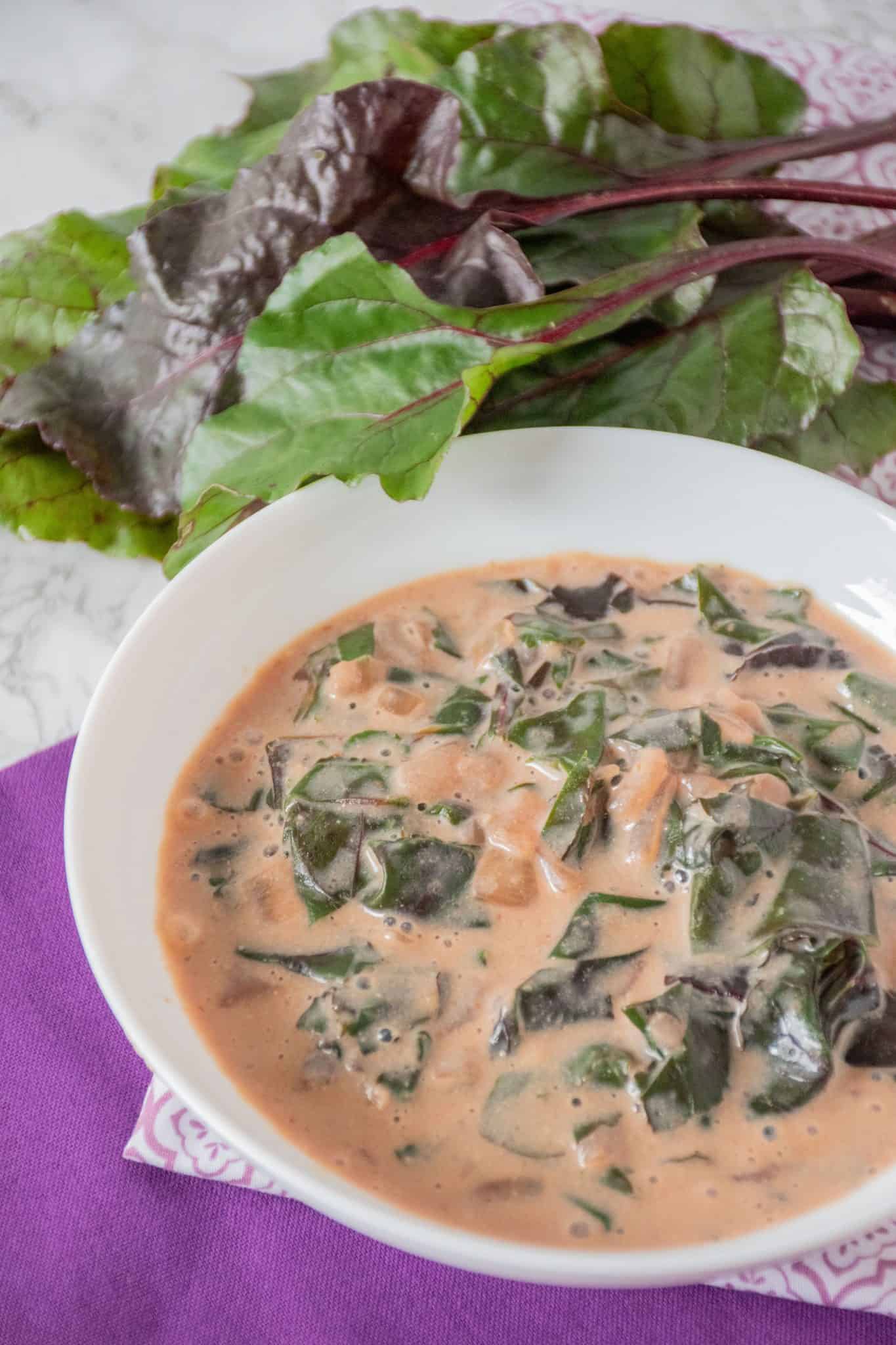
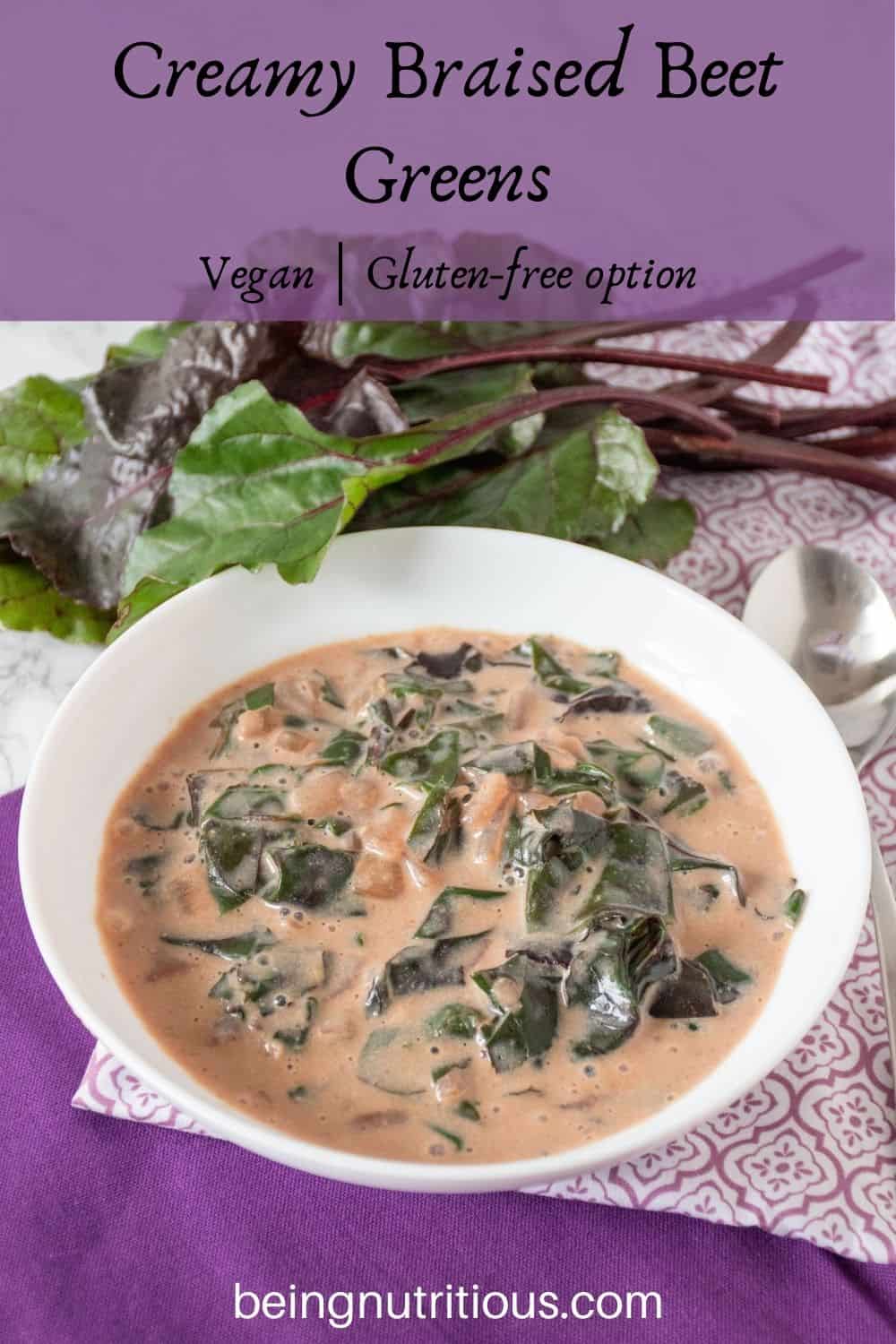
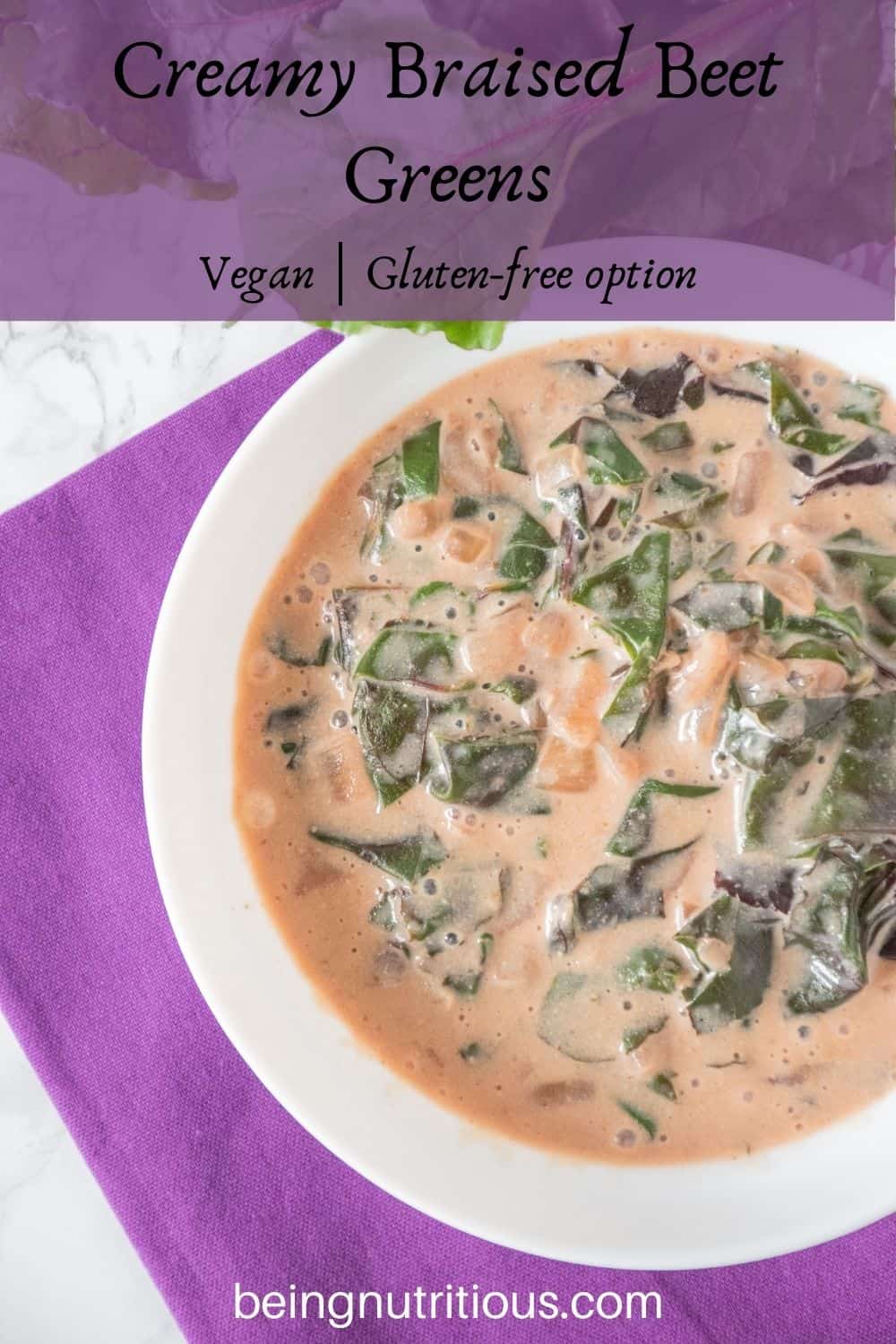
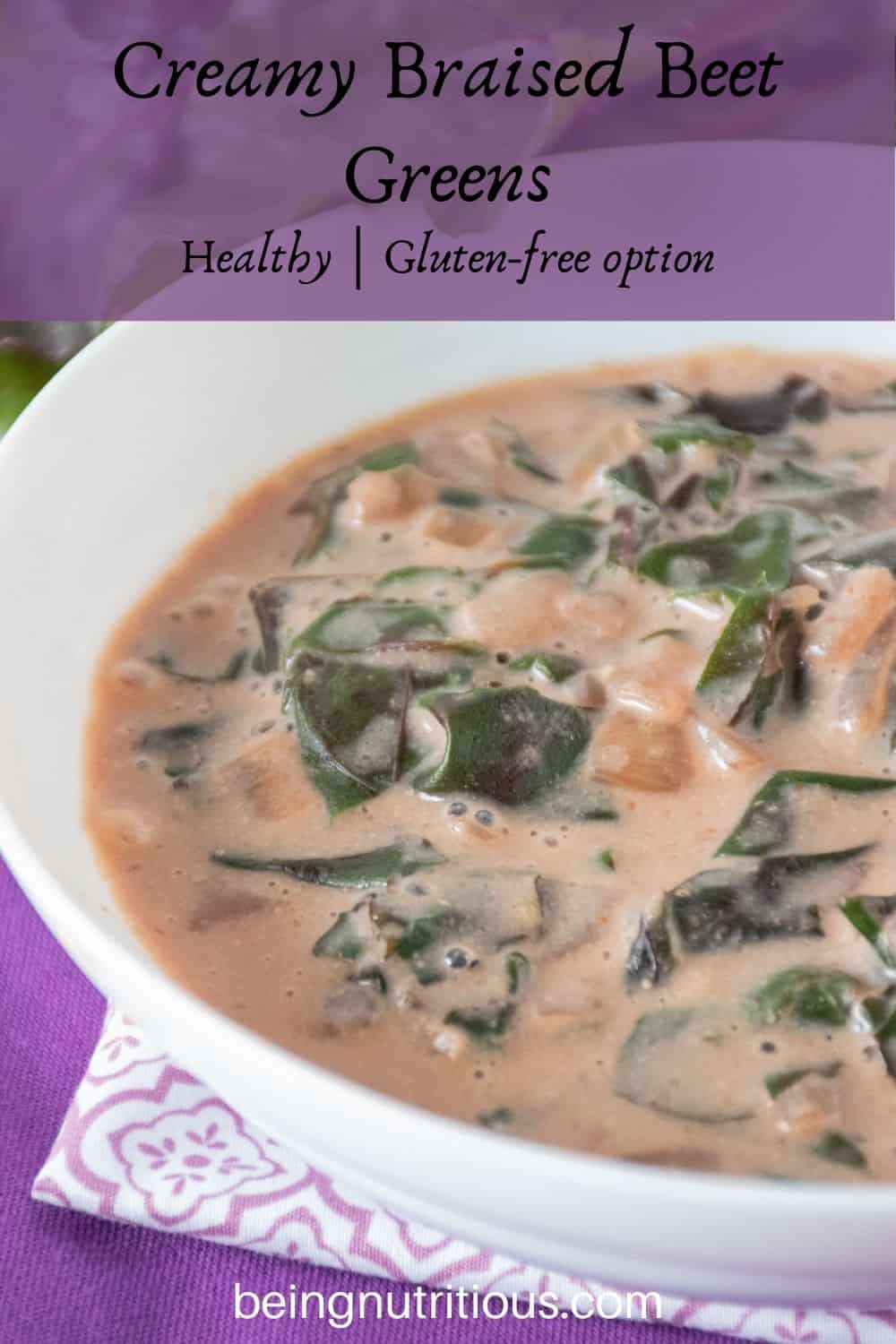
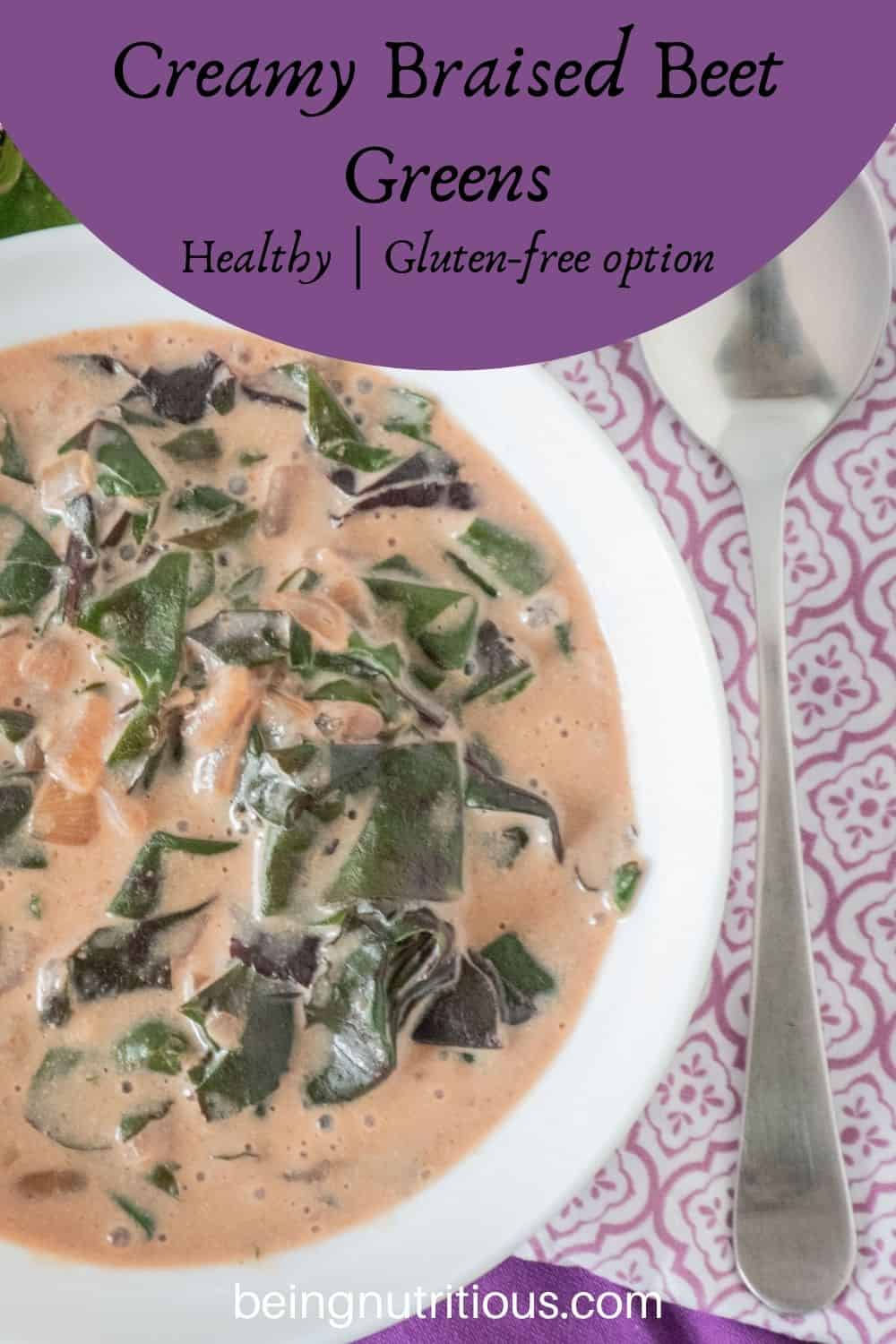
Overhead picture of a bowl of braised greens in a light pink broth.

Creamy Braised Beet Greens is a great way to use greens that are a bit more on the tough, bitter side. Braising softens them perfectly, and using milk or a substitute creates a lovely, light pink broth that cuts through the bitterness. Delicious with a crusty bread, over polenta, or all on its own!

Beet greens are so underappreciated in my opinion! Beets get all the attention, while the greens are left to whither in the fridge, or just get tossed in the trash because we don't know what to do with them. Beet greens are naturally low in fat, but high in fiber, and vitamins A, C, and K. Beet greens are also a good source of potassium, magnesium, calcium, iron, vitamin E, and a variety of other phytonutrients and antioxidants. That's quite a nutrition profile! Beet greens are a great addition to any heart healthy diet (note the vitamin K level if you're on coumadin!).

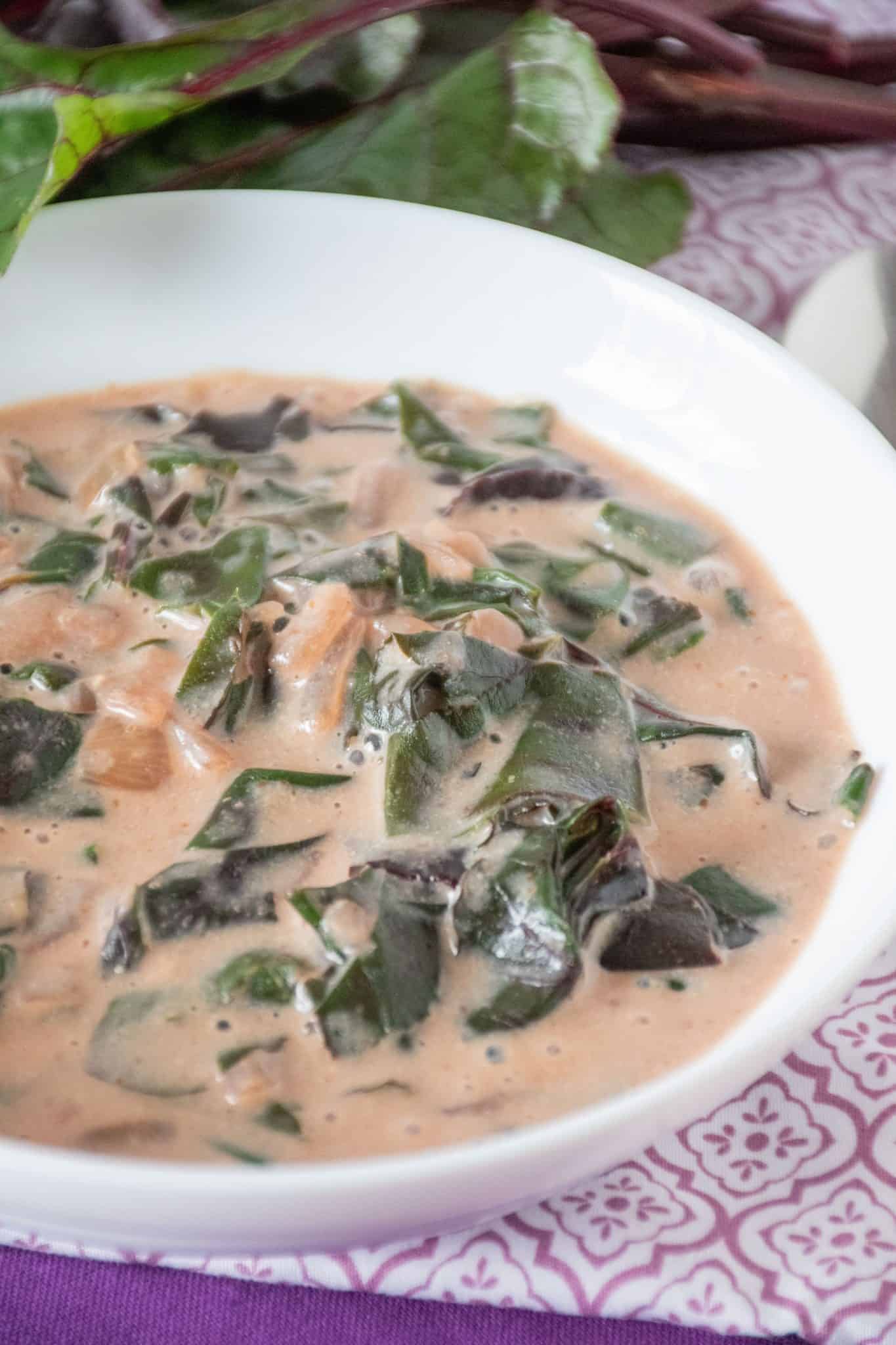
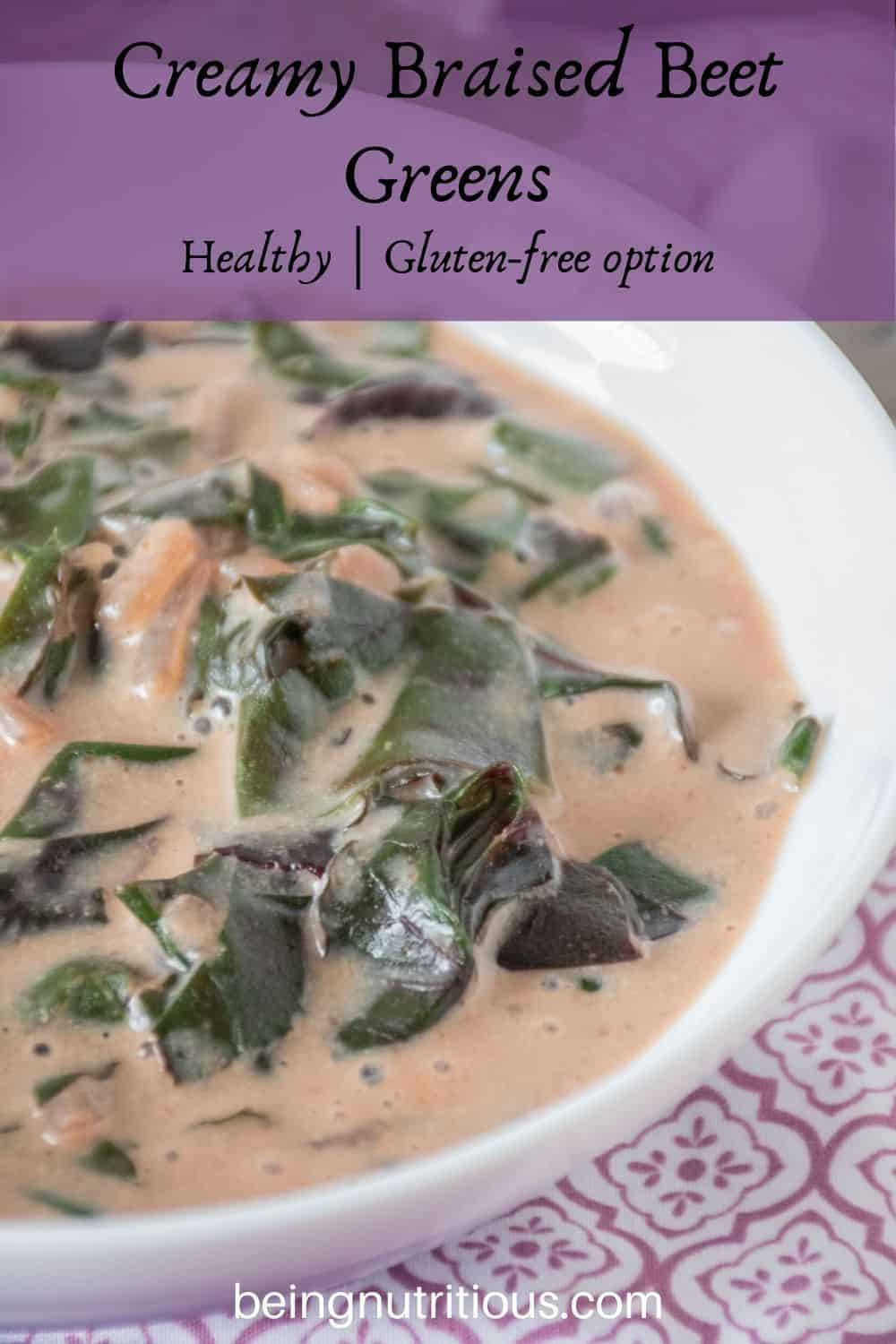
Close up of a bowl of braised greens in a light pink broth.

What else can I make with beet greens?

Beet greens are pretty versatile, and can usually be used in most recipes calling for another green. They are most similar in texture to collard greens, so if you're new to beet greens, try them in collard green recipes. The thick purple stems are edible, but cook at a different rate than the greens, so most often, you'll want to remove those. You can save them to blend into smoothies, or use in another way. Here are some other healthy ideas for beet greens:

  • A quick sauté with olive oil and garlic.
  • Eat them raw in a salad. Just give them a rough chop so they're not too large.
  • Slice thin and mix into pasta, tossed with olive oil and sautéed veggies.
  • Toss whole leaves with oil and a bit of salt and bake until crispy for a delicious snack!
  • Stir into soup instead of spinach.
  • Blend into smoothies.
  • Use the big leaves in sandwiches instead of lettuce.

Tips and substitutions for this recipe

In case you're looking for some substitutions or a few tips, here are some recommended for this recipe!

  • Use collard greens, mustard greens, or kale instead of beet greens.
  • Use 2 chopped shallots or 1 chopped leek instead of the onion. Fancy!
  • Use a gluten free flour or some corn starch mixed in cold water instead of whole wheat flour. For this recipe, you can even use white flour if that's what you have.
  • Use cashew milk, coconut beverage, soy milk, or nonfat milk instead of the almond milk. Any will work; just make sure it's unsweetened. If you use cashew milk, you may need to use less flour since it's thicker than the other options.
  • Add a pinch of nutmeg to take the flavor up a notch!
  • If you have leftovers, refrigerate immediately. When reheating, add a little bit more milk to thin, as it goes get thicker as it cools.
  • This recipe does not freeze well, and I don't recommend it.
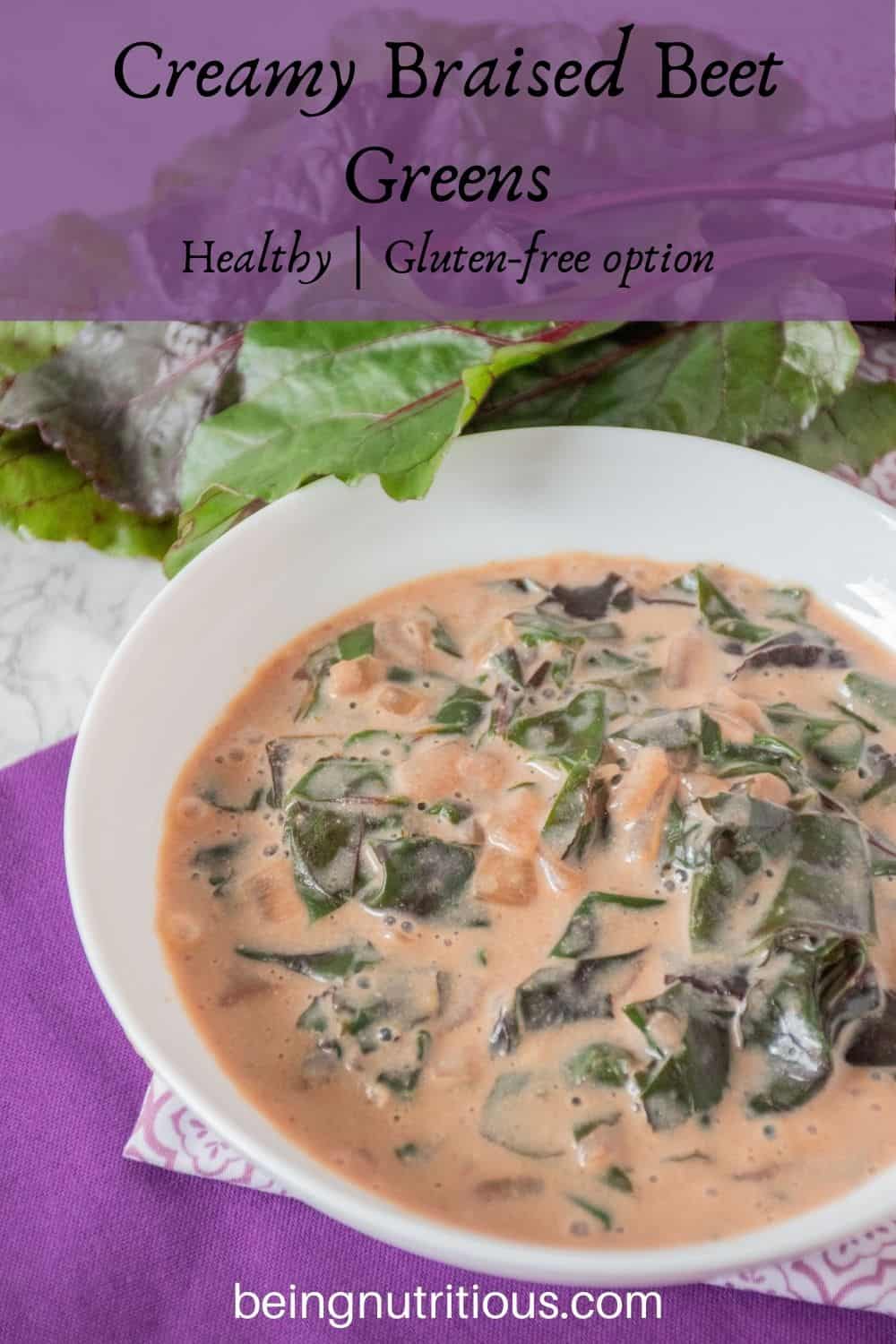
Bowl of braised greens in a light pink broth. A bunch of beet greens visible behind the bowl.

If you try Creamy Braised Beet Greens, let me know in the comments! And also check out Roasted Beets & Carrots with Creamy Garlic Dill Sauce, Creamy Mushroom, Kale, and Wild Rice Soup, and Beans and Greens Breakfast Hash.

📖 Recipe

Overhead picture of a bowl of braised greens in a light pink broth.

Creamy Braised Beet Greens

Laura Yautz
This is a great way to use greens that are a bit more on the tough, bitter side. Braising softens them perfectly, and using milk or a substitute creates a lovely, light pink broth that cuts through the bitterness. Delicious with a crusty bread, over polenta, or all on its own!
No ratings yet
Prevent your screen from going dark
Print Recipe Pin Recipe Save Recipe Saved Recipe!
Prep Time 10 minutes mins
Cook Time 20 minutes mins
Total Time 30 minutes mins
Course Side Dish, vegetable
Cuisine American
Servings 4
Calories 67 kcal

Ingredients
  

  • 1 tablespoon Olive Oil
  • 2 Garlic Cloves, minced
  • ½ medium Onion, chopped
  • 1 tablespoon Whole Wheat Flour (or gluten free substitute)
  • 1 ½ cups Unsweetened Almond Milk (or your preferred dairy or non-dairy milk)
  • 4 cups roughly chopped Beet Greens, thick stems removed
  • Salt and pepper to taste

Instructions
 

  • Heat oil in a large skillet over medium heat, and saute garlic and onions a few minutes until browned.
  • Sprinkle the flour over the onions and garlic, and stir constantly for a minute to cook the flour.
  • Reduce heat to low, and add the milk and beet greens. Stir.
  • Cook over low heat with the lid on for about 15 minutes. Stir every few minutes. The milk should simmer, but not boil.
  • Salt and pepper to taste. Serve immediately with a crusty bread or over polenta.

Nutrition

Calories: 67kcal (3%)Carbohydrates: 5.3g (2%)Protein: 1.9g (4%)Fat: 4.7g (7%)Saturated Fat: 0.5g (3%)Polyunsaturated Fat: 0.7gMonounsaturated Fat: 3.2gSodium: 156.5mg (7%)Potassium: 388.2mg (11%)Fiber: 1.9g (8%)Sugar: 0.8g (1%)Vitamin A: 162.3IU (3%)Vitamin C: 12.9mg (16%)Calcium: 244.5mg (24%)Iron: 1.4mg (8%)

*Nutrition information is an estimate, and will change based on the brand and individual ingredients and amounts you use. This is provided for your convenience only.

Keyword beet greens, collard greens
Tried this recipe?Let us know how it was!
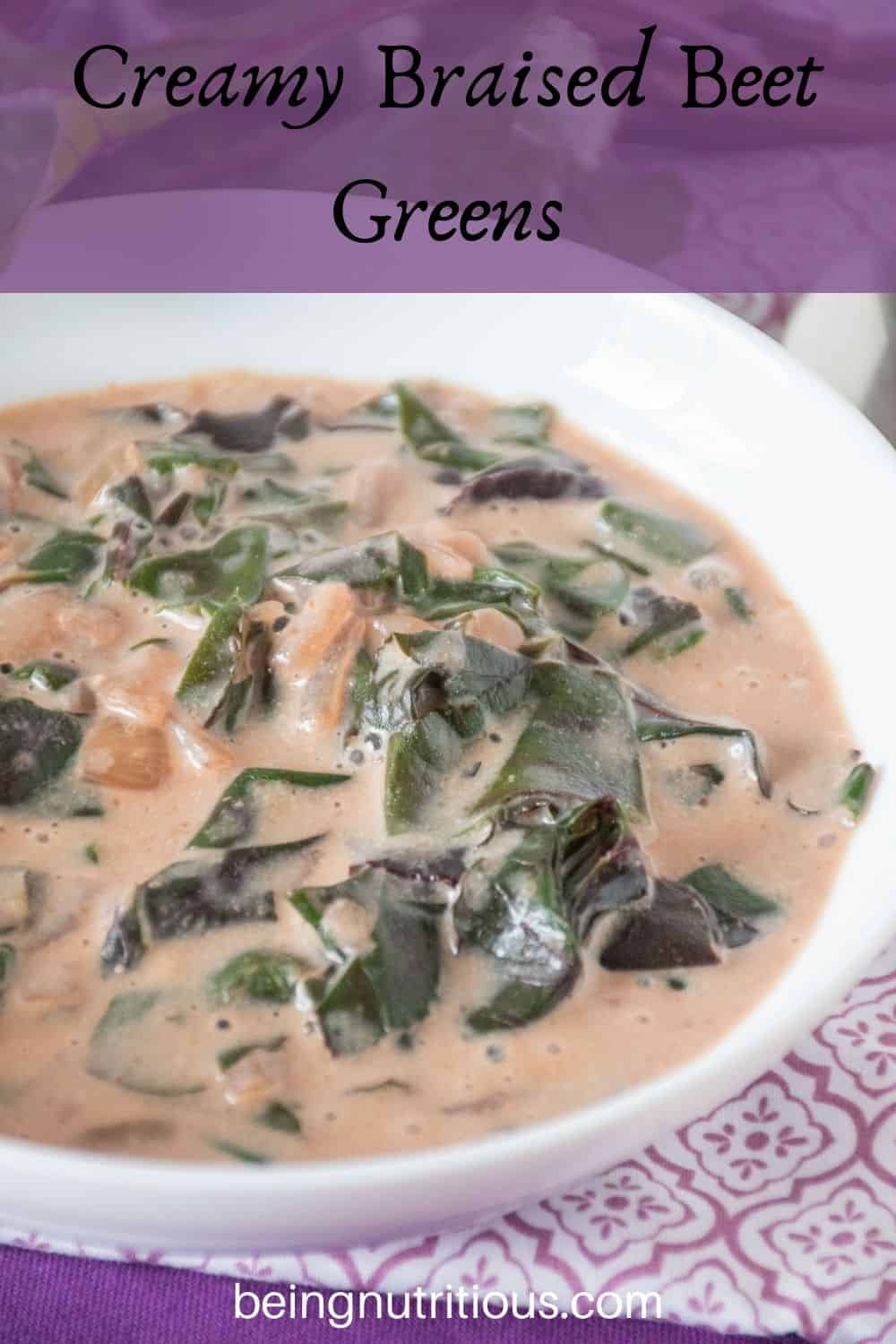
Close up of a bowl of braised greens in a light pink broth. Text overlay: Creamy Braised Beet Greens.
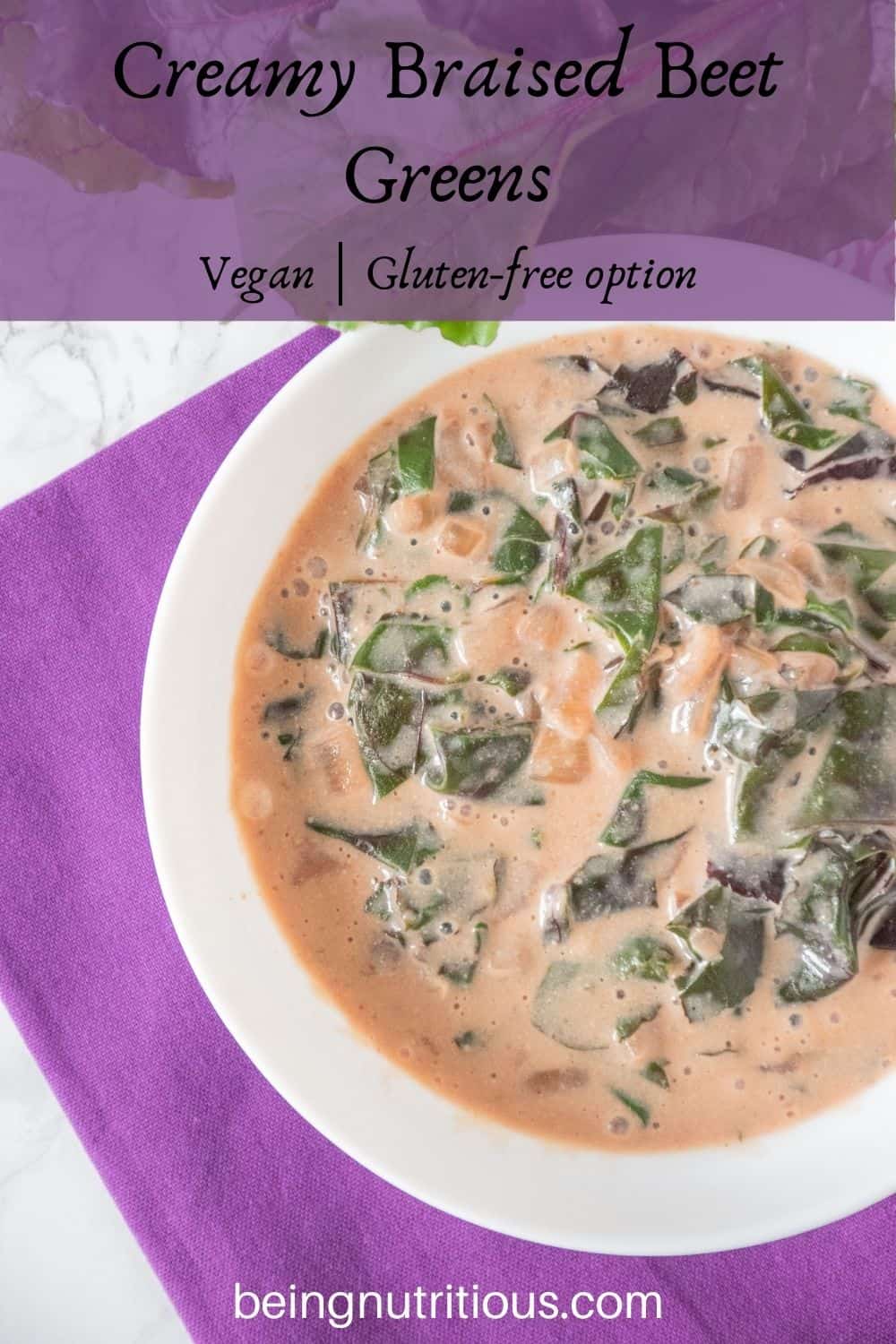
Overhead picture of a bowl of braised greens in a light pink broth. Text overlay: Creamy Braised Beet Greens; vegan, gluten-free option
Bowl of braised greens in a light pink broth. Text overlay: Creamy Braised Beet Greens; vegan, gluten-free option.
Overhead picture of a bowl of braised greens in a light pink broth. Text overlay: Creamy Braised Beet Greens; vegan, gluten-free option.
Bowl of braised greens in a light pink broth. Text overlay: Creamy Braised Beet Greens; healthy, gluten-free option.
Close up of a bowl of braised greens in a light pink broth. Text overlay: Creamy Braised Beet Greens; healthy, gluten-free option.
Overhead picture of a bowl of braised greens in a light pink broth. Text overlay: Creamy Braised Beet Greens; healthy, gluten-free option.

Lentil Stuffed Peppers

November 3, 2020 by Laura Yautz Leave a Comment

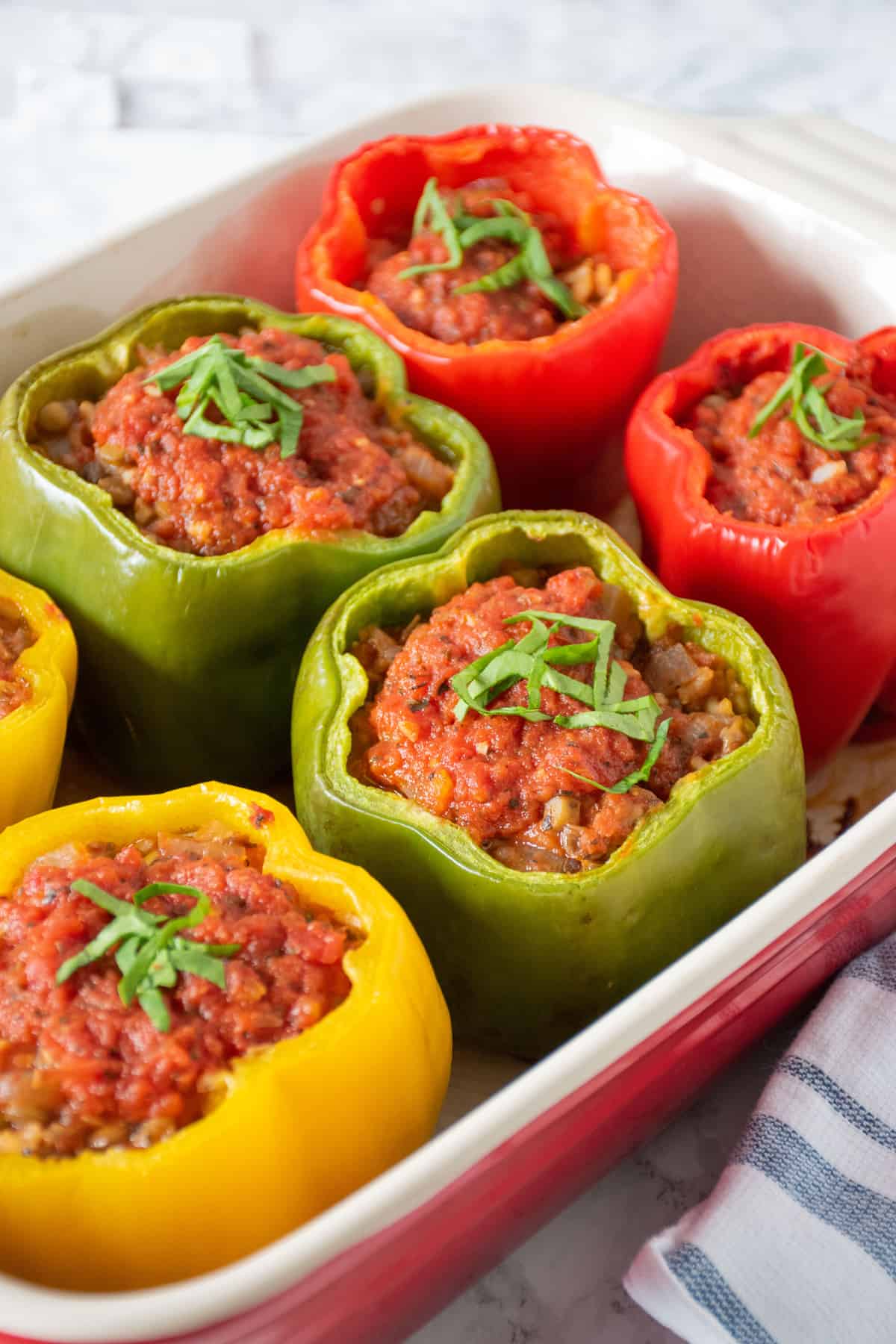
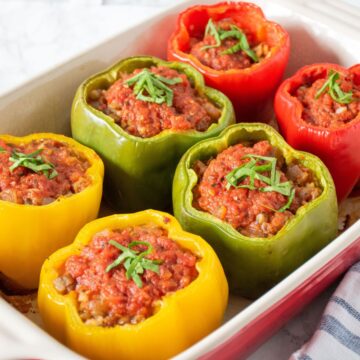
A pan of 6 baked stuffed bell peppers.

Stuffed peppers are quintessential Fall fare, and my vegetarian version is sure to become a favorite. I took flavor notes from more traditional versions, and transformed them into a heart healthy recipe for everyone. A delicious combination of brown rice, lentils, and mushrooms lend some awesome texture, while a homemade marinara sauce, herbs, and liquid smoke add a meaty, umami feel. Even self-proclaimed "carnivores" will love these Lentil Stuffed Peppers.

A pan of 6 baked stuffed bell peppers.

This is Fall comfort food at its finest, and it pairs well with a simple tossed salad, easy Crock Pot Ratatouille, or this simple smoky sauteed spinach. Great for meal prep too, so there's no reason to not enjoy this healthy, delicious dish any day of the week!

[feast_advanced_jump_to]

Heart Health benefits of Lentil Stuffed Peppers

One might dismiss vegetarian dishes as less satisfying or nutritious compared to their meat-filled counterparts, but these lentil stuffed peppers prove that notion wrong. As delicious as they are, their health benefits and nutritional profile make them a worthwhile meal choice.

First and foremost, the humble lentil. Packed with nutrients, lentils are an excellent source of fiber. They help keep your cholesterol levels in check, and offer a powerful protein punch - significant for those following a vegetarian or a plant-based diet.

Bell peppers form the colorful exterior, providing more than just artistic appeal on your plate. They are an excellent source of vitamin C, with a single pepper taking care of more than 100% of your daily requirement. The onions, garlic, and white mushrooms used in the filling lend additional layers of flavor, and provide considerable quantities of essential nutrients such as B vitamins, selenium, and antioxidants.

The brown rice brings a wholesome, nutty flavor and it's also a whole grain that's high in fiber. The olive oil used supports heart health, thanks to its monounsaturated fatty acids.

Lastly, the homemade marinara sauce deserves a special shoutout. Prepared with ripe tomatoes, it is a low sodium choice that enhances the overall taste. Tomatoes are known to be a great source of lycopene, an antioxidant believed to help prevent heart disease, among other health benefits. And the sauce allows us to keep these low sodium stuffed peppers.

It is also notable what these stuffed peppers with lentils don't have. They don't have excessive calories, saturated fat, or sodium, as compared to more traditional stuffed peppers that use either beef or turkey. That makes them the perfect comfort food to take you through all winter long!

Ingredients

Our vegetarian stuffed peppers recipe uses a handful of carefully chosen components to not only please the tastebuds, but also to provide substantial health benefits.

  • Bell Peppers: The star of the show. Their vibrant colors and natural sweetness make them an excellent vessel for the rich stuffing.
  • Olive Oil: A beautiful, healthy fat that enhances the flavor of other ingredients while also aiding in cooking.
  • Onion and Garlic: These two classics lay the flavour foundation. They bring aromatic complexity to the stuffing.
  • White Mushrooms: With their meaty texture, they contribute to the heartiness of these stuffed peppers.
  • Liquid Smoke: An ingredient that introduces a hint of smokiness, capturing some of that traditional flavor associated with stuffed peppers.
  • Brown or Green Lentils: Nutritious and tasty, they bring a lovely bite and essential proteins to the dish.
  • Brown Rice: Another healthy ingredient, brown rice extends the stuffing while adding essential carbs and nutty flavor.
  • Homemade Marinara Sauce: The tangy, Italian-inspired component of the recipe that helps to bind all the ingredients together while making the dish juicier and more flavorful.

See recipe card for quantities.

Instructions

Here is a simple and straightforward step-by-step guide on how to bring this vegetarian dish to life:

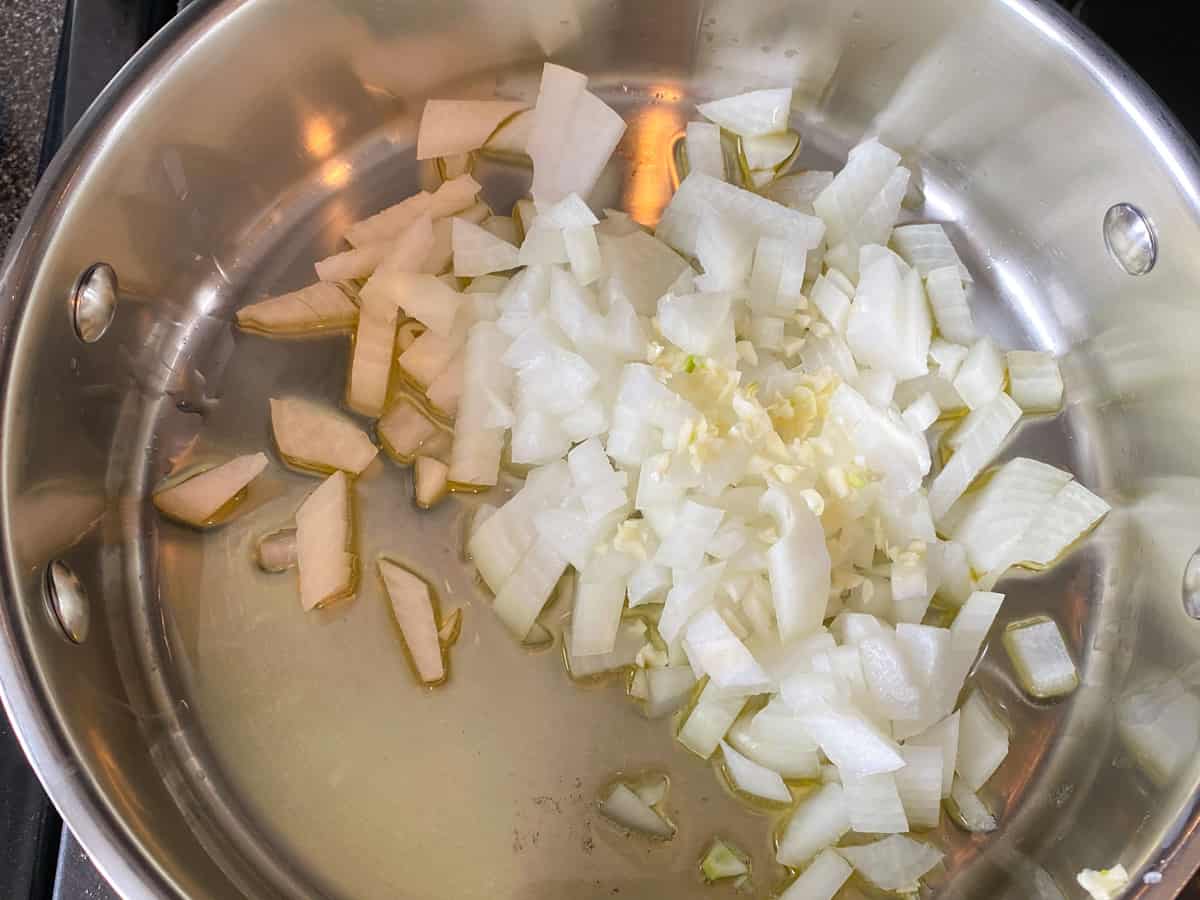
Raw onions and garlic added to a pan with hot oil.

Sauté the onions and garlic.

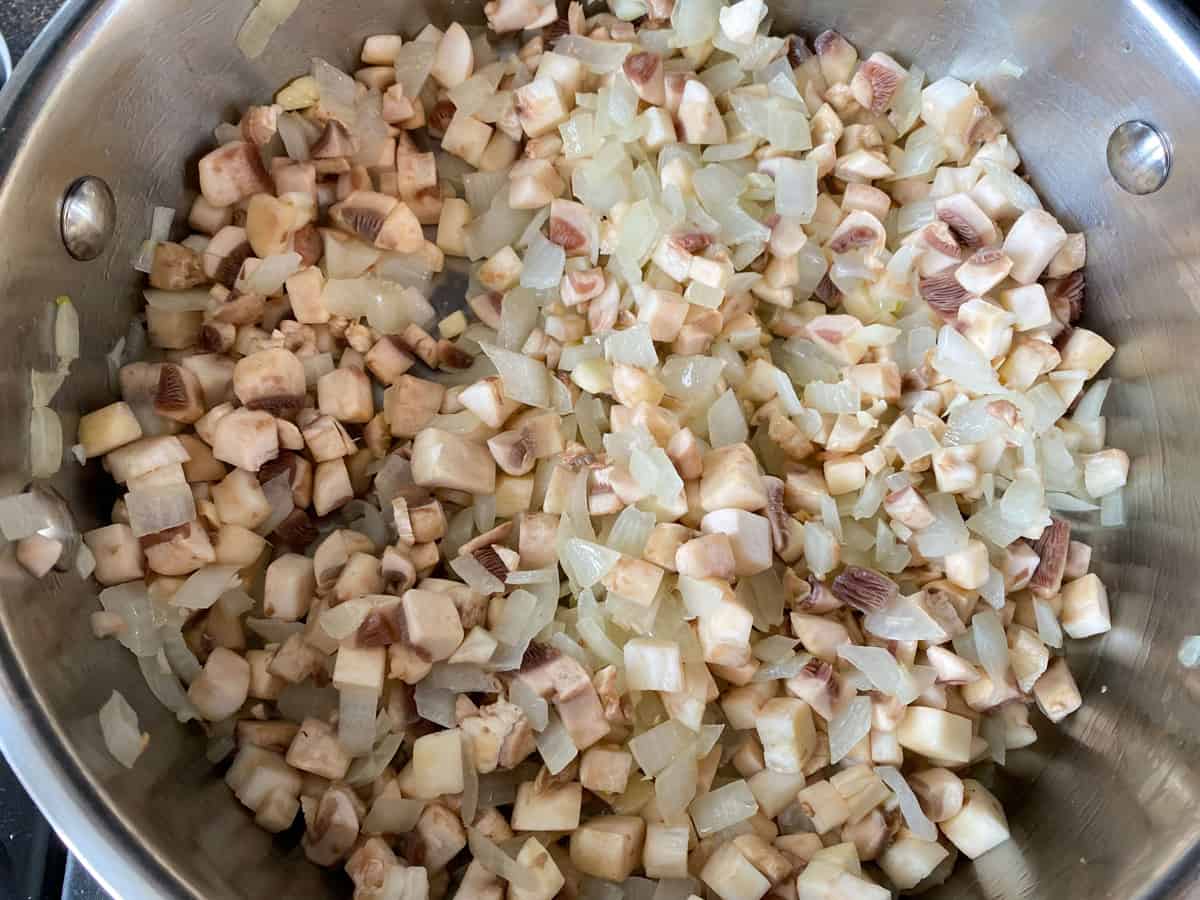
Diced mushrooms added to the pan of sautéed onions.

Add the diced mushrooms.

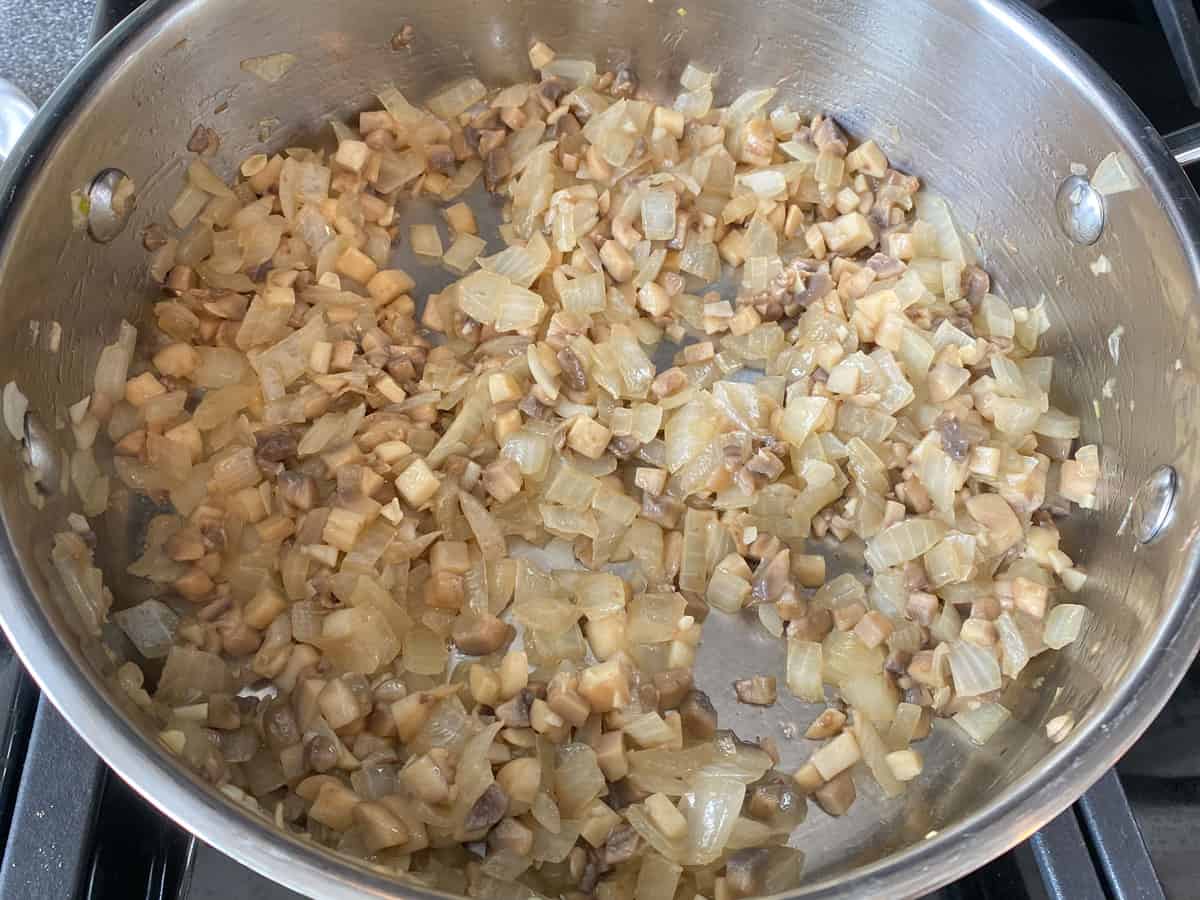
Sautéed onions and mushrooms in a pan.

Continue to cook the onions and mushrooms until the mushrooms release their liquid and most of it has cooked off.

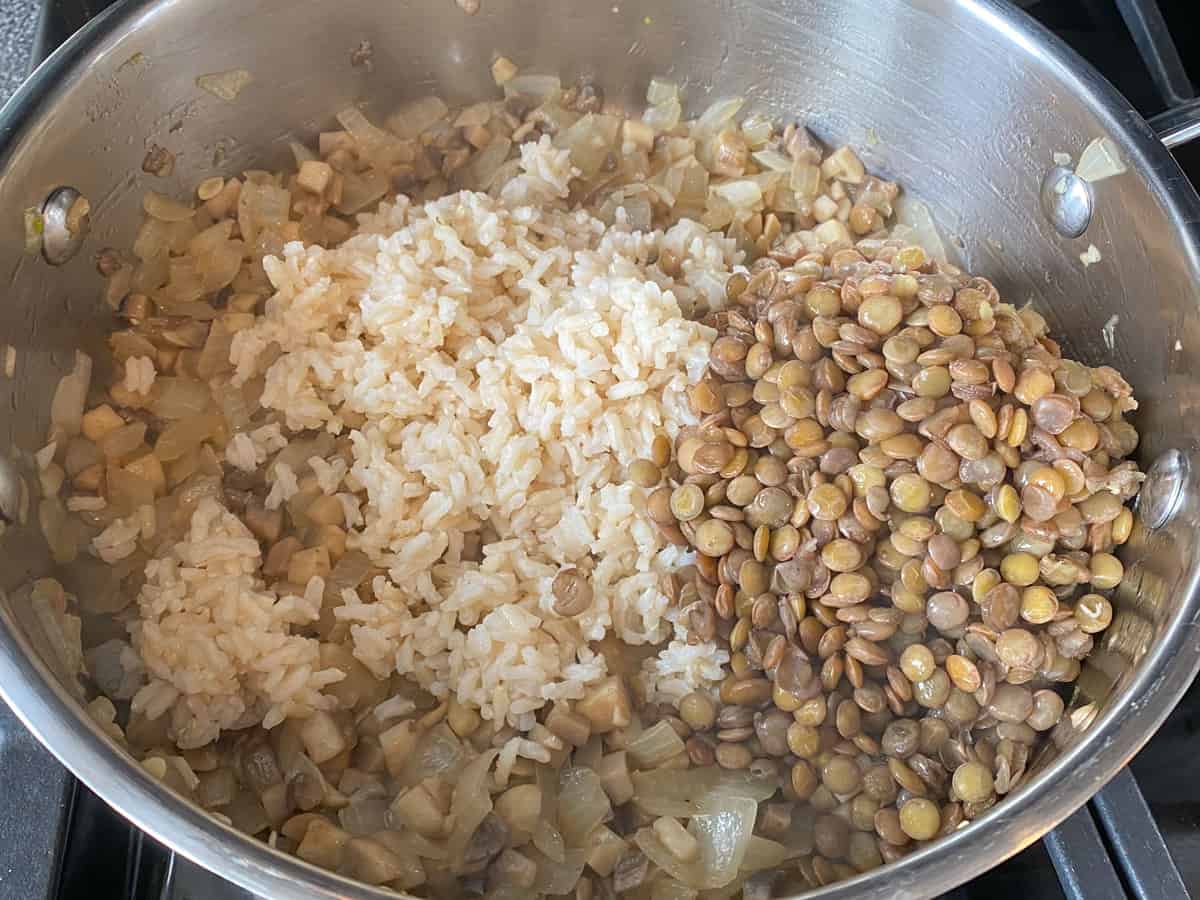
Cooked lentils and rice added to a large pan of filling for stuffed peppers.

Add the cooked lentils and rice, and stir.

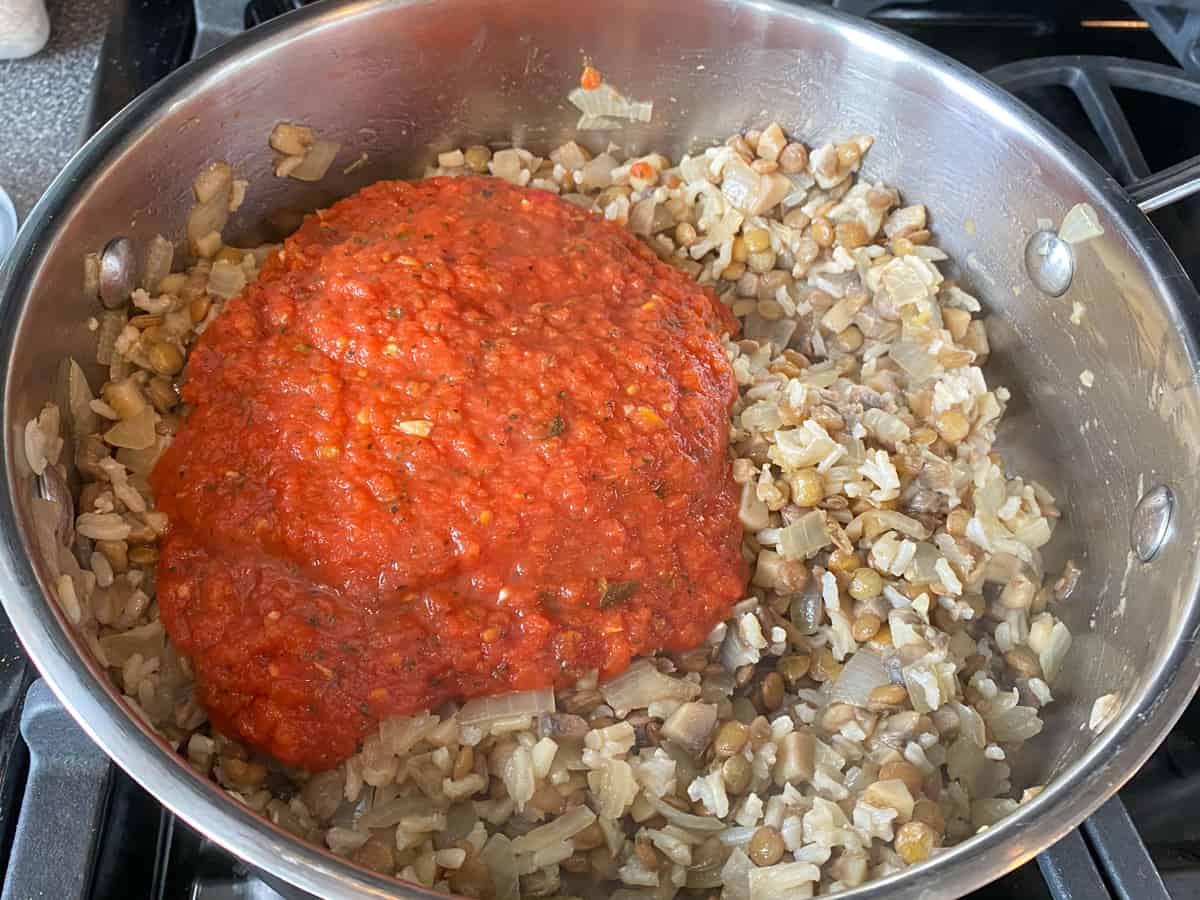
Marinara sauce poured into a pan with cooked filling for stuffed peppers.

Pour in the homemade marinara sauce.

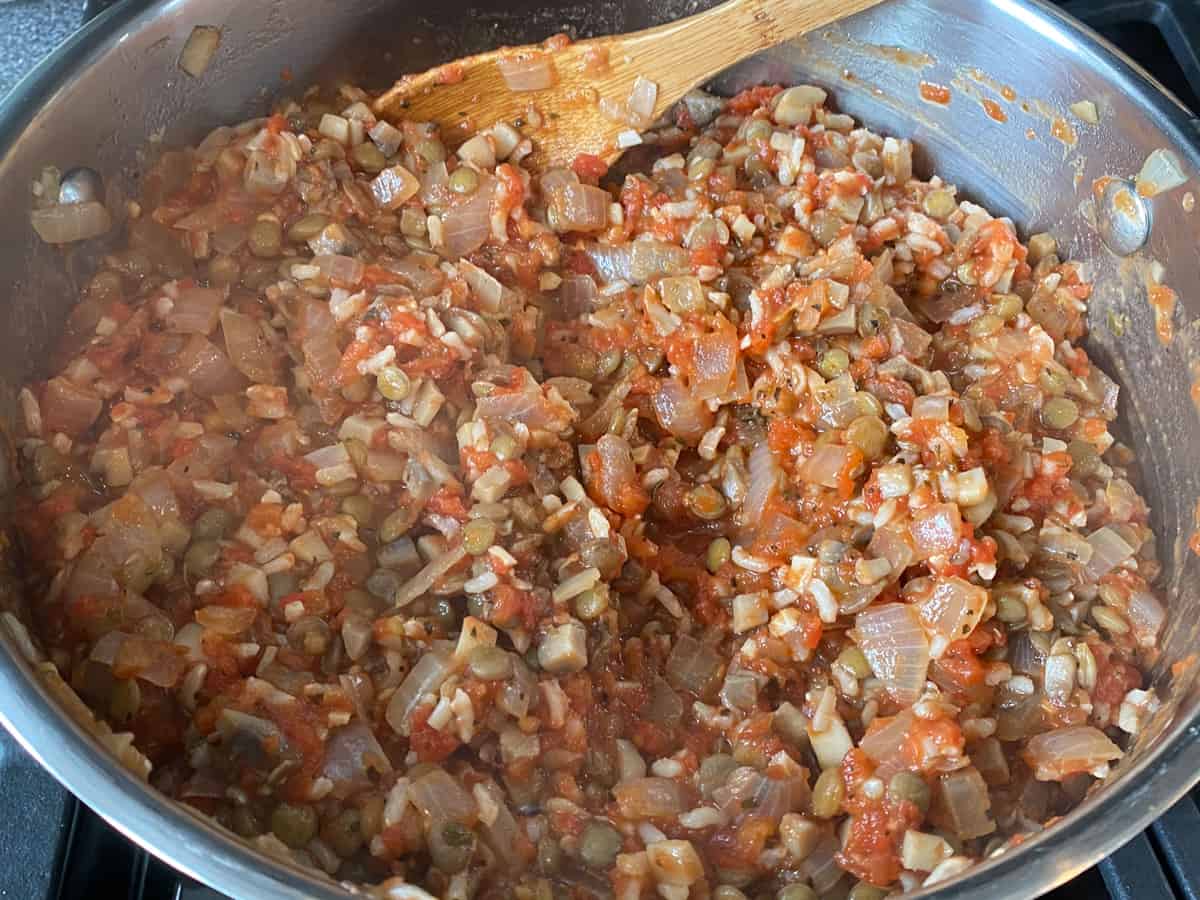
Filling for the stuffed peppers, completed.

Stir to combine the filling, until the mixture is hot.

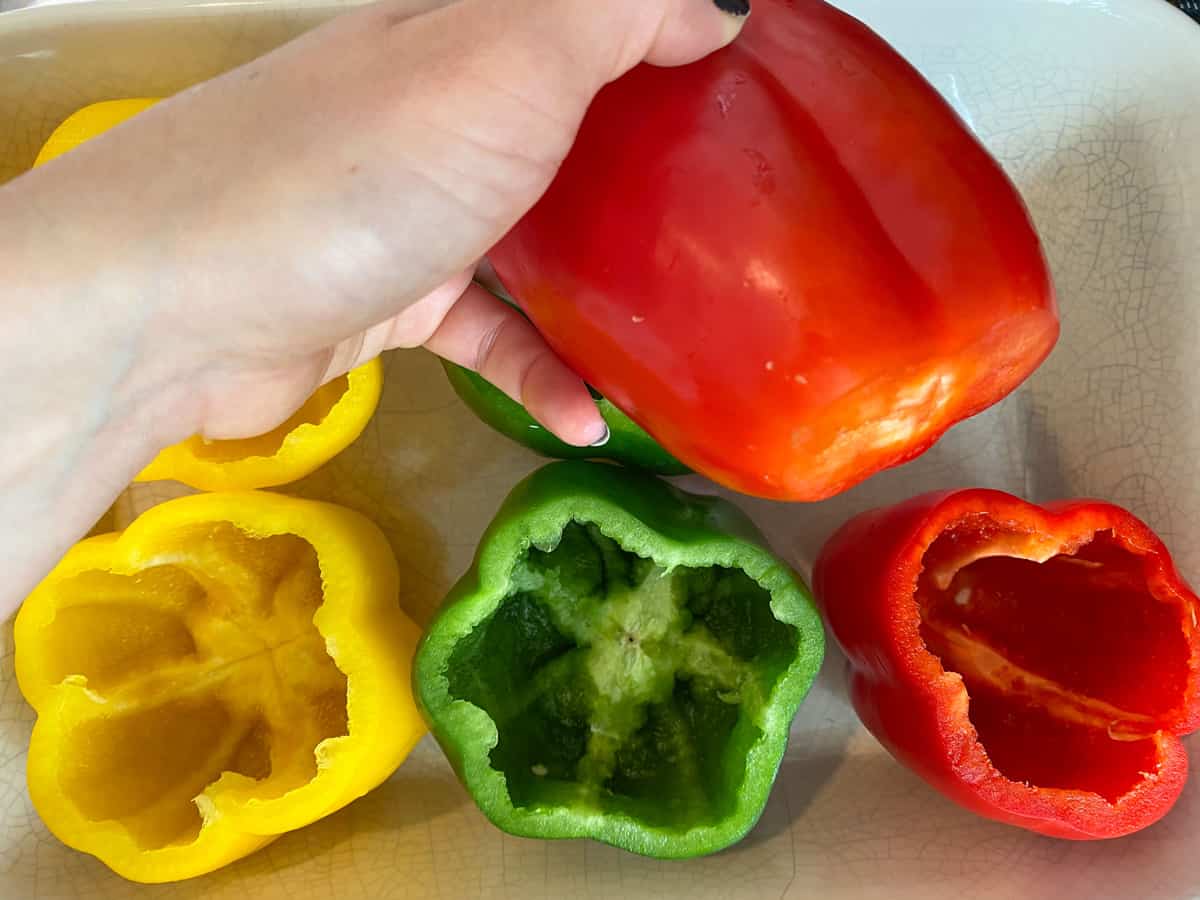
Holding up a bell pepper to demonstrate slicing part of the bottom off to make it sit level in the pan.

Prepare the peppers by cutting off the tops (stem end) and scooping out the seeds. Slice a bit off the bottoms if the peppers won't sit flat.

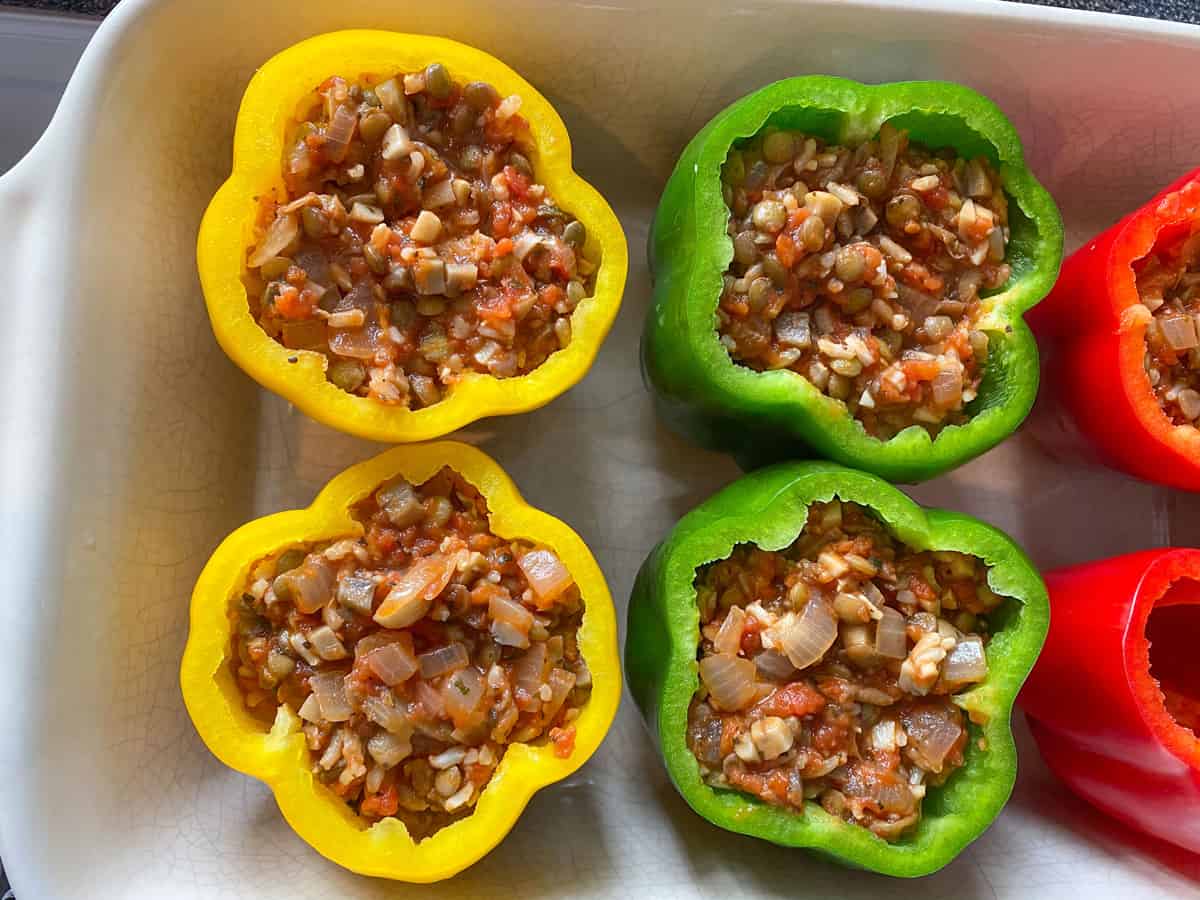
Raw bell peppers, stuffed with filling.

Fill the peppers with the stuffing.

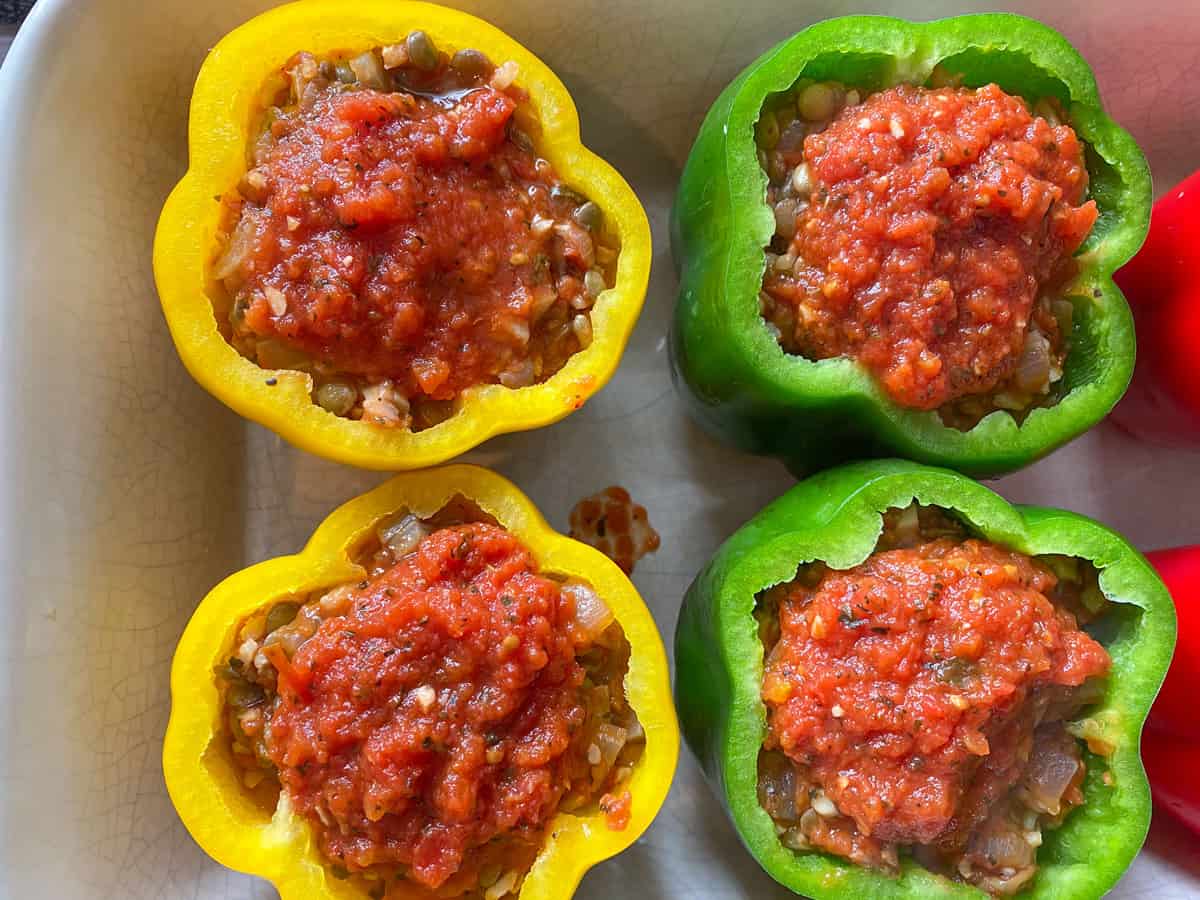
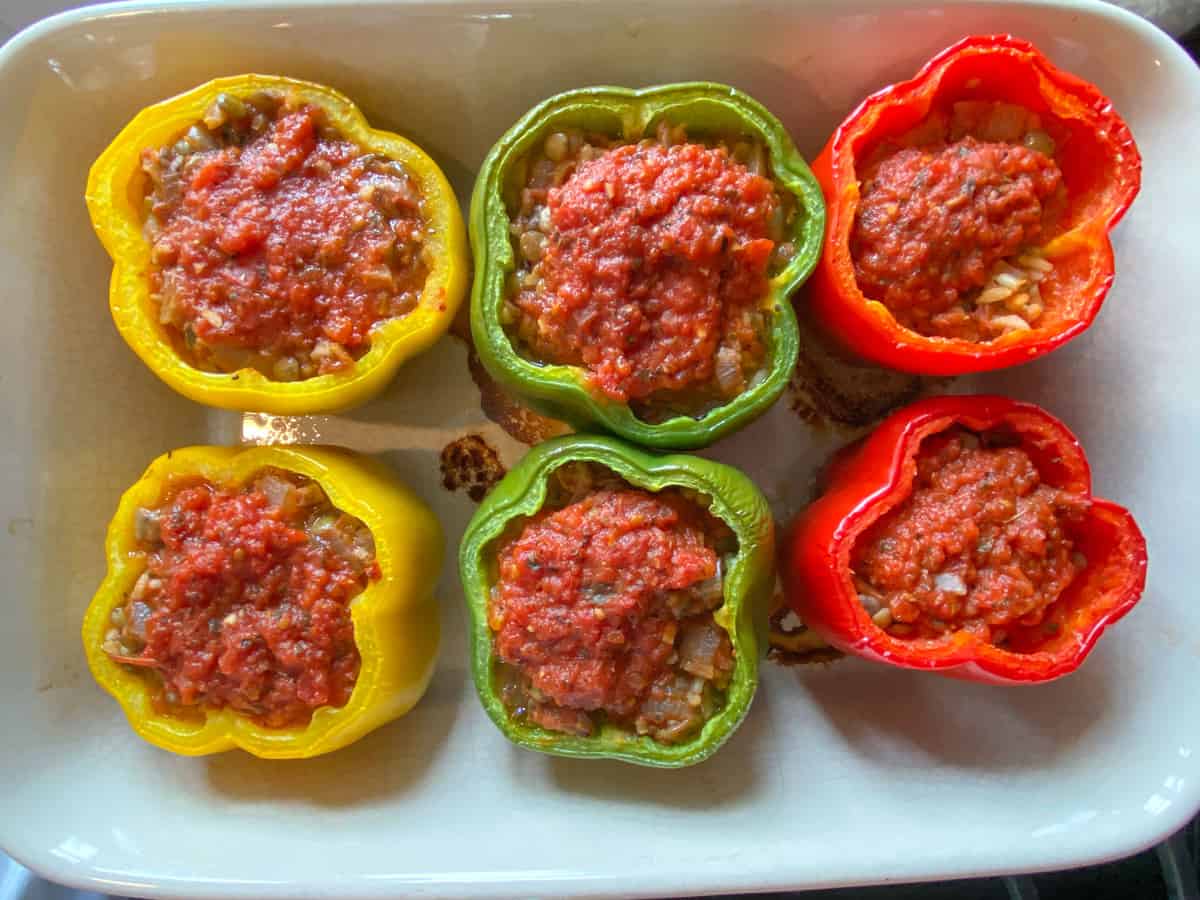
Marinara sauce spooned onto the top of stuffed peppers, just before baking.

Top with extra marinara sauce.

Pan of stuffed peppers after removal from oven.

Bake until hot and bubbly.

Hint: covering the dish with some aluminum foil for the first half of baking will prevent the sauce on top from getting hard and crusty.

Substitutions

These heart healthy stuffed peppers are easily customizable. Here are some options.

  • Grain - instead of rice, try quinoa, bulgur, couscous, or any variety of other grains you like
  • Beans - use black beans, chickpeas, beluga lentils, or any other cooked bean
  • Peppers - use any type of pepper you want, like poblano or banana peppers

Variations

Here are some of my favorite variations on stuffed peppers!

  • Mexican - use enchilada sauce instead of marinara, and top with salsa, guacamole, and sliced jalapeños
  • Slow cooker - put the stuffed peppers into the slow cooker, and let it do the rest - great for meal prep!
  • Chili stuffed peppers - make up a batch of slow cooker Cincinnati Chili, and stuff the peppers with it

Equipment

Nothing special here today! You'll need a cutting board and knife, cooking pots with lids, and a baking dish, plus the appropriate utensils.

I've been really loving these Martha Stewart baking dishes (affiliate link) lately, but use what you have. In a pinch you could even use a rimmed cookie sheet. Just cover the peppers entirely with foil for the first half of the baking.

Storage

You can store the Lentil Stuffed Peppers in an airtight container in the refrigerator for 5 to 7 days. If you want to prepare them in advance, you can refrigerate the uncooked stuffed peppers and simply bake them when you're ready to eat.

You can also freeze them before baking for up to three months. Defrost overnight in the fridge before baking.

Top tip

When you buy bell peppers for this recipe, look for nicely sized ones that are overall mostly symmetrical, and that have knobs on the bottom that will allow them to sit upright. Choose firm peppers without any mushy or discolored spots.

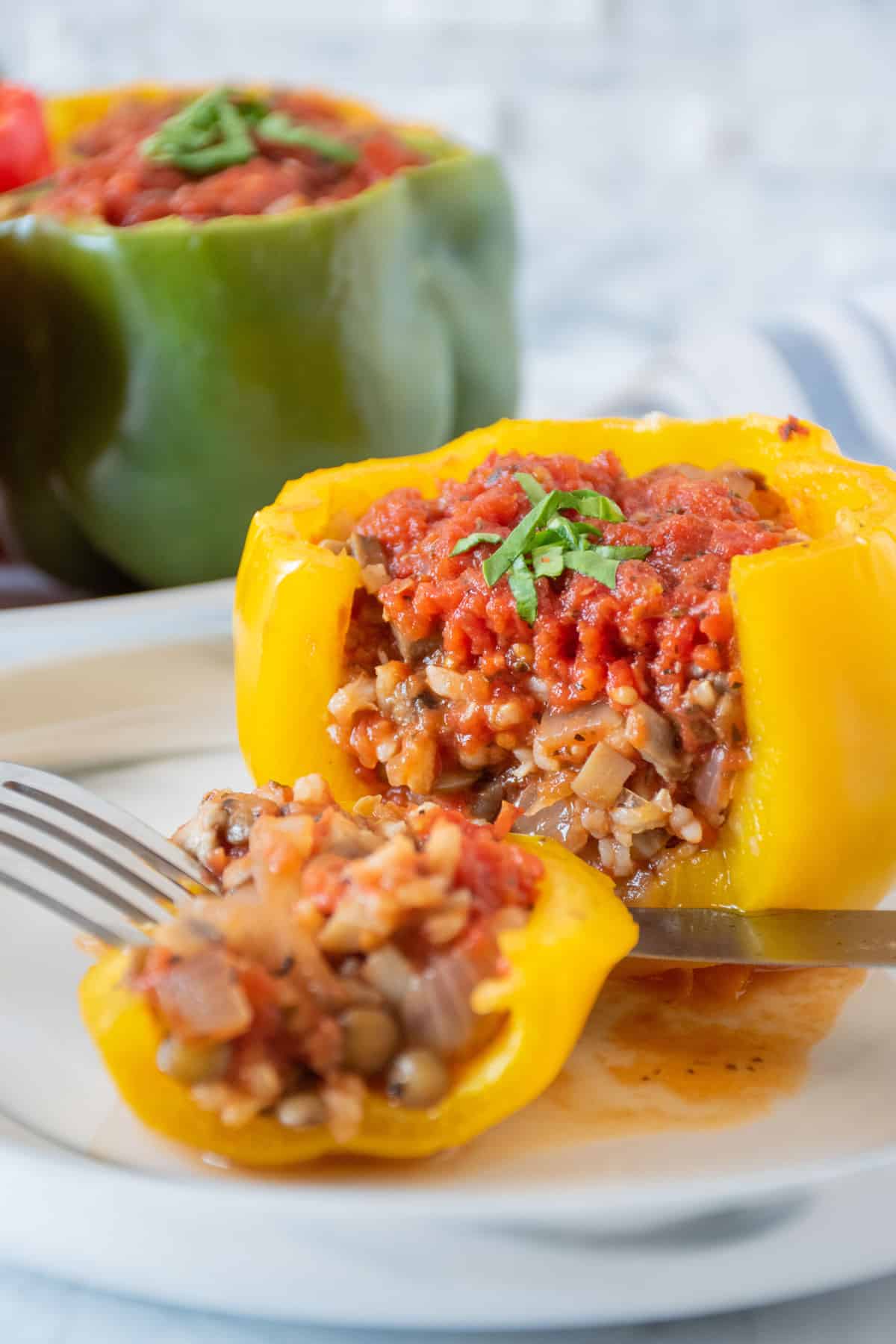
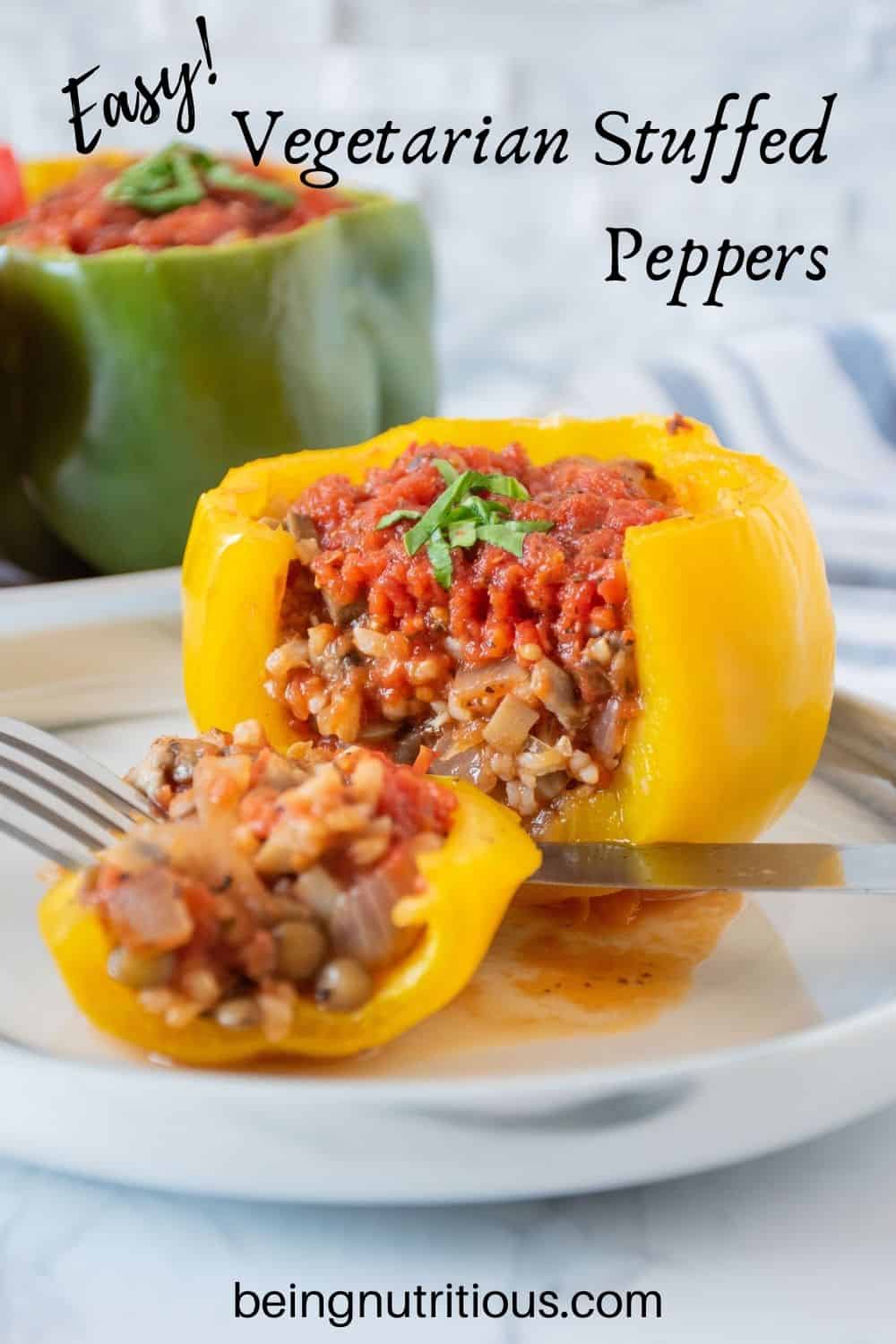
A stuffed yellow bell pepper, with a slice removed, to see the filling inside.

FAQ

I'm not a fan of mushrooms, can I exclude them?

Yes, mushrooms can be excluded if you prefer without dramatically changing the recipe. But you will want to substitute another veggie so you have enough volume of filling. Try other veggies like zucchini, carrots, or spinach, or you can simply increase the amount of lentils and rice.

Can I use store-bought marinara sauce?

While homemade marinara sauce offers a fresh and authentic taste, you can certainly use a good quality store-bought version if you're short on time. Just be sure you check out the sodium content on the nutrition label if that's a concern for you.

Can I prep this recipe ahead of time?

Yes! This recipe is great for meal prep! To make these ahead of time, simply follow the recipe up to (including) topping with the sauce, and then cover and refrigerate until you're ready to bake them off. You can do this up to 5 days in advance. To bake them, preheat oven to 350 degrees F, and bake the peppers as the recipe instructs. You may find you want to bake them a little longer since they'll be cold, but that's up to you.

Related

Looking for other healthy bean entrees? Try these:

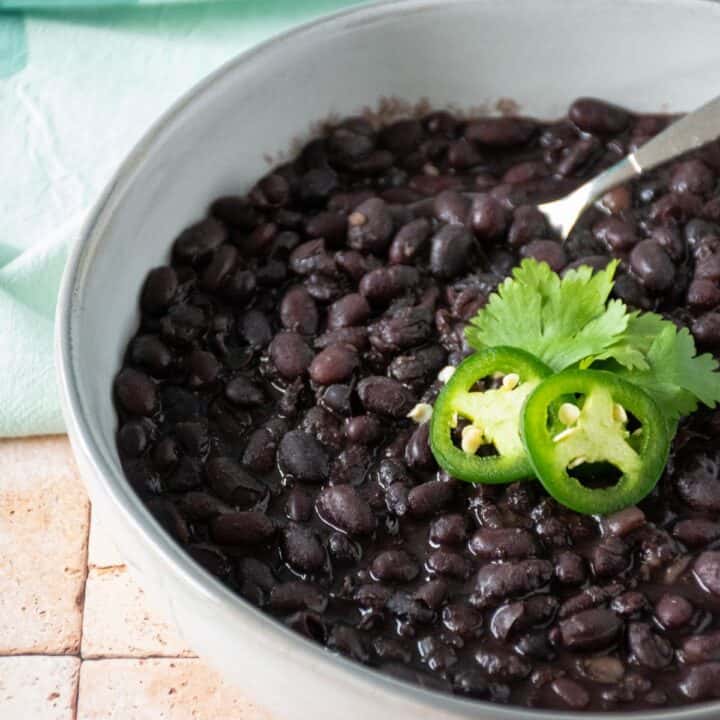
  • Bowl of black beans garnished with cilantro and jalapeno slices.
    Instant Pot Cuban-Style Black Beans
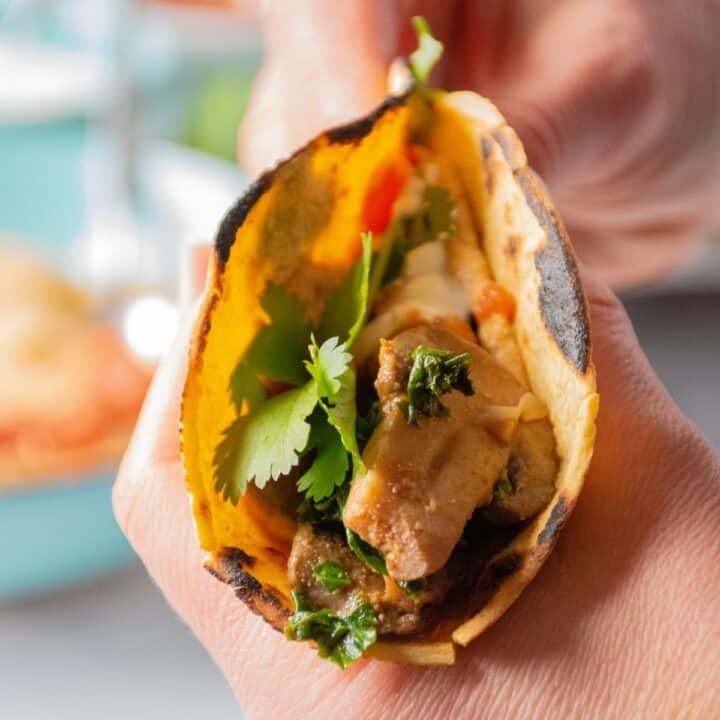
  • Hands holding a taco up, smeared with hummus and loaded with sauteed mushrooms, zucchini, and kale, garnished with cilantro.
    Hummus Tacos with Mushrooms, Zucchini, and Kale
  • Greek lima beans in a bowl, with a pita.
    Greek Gigante Beans {Pressure Cooker Recipe}
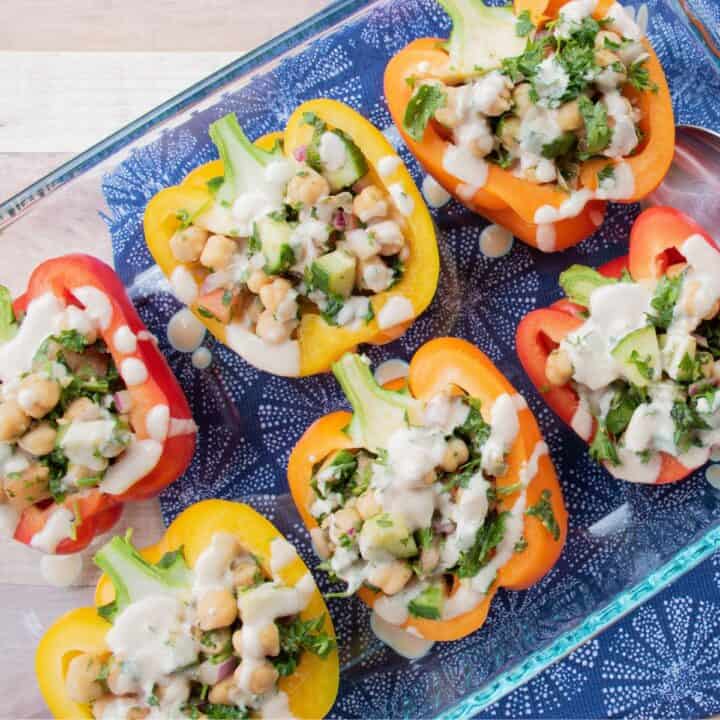
  • Casserole dish with stuffed peppers in it.
    No Bake Chickpea Stuffed Peppers

Pairing

These are my favorite dishes to serve with low sodium stuffed peppers:

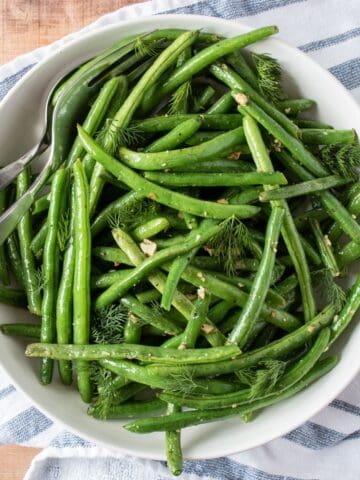
  • Roasted green beans in a bowl with serving utensils, garnished with fresh dill.
    Garlic Roasted Green Beans
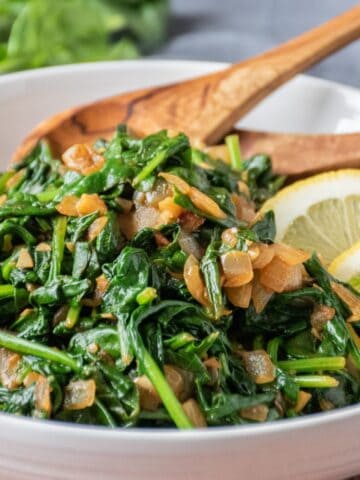
  • Serving bowl with sauteed spinach and onions in it, with wooden serving spoons and garnished with lemon slices.
    Sauteed Spinach and Onions with Smoked Paprika
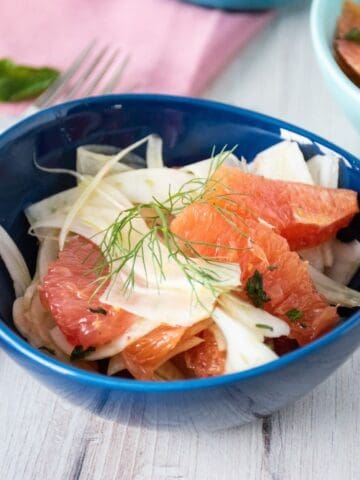
  • Salad with citrus and fennel in a small bowl, garnished with a fennel frond.
    Fennel Grapefruit Salad with Honey Mint Vinaigrette
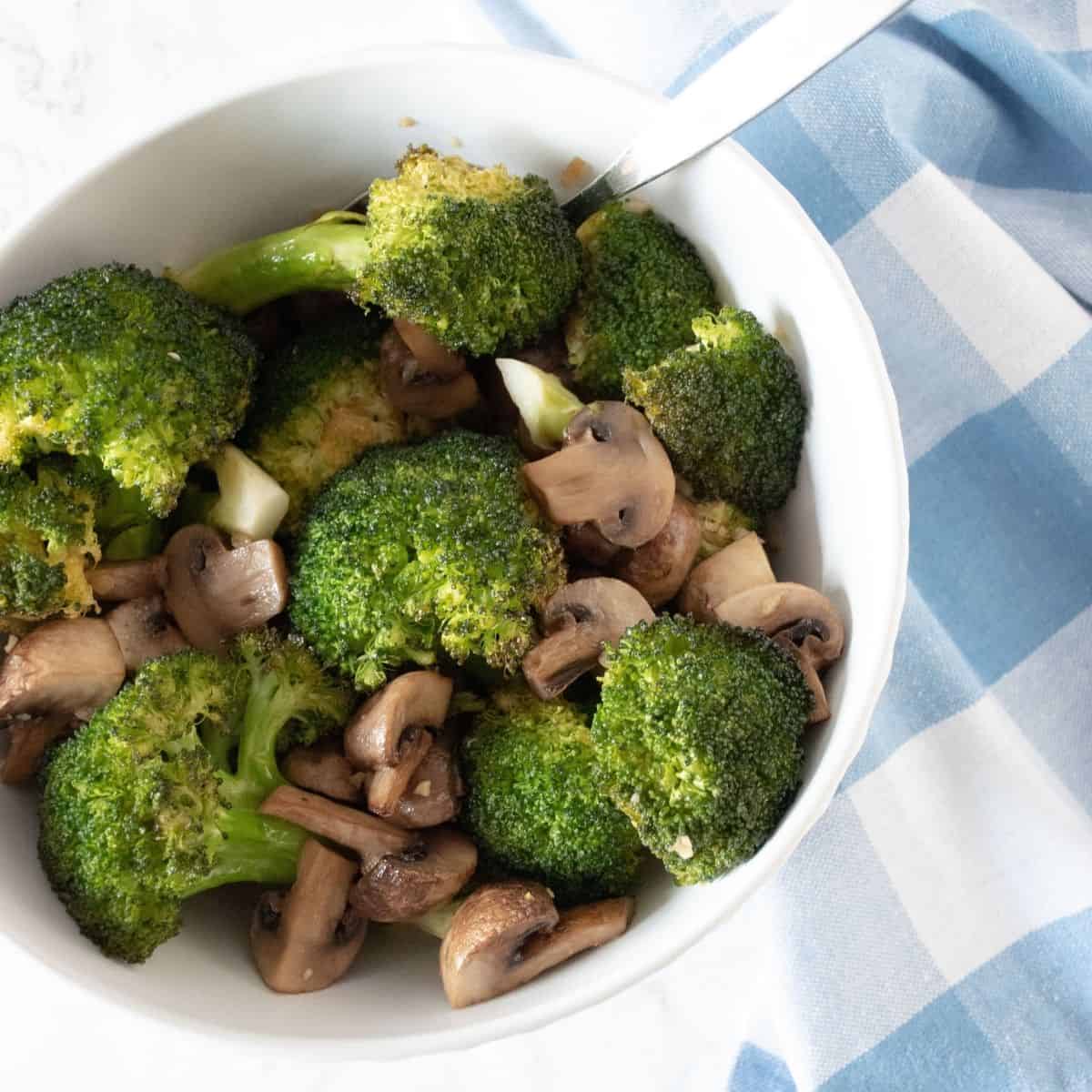
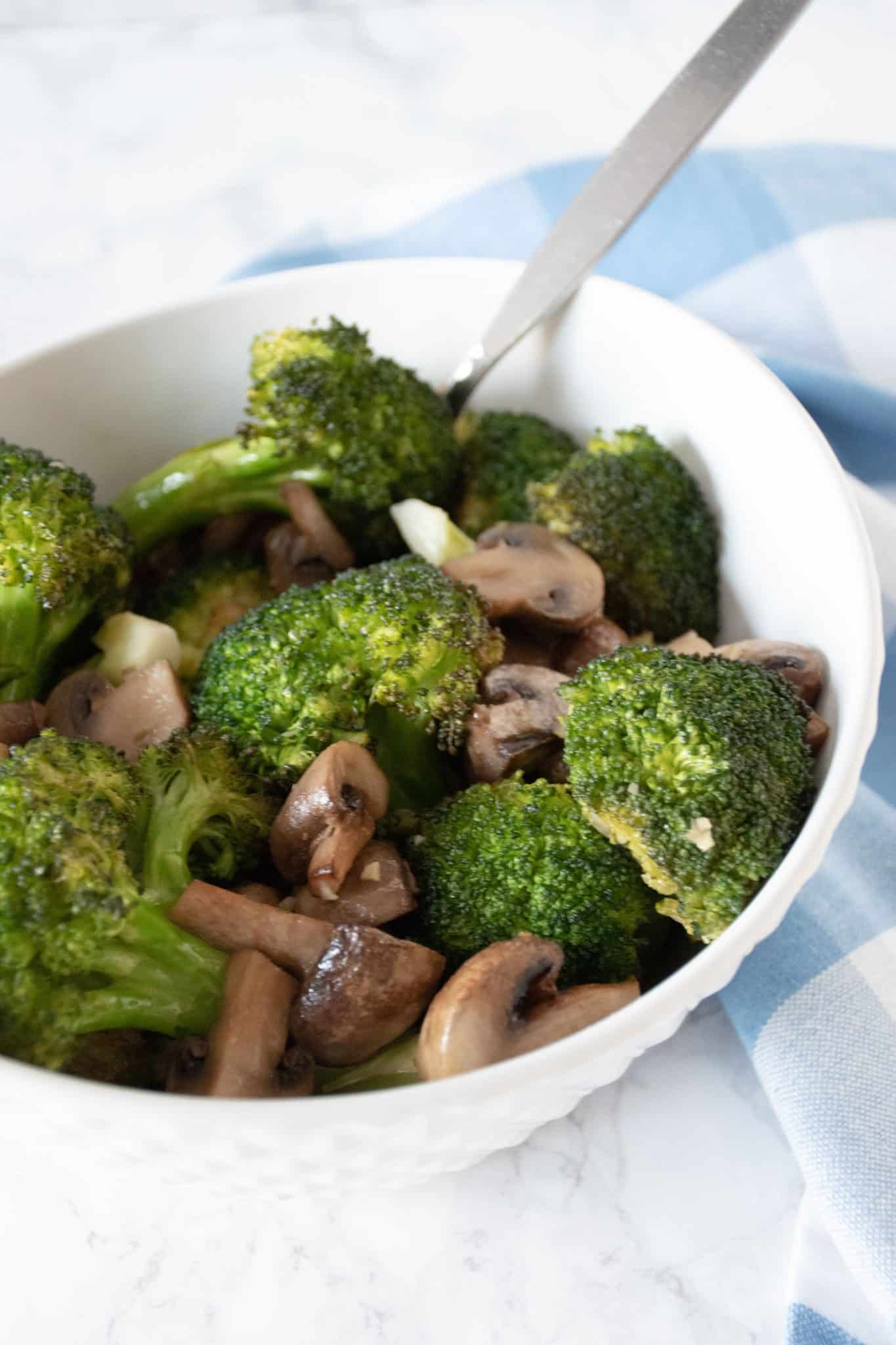
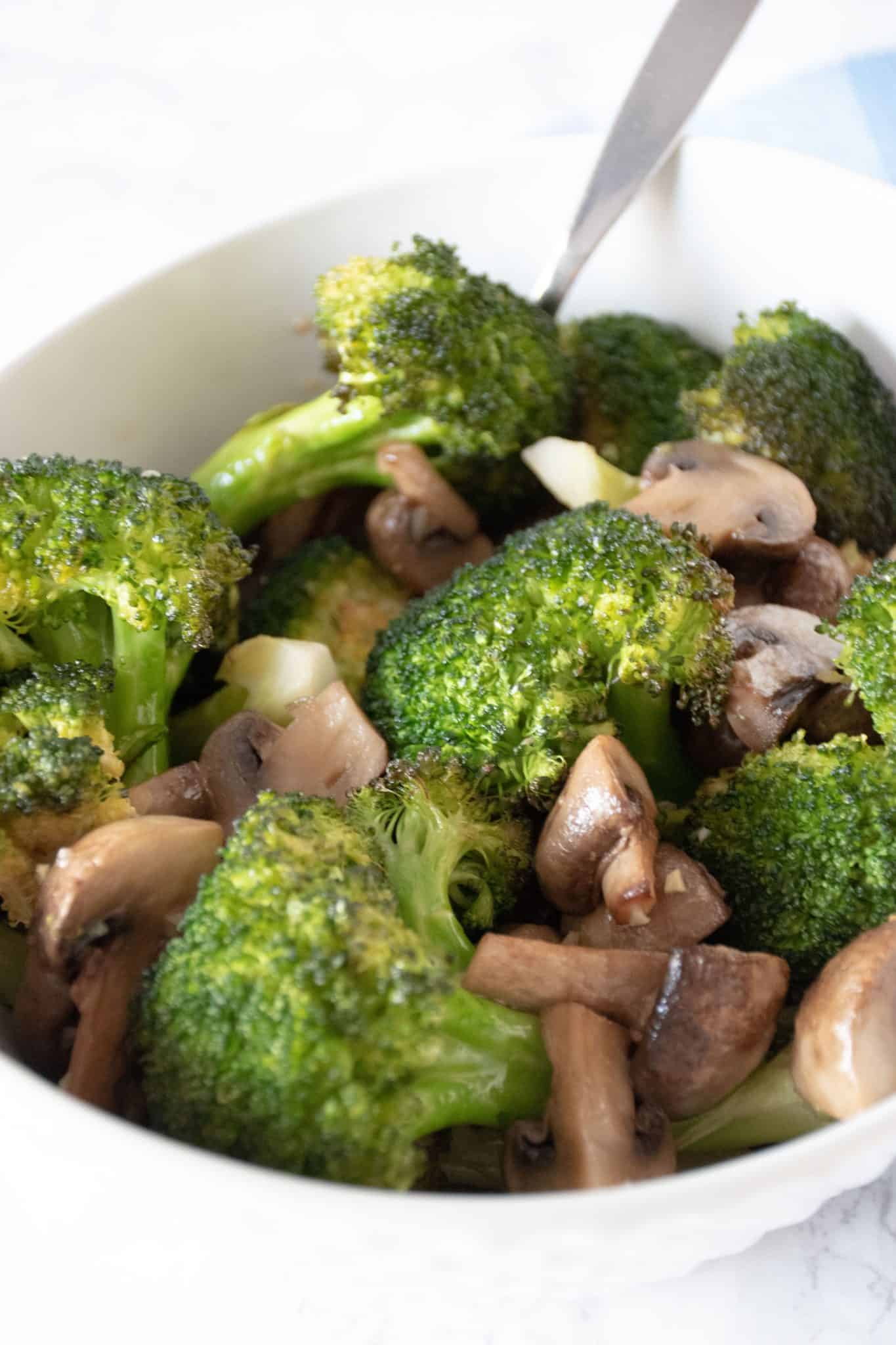
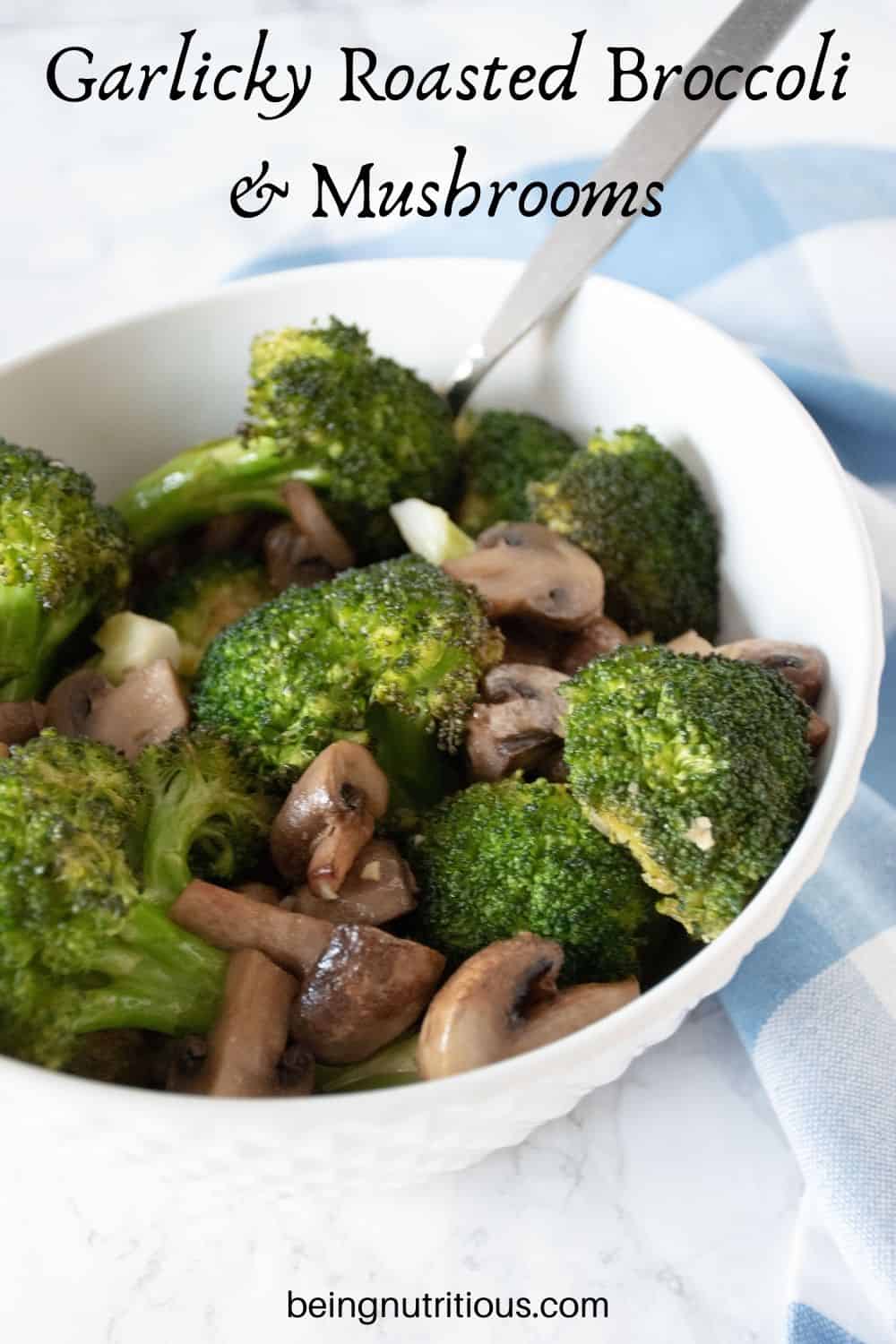
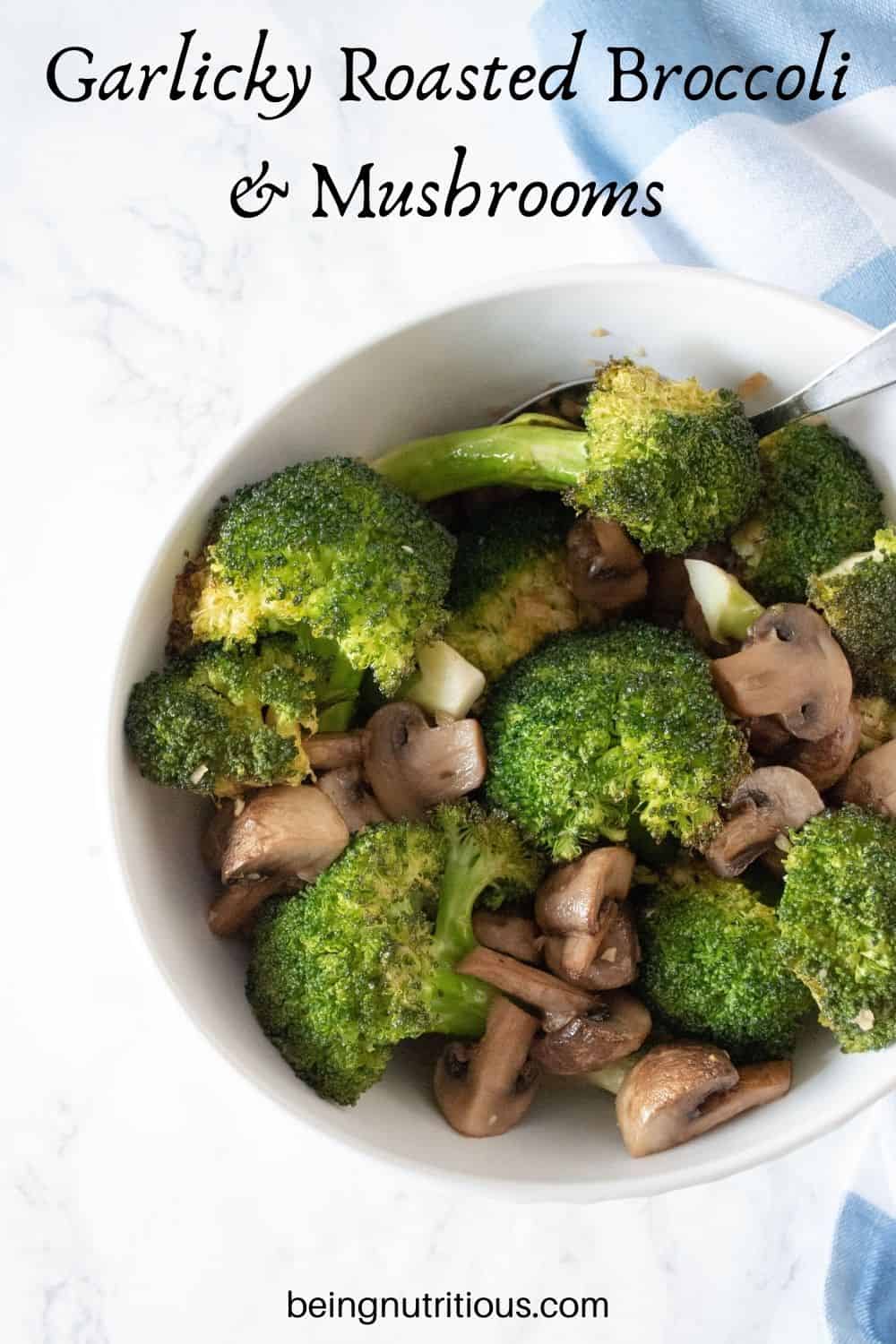
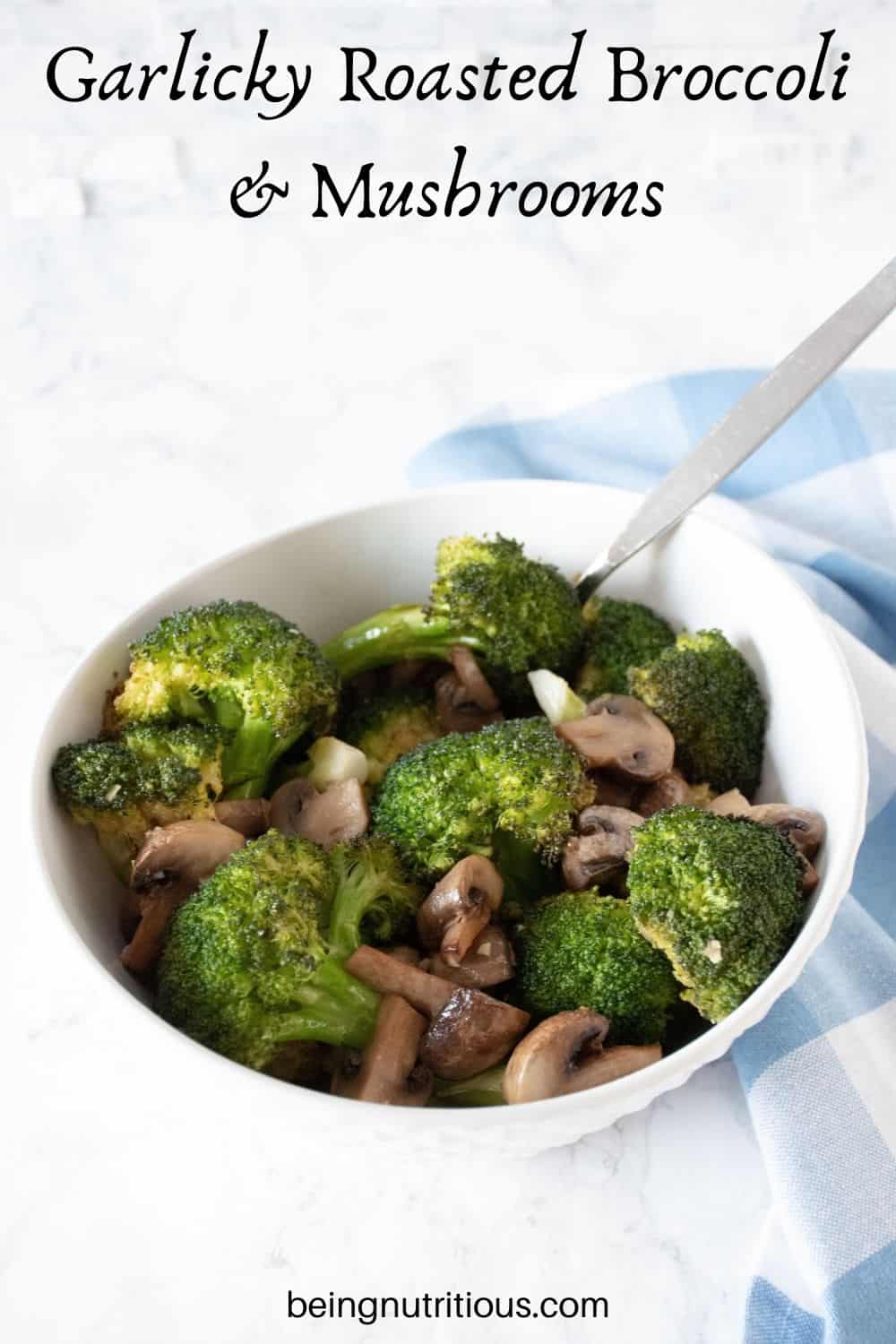
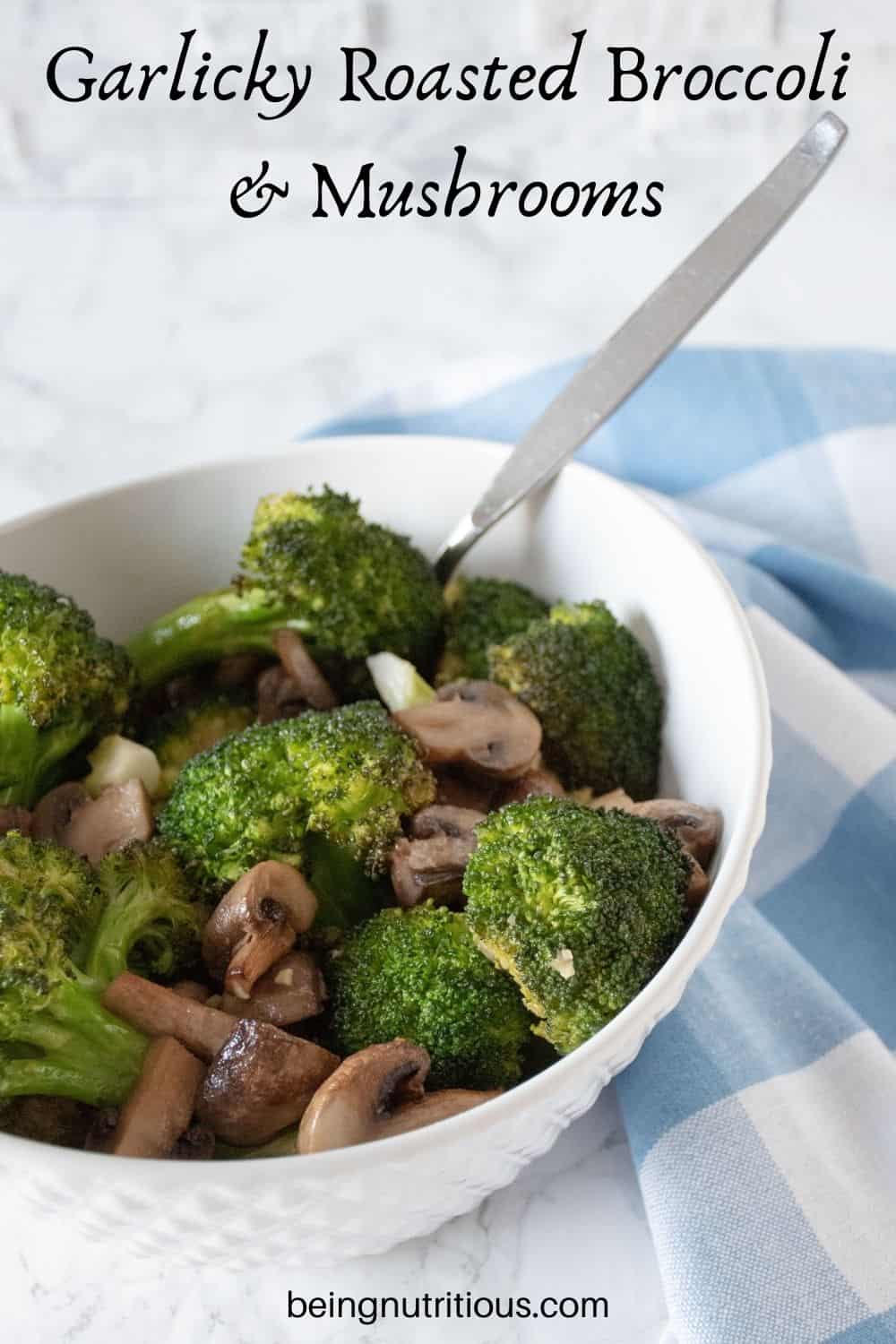
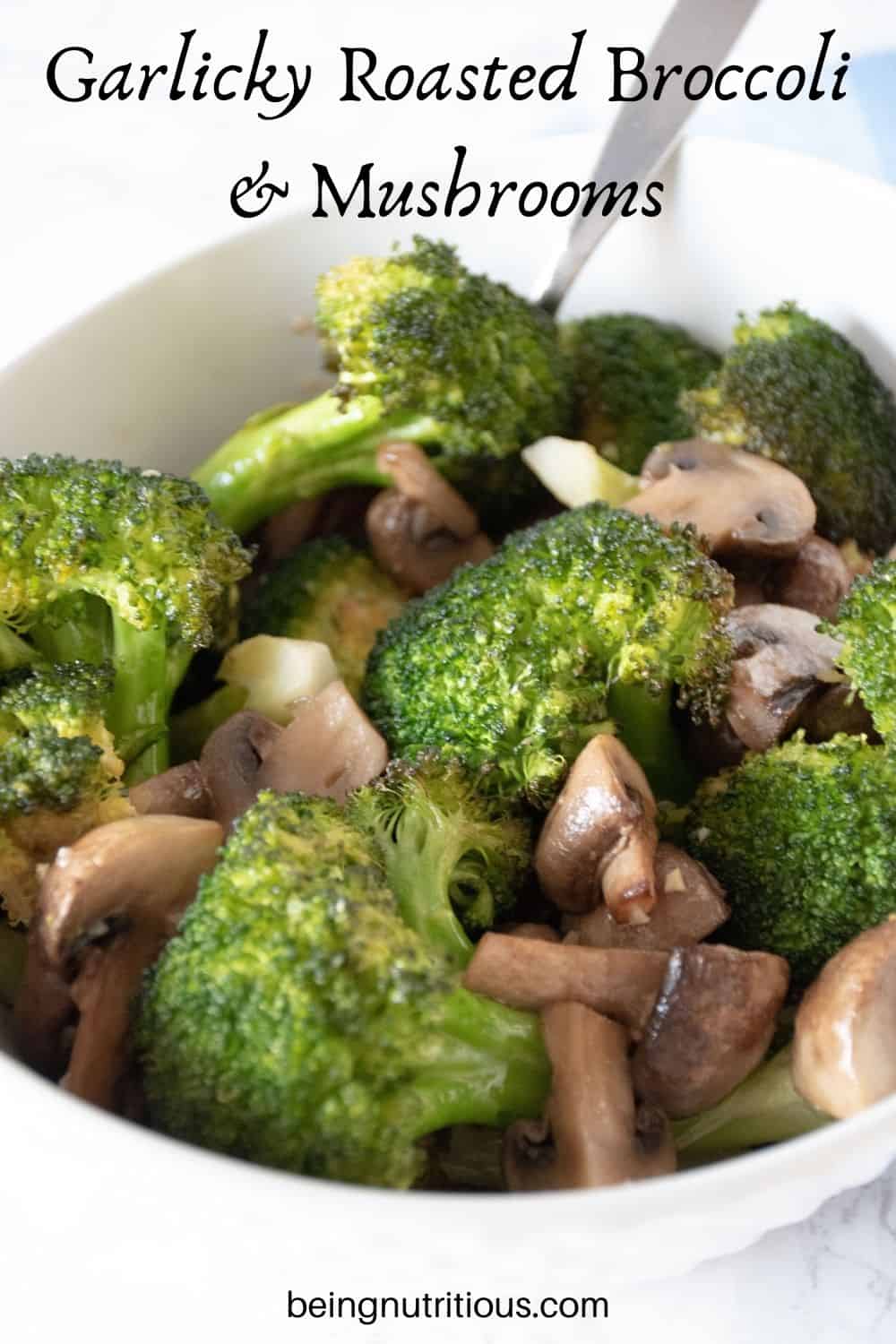
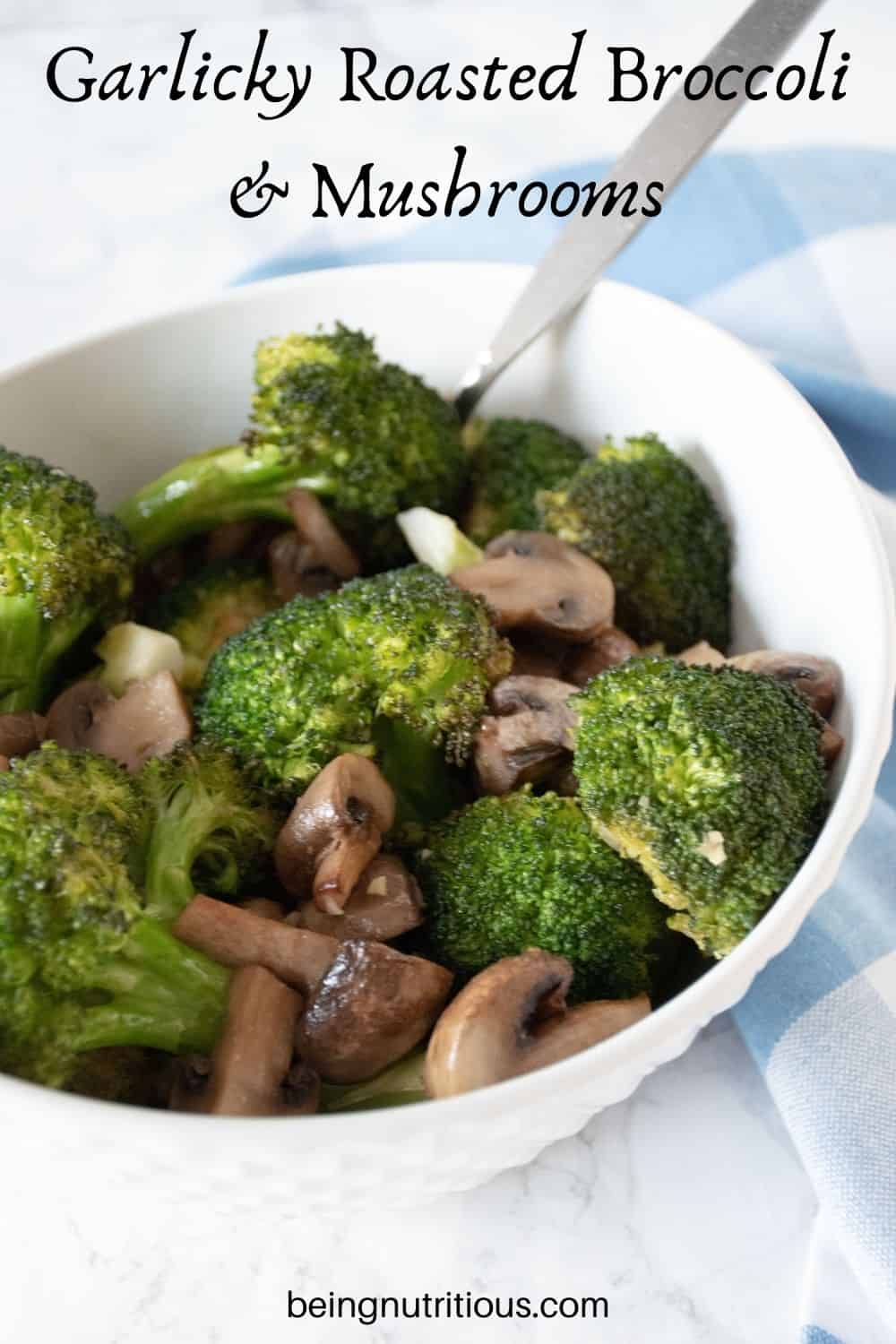
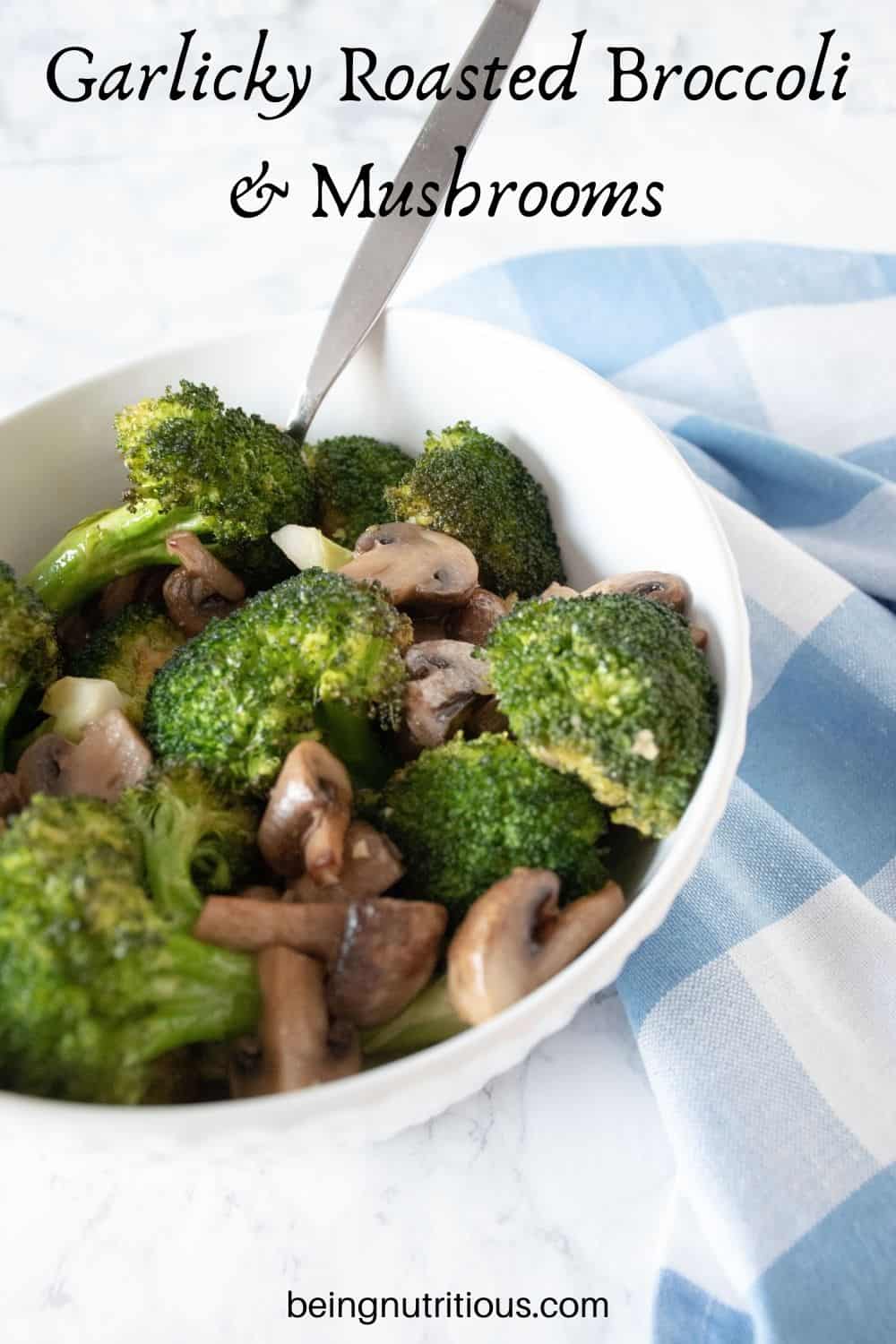
  • Roasted broccoli and mushrooms in a bowl.
    Garlicky Roasted Broccoli & Mushrooms
Want to say thank you?

📖 Recipe

A pan of 6 baked stuffed bell peppers.

Lentil Stuffed Peppers

Laura Yautz
These delicious peppers are stuffed with a mixture of lentils, mushrooms, and rice, for a winning combination even meat eaters will devour!
5 from 2 votes
Prevent your screen from going dark
Print Recipe Pin Recipe Save Recipe Saved Recipe!
Prep Time 1 hour hr 10 minutes mins
Cook Time 45 minutes mins
Total Time 1 hour hr 55 minutes mins
Course Main Course
Cuisine American
Servings 6
Calories 185 kcal

Ingredients
  

  • 6 medium sized Bell Peppers any color
  • 2 teaspoon Olive Oil
  • 1 medium Onion diced
  • 2 cloved Garlic minced
  • 8 oz White Mushrooms diced small
  • ½ teaspoon Liquid Smoke
  • 1 cup cooked Brown/Green Lentils
  • 1 cup cooked Brown Rice or Quinoa
  • 2 cups Homemade Marinara Sauce divided (or low sodium brand of choice)

Instructions
 

  • If you have not already, cook the lentils and rice according to package directions, and make the marinara sauce.
  • Preheat your oven to 350 degrees F.
  • In a large skillet, heat 2 teaspoons of olive oil over medium heat.
  • Add the onions and garlic, and saute until translucent.
  • Add the mushrooms to the pan, and continue cooking until the mushrooms release their liquid, and most of the liquid evaporates.
  • Add the liquid smoke, lentils, rice and 1 cup marinara sauce, and warm through.
  • Prepare the peppers: Cut the tops off the peppers, and scoop out the insides. Arrange the peppers in a 9x13 (or similarly sized) baking dish. Spray a bit of oil in the bottom if you are worried about them sticking. If the peppers won't sit upright, cut a small slice off the bottom until they won't fall over.
  • Scoop the filling into the prepared peppers, dividing evenly. Pour a spoonful of marinara sauce onto each pepper.
  • Cover with a lid or aluminum foil, and bake for 30 minutes.
  • After 30 minutes, uncover, and bake another 15-20 minutes, until bubbly.
  • Serve hot with the remaining marinara sauce.

Nutrition

Serving: 1stuffed pepperCalories: 185kcal (9%)Carbohydrates: 32.4g (11%)Protein: 8.1g (16%)Fat: 3.6g (6%)Saturated Fat: 0.5g (3%)Polyunsaturated Fat: 0.7gMonounsaturated Fat: 1.9gSodium: 122.1mg (5%)Potassium: 1009.7mg (29%)Fiber: 8.8g (37%)Sugar: 12.1g (13%)Vitamin A: 266.4IU (5%)Vitamin C: 181.1mg (220%)Calcium: 53.6mg (5%)Iron: 2.8mg (16%)

*Nutrition information is an estimate, and will change based on the brand and individual ingredients and amounts you use. This is provided for your convenience only.

Keyword healthy stuffed peppers
Tried this recipe?Let us know how it was!

Food safety

Safety is our top priority in the kitchen! Always keep these tips in mind.

  • Cook to a minimum temperature of 165 °F (74 °C)
  • Do not use the same utensils on cooked food, that previously touched raw meat
  • Wash hands before touching food, and after touching raw meat, your hair, face, pets, etc.
  • Don't leave food sitting out at room temperature for longer than 2 hours (or 1 hour if the weather is hot)
  • Never leave cooking food unattended
  • Always have good ventilation when using a gas stove

See more guidelines at USDA.gov.

As an Amazon Associate I may earn from qualifying purchases. Your purchase helps me keep the lights on, at no additional cost to you! I never recommend products that I don't love. Thanks for your support!

A yellow stuffed pepper, side cut open to reveal stuffing, on a plate. Text overlay: Easy! Vegetarian Stuffed peppers.

What To Do With Leftover Halloween Candy

October 29, 2020 by Laura Yautz 4 Comments

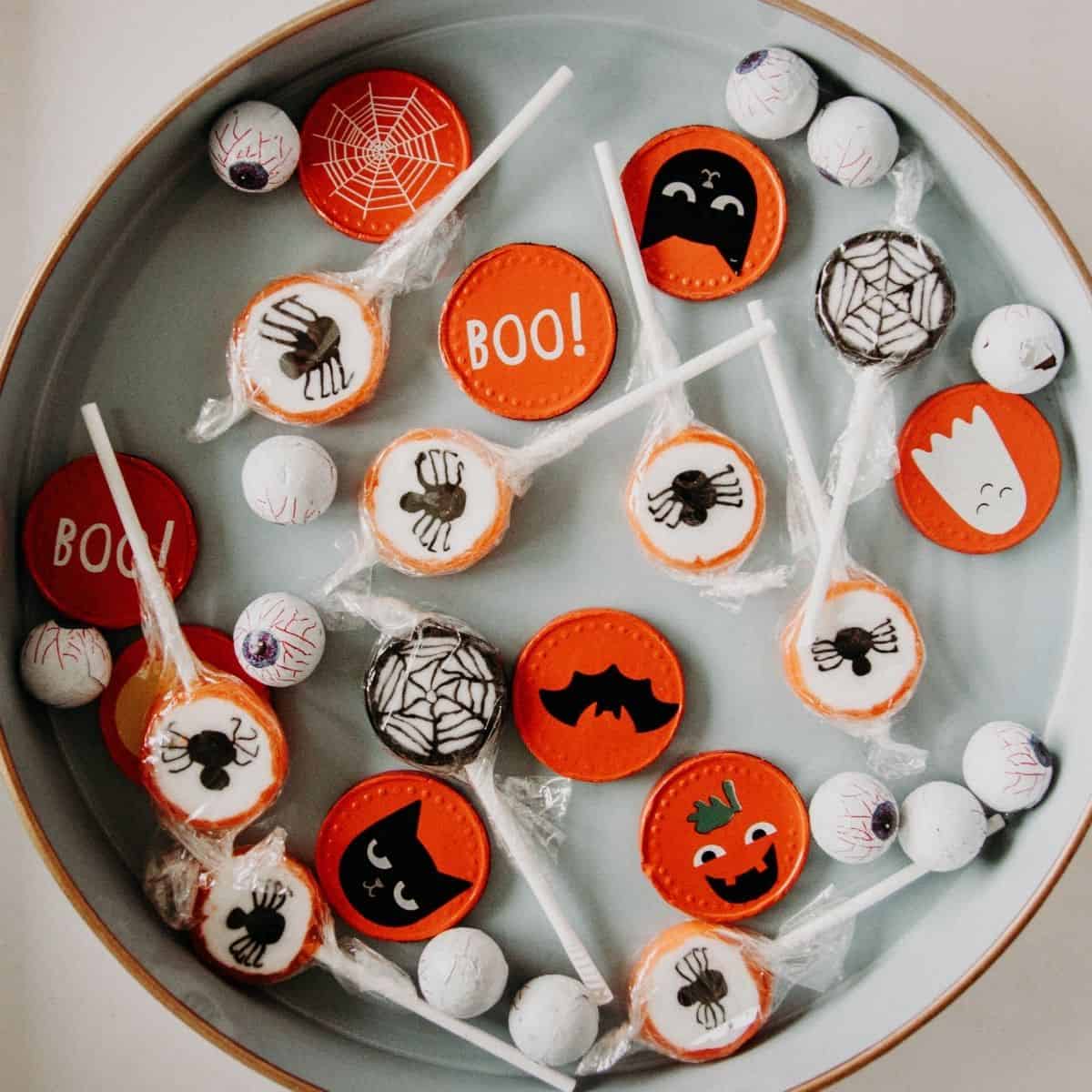
Bowl of halloween candy

The season is upon us once again. If you're like me, you buy way more candy than you'll ever pass out, and now you've got half a bag of leftover Halloween candy, and you know it will only hinder your efforts to get or stay healthy. What to do? Never fear! I've got some ideas for you!

what to do with leftover halloween candy

The mindset for wellness

First, let's talk about mindset. I know how it feels to give away, or otherwise dispose of, food that is yours. Especially if it's food you really like. Trust me, being a dietitian does not absolve me of loving sweets (Reese's are my favorite!)!

But here's the thing - most of us eat WAY too much of it WAY too frequently. It gets away from us. We forget how much we've eaten. We justify it. We chalk it up to weak resolve, or whatever. And before we know it, the bag is empty and there's a mountain of wrappers sitting on the table.

"I might as well just eat the rest of it, and then it will be gone!"

"I can't get rid of those Snickers bars! They're my favorite!"

Sound familiar?

If you find you're thinking similar thoughts, try answering the following questions:

  • What is your health or wellness goal?
  • How will keeping all that candy around contribute to or inhibit that goal?
  • Is the candy more or less important that reaching that goal?
  • What does that candy represent to you that you hesitate to let it go? This is getting deep but sometimes we need to go there!

For most of us, of course the candy isn't more important that our health or wellness goals, but it's still difficult to come to terms with the idea.

Pro tip

When you're really struggling with what to do, sometimes it helps to do this little thought experiment. Ask yourself:

"What would the person I strive to be do?"

That's the future person you will be - when you reach your goals and you're living the life you want to live, the way you want to live it. 

If your ideal self wouldn't eat all the candy, read on!

Donate your leftover Halloween candy

There are lots of charities around that will accept unopened leftover Halloween candy! No more feeling bad about just throwing it in the trash! Contact your local homeless shelters and food banks to see if they accept it. Several organizations also put together care packages for soldiers overseas using donated candy. Here are some options to find a donation center near you:

Treats for Troops
Halloween Candy Buy Back

Take it to work

I know lots of us may be working from home now, but if you go to a physical workplace, this is a great way to spread the love! Just make sure anything you take is in its original wrapper.

Freeze it and ration it

There's truly nothing wrong with having a piece of candy here and there. Freezing it allows you to ration it better because you don't have a huge pile of candy sitting in front of you, and you won't mindlessly eat it because it has to thaw - unless you're the type to eat it frozen! Take one or two pieces out to thaw at a time for snacking.

If you already know you're not the type of person to be able to have just one or two, this option may not be for you. Be honest with yourself.

Give leftover candy away

Give it to a family member, friend, or neighbor who would appreciate it. Long term care facilities or other group home-type setting may also love to have it.

Leftover Halloween candy.

Many people struggle this time of the year - the time I've dubbed "Hallo-thanksgiv-mas." This year, you can make it different. Be the person you want to be right now. You can do it!

How do you get rid of leftover Halloween candy that supports your health and wellness? Let me know your Hallo-thanksgiv-mas wins in the comments section below!

How to Roast Pumpkin Seeds

October 28, 2020 by Laura Yautz Leave a Comment

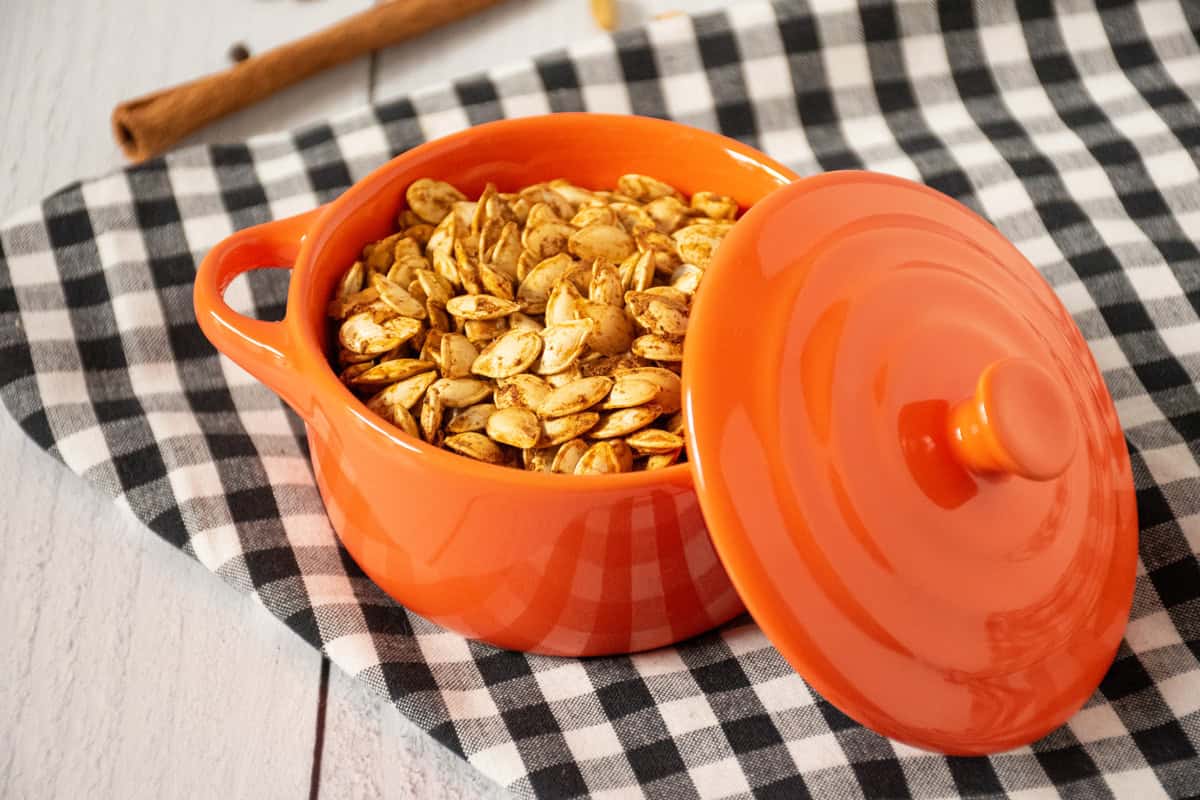
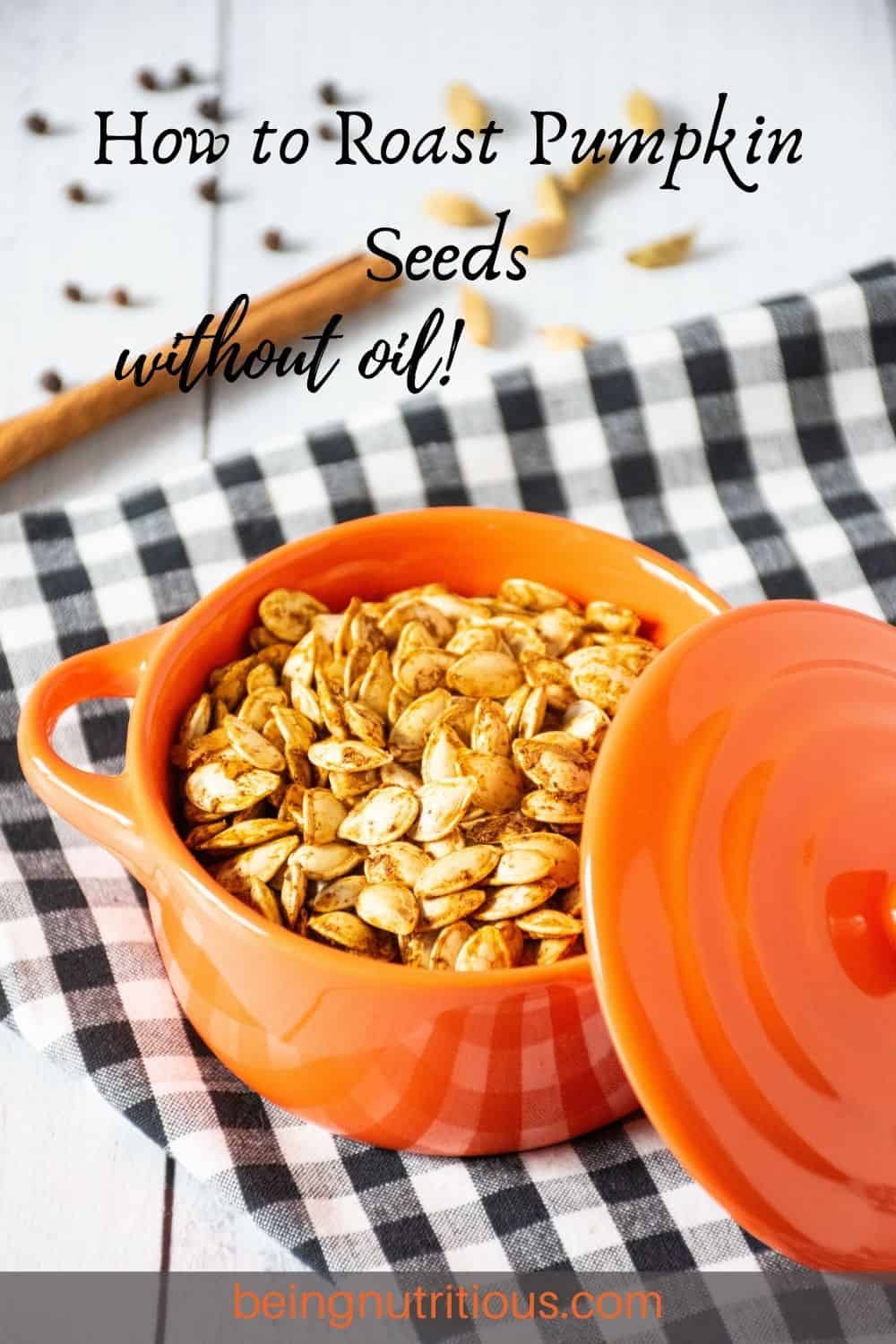
Close up of roasted pumpkin seeds.

If it's pumpkin carving season, it's pumpkin seed roasting season! No matter how you season them, this is your go-to guide for how to roast pumpkin seeds. And here's a bonus: this recipe uses no oil, and no washing those seeds! Any extra pulp left on the seeds will crisp up, too, and it's really yummy! There's no way to get those seeds in the oven quicker.

This post may contain affiliate links. See our Disclaimer for more information

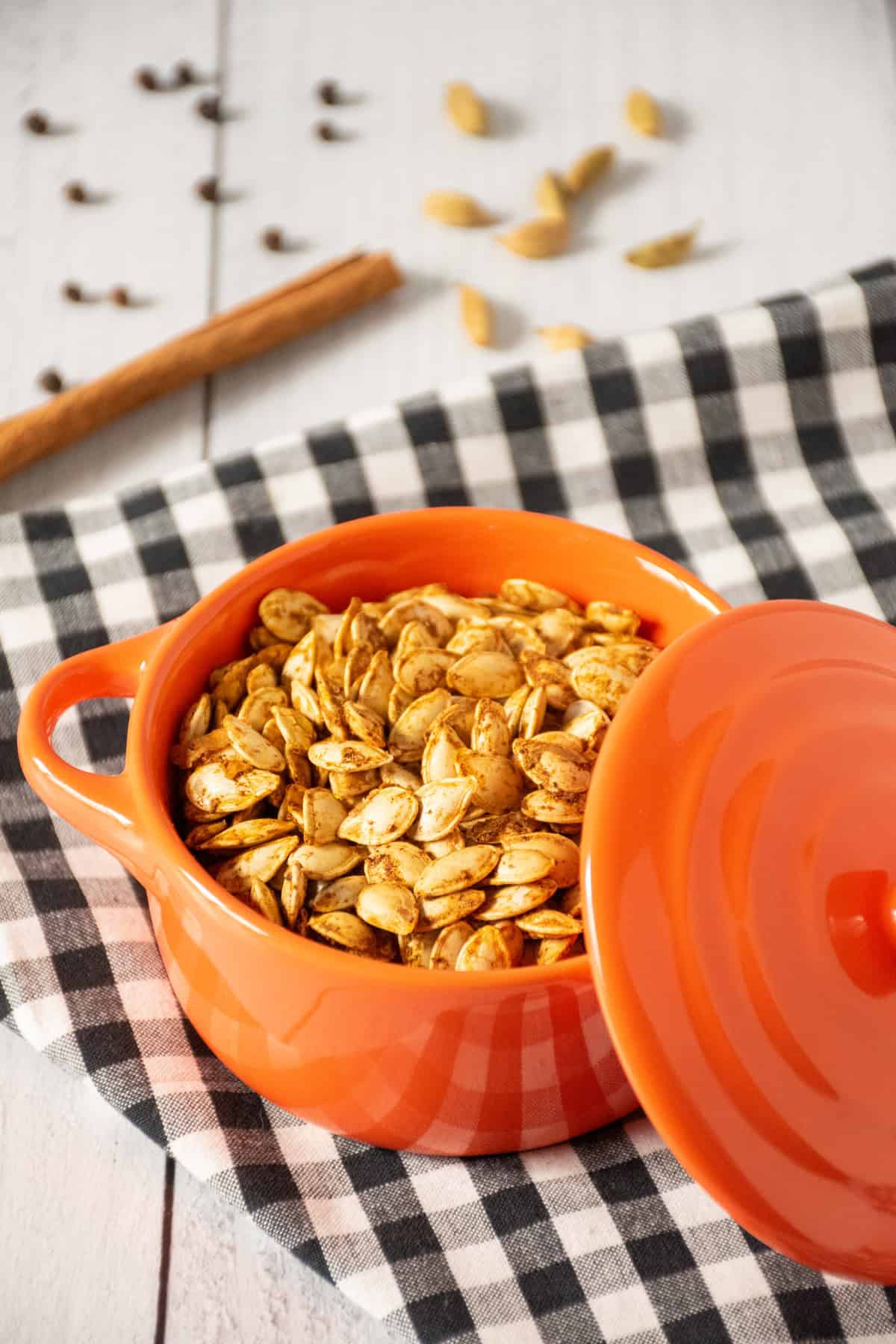
Roasted pumpkin seeds in a tiny orange crock.

If you've ever wondered how to roast pumpkin seeds, we've got you covered! You'll love how easy it is to make this delicious crunchy snack every pumpkin carving season!

[feast_advanced_jump_to]

Heart Health Benefits of Roasted Pumpkin Seeds

These roasted pumpkin seeds are a great nutrient-dense and antioxidant filled snack. The nutrition in them can help improve lipid profiles, reduce LDL oxidation, and support blood pressure (1). Roasting them can make some of these nutrients more available for our bodies to use (2).

Macronutrients

Pumpkin seeds are high in unsaturated fat (primarily linoleic and oleic acids) and fiber. These unsaturated fats help lower the risk of heart disease, particularly when used in place of saturated fat or carbohydrate foods (3, 4).

Keeping the hull on increases the fiber (mostly insoluble fiber) to fat ratio, and also decreases the calorie content per gram (1, 5). This can potentially lead to increased feelings of satiety, which can be useful in weight management.

Micronutrients and Bioactive Components

Pumpkin seeds are also a good source of magnesium, potassium, zinc, and vitamin E. We keep this snack low sodium by using only a pinch of salt if it's needed, and amping up the phytochemical content with herbs and spices.

While the herb and spice nutrient content will vary depending on what you use, here's a run down of the phytonutrients and antioxidants in whole pumpkin seeds (unhulled):

  • Linoleic acid - polyunsaturated omega-6 fatty acid that can may lower the risk of coronary heart disease (3);
  • Oleic acid - monounsaturated omega-9 fatty acid that can help lower cholesterol and reduce the risk of heart disease (4);
  • Insoluble fiber - type of fiber that does not dissolve in water, and helps add bulk to the stool, reducing constipation risk (6)
  • Tocopherol isomers - vitamin E derivatives and antioxidants that help protect lipids from peroxidation (7);
  • Phenolic compounds and flavonoids - contribute to the antioxidant effect of the seeds (1); and
  • Phytosterols - bioactive compound found in plant foods that helps reduce cholesterol absorption in the intestinal tract, thereby reducing blood LDL levels (8).

Ingredients

One simple ingredient here!

Ingredients for roasted pumpkin seeds.
  • Seeds from a pumpkin

See recipe card for quantities.

Instructions

Who knew how easy it could be to roast pumpkin seeds from your Jack-o-lantern carving activities?!

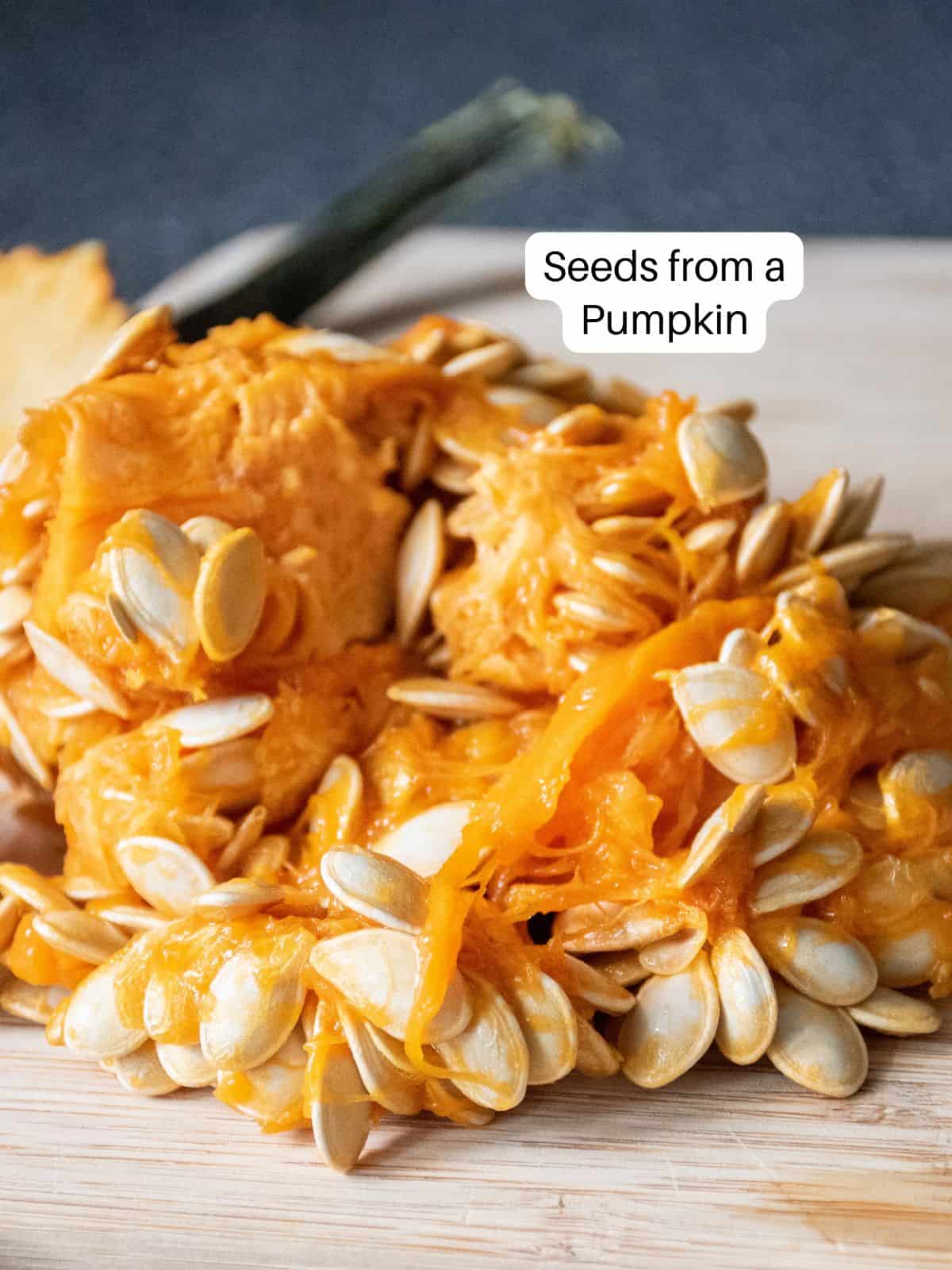
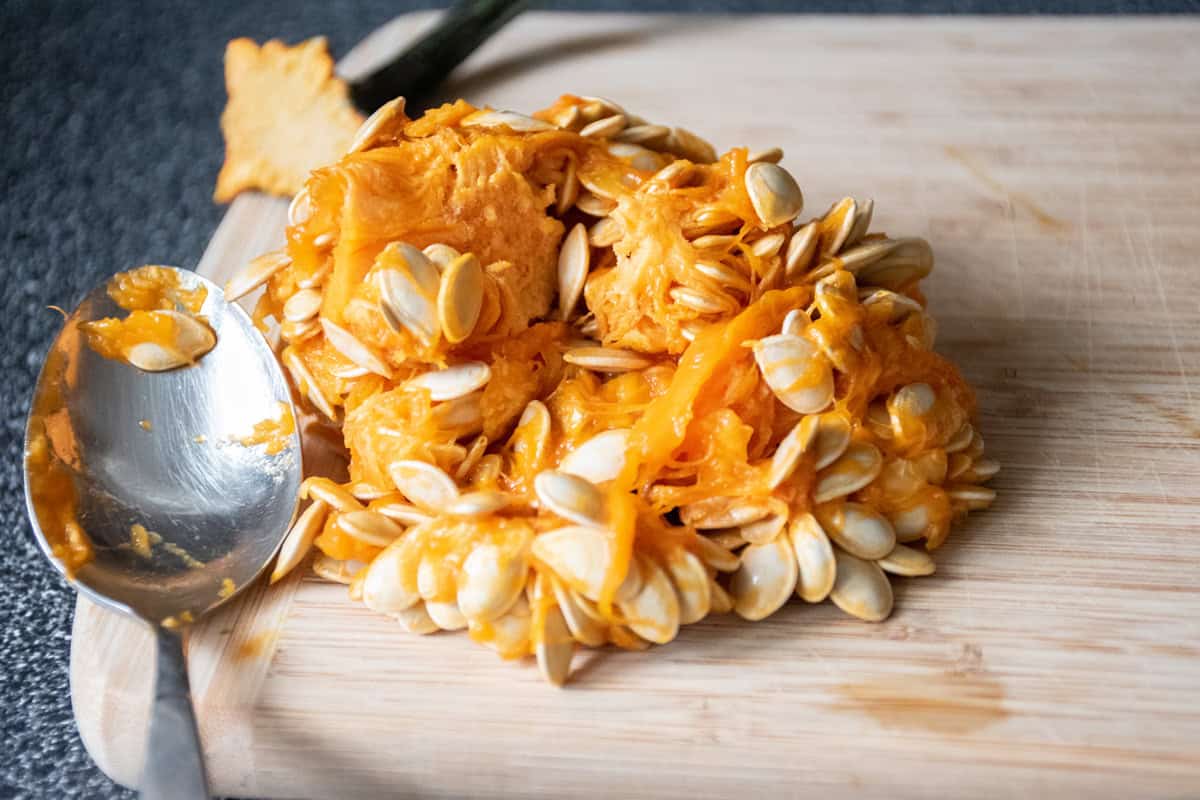
Raw pumpkin seeds and pulp, just scooped out of a pumpkin.
  1. Step 1: Remove the seeds and pulp from the pumpkin.
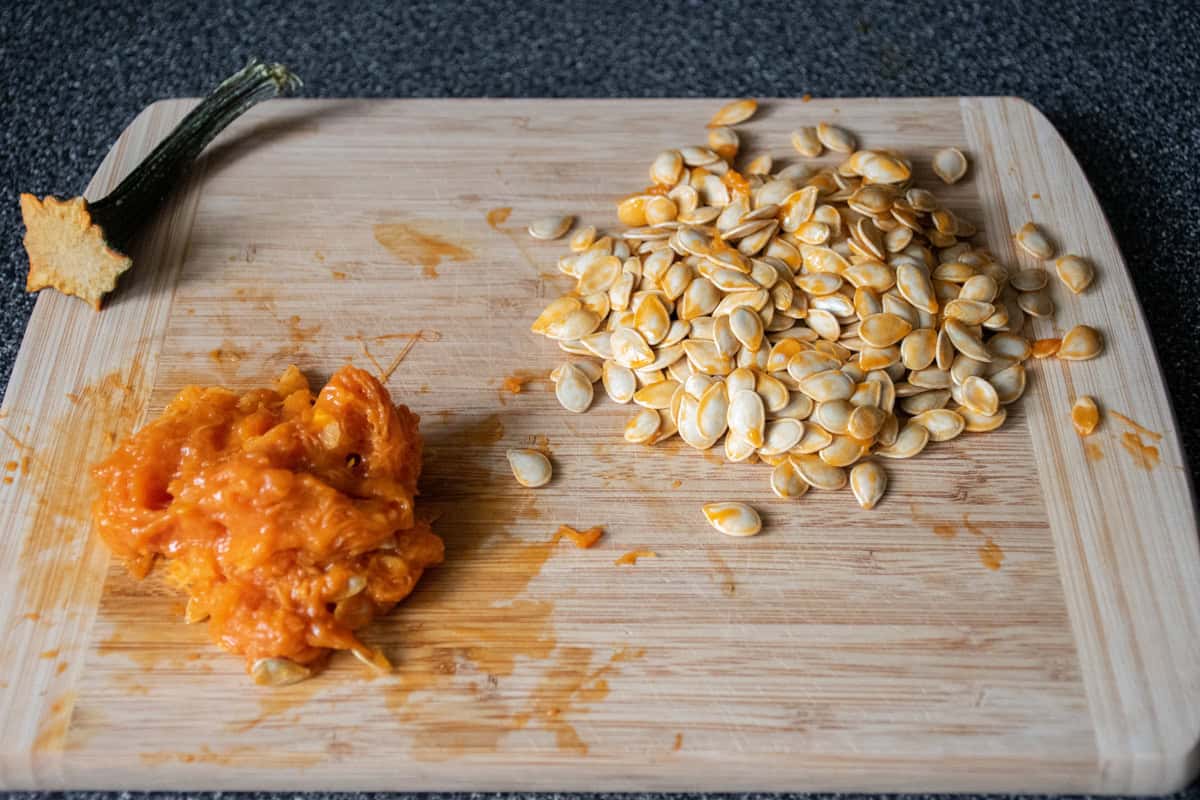
Raw pumpkin seeds separated from their pulp.
  1. Step 2: Separate the seeds from the pulp. It's fine if some of the pulp is still clinging to the seeds.
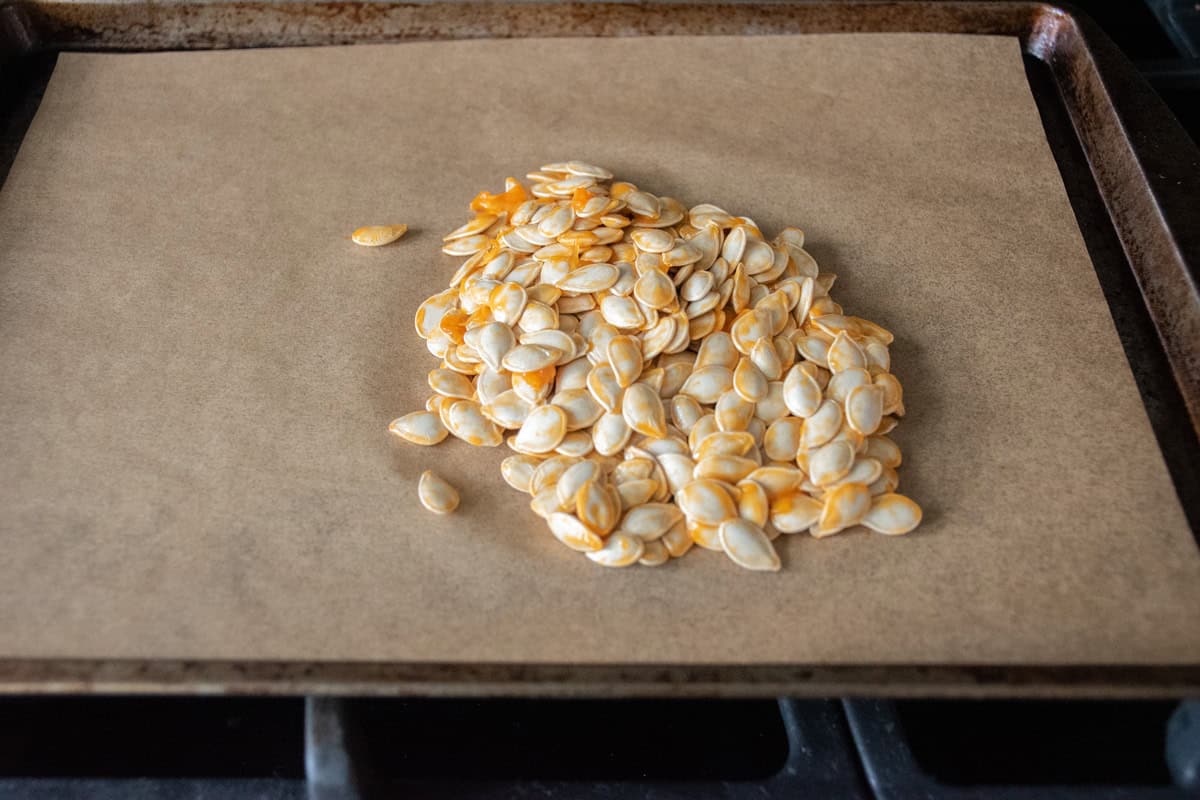
Raw pumpkin seeds on a lined baking sheet.
  1. Step 3: Transfer the seeds to a lined baking sheet, add your seasoning of choice, and spread them out as much as you can.
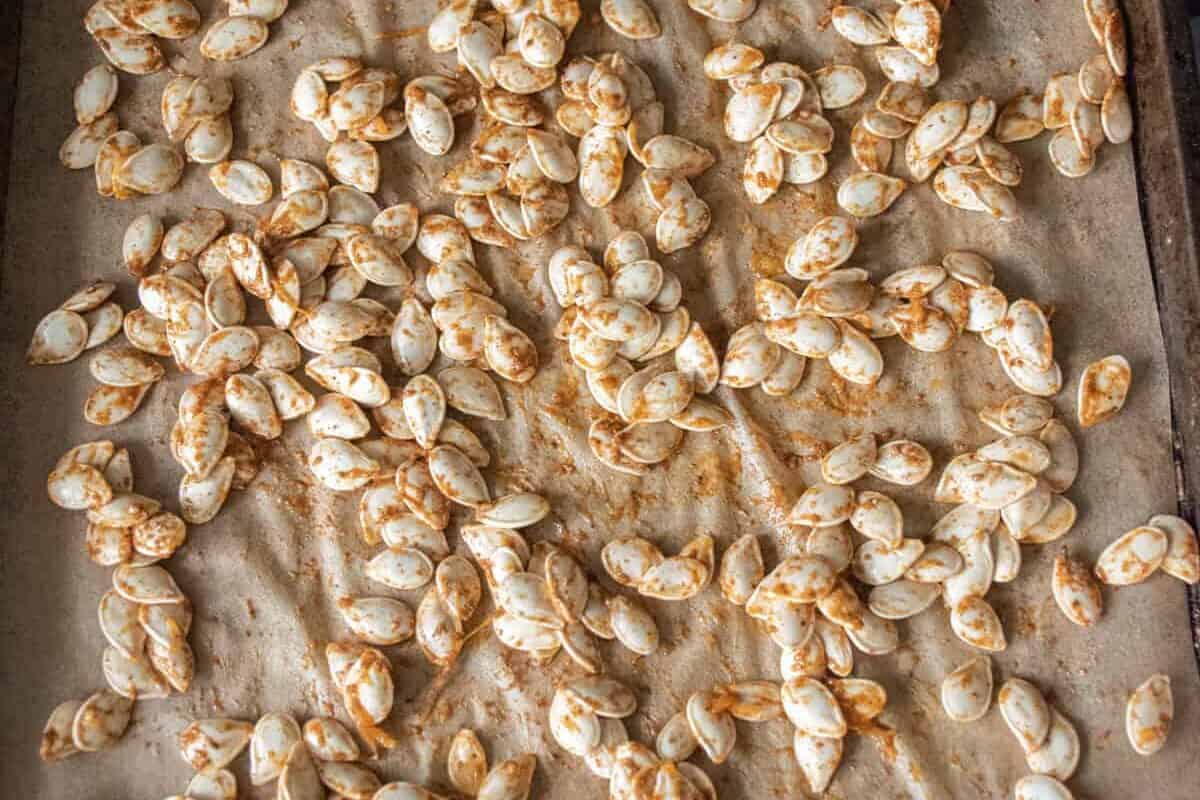
Roasted pumpkin seeds on a lined baking sheet.
  1. Step 4: Bake until crispy.

Hint: a little pulp left of the seeds makes for a delicious and crispy coating, plus adds a bit of nutrition!

Variations

There are endless variations on roasted pumpkin seeds, depending on what spices you use! Here are some of my favorites!

  • Taco seeds - use salt free taco seasoning for a delicious Mexican flair
  • Chai seeds - use chai seasoning for a warm and spicy take
  • Pumpkin spice - use pumpkin pie spice for a classic pairing
  • Thanksgiving seeds - use poultry seasoning for Thanksgiving flavors
    Roasted pumpkin seeds in a tiny orange crock.

    Equipment

    A big spoon to scoop out the seeds and pulp from your pumpkin, and a baking sheet with parchment paper (or other liner) are all you'll need for this simple roasted pumpkin seeds recipe!

    Storage

    Store cooled seeds in an airtight container for up to two weeks.

    Healthy heart pro tip

    Consider eating both the hull and the seed! While the seed itself is a nutritional powerhouse, the hull adds insoluble fiber and extra nutrition, as well as lowers the total calories and fat per serving, potentially aiding in cholesterol and weight management (5, 9).

    FAQ

    What type of pumpkin should I use for roasted pumpkin seeds?

    Any type of pumpkin or squash will do! Sugar pumpkins (for baking), jack-o-lantern pumpkins, or any variety of squash, like butternut, acorn, or kabocha can be used for roasting.

    Can I eat the white shells?

    Yes, the white hulls (shells) are edible, and provide additional fiber and nutrition!

    What's the difference between pumpkin seeds and pepitas?

    Pepitas are hulled pumpkin seeds; that is, pumpkin seeds without the shell. Pumpkin seeds are generally the whole thing; seed and hull. You can easily tell whether the seeds are hulled or not, because whole seeds are white in color and quite large, while hulled seeds are much smaller and green.

    Related

    Looking for more healthy pumpkin recipes? Try these:

    • Pumpkin steel cut oats risotto in a heart shaped bowl, garnished with fresh sage leaves and chopped parsley.
      Slow Cooker Pumpkin Risotto with Steel Cut Oats
    • Small jar of pumpkin spice syrup.
      Healthy Pumpkin Spice Syrup
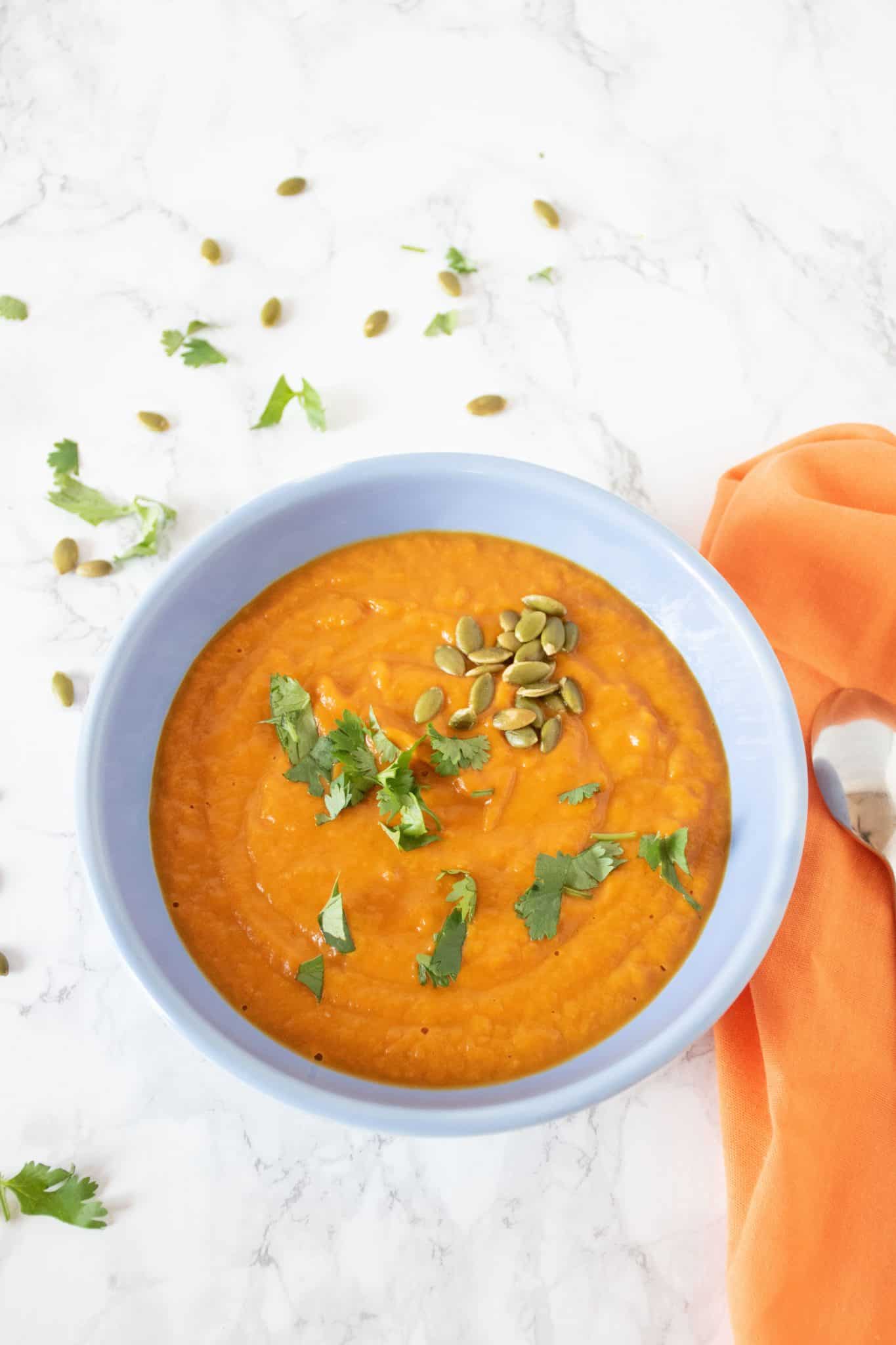
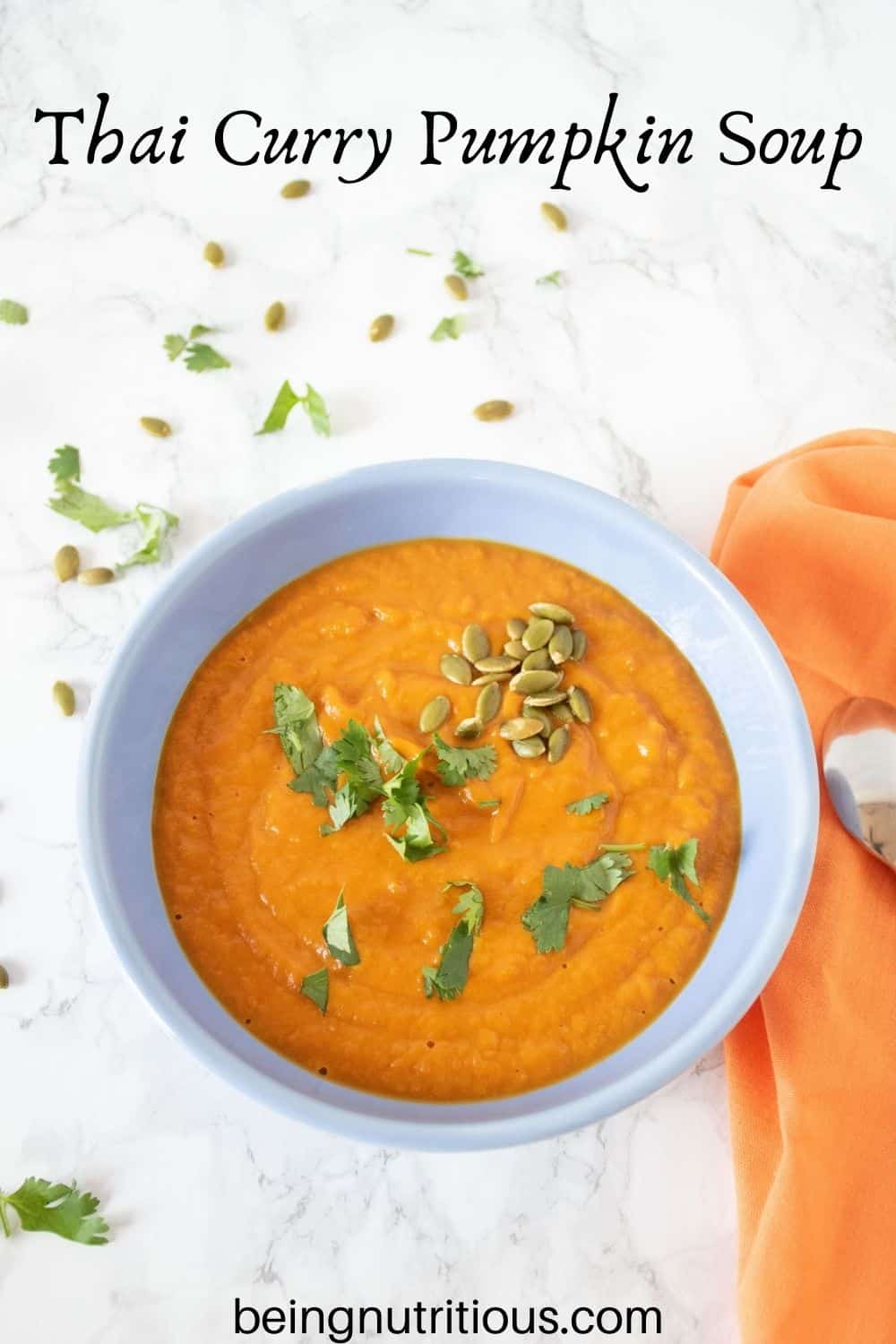
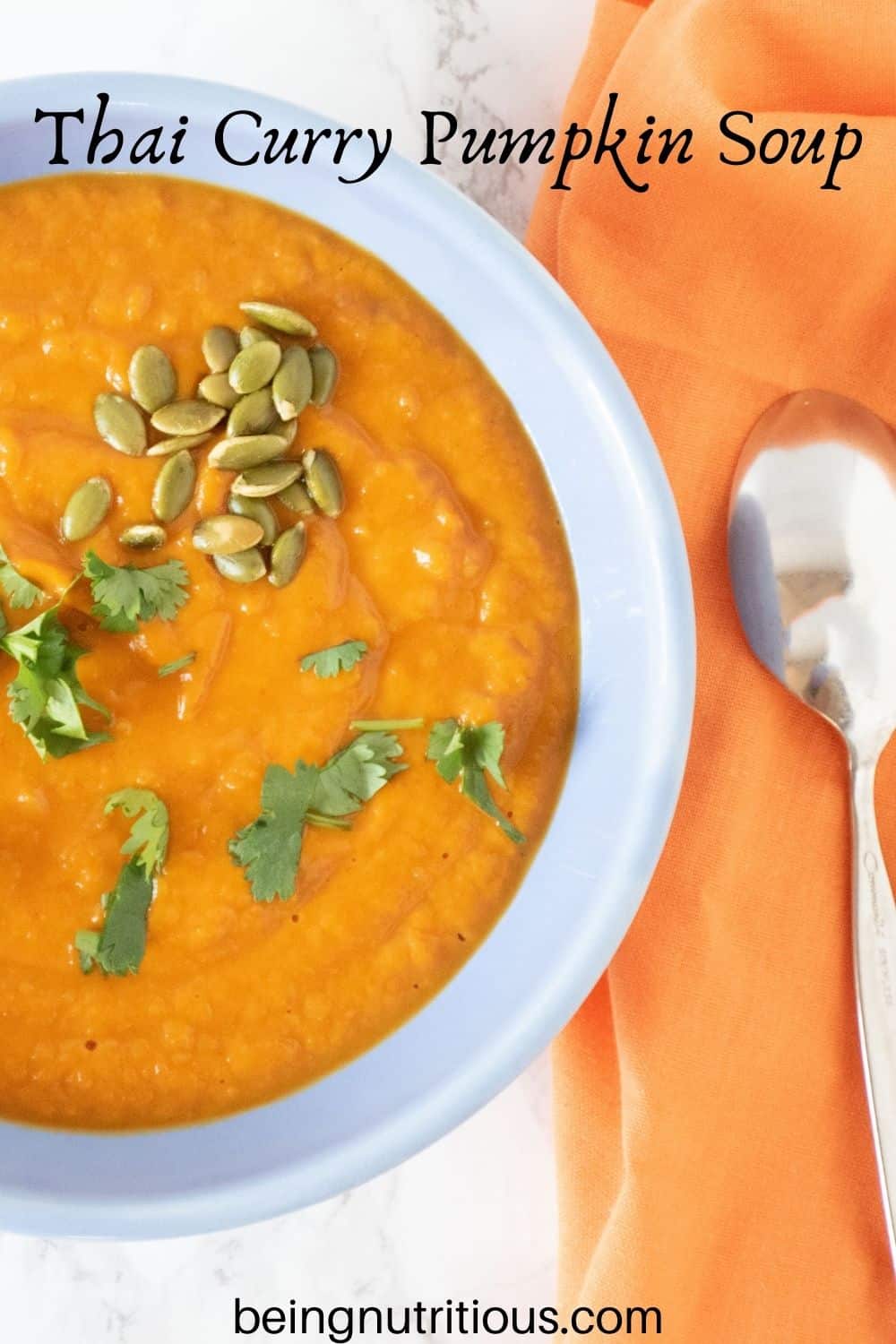
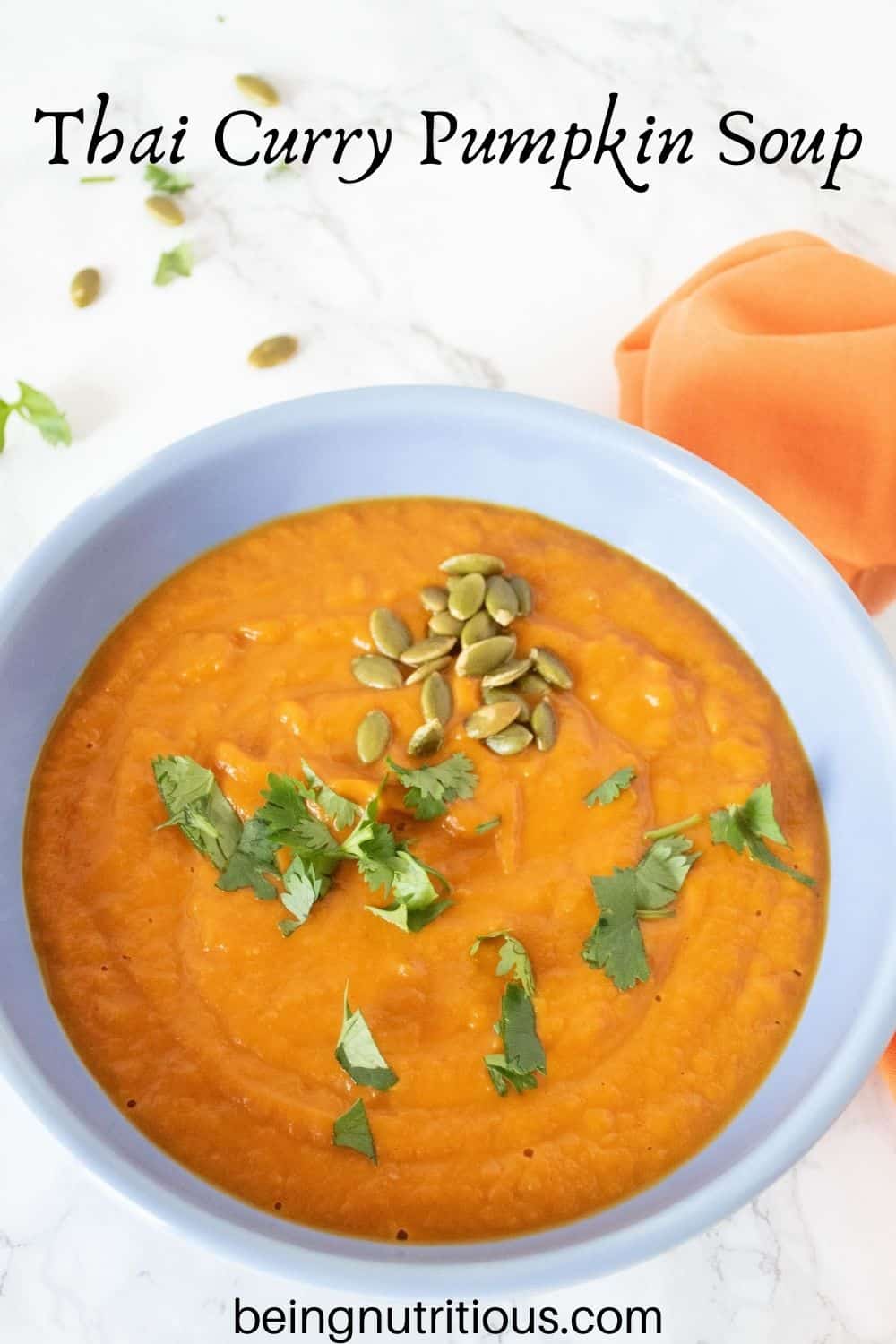
    • Overhead shot of pumpkin soup in a blue bowl, garnished with cilantro and pepitas.
      Thai Curry Pumpkin Soup
    • Pumpkin Granola spilling out of a glass jar
      Heart Healthy Pumpkin Granola
    Want to say thank you?

    📖 Recipe

    Close up of roasted pumpkin seeds.

    Roasted Pumpkin Seeds

    Laura Yautz
    Pumpkin carving season is also roasted pumpkin seed season! This is your go-to base recipe for any kind of flavors you want to add! No oil or washing needed!
    No ratings yet
    Prevent your screen from going dark
    Print Recipe Pin Recipe Save Recipe Saved Recipe!
    Prep Time 10 minutes mins
    Cook Time 20 minutes mins
    Total Time 30 minutes mins
    Course Appetizer, Snack
    Cuisine American
    Servings 2 (varies)
    Calories 71 kcal

    Equipment

    • Large baking sheet
    • Parchment Paper

    Ingredients
      

    • ½ cup Raw pumpkin seeds separated from pulp
    • ¾-1 teaspoon Seasoning of choice (ex: taco, chai, Italian, etc.)
    • Pinch Salt, to taste

    Instructions
     

    • Preheat oven to 400 degrees F.
    • Place the raw pumpkin seeds, separated from the pulp (it's okay if there's still some clinging to the seeds that you can't get off), on a baking sheet lined with parchment paper.
    • Sprinkle the seeds with the seasoning you've chosen, a pinch of salt if desired, and mix well. Spread out as much as possible.
    • Bake 15-20 minutes, stirring halfway through, until the seeds and any remaining pulp are crispy.
    • Store in an airtight container.

    Nutrition

    Serving: 0.25cupCalories: 71kcal (4%)Carbohydrates: 9g (3%)Protein: 3g (6%)Fat: 3g (5%)Saturated Fat: 0.6g (4%)Polyunsaturated Fat: 1.4gMonounsaturated Fat: 1gSodium: 3mgPotassium: 147mg (4%)Fiber: 3g (13%)Sugar: 0.4gVitamin A: 1.6IUVitamin C: 0mgVitamin K: 0.3µgCalcium: 8.8mg (1%)Iron: 0.5mg (3%)Magnesium: 42mg (11%)

    *Nutrition information is an estimate, and will change based on the brand and individual ingredients and amounts you use. This is provided for your convenience only.

    Keyword oil free pumpkin seeds
    Tried this recipe?Let us know how it was!

    Food safety

    These are important safety tips for roasted pumpkin seeds:

    • Wash hands before beginning, whenever they are soiled, and after touching face, hair, pets, etc.
    • Never leave cooking food unattended
    • Keep your face back when opening the oven to avoid hot air burns
    • Always remove items from the oven with appropriate pot holders or mitts to avoid burns

    See more guidelines at USDA.gov.

    Small pot filled with roasted pumpkin seeds. Text overlay: How to roast pumpkin seeds without oil

    How to Make Pumpkin Puree

    October 26, 2020 by Laura Yautz Leave a Comment

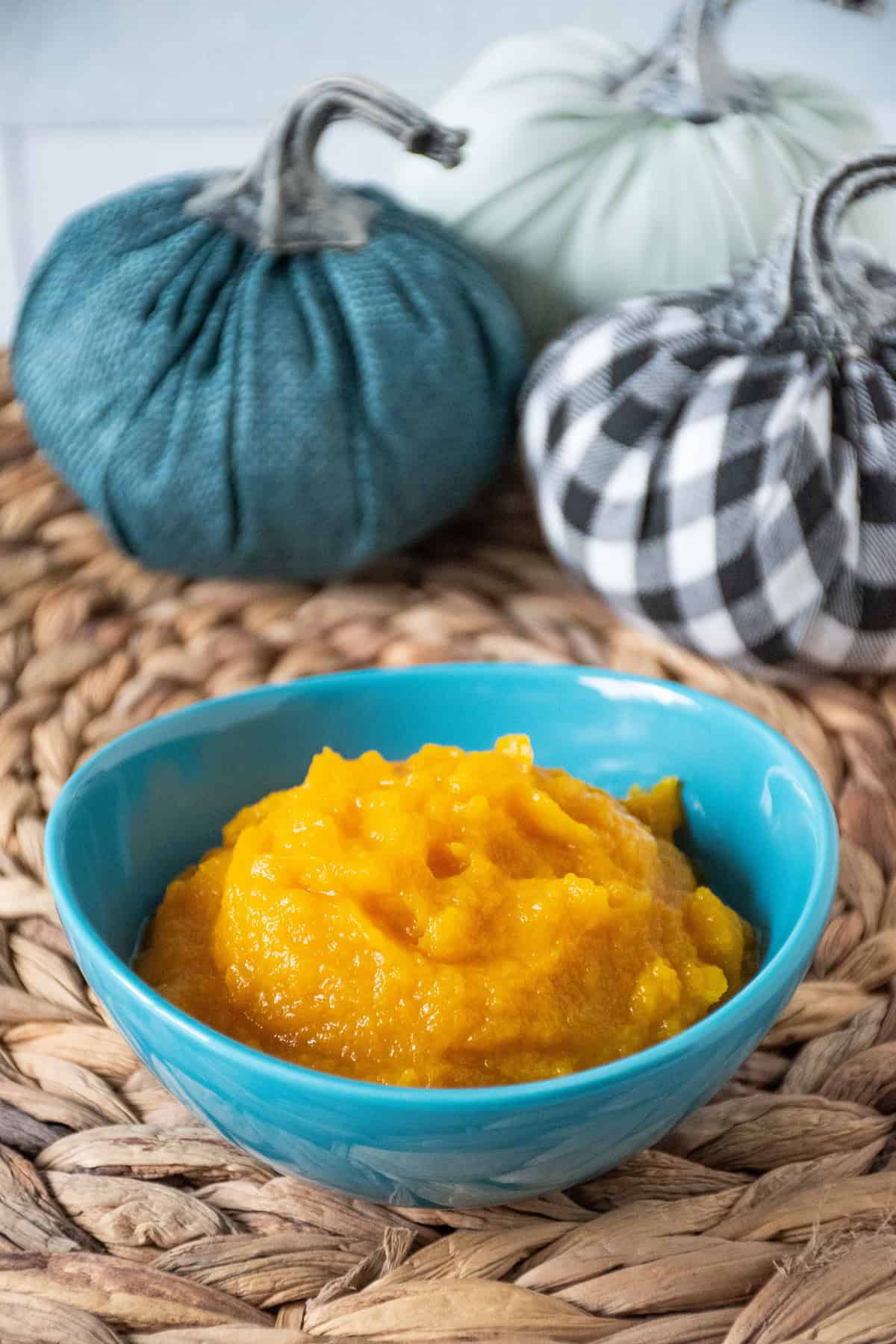
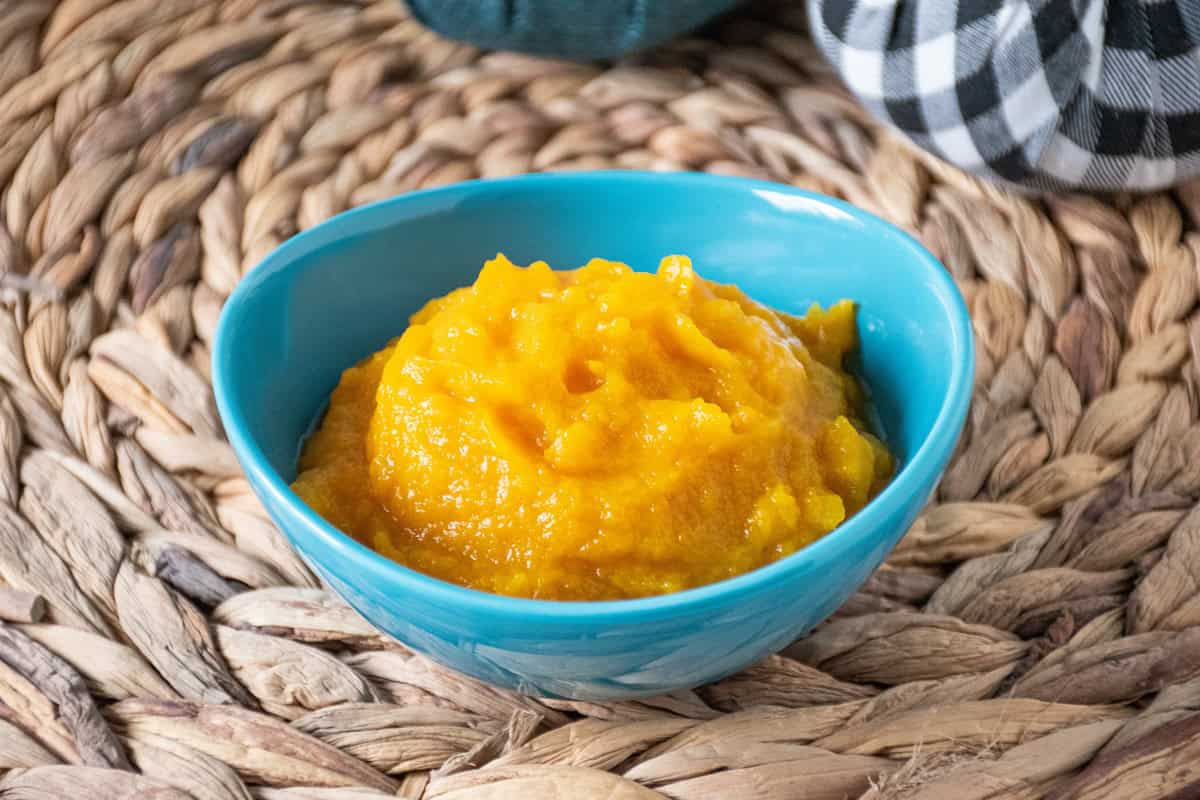
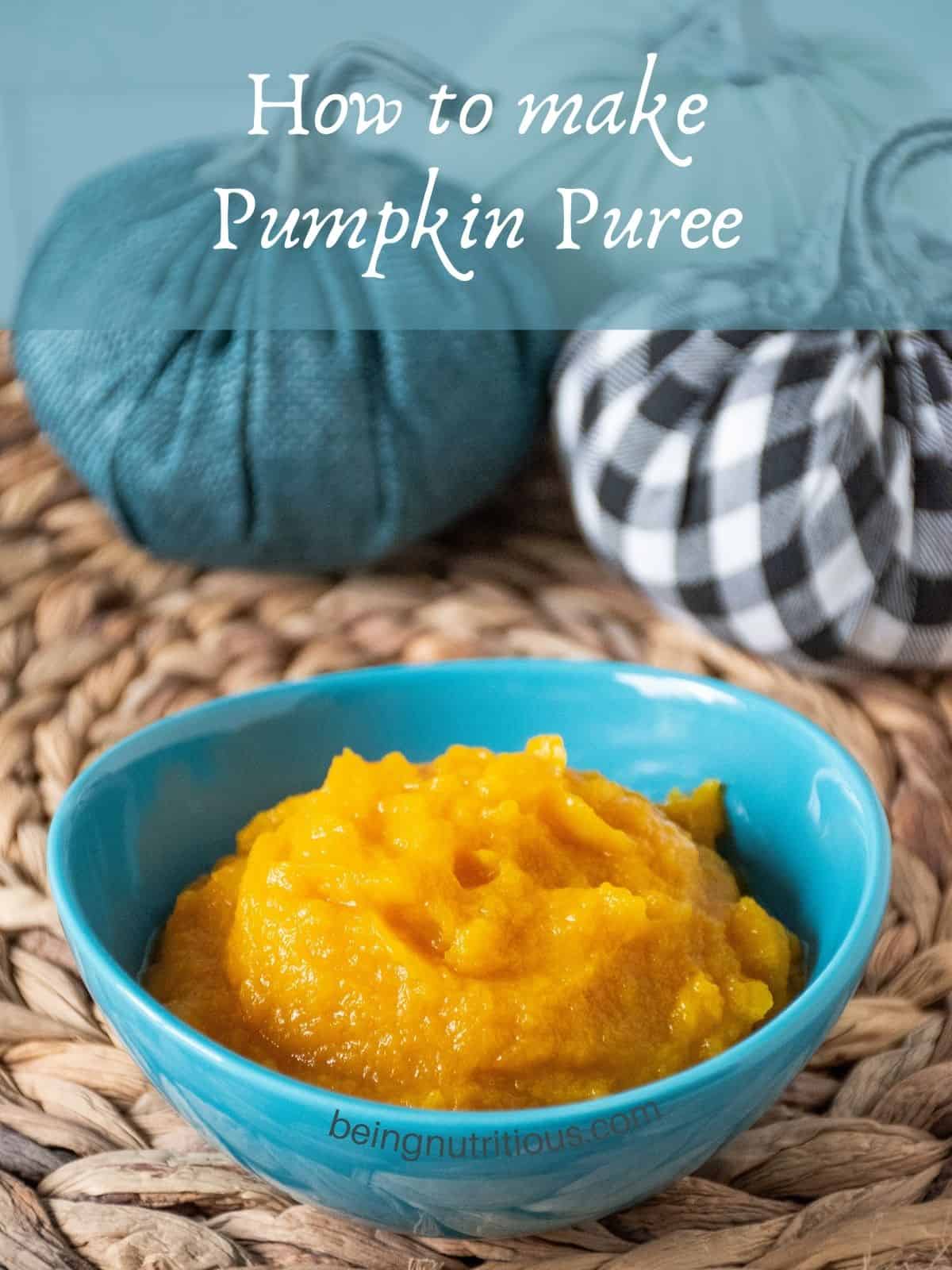
    Small bowl of pureed pumpkin.

    Did you ever wonder how to make pumpkin puree from a fresh pumpkin? I'll show you how easy it is to have homemade pumpkin puree that's all ready for pies, cookies, breads, pudding, or anything else you want to create. You'll never have to make a frenzied run to the store for a single can ever again. Once you make your own, you'll never go back to canned!

    This post may contain affiliate links. See our Disclaimer for more information

    Small bowl of pumpkin puree.

    I love pumpkin in both sweet and savory dishes. It's also great as an egg or oil substitute in many baking recipes (sub ¼ cup for each egg, or one-to-one as an oil/butter sub).

    Make sure to check out my favorite pumpkin recipes, like Pumpkin Spice Syrup, Pumpkin Risotto, and Thai Curry Pumpkin Soup. You can also sub pumpkin puree into Carrot Turmeric Muffins (use instead of applesauce), or Heart Healthy Pancakes (use instead of both the flax and oil).

    [feast_advanced_jump_to]

    Ingredients

    Here is what you'll need for this recipe, along with some applicable substitutions and notes.

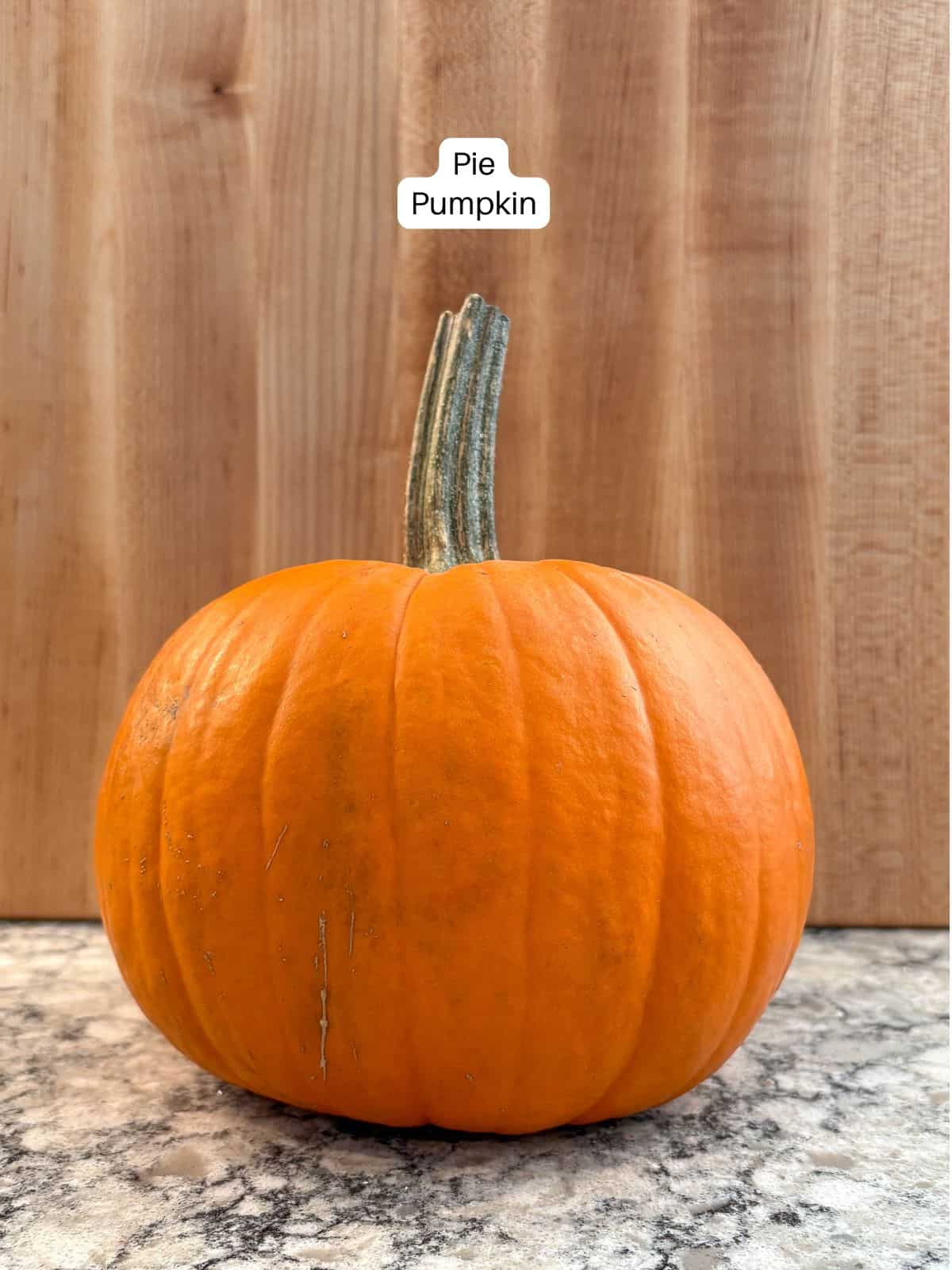
    Pie pumpkin. Single ingredient for making pumpkin puree.
    • Pie pumpkin, sometimes also called a sugar pumpkin. You can technically also use a large jack-o-lantern pumpkin, but the flesh will be thinner and more watery. You may want to strain it.

    See recipe card for quantities.

    Instructions

    Here's an easy step-by-step guide for making pumpkin puree from a fresh pumpkin.

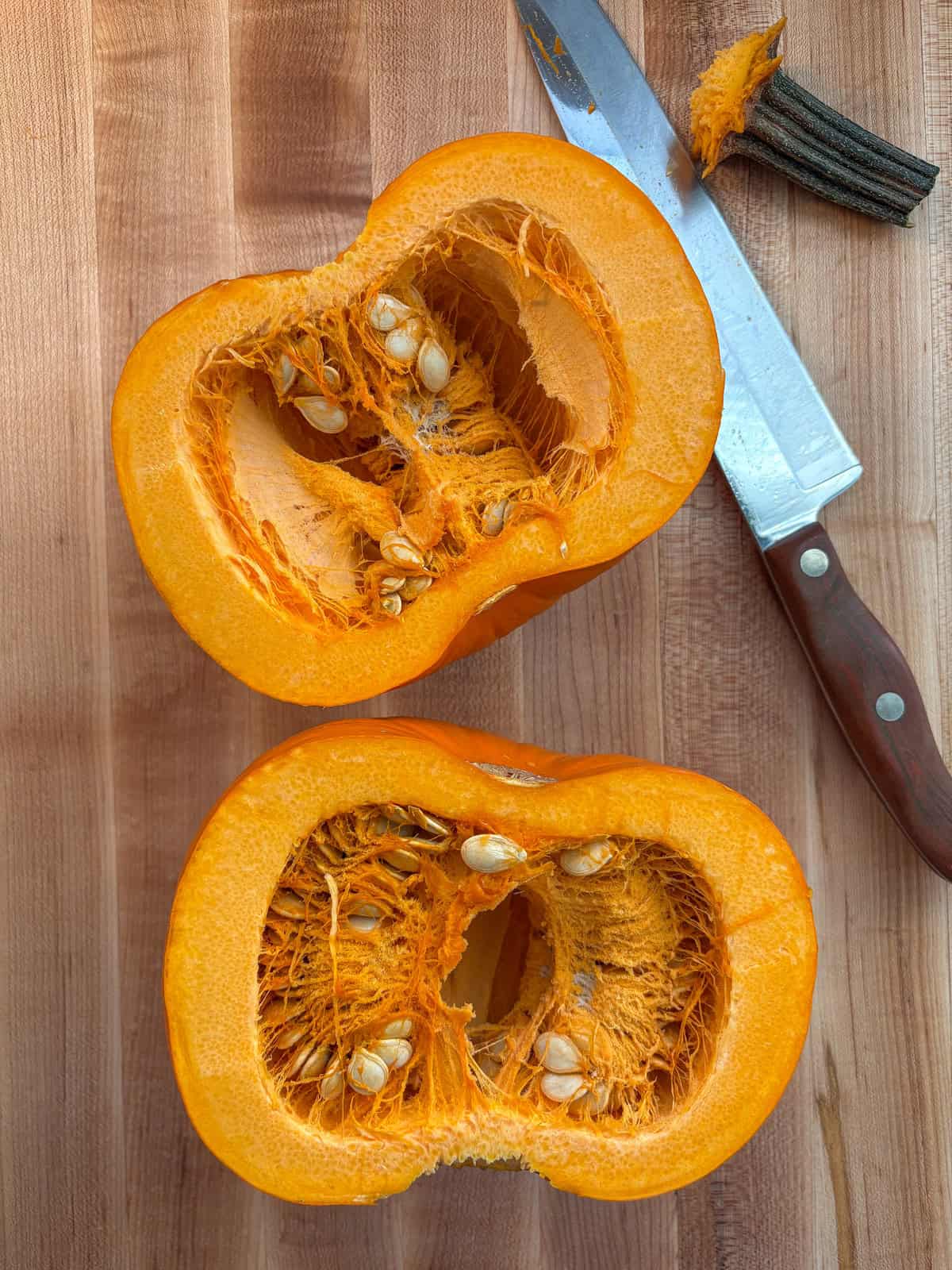
    Raw pumpkin, sliced in half, on a cutting board.
    1. Step 1: Remove the stem, and slice the pumpkin in half.
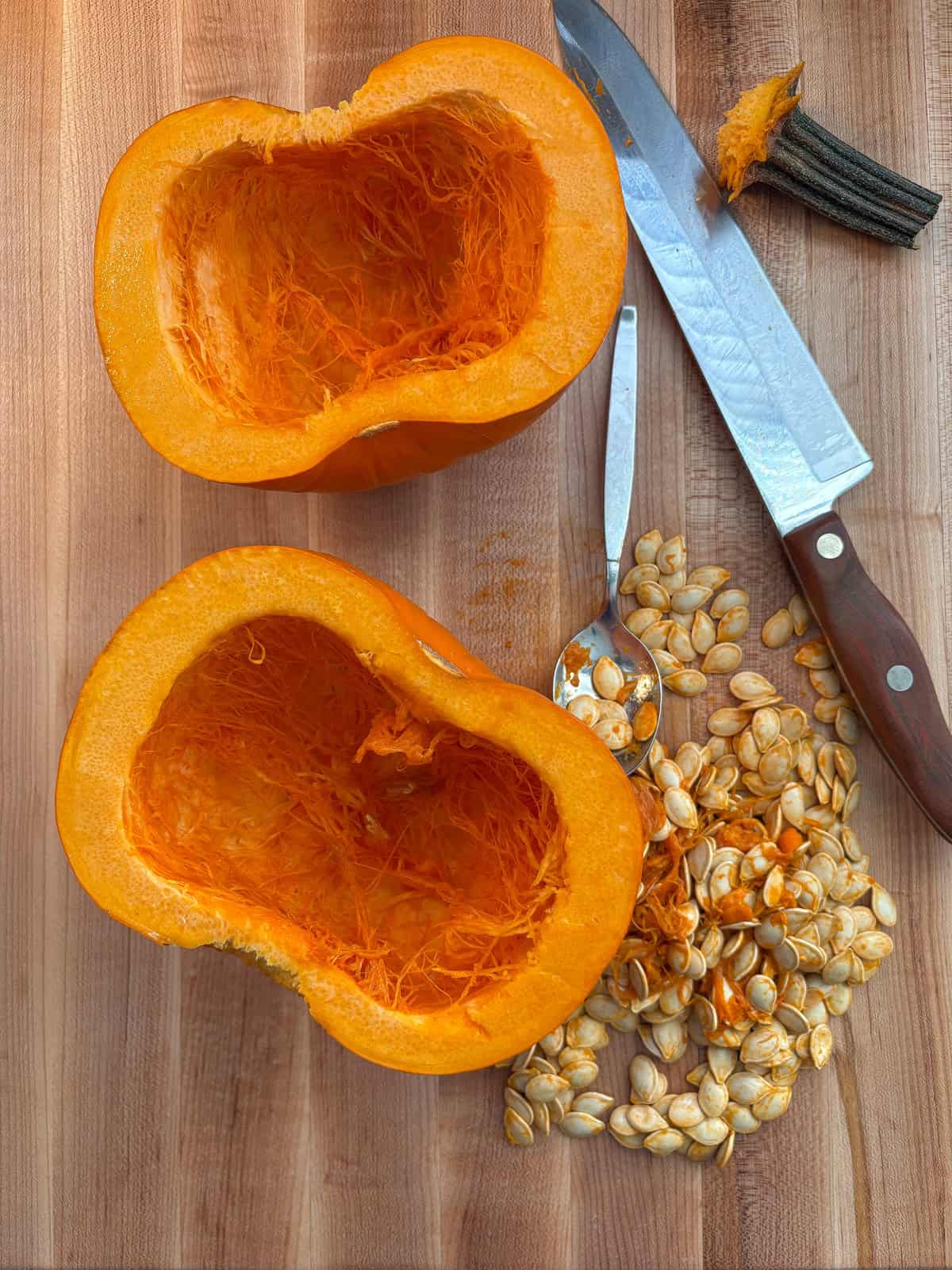
    Raw pumpkin halves, face up on a cutting board, with the seeds removed.
    1. Step 2: Use a spoon to scoop out the seeds. It's not vital to scoop out all the stringy bits. Those will puree up just fine.
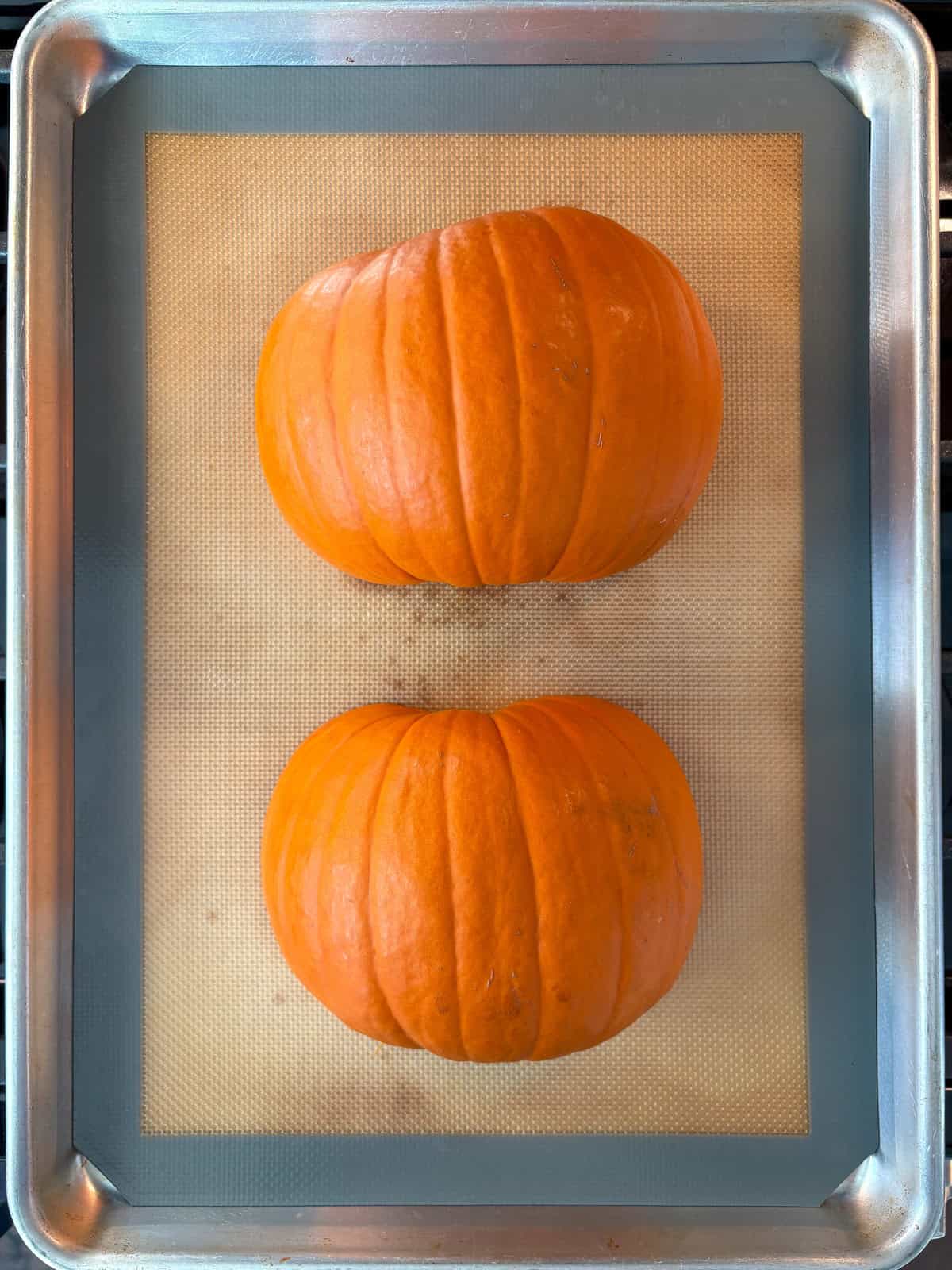
    Raw pumpkin halves, face down on a baking sheet.
    1. Step 3: Lay the pumpkin halves face down on a lined baking sheet.
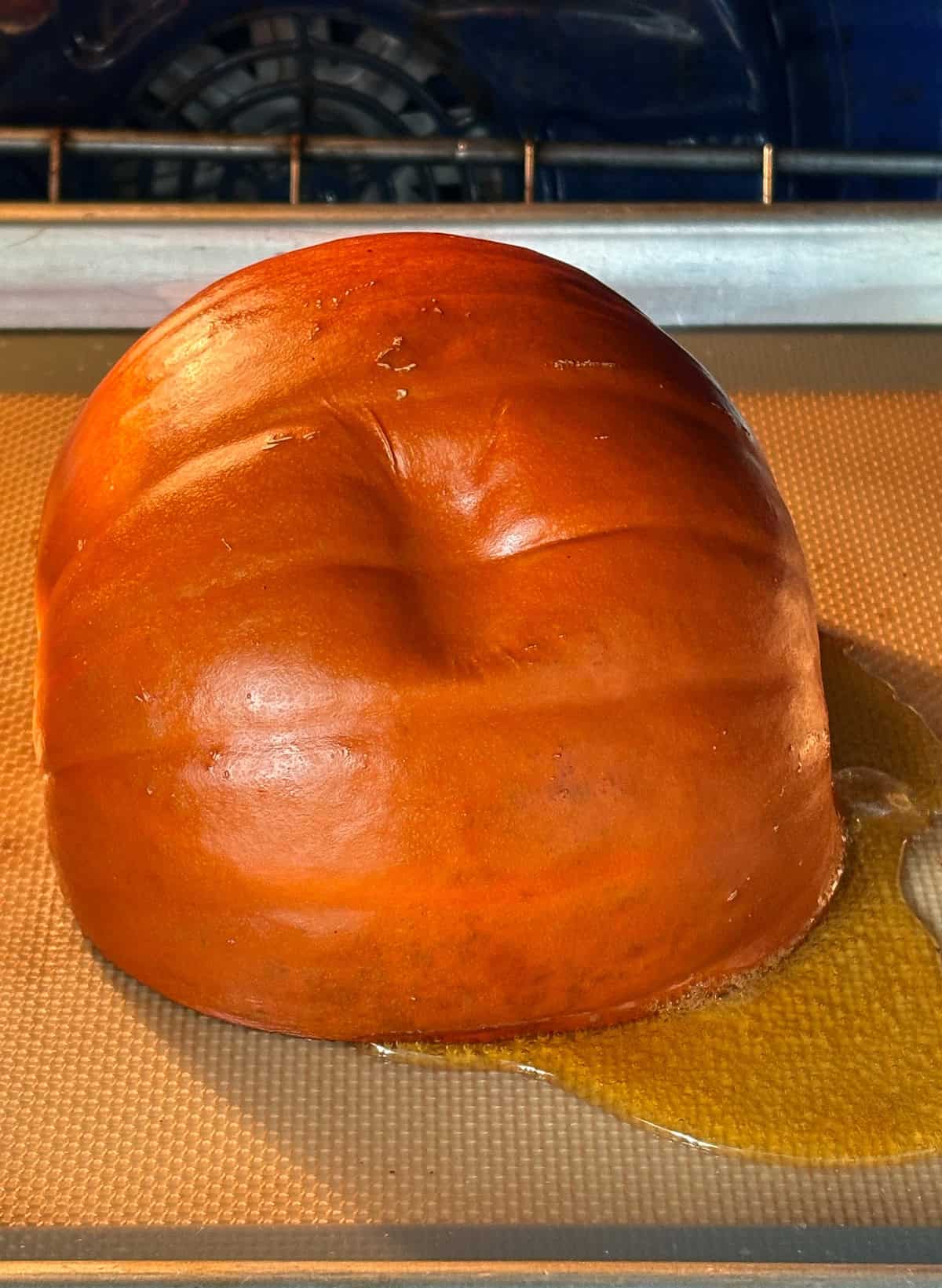
    Face down pumpkin half, in the oven, with an indentation in the side, proving it is soft enough.
    1. Step 4: Bake until the pumpkin is very soft.
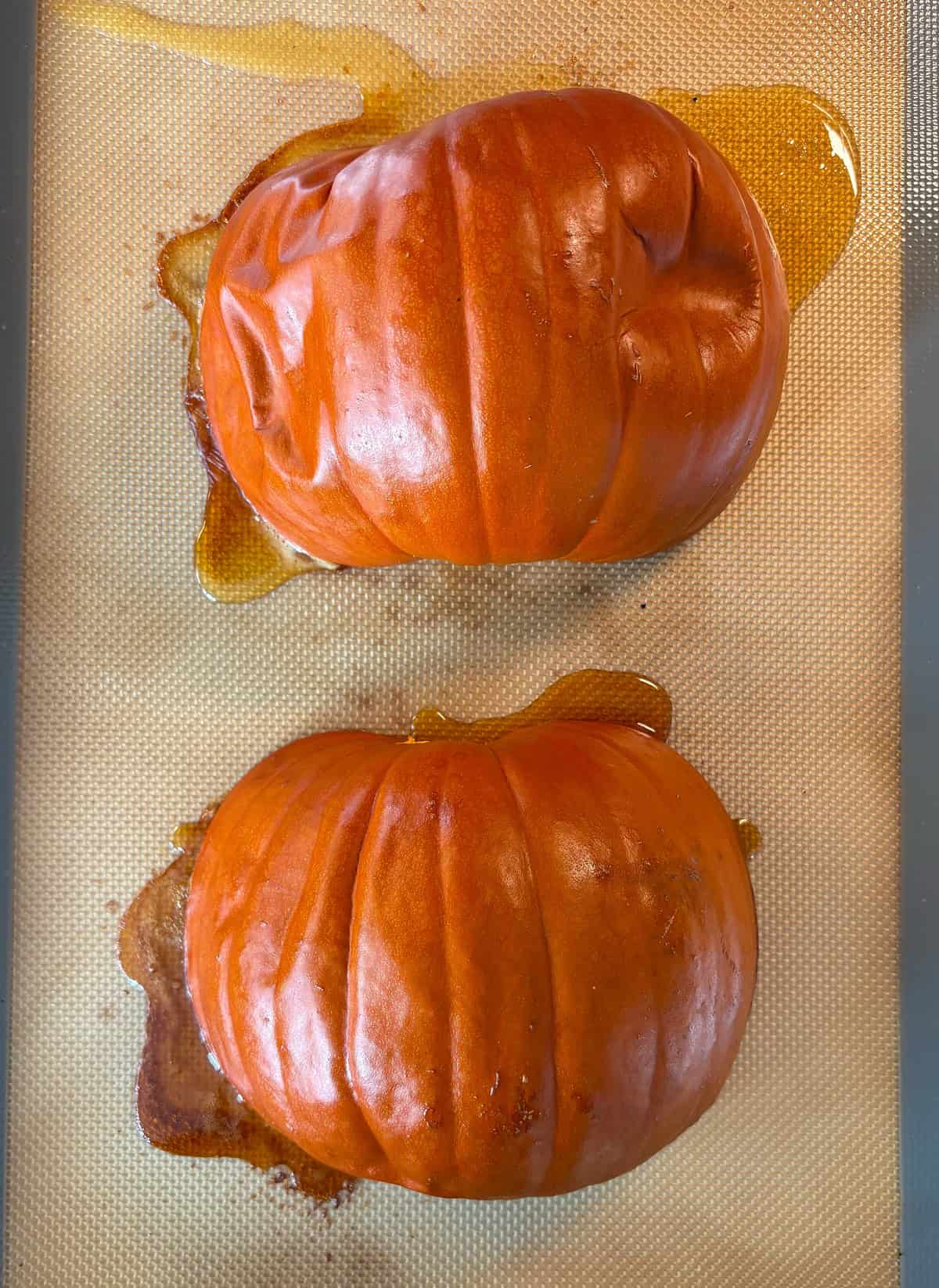
    Baked pumpkin halves, face down on a baking sheet.
    1. Step 5: Remove from the oven and let the pumpkin cool enough to handle.
    Baked flesh of a pumpkin scooped into the bowl of a food processor.
    1. Step 6: Scoop the pumpkin flesh out of the skin, and into a food processor.
    Pureed pumpkin in the bowl of a food processor.
    1. Step 7: Process on high for a few minutes until the mixture is completely smooth.

    Hint: to see if the pumpkin is soft enough, I like to push gently on the side of one of the halves. It should indent easily and not return to its original shape.

    Variations

    Did you know you can use other sweet winter squashes in place of pumpkin to make all your Fall treats? Try these:

    • Butternut squash
    • Acorn squash
    • Kabocha squash
    • Buttercup squash
    • Honeynut Squash

    Equipment

    To make pumpkin puree, you will want a large cutting board and chef knife. These make the task of cutting the large pumpkin much easier and safer!

    Make sure you also have a baking sheet lined with either a silicone baking mat or parchment paper ready, and a food processor.

    Storage

    Pumpkin puree can be stored in the refrigerator for about 5 days.

    Homemade pureed pumpkin can also be frozen for 6-9 months.

    Healthy heart pro tip

    Don't forget to save those seeds for roasting! Pumpkin seeds are incredibly nutritious, and a great snack! Learn how to roast pumpkin seeds with our step by step instructions!

    Pureed pumpkin in a small bowl.

    FAQ

    Can I use any pumpkin for puree?

    Technically, yes. You can use any type of pumpkin to make puree. Giant pumpkins that are grown for jack-o-lanterns have been selectively bred to grow large and fast, and have thin flesh. In the process, these pumpkins give up a lot of their sugar, leaving them tasting bland and watery. So while you can use them to puree, they're really best to use for carving (and seed roasting!).
    The best pumpkins for making puree are called pie pumpkins or sugar pumpkins. Pie pumpkins are smaller, and you can usually find them in your grocery store's produce section near other winter squash like butternut and acorn.

    How to make pumpkin puree less watery

    You may notice your homemade pumpkin puree is more watery than the canned version. While it's completely fine to use it take way, the extra water may alter some results for baked goods. To fix this, line a mesh strainer with paper towels or a coffee filter, and add the pumpkin. Let it strain until it reaches the consistency you prefer.

    Related

    Looking for other healthy DIY recipes? Try these:

    • Close up of roasted pumpkin seeds.
      How to Roast Pumpkin Seeds
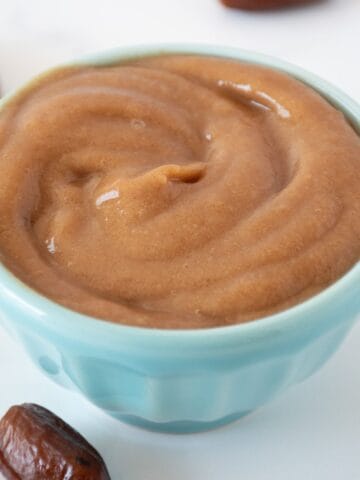
    • Small bowl with date paste in it.
      Date Paste (for natural sweetness)
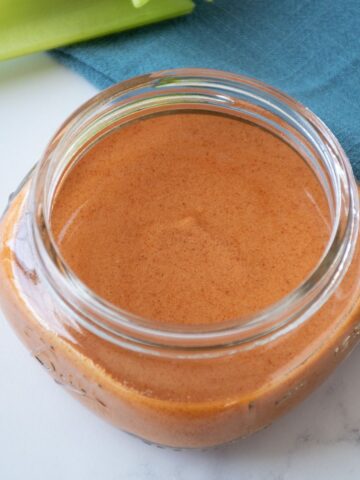
    • Buffalo sauce in a small jar, with celery sticks in the background.
      Low Sodium Buffalo Sauce
    • Small glass pitcher of chocolate sauce.
      Healthy Chocolate Sauce

    Pairing

    These are some of my favorite recipes to use pumpkin puree in:

    • Pumpkin steel cut oats risotto in a heart shaped bowl, garnished with fresh sage leaves and chopped parsley.
      Slow Cooker Pumpkin Risotto with Steel Cut Oats
    • Pumpkin Granola spilling out of a glass jar
      Heart Healthy Pumpkin Granola
    • Overhead shot of pumpkin soup in a blue bowl, garnished with cilantro and pepitas.
      Thai Curry Pumpkin Soup
    • Small jar of pumpkin spice syrup.
      Healthy Pumpkin Spice Syrup
    Want to say thank you?

    📖 Recipe

    Small bowl of pureed pumpkin.

    Pumpkin Puree

    Laura Yautz
    It's incredibly easy to make your own pumpkin puree with a fresh pumpkin!
    No ratings yet
    Prevent your screen from going dark
    Print Recipe Pin Recipe Save Recipe Saved Recipe!
    Prep Time 5 minutes mins
    Cook Time 45 minutes mins
    Total Time 50 minutes mins
    Course vegetable
    Cuisine American
    Calories 45 kcal

    Equipment

    • Food processor

    Ingredients
      

    • 1 Pie or sugar pumpkin

    Instructions
     

    • Preheat oven to 400 degrees F.
    • Carefully, cut the pumpkin in half.
    • Using a spoon, scoop out the seeds and set them aside if you intend to roast them, or discard.
    • Place the pumpkin halves face down on a baking sheet.
    • Bake for about 45 minutes, or until the pumpkin is very soft, and you can push the skin in without much pressure.
    • Allow the pumpkin to cool.
    • Scoop the flesh out of the skin, and into a food processor.
    • Puree for a few minutes until the pumpkin is very smooth.
    • Keep in the refrigerator for up to a week, or freeze for up to 6 months.

    Nutrition

    Serving: 0.5cupCalories: 45kcal (2%)Carbohydrates: 10g (3%)Protein: 1g (2%)Fat: 0.5g (1%)Saturated Fat: 0.02gPolyunsaturated Fat: 0.02gMonounsaturated Fat: 0.05gSodium: 5mgPotassium: 330mg (9%)Fiber: 3g (13%)Sugar: 5g (6%)Vitamin A: 3164IU (63%)Vitamin C: 5mg (6%)Vitamin K: 20µg (19%)Calcium: 20mg (2%)Iron: 1mg (6%)Magnesium: 28mg (7%)

    *Nutrition information is an estimate, and will change based on the brand and individual ingredients and amounts you use. This is provided for your convenience only.

    Keyword how to cook a pumpkin, squash puree
    Tried this recipe?Let us know how it was!

    Food safety

    These are important safety tips for homemade pumpkin puree:

    • Wash hands before beginning, whenever they are soiled, and after touching face, hair, pets, etc.
    • Never leave cooking food unattended
    • Keep your face back when opening the oven to avoid hot air burns
    • Always remove items from the oven with appropriate pot holders or mitts to avoid burns

    See more guidelines at USDA.gov.

    Pumpkin puree in a small bowl. Text overlay: how to make pumpkin puree.

    Applesauce Carrot Muffins

    October 19, 2020 by Laura Yautz Leave a Comment

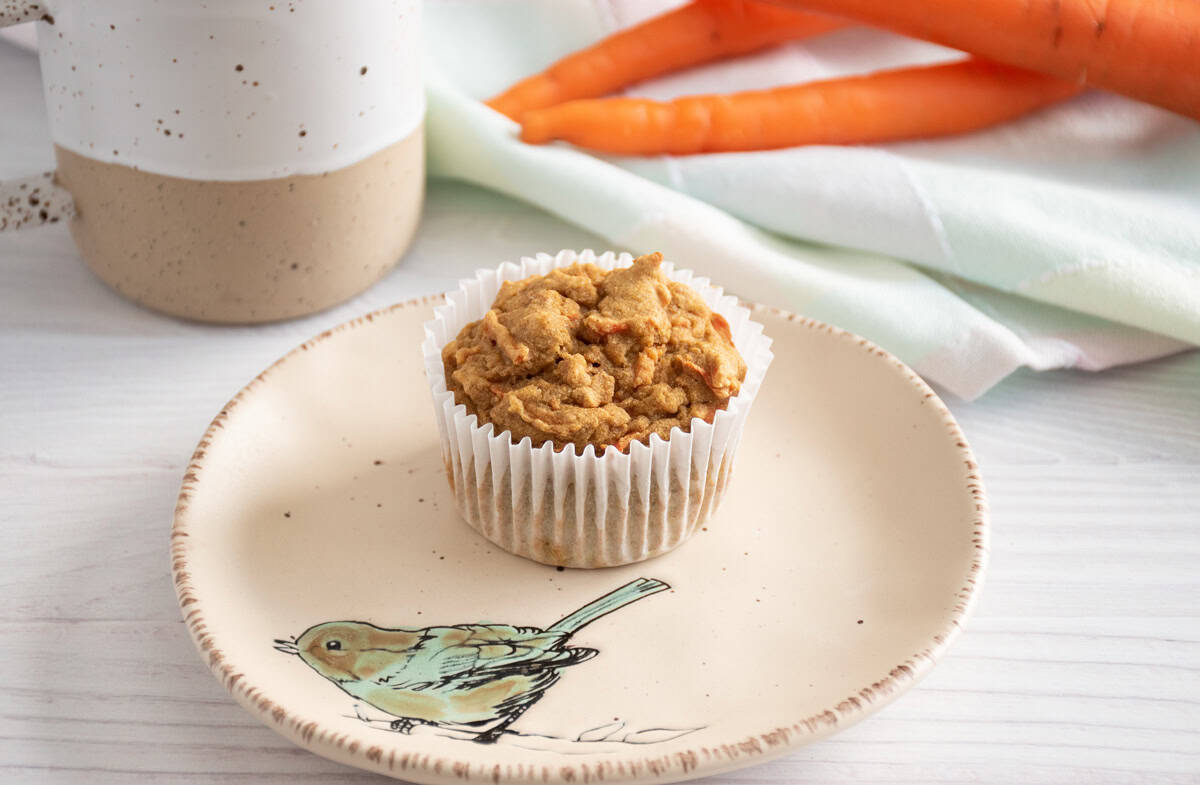
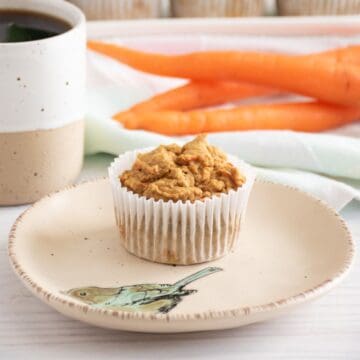
    A muffin on a plate, with a cup of coffee nearby.

    Muffins have kind of achieved an undeserved health halo. Honestly, most of them are just cupcakes without frosting! But these Applesauce Carrot Muffins are actually healthy! Boasting whole grains, no added sugar (date sweetened!), and vegetables! But no one will ever know, because they're just as delicious, lightly sweet, and super moist as any other muffin!

    (Grab my free list of heart health baking substitutions at the end of this post!)

    This post may contain affiliate links. See our Disclaimer for more information

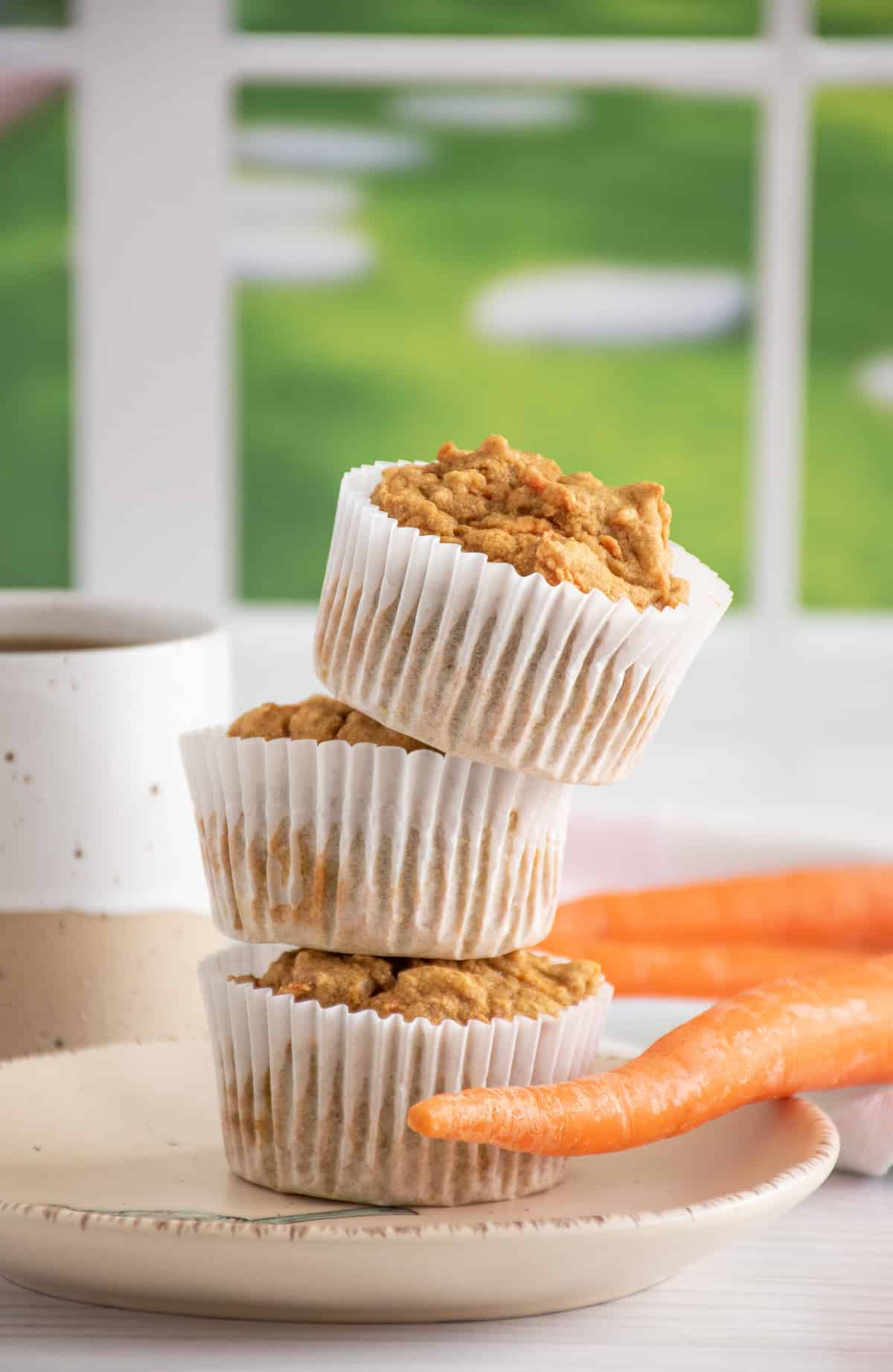
    Stack of 3 muffins on a plate.

    Carrots are pretty versatile. They are a delicious Fall vegetable, so they're found in many recipes inspired by the season. They're also slightly sweet, so they are also great in a lot of desserts (hello, carrot cake!). But of course not all of those recipes are healthy. Our muffins are, though!

    For other healthier carrot recipes, try Carrot Oatmeal with Pineapple, Roasted Maple Curry Carrots, or Carrot Waffles!

    [feast_advanced_jump_to]

    Heart Health Benefits of Applesauce Carrot Muffins

    We designed these muffins to be delicious and cardioprotective at the same time! Our recipe leaves out the butter, eggs, refined sugar, and dairy, and instead layers together ingredients with well documented cardiovascular benefits. These muffins may help lower LDL cholesterol and blood pressure, inhibit inflammation, and reduce oxidative stress.

    Macronutrients

    Applesauce carrot muffins are around 150 calories a piece, low in carbohydrates and protein, and moderate in total fat. Most of the fat amount is polyunsaturated fat (more on that below), from walnuts and flax. The recipe is also high in fiber, helping to keep you satisfied longer, and reduce cholesterol.

    Micronutrients and Bioactive Components

    Bioactive compounds are substances that have effects within the body that promote good health. Here are some of the most abundant bioactive compounds in applesauce carrot muffins:

    • Ferulic acid - (in whole wheat flour) a phenolic acid with strong antioxidant activity, it's one of the most well studied and most abundant phenolic acid in whole grains (1);
    • Insoluble fiber - (in whole wheat flour and dates) type of fiber that does not dissolve in water, and helps add bulk to the stool, reducing constipation risk (2, 3);
    • β- and α-carotene - (in carrots) these carotenoids can help improve cardiovascular risk factors and increase circulating antioxidants (4, 5);
    • Flavonoids, proanthocyanidins, and chlorogenic acid - (in applesauce) polyphenols with antioxidant effects that may improve endothelial function (6);
    • Soluble fiber - (in applesauce and flax) a type of fiber that dissolves in water and can help lower cholesterol and blood sugar (2);
    • Potassium - (in dates and carrots) a mineral that helps to lower blood pressure by helping the body eliminate sodium;
    • Magnesium - (in whole wheat, dates and walnuts) a mineral with important roles in blood sugar control, muscle and nerve function, blood pressure regulation, and heart rhythm regulation;
    • Genistein and daidzein - (in soy milk) soy isoflavones that can help lower LDL cholesterol and improve heart health markers (7, 8)
    • Cinnamaldehyde - (in cinnamon) flavonoid that gives cinnamon its color and flavor. Cinnamon can help lower blood pressure and LDL cholesterol, and raise HDL cholesterol (9);
    • Curcumin - (in turmeric) a polyphenol with powerful antioxidant and anti inflammatory effects. It has been studied for its ability to reduce cholesterol, improve endothelial function, and prevent some types of arrhythmias (10);
    • Gingerols and shogaols - (in ginger) bioactive ginger phenolics that may have antioxidant, antiplatelet and modest lipid and blood pressure lowering effects (11, 12);
    • Secoisolariciresinol diglucoside - (in flax seeds) an antioxidant lignan that may reduce the development of atherosclerosis due to high cholesterol, and may reduce blood pressure (13); and
    • Alpha-linolenic acid (ALA) - (in flax seeds and walnuts) an omega-3 fatty acid found primarily in plants that seems to reduce the risk of cardiovascular disease (14).

    Ingredients

    Here is what you'll need for this recipe, along with some applicable substitutions and notes.

    Ingredients for applesauce carrot muffins.
    • Whole wheat pastry flour - regular whole wheat flour will make the muffins less delicate. Whole wheat pastry flour is the way to go for healthier baked goods.
    • Shredded carrots - shred them as finely as your shredder allows
    • Applesauce - get unsweetened
    • Date paste - it freezes well, so keep leftovers on hand for other recipes!
    • Walnuts - or any type of nut you like
    • Soy milk - unsweetened, or whatever nondairy beverage you prefer
    • Ground flaxseed - or ground chia seeds
    • Baking powder
    • Cinnamon
    • Turmeric
    • Ground ginger
    • Salt - just a little, but you can omit it if you prefer

    See recipe card for quantities.

    Instructions

    This goes similar to any other muffin recipe, once you have the carrots shredded.

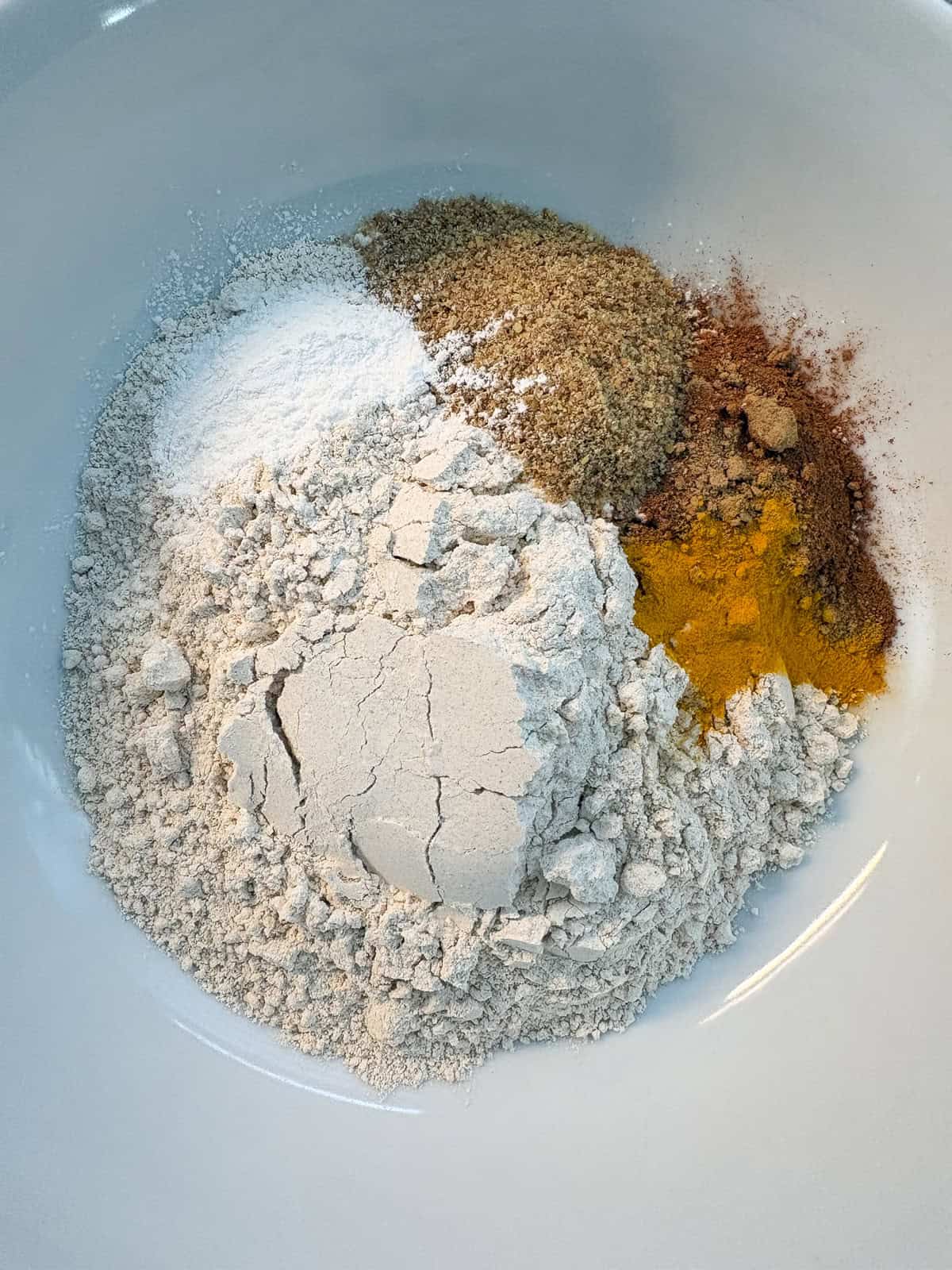
    Dry muffin ingredients in a bowl.
    1. Step 1: Combine the dry ingredients in a bowl.
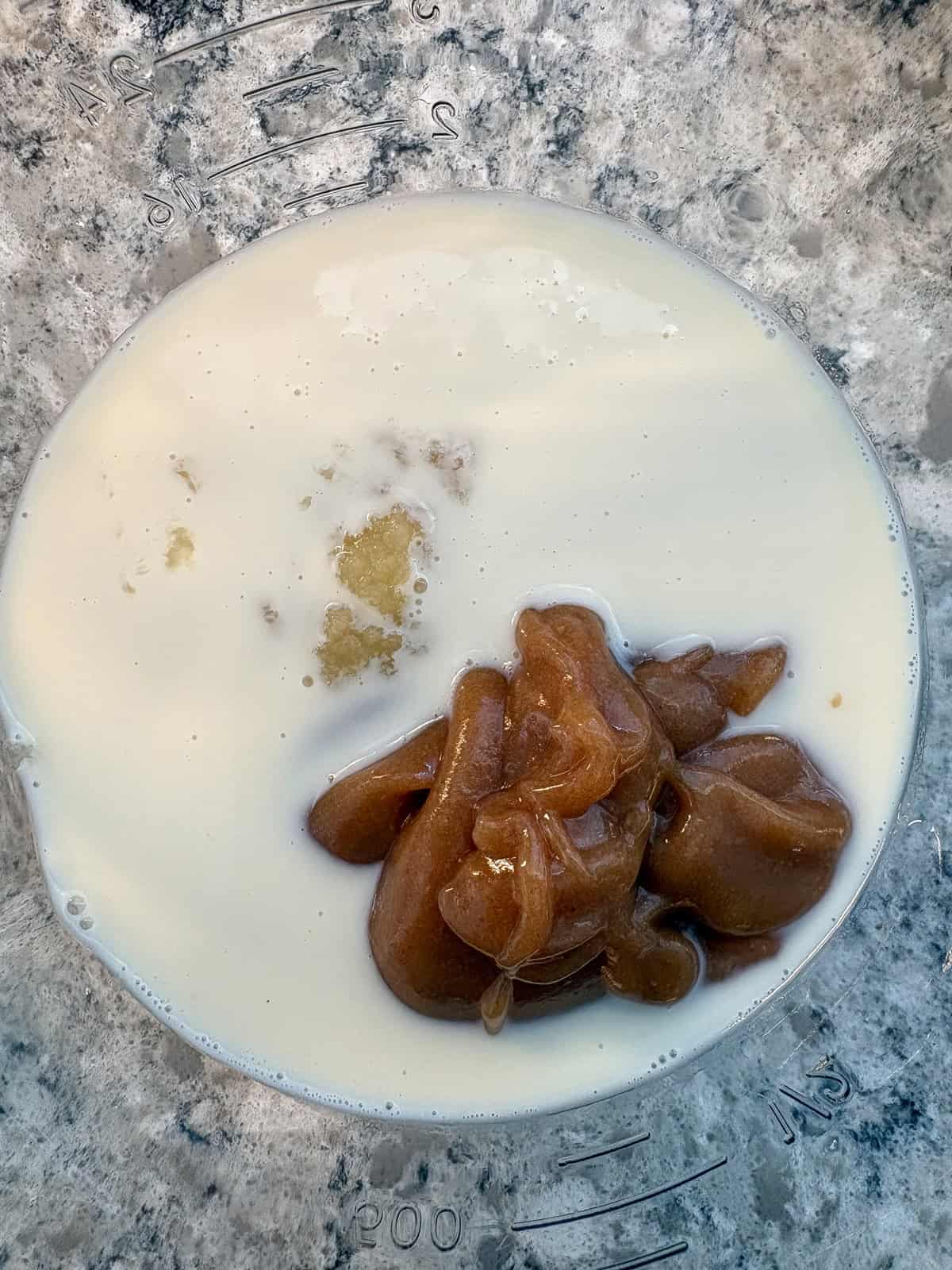
    Wet ingredients in a mixing bowl.
    1. Step 2: Combine the wet ingredients in a separate bowl.
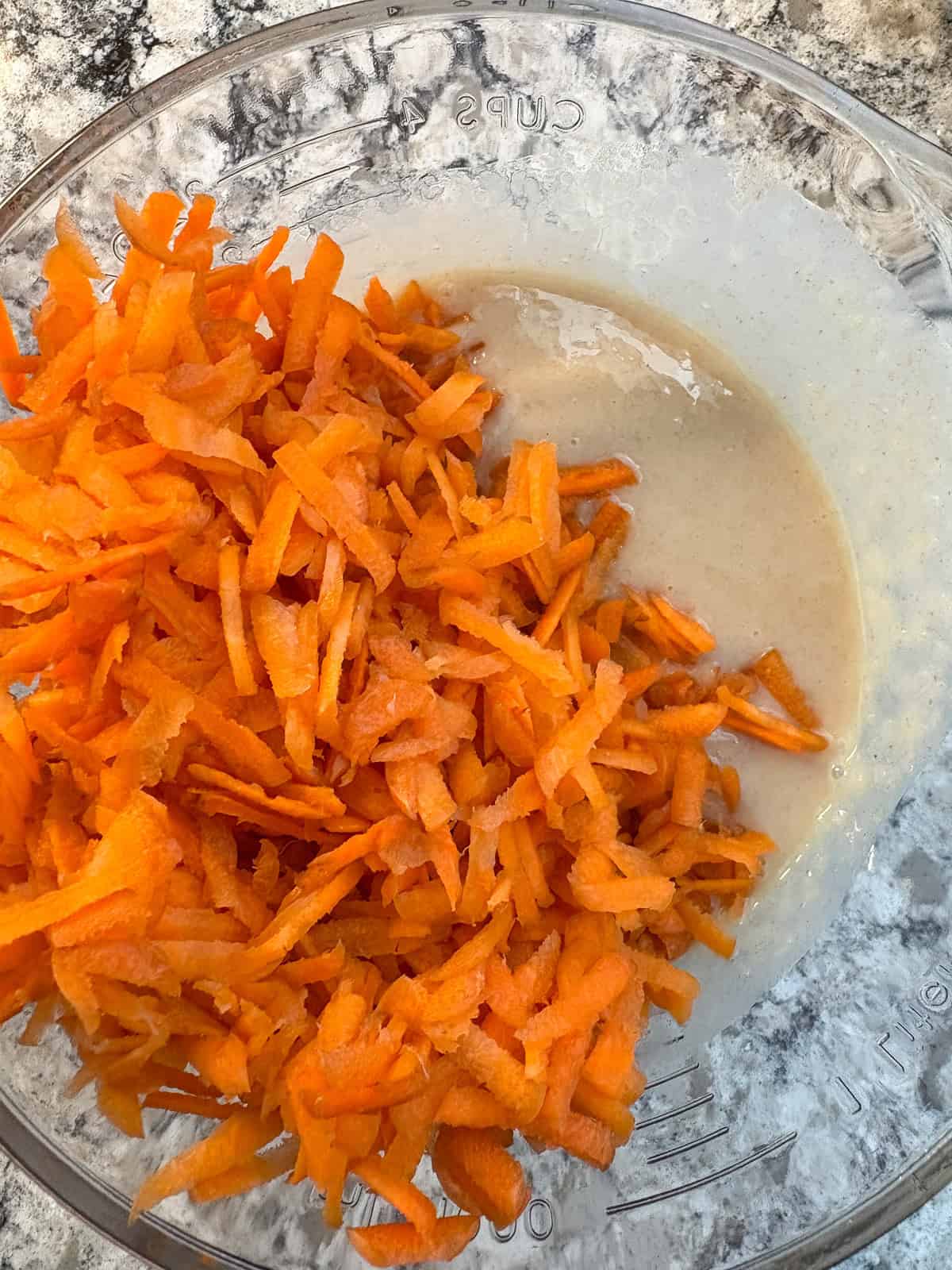
    Shredded carrots added to wet ingredient mixture.
    1. Step 3: Add the carrots to the wet ingredients.
    Mixed shredded carrots into wet ingredients.
    1. Step 4: Mix the carrots well.
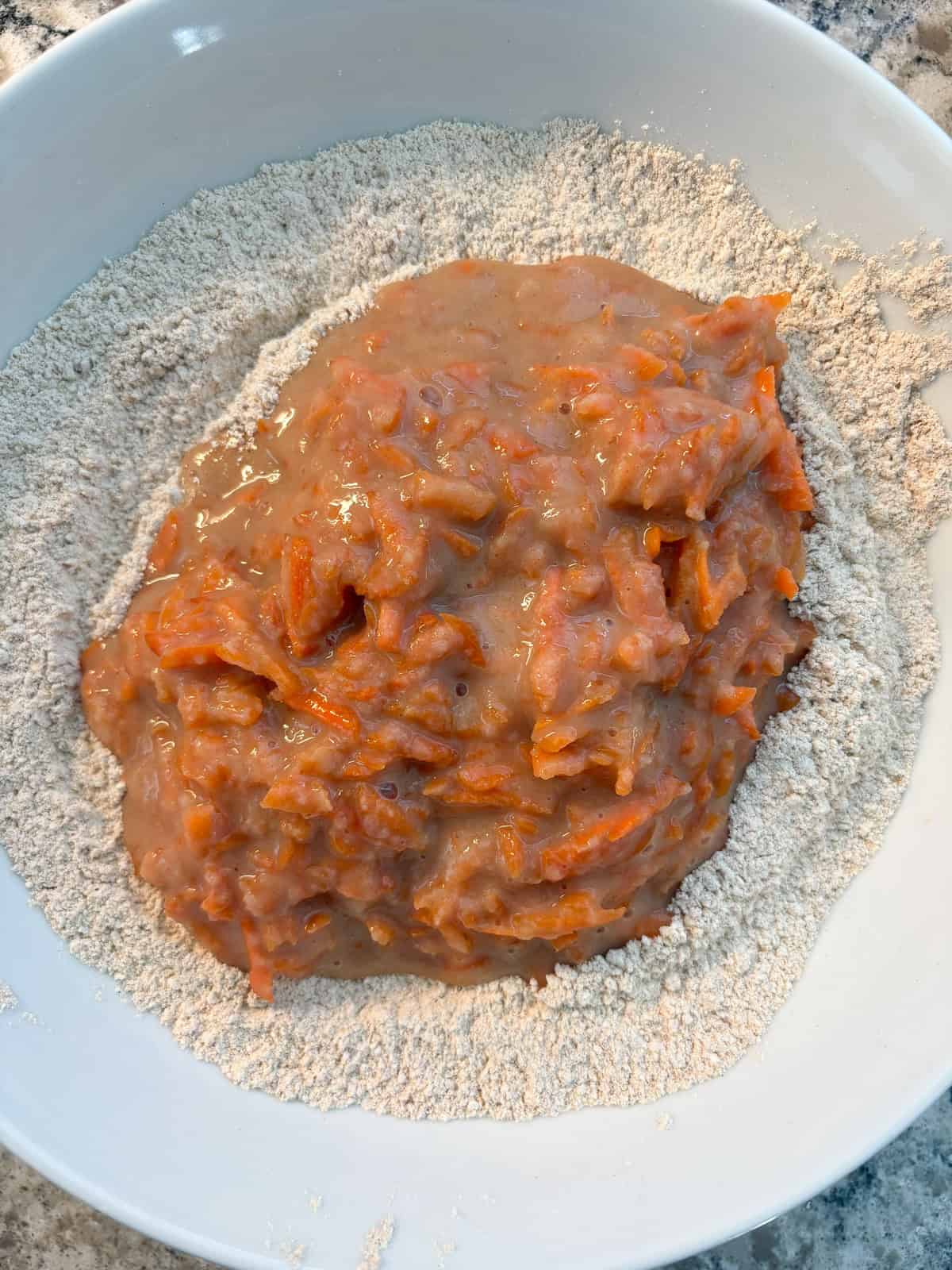
    Wet ingredient mixture poured into dry ingredient mixture.
    1. Step 5: Pour the wet ingredients into the dry, and stir until just combined.
    Nuts added to the batter.
    1. Step 6: Gently fold the nuts into the batter.
    Muffin batter divided among 12 muffin cups.
    1. Step 7: Divide the batter among 12 prepared muffin cups.
    Baked muffins, still in the pan.
    1. Step 8: Bake until a toothpick inserted into the center of one of the muffins comes out clean.

    Hint: make sure to shred the carrots as finely as you can. If they are too thick, they won't cook through, and can be crunchy in your muffins.

    Variations

    Try these slight variations on this muffin recipe!

    • Fruit - try adding ½ cup dried fruit, like raisins or cranberries, to the batter. Chopped dried pineapple would be fantastic, too!
    • Fruit juice - Apple cider or apricot nectar would both work great in place of the milk. Carrot juice would be delicious in this recipe, too! Consider reducing the amount of date paste if you use fruit juice, as your muffins will be sweeter.
    A muffin on a plate.

    Equipment

    You will need a vegetable shredder or grater for the carrots. The shredded carrots you get at the store are too large for this recipe.

    Other than that, you want basic tools, like mixing bowls and spoons, and measuring cups/spoons. Don't forget a muffin pan!

    Storage

    Cool the muffins in the pan for 5-10 minutes, and then remove them to a cooling rack. Cool them completely before storing in an airtight container for up to 5 days.

    The muffins can be frozen for up to 6 months. Thaw in the refrigerator overnight before eating.

    Healthy heart pro tip

    We know that higher circulating beta-carotene is associated with lower cardiovascular disease, stroke, cancer, and overall mortality (15). However, studies also show that supplementation with beta-carotene may increase the risk for cardiovascular disease (16). The takeaway is to focus on food sources of beta-carotene for cardiovascular health, and always discuss supplements with your health care provider.

    FAQ

    What can I use instead of applesauce?

    You can use another fruit or vegetable puree, like pumpkin, banana, or sweet potato. If you use something less sweet, like pumpkin, you may need more sweetener.

    My muffins came out dry and tough. How can I fix that?

    The muffins will come out dry if they are overbaked. Make sure to bake them only until a toothpick inserted into the center of one comes out clean. Substituting whole wheat flour for the whole wheat pastry flour can cause a drier product as well.

    The muffins stick to the wrapper. What can I do about that?

    The muffins may stick to the inside of the wrapper because they don't have any butter or oil in them. You can remedy this by giving each wrapper a few spritzes of nonstick cooking spray before adding the batter.

    Related

    Looking for other recipes like this? Try these:

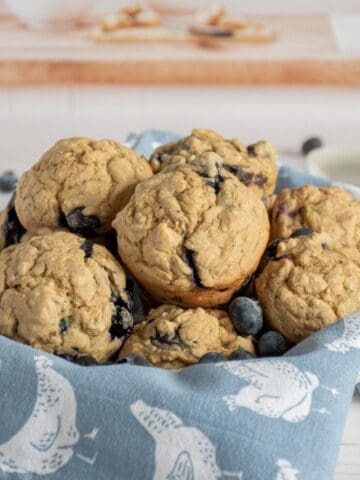
    • Muffins in a serving bowl.
      Blueberry Zucchini Muffins with Lavender
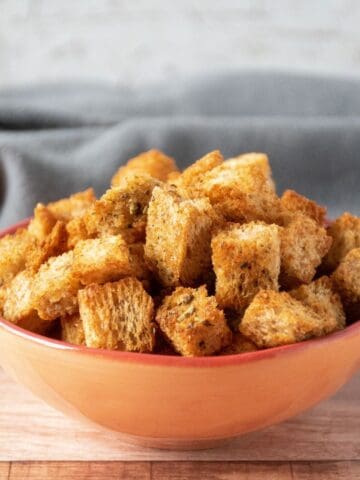
    • Croutons in a small bowl.
      Italian Seasoned Whole Wheat Croutons
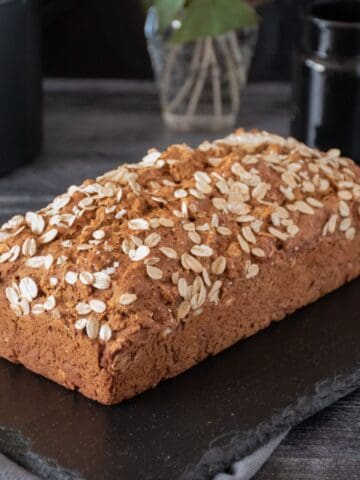
    • Whole, unsliced loaf of bread, sprinkled with oats.
      Irish Wheaten Bread
    • Single muffin on a dish. A stack of muffins is visible in the background.
      Cinnamon Raisin Muffins

    Pairing

    These are my favorite dishes to serve with Applesauce Carrot Muffins:

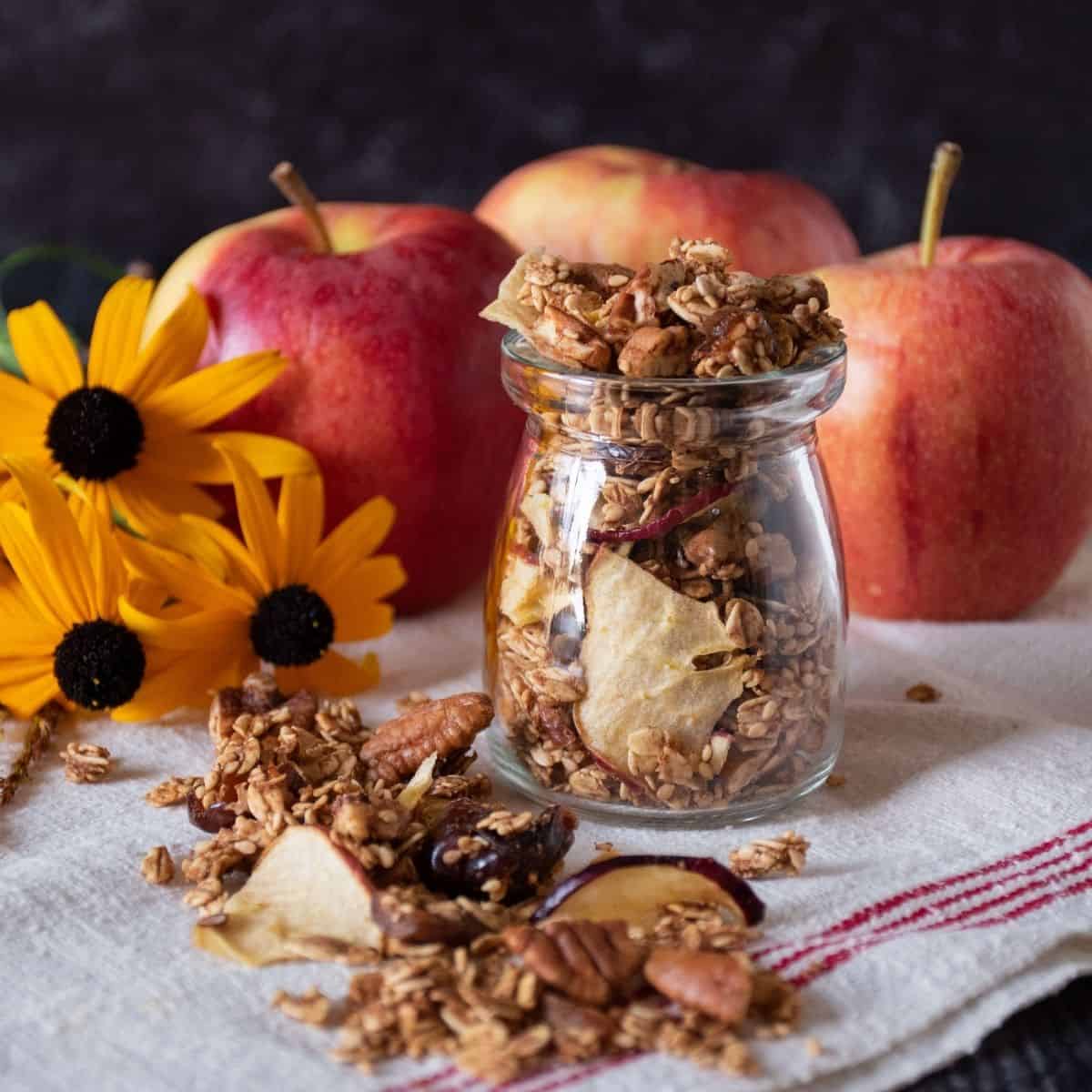
    • Small jar with granola in it.
      Apple Cinnamon Granola
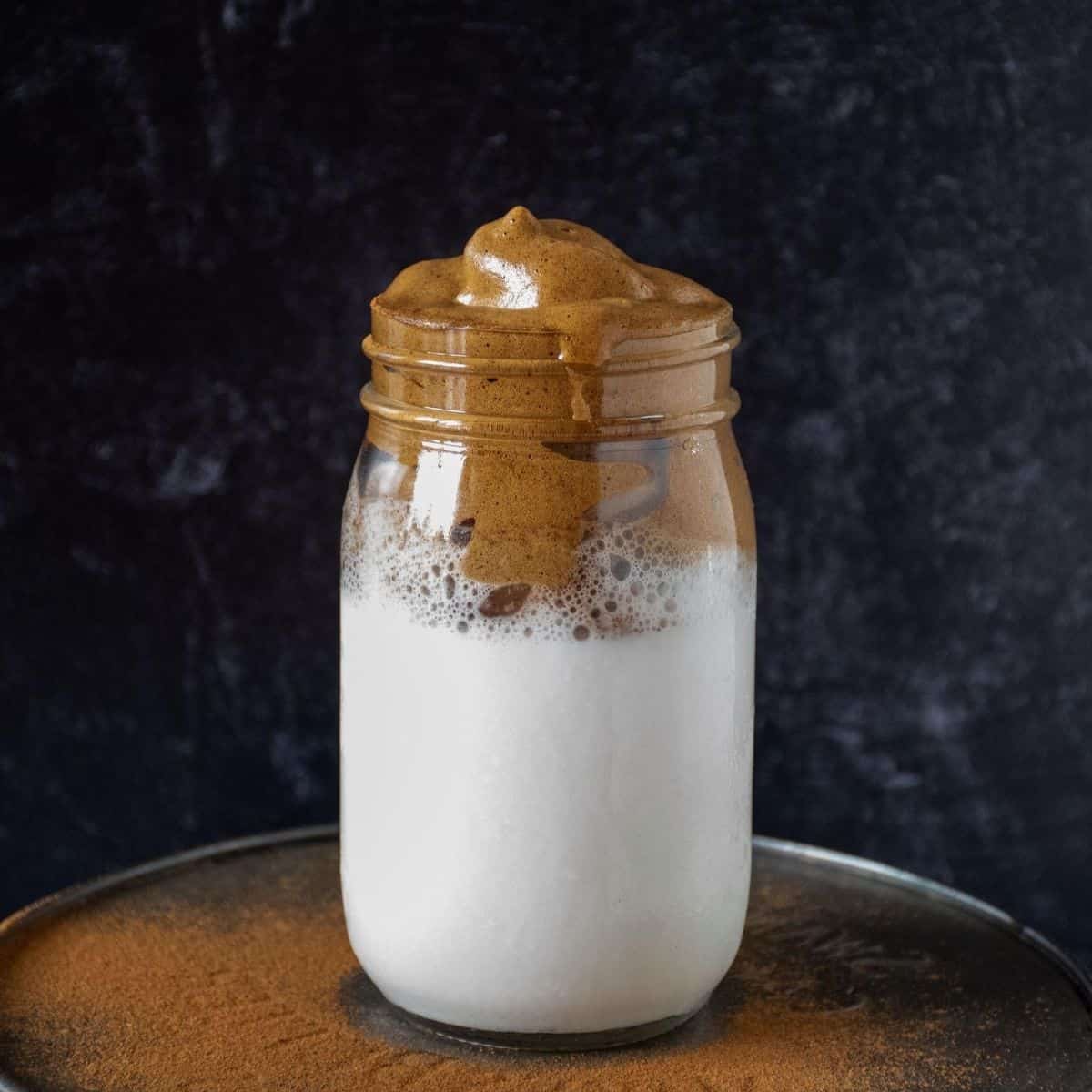
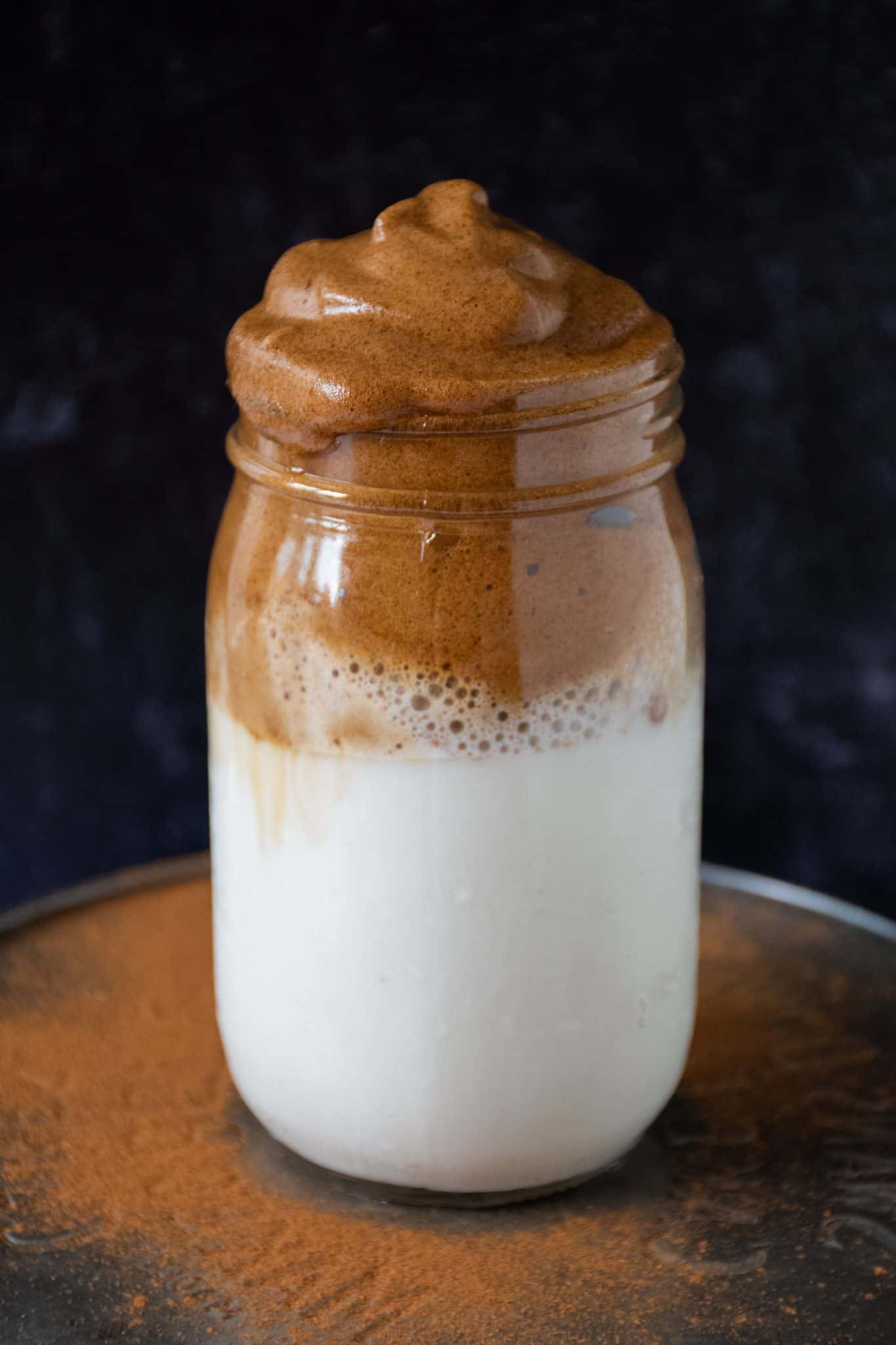
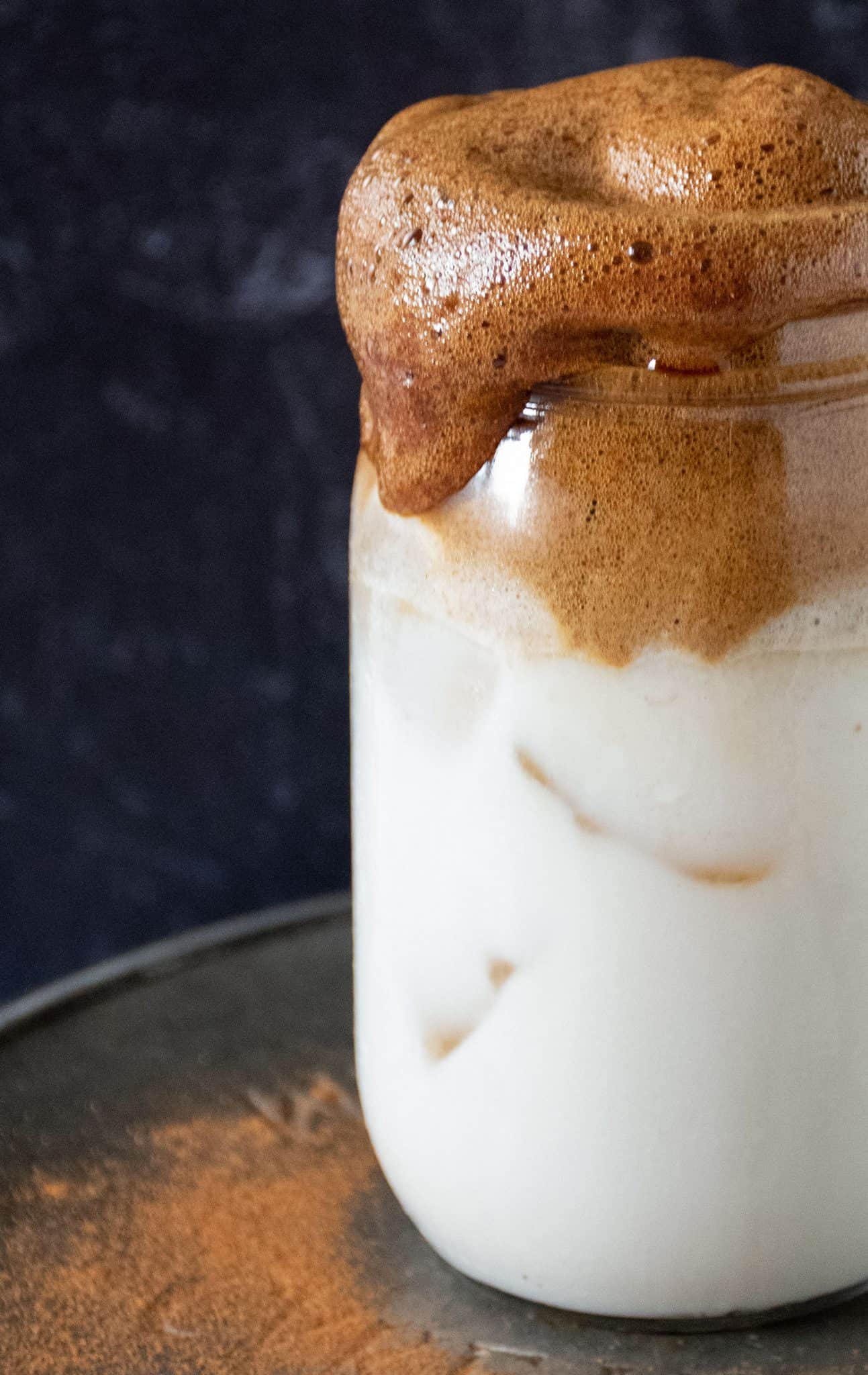
    • Frothy, whipped coffee, over iced almond milk, in a Mason jar in front of a dark background.
      Heart Healthy Whipped Coffee
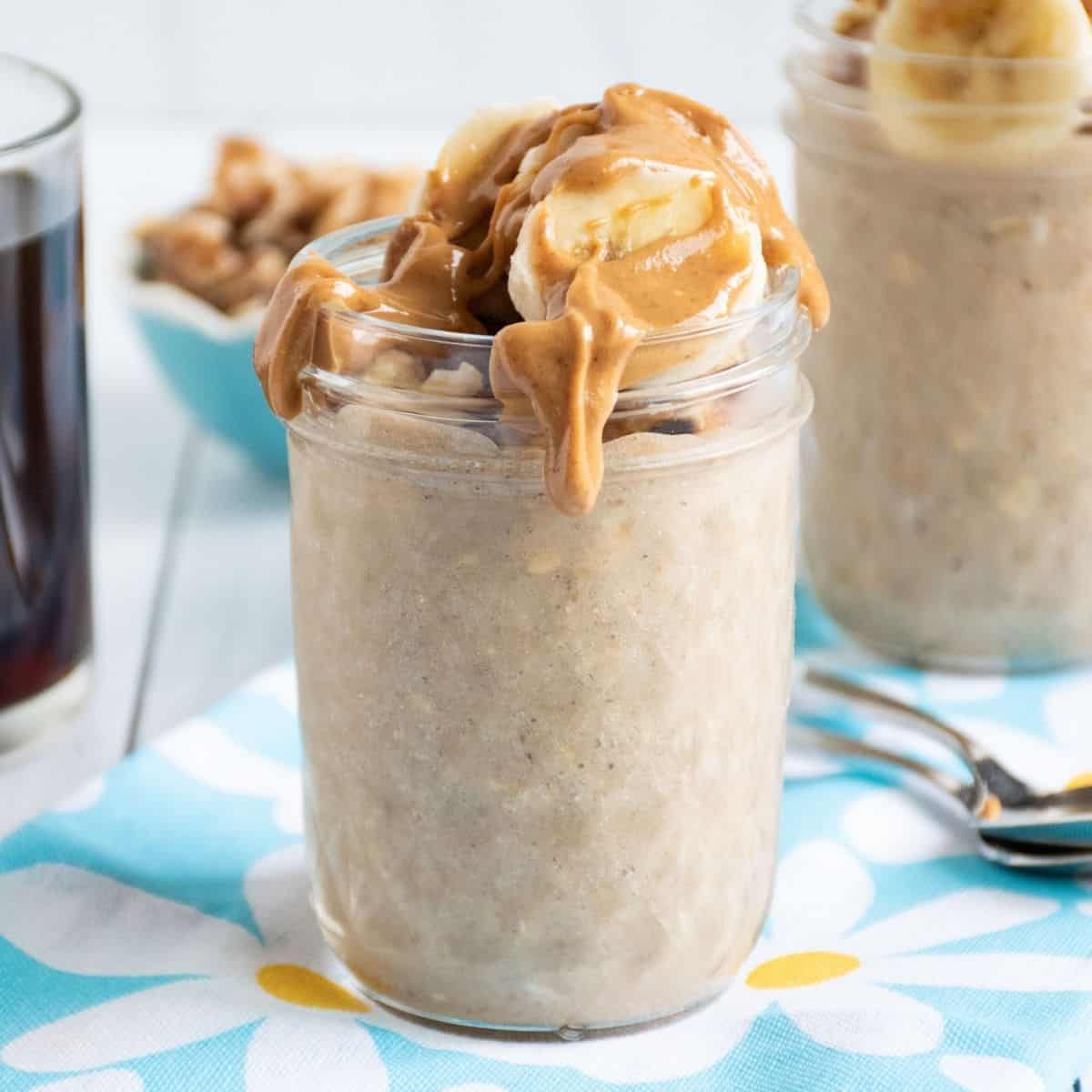
    • Small mason jar of oatmeal with walnuts and banana slices on top, with a drizzle of peanut butter
      Banana Bread Overnight Oats
    • Orange drink in a glass with a straw, garnished with an orange slice.
      Blended Immunity Drink

    Heart Healthy Baking Substitutes

    Baking can be tricky to make healthy! If you're looking for more tips, grab my list of Heart Healthy Baking Substitutes:

    Get the Baking Substitutions List!
    Want to say thank you?
    Add us as a trusted site on Google

    📖 Recipe

    A muffin on a plate, with a cup of coffee nearby.

    Applesauce Carrot Muffins

    Laura Yautz
    These are easy, delicious, and whole grain muffins! Kids and adults will love these super moist treats sweetened with dates!
    No ratings yet
    Prevent your screen from going dark
    Print Recipe Pin Recipe Save Recipe Saved Recipe!
    Prep Time 15 minutes mins
    Cook Time 20 minutes mins
    Total Time 35 minutes mins
    Course Bread, Breakfast, Brunch, Snack
    Cuisine American
    Servings 12
    Calories 149 kcal

    Equipment

    • Measuring Cups and Spoons
    • 2 Mixing bowl
    • Vegetable Grater
    • Muffin Pan

    Ingredients
      

    Dry Ingredients

    • 1 ½ cup Whole Wheat Pastry Flour
    • 1 tablespoon Ground Flax
    • 2 teaspoon Cinnamon
    • 1 ½ teaspoon Baking Powder
    • ½ teaspoon Turmeric
    • ½ teaspoon Ground Ginger
    • ¼ teaspoon Salt

    Wet ingredients

    • 2 cups grated Carrots
    • ¾ cup Unsweetened Soy Milk or your choice
    • ½ cup Unsweetened Applesauce
    • ½ cup Date Paste
    • ½ cup Walnuts chopped

    Instructions
     

    • Preheat oven to 375 degrees F.
    • Prepare muffin tin by either greasing the cups or using paper liners.
    • In a large bowl, mix all the dry ingredients together well.
    • In another bowl, combine the wet ingredients, except nuts, and mix well.
    • Pour the wet ingredients into the dry ingredients, and stir until just combined. Do not over mix.
    • Fold the nuts into the batter
    • Divide the batter among the 12 muffin cups, filling each cup about ⅔ - ¾ full.
    • Bake for 20-25 minutes, until a toothpick inserted in the center of a muffin comes out clean.
    • Cool in the pan for 5-10 minutes, before removing the muffins from the pan and allowing them to cool completely on a cooling rack.
    • Store in an airtight container for a few days at room temperature, or up to a week in the refrigerator.

    Nutrition

    Serving: 1muffinCalories: 149kcal (7%)Carbohydrates: 27g (9%)Protein: 3.6g (7%)Fat: 4.5g (7%)Saturated Fat: 0.4g (3%)Polyunsaturated Fat: 2.9gMonounsaturated Fat: 0.6gSodium: 133mg (6%)Potassium: 274mg (8%)Fiber: 4.7g (20%)Sugar: 11g (12%)Vitamin A: 540IU (11%)Vitamin C: 1.3mg (2%)Vitamin K: 3µg (3%)Calcium: 72mg (7%)Iron: 1.4mg (8%)Magnesium: 23.7mg (6%)

    *Nutrition information is an estimate, and will change based on the brand and individual ingredients and amounts you use. This is provided for your convenience only.

    Keyword carrot muffins, healthy muffins
    Tried this recipe?Let us know how it was!

    Food safety

    These are important safety tips for applesauce carrot muffins:

    • Wash hands before beginning, whenever they are soiled, and after touching face, hair, pets, etc.
    • Cook foods completely through
    • Do not taste the raw batter. Even without raw eggs in it, raw flour is not a ready-to-eat product and can harbor illness-causing bacteria.
    • Never leave cooking food unattended

    See more guidelines at USDA.gov.

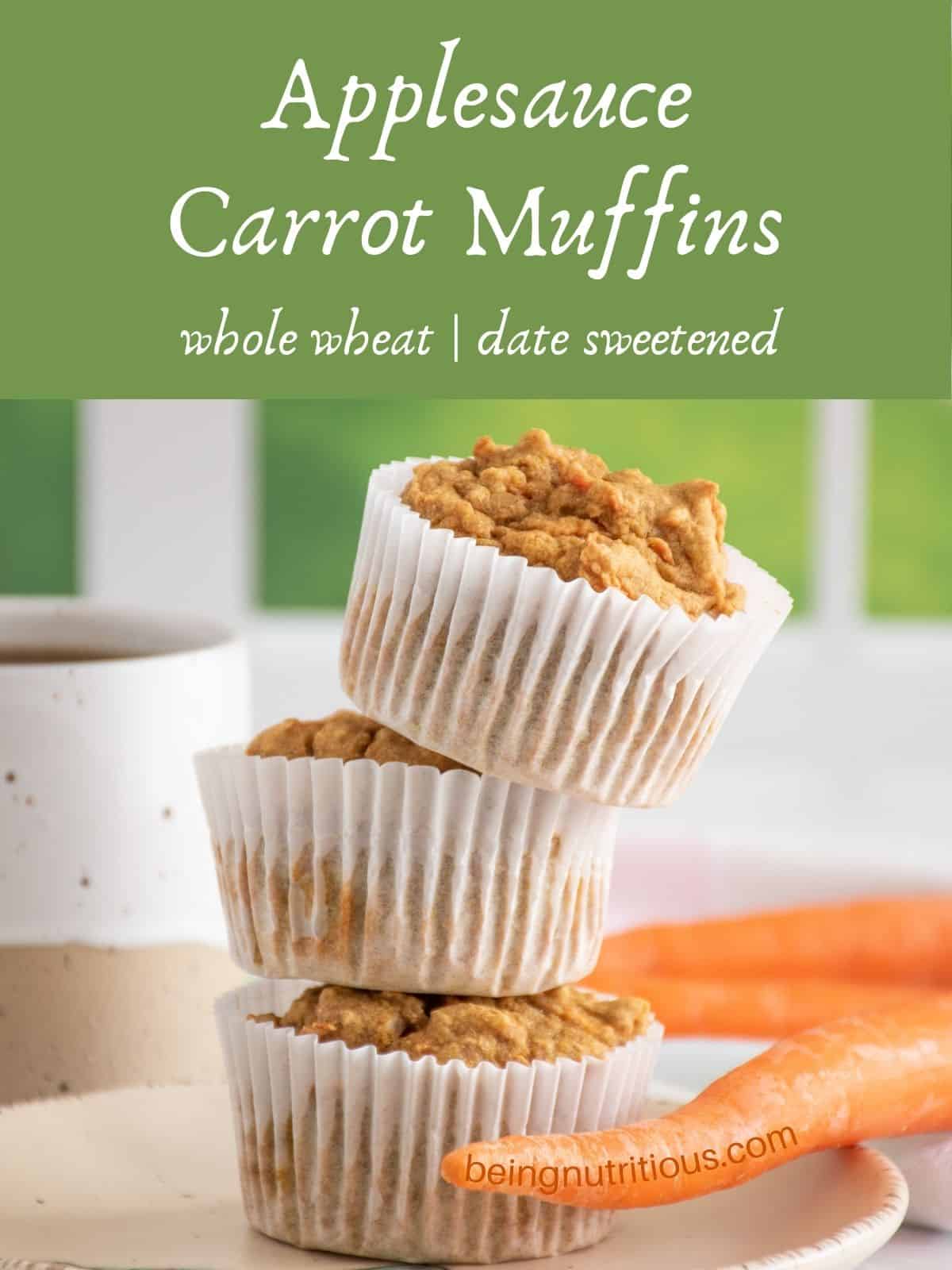
    Stack of 3 muffins on a plate. Text overlay: Applesauce Carrot Muffins; whole wheat; date sweetened.

    How to Read Food Labels for Heart Health

    October 16, 2020 by Laura Yautz Leave a Comment

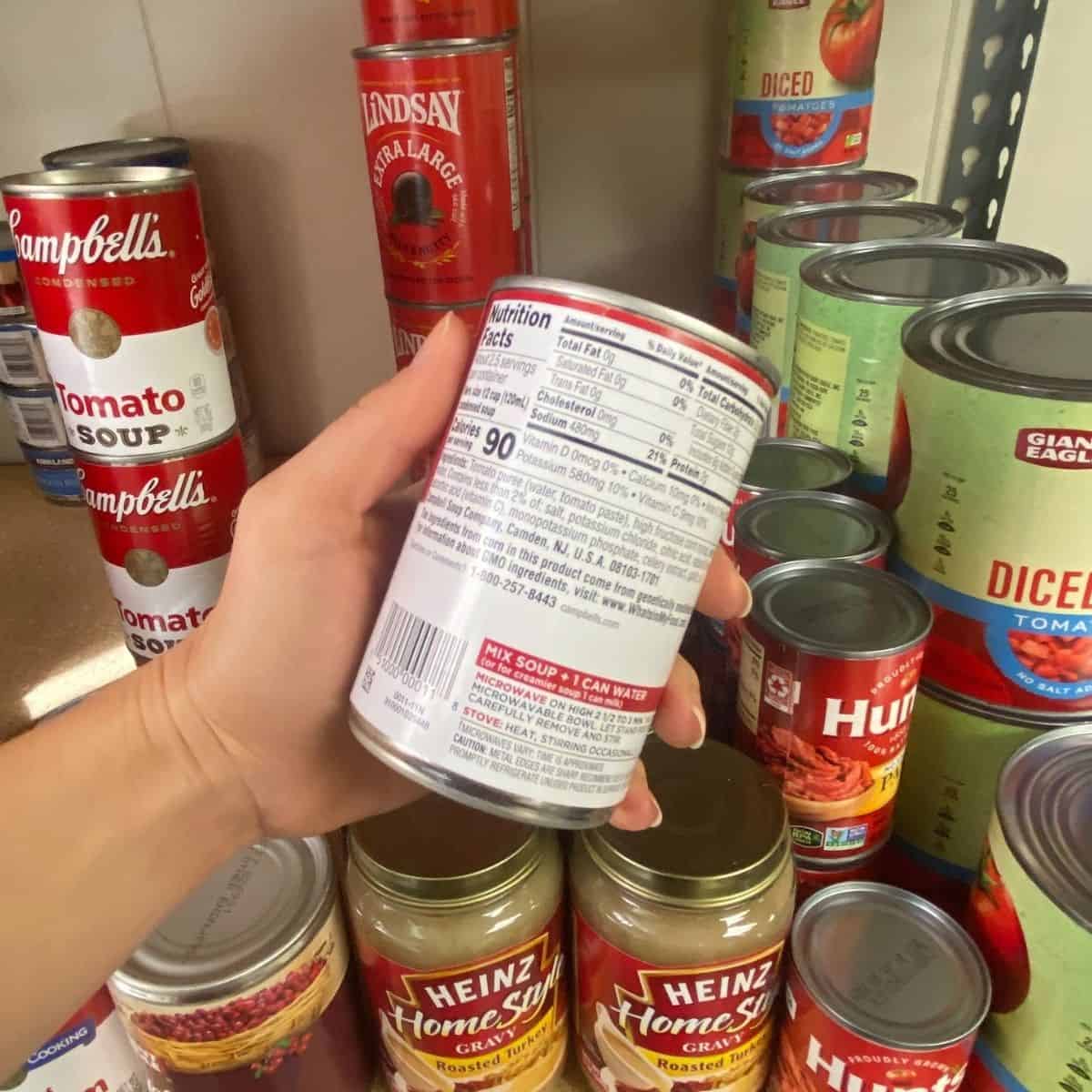
    Hand holding a can with the nutrition facts label showing

    Do you know how to read food labels to make heart healthy food choices? If you're not used to it, it can be an adjustment and takes practice. In this article, we review all the important information you need to know to make the heart healthiest choices at the grocery store!

    Let's use this label for reference:

    Nutrition label, divided into 4 sections.

    You can see the label is divided into 4 important sections. Use these links to skip to the sections you need more information about, if you don't need all the information in this article!

    • Section 1: Serving Size information
    • Section 2: Calories
    • Section 3: Macronutrients and other key nutrients
      • Total Fat
      • Saturated Fats
      • Trans Fats
      • Monounsaturated and Polyunsaturated Fats
      • Cholesterol
      • Sodium
      • Total Carbohydrates
      • Fiber
      • Total Sugars (Including Added Sugars)
      • Protein
    • Section 4: Important Vitamins and Minerals

    Section 1: Serving size information

    This is a very important section of the label. This section tells you how much of that food contains the rest of the nutrition on the label. It also may tell you how many servings are in the whole container. This label comes from a box of individually packaged biscuits. So, in this case, the serving size is one pack, containing 4 biscuits. You may need to measure the food to get the correct serving size. Note that there is no standard serving size. Companies generally choose whatever seems reasonable for their product, but can vary widely between brands. Also, just because the serving size is listed as a particular amount doesn't mean that's all you can or should eat. Just know that if you eat 2 or 3 servings, you will have eaten 2 or 3 times all the nutrition on the label.

    Section 2: Calories

    A calorie is a unit of energy. This part of the label tells you how many calories are in one serving of the food. Calories aren't "bad." We need to eat calories to sustain our lives and the things we want and need to do every day. Constantly consuming too many calories can lead to weight gain. Constantly consuming too few calories can lead to weight loss. It's also important to know that these outcomes will occur regardless of the source of calories. A calorie is calorie, and our body can't tell the difference between a calorie from a chocolate bar and a calorie from lettuce. However, every calorie does come packaged with different nutrition. And that's where the healthfulness of the food comes in, and the importance of reading the rest of the label.

    Section 3: Macronutrients and other key nutrients

    Macronutrients are fat, carbohydrates, and protein. You can see these are further divided into subcategories and there are a couple extras that aren't macronutrients. There are also percent daily values listed on the right hand side of the label. This can be useful to help you balance choices, but know these values are based on a 2000 calorie diet, so your personal needs may be more or less depending on your individual calorie needs. All foods and beverages are some combination of the three main macronutrients (alcohol is a fourth macronutrient, but is usually only included on alcoholic beverages). Like calories, none of these nutrients are "bad," and we need them all, except cholesterol and added sugar, in different amounts.

    Total Fat

    We know that the type of fat matters more than the total amount of fat eaten. Still, eating too much fat means you may not be eating enough of something else. Plus, fat does have a lot more calories than either carbohydrates or protein. A moderate amount of fat is recommended. About 30% of your daily calories is a good amount to ensure proper absorption of vitamins, satiety, and satisfaction, without going overboard.

    Saturated Fats

    Saturated fat is a type of fat that can contribute to high cholesterol levels if eaten in excess. Some people are also more sensitive to it, and tend to produce more cholesterol as a result. If you have high cholesterol, you should take steps to limit (not eliminate) the amount of saturated fat you consume. Less than 10% of total calories is recommended. Your doctor may recommend even less depending on your situation.

    Trans Fats

    Trans fats are unsaturated fats that are artificially saturated using a process called hydrogenation. These fats are even more harmful to your health than saturated fats, and contribute no beneficial effects. While trans fats are being phased out of the food supply, you may still find them in some products. You should avoid all trans fats if possible. Double check the ingredient list and look for partially hydrogenated oils (these are trans fats).

    Monounsaturated and Polyunsaturated Fats

    These fats are not required to be on labels, so you may or may not see them listed. These are heart healthy fats. They do slightly different things for our hearts, but the important thing to remember when you read labels is that these are healthier than the other types of fats, and you should choose products higher in these.

    Cholesterol

    Cholesterol isn't a fat. It's a waxy substance that our bodies use to make new cells and for other processes. Our bodies need cholesterol. However, for some of us, too much cholesterol can be produced, leading to clogged arteries and an overall increased risk of heart attack and stroke. Most of the cholesterol we eat doesn't lead to increased cholesterol in the blood, but it can for some people. It's also not necessary to eat cholesterol, since the body makes it mainly from saturated fats. There's no recommended limit on cholesterol anymore for healthy people, but if you have high cholesterol, you may consider limiting it in case you are more sensitive to it.

    Sodium

    Sodium is a big concern for many of us. We know sodium contributes directly to blood pressure increases. We should all be consuming less of it, but especially those of us with high blood pressure. Read more about the link between sodium and blood pressure here. A good rule of thumb is to look for snacks under 150mg sodium per serving, and prepared meals under 500mg total. Those are generous, as the limit for sodium is 1500mg per day. You can see how quickly that adds up!

    Total Carbohydrates

    Like total fat, the amount of total carbohydrates matters less than the type of carbohydrates. Carbohydrates are important to help with the production of energy, as well as some hormones. Roughly 40-60% of your total calories should be carbohydrate, but remember to look below the total at the types of carbohydrates that mainly make up the product.

    Fiber

    Fiber is a type of carbohydrate that we can't digest, but is very important, especially for heart health. The vast majority of us don't get anywhere close to eating the amount of fiber we should. There is no upper limit for fiber intake, but women under 50 should consume at least 25 grams per day, and women over 50 should consume at least 21 grams per day. Men under 50 should consume at least 38 grams per day, and men under 50 should consume at least 35 grams per day. Learn more about fiber and heart health in our article.

    Choose products that have at least a few grams of fiber. More is better, but remember that fiber is naturally occurring only in whole plant foods: whole grains, fruits, vegetables, nuts, seeds, and beans. Animal foods like meat, cheese, milk, butter, and eggs have no natural fiber.

    Total Sugars

    Sugars are another type of carbohydrate. There are two types of sugars that are included in total sugars, and they are not created equal. To know whether the total sugar amount is a concern or not, look below at the amount of added sugar.

    Added sugar can contribute extra calories, and lead to heart disease, among other health problems, in excess. They also taste good! Added sugars include sweeteners like table sugar, brown sugar, corn syrup (including high fructose corn syrup), honey, molasses, and many, many more.

    Naturally occurring sugars are those that are not added, but are inherently part of the food. Products like fruit and fruit products, vegetables, milk, and yogurt all have naturally occurring sugars. There is no recommended limit on naturally occurring sugar.

    Products typically contain some combination of naturally occurring and added sugars. Look for products that contain as little added sugars as possible. The American Heart Association recommends no more than 36 grams of added sugar per day for men, and no more than 25 grams of added sugars per day for women. Added sugars, like sodium, can add up quickly throughout the day. It may be obvious that products like cookies, cakes, and pies are high in sugar, but it's also in products like creamers, (most) cereal, oatmeal packets, yogurt, breads, salad dressings and sauces/condiments.

    Protein

    Protein is an important building block for all the cells in your body, and multiple processes. Getting adequate protein isn't a problem for most people. Most of us eat much more protein than we need, actually. About 20-30% of calories, give or take, should be from protein.

    If you find you are in the majority, in that you consume more protein than needed, consider decreasing your amount of protein, and increasing the amount of something else you don't eat enough of - like fiber or healthy fats.

    Section 4: Important Vitamins and Minerals

    In section 4, you will see at least 4 nutrients listed, calcium, vitamin D, iron, and potassium. These are nutrients many people don't get enough of. You may see others listed in addition, at the manufacturer's discretion. Both the actual amount and % daily value are listed, since not all people have the same needs.

    Reading food labels can be confusing, but with a little practice, you can become a pro! What's the most confusing part of how to read food labels for you? Let me know in the comments below!

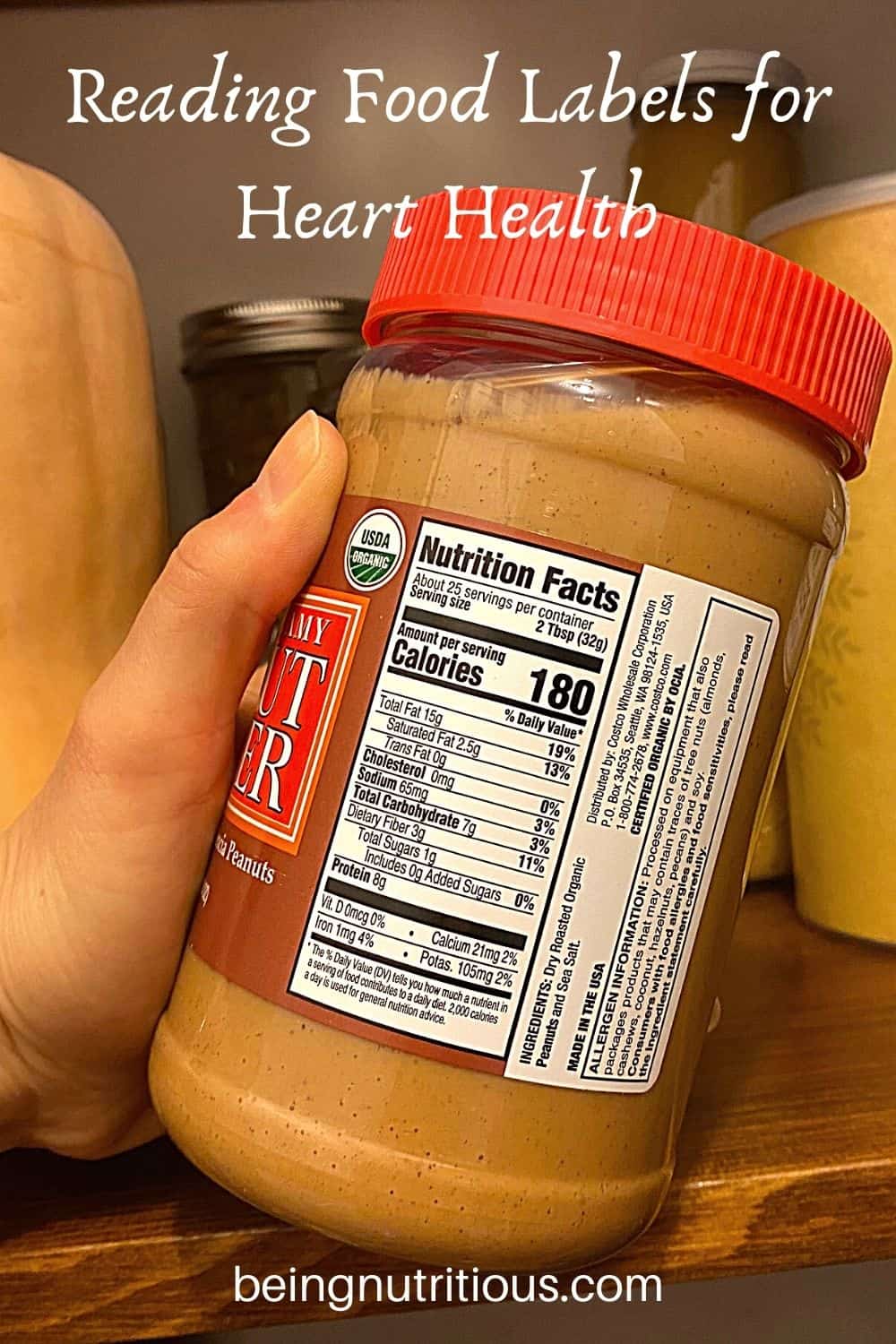
    Hand holding a jar of peanut butter, with the nutrition facts label showing. Text overlay: Reading Food Labels for Heart Health

    Green Tomato Soup with Roasted Garlic

    October 9, 2020 by Laura Yautz 9 Comments

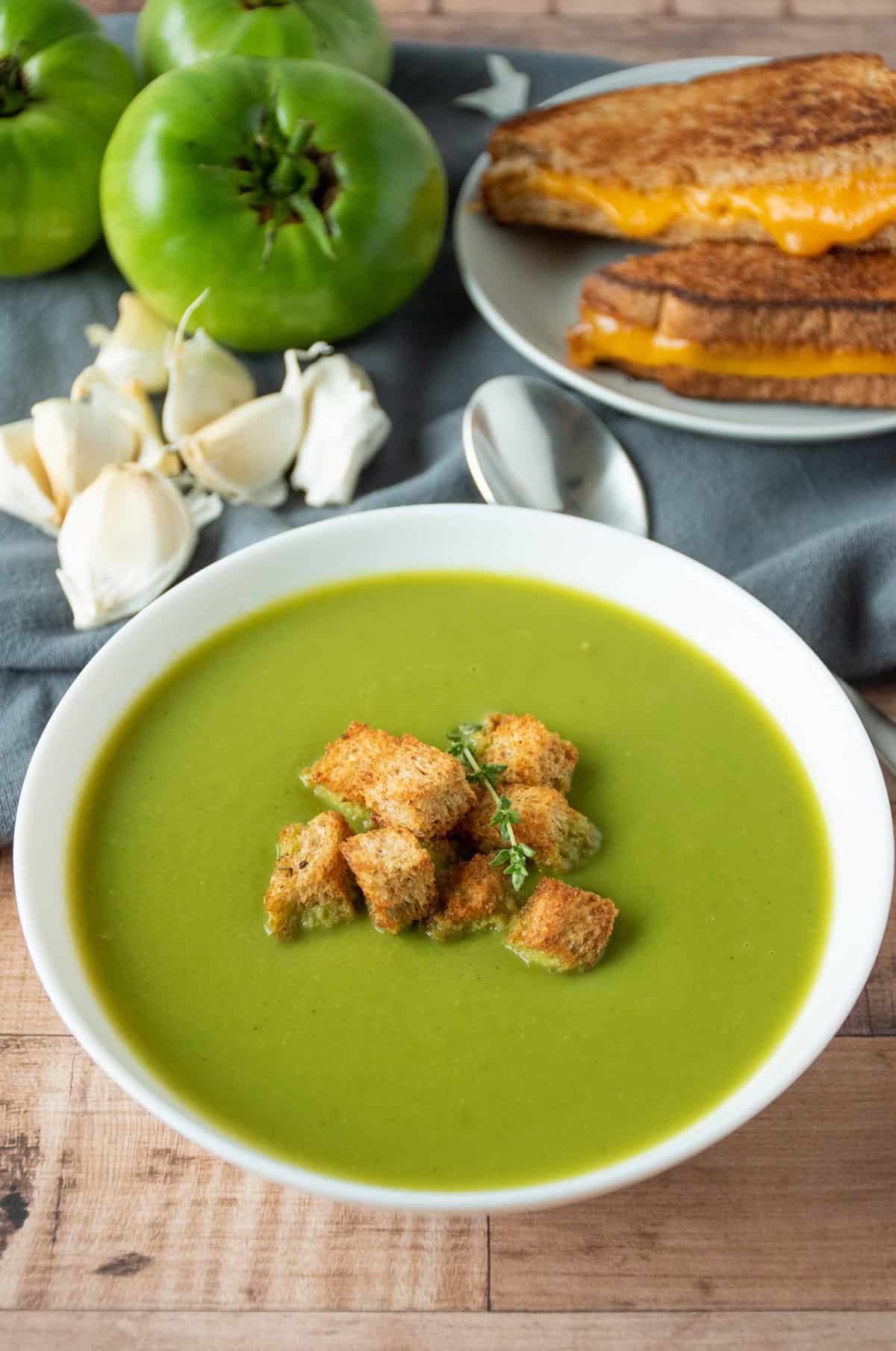
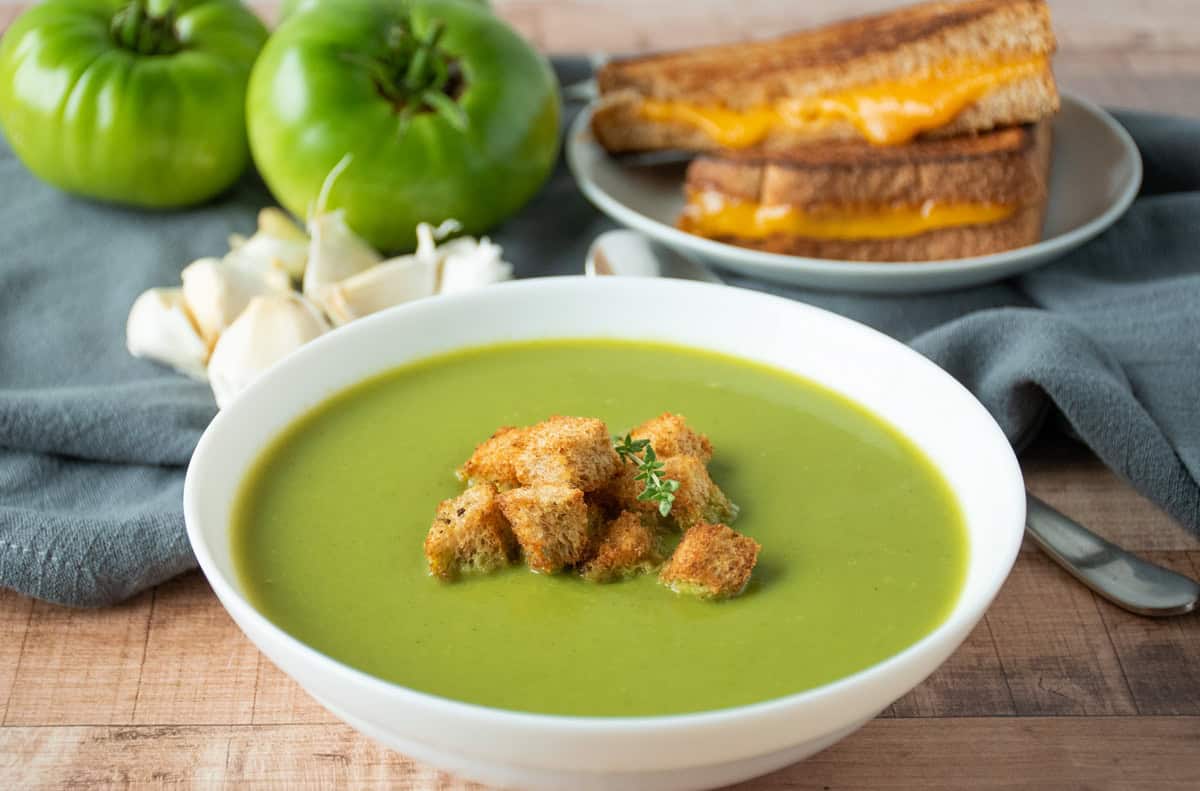
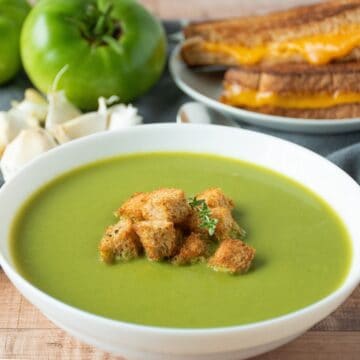
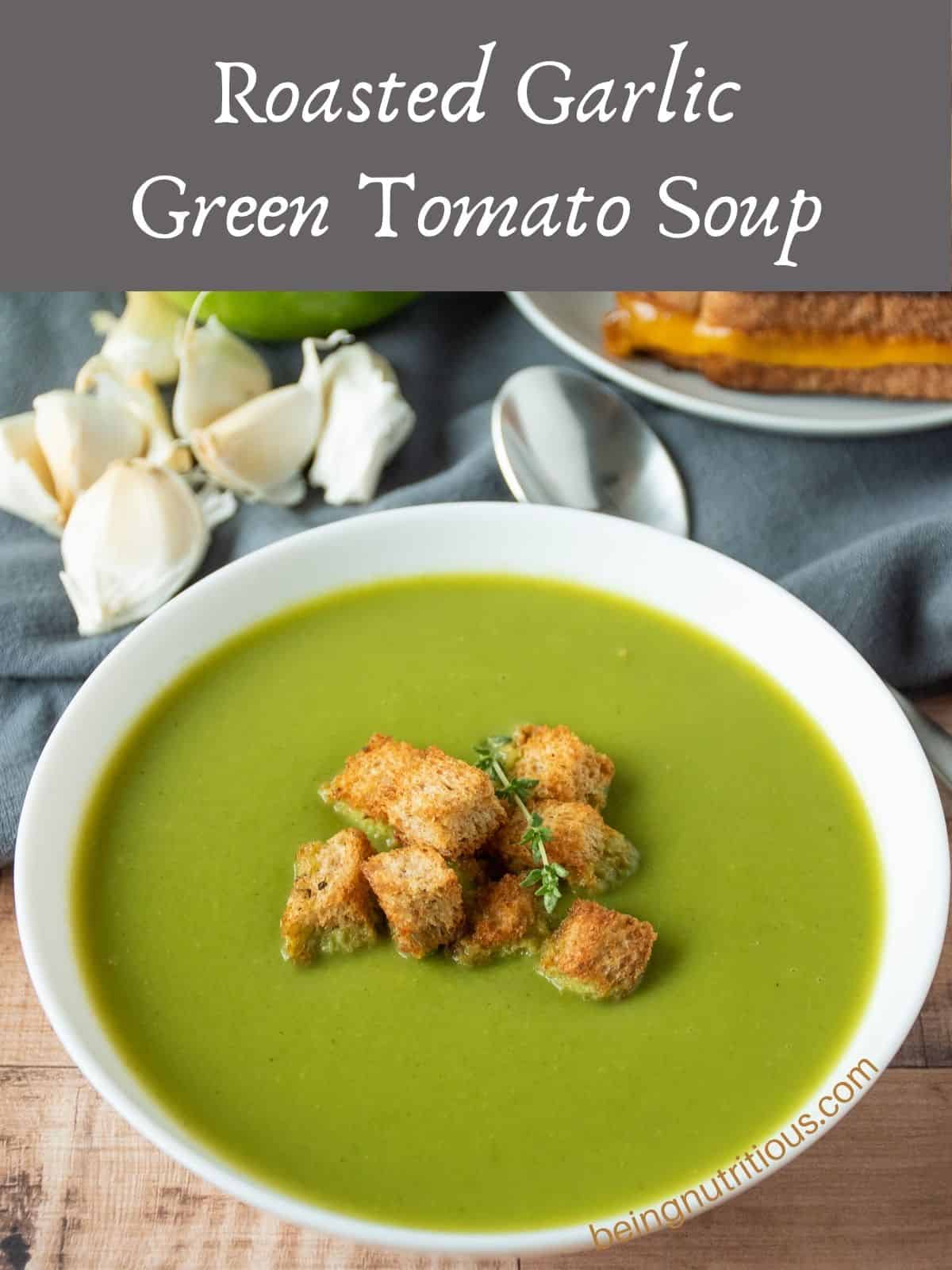
    Green soup in a bowl, garnished with homemade croutons and fresh thyme. A grilled cheese sandwich and fresh garlic and green tomatoes are in the background.

    The end of growing season calls for this easy and delicious Green Tomato Soup! We treat the tomatoes to a nice sauté with the onions to help reduce their tartness, while developing a deep caramelized flavor that pairs well with the roasted garlic. We finish it off with some homemade croutons, designed to complement, for Fall soup perfection.

    This post may contain affiliate links. See our Disclaimer for more information

    Green soup in a bowl, garnished with homemade croutons and fresh thyme. A grilled cheese sandwich and fresh garlic and green tomatoes are in the background.

    It happens every year. The weather changing means most anything growing outside needs harvested, ripe or not. But if your lifestyle is a heart healthy one, you probably want something other than the always popular Fried Green Tomatoes. Not that we don't love a good fried green tomato! We just want something a little different (and healthier) sometimes. Plus, let's be honest, you have more than enough green tomatoes for BOTH fried green tomatoes and this green tomato soup recipe, right?!

    Need more uses for green tomatoes? Get my Top 5 Healthy Ways to Use Green Tomatoes list at the bottom of this post!

    [feast_advanced_jump_to]

    Heart Health Benefits of Green Tomato Soup

    This green tomato soup version is low in calories and saturated fat, and naturally cholesterol free. It's high in potassium and vitamins C and K, and a good source of fiber, monounsaturated fats, calcium, iron, and magnesium.

    The ingredients we chose can help support lowered blood pressure, improved endothelial function, reduced oxidative stress and inflammation, and improved lipid profiles and platelet function (1, 2, 3, 4, 5).

    Macronutrients

    Being low in calories and moderate in carbohydrates, but a good source of fiber and monounsaturated fats makes green tomato soup and great accompaniment to meals. While not high in protein, it still contains 6 grams protein per serving, which can be increased more with the addition of roasted chickpeas or pureeing them into the soup.

    Micronutrients and Key Bioactive Compounds

    Being high in potassium, vitamin C, and vitamin K makes the soup a great recipe for that fall to winter transition when our immune systems may need a little boost. Despite being dairy free, green tomato soup is still a good source of calcium! It's also a good source of iron and magnesium, two important minerals for heart function.

    Additionally, there are many bioactive components in our ingredient list! Here are the key ones you can expect in green tomato soup:

    • Monounsaturated fats - (in olive oil) type of fat molecule that can help lower LDL cholesterol, and provides nutrition to maintain and build you body's cells (6);
    • Hydroxytyrosol and oleuropein - (in olive oil) polyphenols that may be preventative against high blood pressure, stroke, and heart attack (7);
    • Allicin - (in garlic) organosulfur compound that, along with other garlic compounds, boasts antioxidant and antiplatelet effects. It may also improve oxidative stress and lower blood lipids (2);
    • α-tomatine - (in green tomatoes) a glycoalkaloid known to have fungicidal and antimicrobial properties, in addition to helping reduce LDL cholesterol and cancer risk (3, 8, 9);
    • Nitrates - (in spinach) inorganic anion with demonstrated effects like reducing blood pressure, inhibiting platelet aggregation, and improving endothelial dysfunction (4); and
    • Thymol - (in thyme) a phenol that shows antimicrobial, antioxidant, anticarcinogenic, anti-inflammatory, and antispasmodic activities (5, 10).

    Ingredients

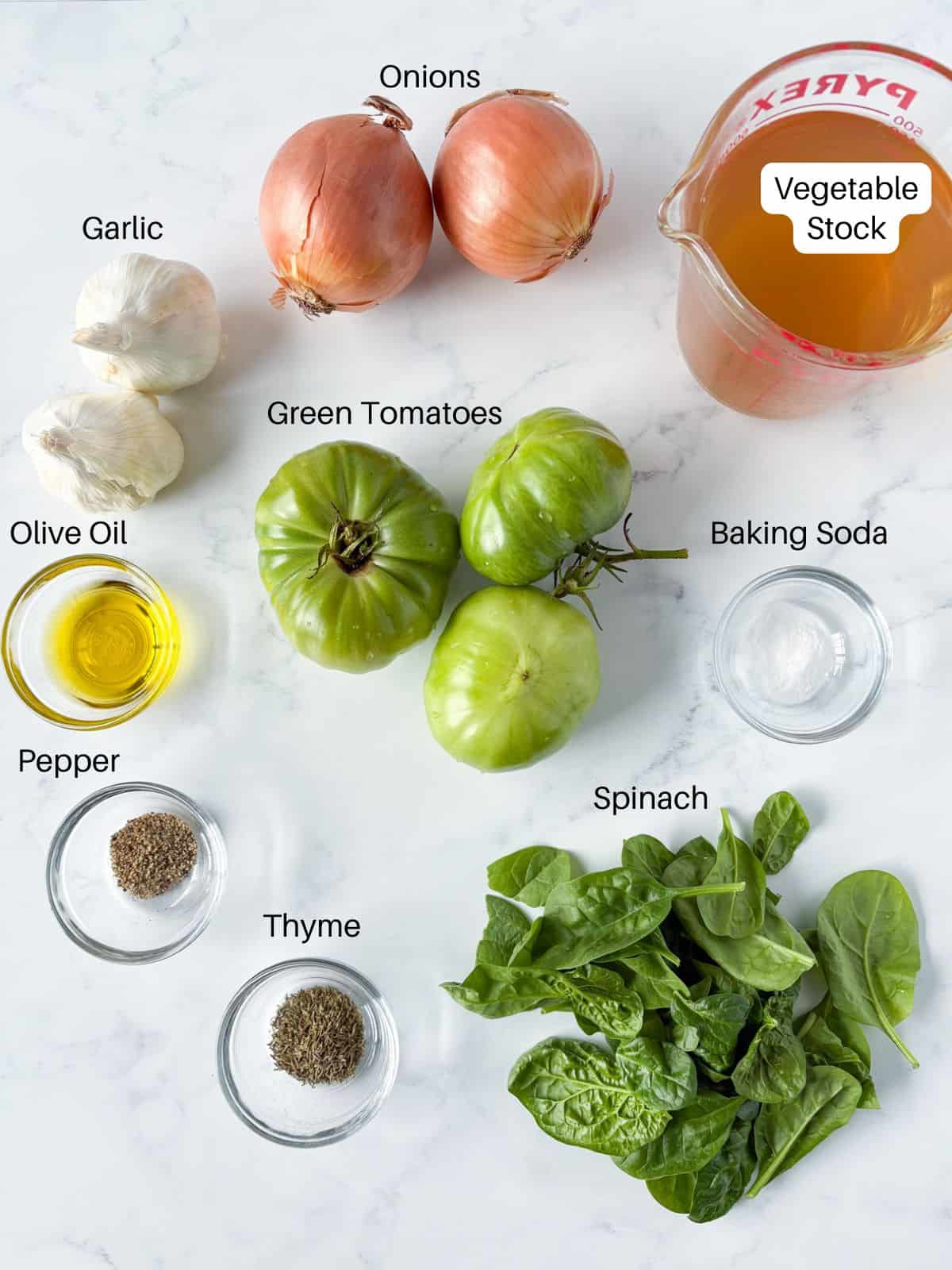
    We start with fresh green tomatoes from our garden (or the market), and amp it up from there with plenty of mellowed out garlic and onions, and spinach for a lovely green color.

    Ingredients for green tomato soup.
    • Green tomatoes
    • Onions
    • Garlic
    • Homemade vegetable stock
    • Spinach
    • Olive oil
    • Dried thyme
    • Salt and pepper
    • Baking soda
    • Whole wheat croutons (not pictured)

    See recipe card for quantities.

    Instructions

    To make Green Tomato Soup, we start by roasting two heads of garlic. It's easy and really takes the soup over the top. Here's what else you'll need to do:

    Two heads of garlic with the tops sliced off to reveal the cloves.
    1. Step 1: Cut the tops of the heads of garlic off, just low enough to reveal all (or most of) the cloves.
    Oil drizzled over the head of garlic, on a sheet of foil.
    1. Step 2: Over a small square of foil, drizzle with olive oil.
    Garlic heads wrapped in foil for roasting.
    1. Step 3: Wrap the foil around the heads, and bake until very soft.
    Roasted garlic, unwrapped on foil.
    1. Step 4: Unwrap the foil, and allow the heads to cool to the touch.
    Roasted garlic cloves removed from the head, in a small glass bowl.
    1. Step 5: Gently squeeze the head over a bowl to remove the cloves.
    Onions, chopped, on a cutting board.
    1. Step 6: Chop the onions.
    Onions sautéing in a pot.
    1. Step 7: Heat the oil in a pan, and add the onions, pepper, and salt.
    Onions sautéing in a pot.
    1. Step 8: Sauté until browned and soft, about 10-15 minutes.
    Green tomatoes, chopped, on a cutting board.
    1. Step 9: Chop the tomatoes.
    Chopped tomatoes added to sautéed onions.
    1. Step 10: Add the tomatoes to the onions in the last 5 minutes of their sauté.
    Vegetable stock and dried thyme added to pot.
    1. Step 11: Pour the vegetable stock into the onions and tomatoes, and add the thyme.
    Tomatoes and onions simmering in stock.
    1. Step 12: Bring to a boil, reduce heat to medium-low, and simmer, covered, until the tomatoes are soft.
    Spinach and roasted garlic in blender.
    1. Step 13: Place the spinach and roasted garlic in the blender.
    Tomato mixture in blender.
    1. Step 14: Pour the tomato and onion mixture into the blender as well.
    Soup blended in a blender.
    1. Step 15: Blend on high until very smooth; about 2 minutes.
    Baking soda added to soup, in a pot.
    1. Step 16: Return the soup to the pot, and add the baking soda.
    Bubbles forming in the soup after baking soda is added.
    1. Step 17: Stir continuously as the soup bubbles up.
    Finished green tomato soup, in a pot.
    1. Step 18: Continue stirring until the bubbling stops, and bubbles dissipate. Serve hot, garnished with croutons and fresh thyme, as desired.

    Hint: don't omit the baking soda! It helps neutralize some of the acid in the green tomatoes to mellow out the flavor. Without it the soup is cheek-puckeringly tart!

    Substitutions

    • Green tomatoes - if you've got a ton of red tomatoes, you can use them instead for a more classic tomato soup! Just leave out the spinach and baking soda.
    • Spinach - try using kale instead of spinach. It won't blend up as well if you aren't using a high speed blender. Arugula is another option for a bit of a peppery punch.
    • Garlic - you could leave it out all together, or use garlic paste if you don't want to roast it. Add it with the onions to mellow out a bit.

    Variations

    • Ultra creamy - instead of vegetable stock, use milk or your nondairy milk substitute of choice (be sure to simmer it gently so it doesn't scorch)
    • Smoky - add smoked paprika or a few drops of liquid smoke
    • High protein - add roasted chickpeas for some crunchy texture, or puree chickpeas or other beans into the soup for a creamy texture
    Green soup in a bowl, garnished with homemade croutons and fresh thyme. A grilled cheese sandwich and fresh garlic and green tomatoes are in the background.

    Equipment

    For this green tomato soup recipe, make sure you have a 3 quart pot (or larger) with a lid, measuring cups and spoons, a kitchen scale, and a cutting board and knife.

    You also need a blender. A high speed blender, like Vitamix, will be best for texture, but use what you have.

    Storage

    Cool the soup completely and store in an airtight container in the refrigerator for up to 5 days.

    This recipe can be frozen for up to 6-9 months.

    Healthy heart pro tip

    Using baking soda in this recipe is necessary, but it adds a good amount of sodium. Keep the soup on the lower side of sodium content by making sure to use either a no salt homemade vegetable stock, or a no added salt commercial vegetable broth or stock, like Kitchen Basics Unsalted Vegetable Stock (affiliate).

    FAQ

    Are green tomatoes poisonous?

    Green tomatoes do contain some compounds that can be toxic in high amounts. These compounds are called solanine and tomatine. They are also present in other foods we consider staples, like potatoes and eggplant. They lend a bitter taste to the fruit, and the compounds do decrease in concentration as the fruits ripen. Studies have found that the content of toxic compounds in green tomatoes are too low at at normal culinary usage amounts to cause problems (9 ,11).

    It's worth noting, too, that some people do seem to exhibit a sensitivity to tomatoes, more so in their unripe stages. If you find that you experience headaches, nausea, or any other gastrointestinal symptoms after eating green tomatoes (or any food for that matter), it's probably wise to eat it very moderately, or avoid it altogether.d answer them here

    How can I ripen green tomatoes?

    Many times, green tomatoes will ripen if given the chance, especially if they've already started to turn. I've had many simply ripen while waiting for me to use them in a recipe!

    Another tried and true method is to wrap them, individually in newspaper, and put them in a box. Check them every day or so, and once you can see them start to turn colors, you can unwrap them and leave them on the counter to finish.

    Can you freeze green tomatoes?

    Yes! Freezing is a great way to preserve green tomatoes! Simply slice or quarter the washed green tomatoes, and arrange them on a parchment lined cookie sheet. Pop them in the freezer until they are solid. Then transfer them to a zipper freezer bag, and store in the freezer for up to 6 months.

    Top 5 Healthy Ways to Use Green Tomatoes

    close up of green tomatoes

    Here it is! I promised you some great healthy uses for green tomatoes - that aren't fried! Click the button below to get it.

    What Can I Do With Green Tomatoes?

    Related

    Looking for other unique recipes to use up garden veggies? Try these:

    • Radish Greens Hummus in a bowl with a hand dipping a carrot stick in it.
      Radish Greens Hummus
    • Silver bowl with charred radish pods, garnished with orange peel. Fresh radish pods and sliced orange in background
      Citrus Charred Radish Pods
    • Overhead picture of a bowl of braised greens in a light pink broth.
      Creamy Braised Beet Greens
    • Close up of purple and green beans
      How to Freeze Beans from the Garden

    Pairing

    These are my favorite recipes to serve with Green Tomato Soup:

    • Croutons in a small bowl.
      Italian Seasoned Whole Wheat Croutons
    • Overhead picture of large plate with salad on it.
      Arugula Avocado Salad with Pineapple Vinaigrette
    • 2 slices of cornbread stacked on one another, with honey being drizzled over them.
      Sweet Potato Cornbread
    • Half of a baked pear in a dish, drizzled with chocolate sauce and toasted walnuts.
      Cinnamon Baked Pears with Toasted Walnuts and Chocolate Sauce
    Want to say thank you?

    Reader Review

    "I like this lots!!! I used Beyond sausage and Better than Bouillon garlic vegetable broth. Delicious. A keeper."

    ⭐⭐⭐⭐⭐

    📖 Recipe

    Green soup in a bowl, garnished with homemade croutons and fresh thyme. A grilled cheese sandwich and fresh garlic and green tomatoes are in the background.

    Green Tomato Soup with Roasted Garlic

    Laura Yautz
    The end of growing season calls for this easy and delicious Green Tomato Soup! We treat the tomatoes to a nice sauté with the onions to help reduce their tartness, while developing a deep caramelized flavor that pairs well with the roasted garlic.
    4.20 from 5 votes
    Prevent your screen from going dark
    Print Recipe Pin Recipe Save Recipe Saved Recipe!
    Prep Time 30 minutes mins
    Cook Time 25 minutes mins
    Total Time 55 minutes mins
    Course Soup
    Cuisine American
    Servings 4
    Calories 188 kcal

    Equipment

    • Kitchen scale
    • Large cutting board
    • Chef knife
    • Measuring Cups and Spoons
    • Liquid Measuring Cup
    • 3 quart pot with lid
    • High speed blender

    Ingredients
      

    • 2 heads Garlic
    • 2 tablespoon Olive oil divided
    • 2 medium Onions chopped
    • Pinch Salt and Freshly ground Black Pepper
    • 2 lbs Green Tomatoes chopped large
    • 2 cups Homemade Vegetable Stock
    • 1 teaspoon Dried Thyme
    • 2 cups Spinach
    • ½ teaspoon Baking Soda
    • Italian Seasoned Whole Wheat Croutons for garnish

    Instructions
     

    Roast the Garlic

    • Preheat oven to 400 degrees F.
    • Remove outer paper of the heads of garlic, allowing them to still stay together. Cut the tops off the heads, exposing the cloves.
    • Place each head on a small square of foil, and drizzle with ½ tablespoon of oil each.
    • Wrap the heads in the foil, and place in the oven for about 30 minutes, until all the cloves are very soft (like butter).
    • If you are making the croutons, make them now, while the garlic roasts!
    • Remove garlic from the oven, and unwrap the heads to allow them to cool.

    Make the Soup

    • Heat 1 tablespoon oil in a large skillet, and sauté the onions, salt and pepper, until browned and very soft, about 15-20 minutes.
    • In the last 5 minutes of sauteing, add the chopped green tomatoes, and continue cooking.
    • Pour the vegetable stock into the pot, along with the thyme, and bring to a boil. Reduce heat to medium-low, and simmer until the tomatoes are soft, about 5-10 minutes.
    • To the blender, add the spinach and roasted garlic.
    • Pour the tomato mixture over the spinach in the blender.
    • Puree on high until the soup is very smooth, about 2-3 minutes.
    • Return the soup to the pot (off the heat), and stir in the baking soda.
    • The soup will start to bubble as the baking soda neutralizes some of the acid. Continue stirring until the bubbling stops, and all the bubbles dissipate.
    • Pour into bowls, and garnish with croutons, fresh thyme, and a sprinkle of nutmeg, as desired.

    Nutrition

    Serving: 1.5cupsCalories: 188kcal (9%)Carbohydrates: 28g (9%)Protein: 6g (12%)Fat: 7.5g (12%)Saturated Fat: 1.1g (7%)Polyunsaturated Fat: 1gMonounsaturated Fat: 5gSodium: 334mg (15%)Potassium: 789mg (23%)Fiber: 4.4g (18%)Sugar: 13g (14%)Vitamin A: 400IU (8%)Vitamin C: 63mg (76%)Vitamin K: 108µg (103%)Calcium: 113mg (11%)Iron: 3mg (17%)Magnesium: 50mg (13%)

    *Nutrition information is an estimate, and will change based on the brand and individual ingredients and amounts you use. This is provided for your convenience only.

    Keyword green tomato recipes, tomato soup
    Tried this recipe?Let us know how it was!

    Food safety

    Safety is our top priority in the kitchen! Always keep these tips in mind.

    • Wash hands before touching food, and after touching your hair, face, pets, etc.
    • Make sure all needed utensils and equipment are clean before beginning
    • Cook to a minimum temperature of 165 °F (74 °C)
    • Don't leave food sitting out at room temperature for extended periods
    • Never leave cooking food unattended
    • Always have good ventilation when using a gas stove
    • Take extra care when blending hot liquids to properly vent the blender
    • Always open the lid of cooking pots away from your face to avoid scalding burns

    See more guidelines at USDA.gov.

    Green soup in a bowl, garnished with homemade croutons and fresh thyme. Text overlay: Roasted Garlic Green Tomato Soup.

    Roasted Kale Salad with Apple Maple Vinaigrette

    October 4, 2020 by Laura Yautz 1 Comment

    Kale salad in a wooden bowl.

    This roasted kale salad is perfect for Fall, boasting seasonal roasted veggies like beets, butternut squash and potatoes, and sporting a delicious, homemade Apple Maple Vinaigrette! Treating kale to a quick oil massage and roast helps cut some of its bitter qualities, as well and making it more tender. We added chickpeas roasted with cinnamon to complete this perfect Autumn meal.

    Kale salad in a wooden bowl with apple maple vinaigrette in the background.

    Can I eat kale if I'm on coumadin?

    If you're taking the blood thinner coumadin (AKA warfarin), you are probably being careful of your vitamin K intake. The short answer is yes, you can eat kale if you're on coumadin. But the caveat is you need to maintain a relatively consistent intake of vitamin K so your medications can be properly adjusted. If you don't typically consume foods high in vitamin K and would like to, talk to your doctor about how to start including more, so your bloodwork can be closely monitored. Read more about this topic in our article, Vitamin K and Heart Health!

    Can I use raw kale in salads?

    In this recipe, you've no doubt noticed I'm using roasted kale. Can you use raw kale? Yep! If you want to cut out a few steps, by all means, use raw kale! I'm roasting my kale for a few reasons:

    First, roasting imparts a lovely flavor that reminds me of Fall. I love that!

    Second, roasting makes the kale more tender, and cuts some of its bitter qualities down.

    And third, I honestly just don't love raw kale - but I do love it roasted! If you are like me, this is the way you'll want to make all your kale salads from now on!

    But even if you don't roast it, you'll still want to massage it with a bit of oil before you use it.

    How do you massage kale?

    Massage? The kale? What kind of fluffy froo-froo is this? 😉

    Ha ha. I admit it sounds weird. But this step is super important to tenderize your kale, especially if you're using it raw - but don't disregard if you're roasting. After you chop and remove the thick stems, put the kale in a big bowl and add a few teaspoons of oil. A little salt, too, if you're so inclined. Then use your hands to slowly work the oil onto every leaf. A few minutes is all it takes. The leaves will start to turn bright green and shiny.

    You can also massage it with nothing but your hands, or in a little water, if you'd like to lower the amount of oil you use.

    massaged kale on a baking sheet, ready for roasting.
    Kale massaged with a bit of olive oil. Look how vibrant!

    Tips and Substitutions

    The sky is the limit with salad substitutions! But here are some important tips, and recommended substitutions you may want to use:

    • Definitely massage your kale! See above.
    • To reduce your roasting time, try steaming or boiling your chopped veggies until they just start to soften. Then toss with oil and roast until browned.
    • Use another green, like spinach, collards, mustard, or romaine lettuce. No need to roast (or massage!) these.
    • Don't like beets? Leave them out, or use another vegetable like carrots or parsnips.
    • Try sweet potatoes in place of the red potatoes - or any other potato. I used red because I like the waxy consistency vs starchy for this salad.
    • Use another squash instead of butternut. Consider pumpkin or acorn squash. Even delicata squash would be delicious, but wouldn't need to roast as long.
    • Beets tend to bleed on everything they touch. If you don't want them to turn your squash and potatoes purple, keep them separated on the baking sheet, or use separate baking sheets.
    • Use another bean in place of chickpeas, like black beans, lentils, or kidney beans. I love the neutral taste of chickpeas here, because there's a lot of other flavors going on, but any other bean would be great, too!
    • Use apple juice if you don't have apple cider for the dressing.
    • Use honey if you don't have pure maple syrup. It won't have the maple taste, but will still be yummy!
    Kale salad in a wooden bowl.

    If you make Roasted Kale Salad with Apple Maple Vinaigrette, don't forget to let me know in the comments!

    If you're concerned about your heart health, make sure to check out the 3 Best Diets for Heart Health, and browse our archives by dietary needs!

    📖 Recipe

    Kale salad in a wooden bowl.

    Roasted Kale Salad with Apple Maple Vinaigrette

    Laura Yautz
    This roasted kale salad is perfect for Fall, boasting seasonal roasted veggies like beets, butternut squash and potatoes, and sporting a delicious, homemade Apple Maple Vinaigrette!
    5 from 1 vote
    Prevent your screen from going dark
    Print Recipe Pin Recipe Save Recipe Saved Recipe!
    Prep Time 10 minutes mins
    Cook Time 1 hour hr
    Total Time 1 hour hr 10 minutes mins
    Course Lunch, Main Course, Salad
    Cuisine American
    Servings 4
    Calories 365 kcal

    Ingredients
      

    • 2 large Red Potatoes, roughly chopped
    • 2 cups chopped Butternut Squash
    • 3 medium Beets, peeled and roughly chopped
    • 1 ½ cup (or 1 can) Chickpeas, no added salt
    • ¼ teaspoon Cinnamon
    • 1 lb Kale, chopped, large stems removed
    • 1 ½ tablespoon Olive oil, divided
    • Salt to taste

    For the Dressing

    • 2 ½ tablespoon Apple Cider
    • 2 ½ tablespoon Apple Cider Vinegar
    • 2 ½ tablespoon Olive Oil
    • 1 tablespoon Pure Maple Syrup

    Instructions
     

    • Preheat oven to 350 degrees F.
    • Place the chopped potatoes, squash, and beets on a baking sheet lined with parchment, and toss with 2 teaspoon oil. Sprinkle lightly with salt, if desired.
    • Bake for about an hour (more or less depending on the size of your chop), until soft and browned.
    • Meanwhile, place the chickpeas on a small baking sheet or in a baking dish, and sprinkle with cinnamon and ½ teaspoon oil. Toss to coat.
    • Bake the chickpeas for 20 minutes.
    • On a second large, lined baking sheet, arrange the kale, and drizzle with 2 teaspoon oil. Massage the oil through all the kale with your hands.
    • When the chickpeas are done, remove them from the oven, and put the kale in. Bake the kale for about 15 minutes, until just starting to crisp.
    • Allow all the vegetables to cool a bit (or refrigerate until cold) after roasting.
    • Make the dressing by whisking all the ingredients together in a small bowl.
    • Make the salad by transferring the kale to a large bowl, and adding the other toppings as desired. Drizzle with half the dressing before serving, or at the table.
    • Will keep in the refrigerator for a few days.

    Nutrition

    Calories: 365kcal (18%)Carbohydrates: 60.5g (20%)Protein: 14g (28%)Fat: 10.6g (16%)Saturated Fat: 1.4g (9%)Polyunsaturated Fat: 2gMonounsaturated Fat: 5.9gSodium: 119.6mg (5%)Potassium: 1677.9mg (48%)Fiber: 13.8g (58%)Sugar: 15g (17%)Vitamin A: 941.3IU (19%)Vitamin C: 163.9mg (199%)Calcium: 258.6mg (26%)Iron: 5.2mg (29%)

    *Nutrition information is an estimate, and will change based on the brand and individual ingredients and amounts you use. This is provided for your convenience only.

    Keyword autumn salad, fall salad
    Tried this recipe?Let us know how it was!
    Kale salad in a wooden bowl. Text overlay: Roasted Kale Salad with Apple Maple Vinaigrette, with butternut squash, beets, and red potatoes.
    Kale salad in a wooden bowl. Text overlay: Roasted Kale Salad with Apple Maple Vinaigrette, with butternut squash, beets, and red potatoes.
    Kale salad in a wooden bowl. Text overlay: Roasted Kale Salad with Apple Maple Vinaigrette.
    Overhead shot of kale salad in a wooden bowl. Text overlay: Roasted Kale Salad with Apple Maple Vinaigrette, with butternut squash, beets, and red potatoes.
    Kale salad in a wooden bowl. Text overlay: Roasted Kale Salad with Apple Maple Vinaigrette, with butternut squash, beets, and red potatoes.
    Kale salad in a wooden bowl. Text overlay: Roasted Kale Salad with Apple Maple Vinaigrette, with butternut squash, beets, and red potatoes.
    Kale salad in a wooden bowl. Text overlay: Roasted Kale Salad with Apple Maple Vinaigrette.
    Kale salad in a wooden bowl. Text overlay: Roasted Kale Salad with Apple Maple Vinaigrette.

    Thai Curry Pumpkin Soup

    September 30, 2020 by Laura Yautz Leave a Comment

    Overhead shot of pumpkin soup in a blue bowl, garnished with cilantro and pepitas.

    Originally published October 22, 2018.

    Are you craving creamy, delicious, and warming soup right now? I absolutely am, and Thai Curry Pumpkin Soup is here for it! This recipe is incredibly easy, and pumpkin and Thai curry are a match made in heaven! Five ingredients; 20 minutes. You'll want to get this on the stove immediately, and cozy up with it tonight!

    Pumpkin soup in a blue bowl, garnished with cilantro and pepitas.

    One of my favorite things about fall is pumpkins. Not so much the pumpkin spice everything trend, but foods made with actual pumpkin - especially when it's used in surprising ways (read: NOT pumpkin spice). Though I also enjoy it simply prepared: bake it just like an acorn squash! It makes a lovely autumn side dish with a little sprinkle of cinnamon!

    And let's not forget how nutritious pumpkin is (I'm not talking about pumpkin pie here winking emoji )! By itself, pumpkin is low in calories and high in fiber, making it great for heart health. Notably, pumpkin is a great source of vitamin A. Just one cup will provide 250% of your daily value! It's also a good source of potassium and vitamin C. See more about the nutrition of pumpkin.

    Tips and Substitutions for this recipe

    Even though there are so few ingredients, there are some variations you may wish to use:

    • Use soymilk or cashew milk in place of the coconut milk. Just make sure what you choose is creamy!
    • Use pureed sweet potato, butternut squash, or acorn squash instead of pumpkin.
    • If you don't have an immersion blender, carefully pour the soup into a blender, and puree until smooth. Be sure to vent your blender!
    • To garnish, drizzle a bit of coconut milk and/or toasted pumpkin seed oil into the soup instead of, or in addition to, the cilantro and pepitas.
    • Pepitas are pumpkin seeds.
    Overhead shot of pumpkin soup in a blue bowl, garnished with cilantro and pepitas.

    If you make Thai Curry Pumpkin Soup, let me know in the comments below!

    📖 Recipe

    Overhead shot of pumpkin soup in a blue bowl, garnished with cilantro and pepitas.

    Thai Curry Pumpkin Soup

    Laura Yautz
    Delicious Thai-inspired soup with a fall twist! While technically vegan, this will delight everyone! Makes a quick weekday lunch as well!
    No ratings yet
    Prevent your screen from going dark
    Print Recipe Pin Recipe Save Recipe Saved Recipe!
    Prep Time 5 minutes mins
    Cook Time 15 minutes mins
    Total Time 20 minutes mins
    Course Soup
    Cuisine Asian-Inspired
    Servings 6
    Calories 146 kcal

    Equipment

    • Immersion Blender, or regular blender

    Ingredients
      

    • 1 tablespoon Olive Oil
    • 1 medium Onion chopped
    • 3 cups Pumpkin Puree (or 2 cans)
    • 1 can Light Coconut Milk
    • 1-2 tablespoon Thai Red Curry Paste
    • Pepitas (for garnish)
    • Chopped Cilantro (for garnish)

    Instructions
     

    • In a large pot, heat olive oil and sauté onion until soft and translucent.
    • Add pumpkin puree, coconut milk, and red curry paste, and bring to boil.
    • Blend with immersion blender until smooth. Alternately, puree soup in blender in small batches, making sure to vent the blender. Return to pot and bring to simmer.
    • Serve hot, garnished with pepitas and chopped cilantro, if desired.

    Nutrition

    Serving: 0gCalories: 146kcal (7%)Carbohydrates: 15.9g (5%)Protein: 1.8g (4%)Fat: 9.6g (15%)Saturated Fat: 6.5g (41%)Polyunsaturated Fat: 0.3gMonounsaturated Fat: 1.7gTrans Fat: 0gCholesterol: 0mgSodium: 85.6mg (4%)Potassium: 291.3mg (8%)Fiber: 4.2g (18%)Sugar: 6.3g (7%)Vitamin A: 978IU (20%)Vitamin C: 7.1mg (9%)Calcium: 38mg (4%)Iron: 1.8mg (10%)

    *Nutrition information is an estimate, and will change based on the brand and individual ingredients and amounts you use. This is provided for your convenience only.

    Keyword pumpkin soup
    Tried this recipe?Let us know how it was!
    Overhead shot of pumpkin soup in a blue bowl, garnished with cilantro and pepitas. Text overlay: Thai Curry Pumpkin Soup
    Overhead shot of pumpkin soup in a blue bowl, garnished with cilantro and pepitas. Text overlay: Thai Curry Pumpkin Soup
    Overhead shot of pumpkin soup in a blue bowl, garnished with cilantro and pepitas. Text overlay: Thai Curry Pumpkin Soup
    Overhead shot of pumpkin soup in a blue bowl, garnished with cilantro and pepitas. Text overlay: Thai Curry Pumpkin Soup
    Overhead shot of half the bowl of pumpkin soup in a blue bowl, garnished with cilantro and pepitas. Text overlay: Thai Curry Pumpkin Soup
    Overhead shot of pumpkin soup in a blue bowl, garnished with cilantro and pepitas. Text overlay: Thai Curry Pumpkin Soup
    Overhead shot of pumpkin soup in a blue bowl, garnished with cilantro and pepitas. Text overlay: Thai Curry Pumpkin Soup
    Overhead shot of pumpkin soup in a blue bowl, garnished with cilantro and pepitas. Text overlay: Thai Curry Pumpkin Soup

    Should I Avoid Black Licorice If I Have Heart Problems?

    September 25, 2020 by Laura Yautz Leave a Comment

    Black licorice candies sitting on licorice root, with lemon slices behind.

    By now we've probably all heard about the man in Massachusetts who died after his heart stopped from eating too much licorice. So now you're probably wondering if you should avoid black licorice if you have heart problems! Let's take a look at what happened in this case, and what's the deal with black licorice.

    Black licorice candies sitting on licorice root, with lemon slices behind. Text overlay: Should I Avoid Black Licorice if I Have A Heart Condition?

    Can Black Licorice Really Stop Your Heart?!

    First let me say that this is incredibly rare. Even in people who love black licorice, they usually don't eat enough for this to happen.

    That said, yes, black licorice can cause heart problems. Even a small amount can start to raise your blood pressure. The culprit is a compound in licorice root called glycyrrhizin. Glycyrrhizin is a chemical that gives licorice its sweet flavor. In large and sustained amounts, it can cause sodium retention and low potassium levels, fluid retention (edema), and high blood pressure, arrhythmia, and heart failure (1). In the case in Massachusetts, the man reportedly ate a bag and a half of black licorice candies for a couple weeks, leading to dangerously low potassium levels, and ultimately heart failure.

    These effects are reversible when we stop eating it, but it can take several months for this to happen.

    How Much Black Licorice Is Too Much?

    A safe amount of glycyrrhizin (also called glycyrrhizic acid) varies by person due to differences in metabolism. But it seems that 100 milligrams or less per day is unlikely to cause adverse effects in most people (2). That translates into about 50 grams (a little under 2 oz) of licorice candy. Most people who consume 400 mg of glycyrrhizin or more a day will experience adverse effects.

    What foods contain glycyrrhizic acid?

    Glycyrrhizic acid is approved as an additive in foods, and is generally recognized as safe (GRAS). In addition to being naturally occurring in licorice root, it is often added to bitter medicines and beverages, candies, and even sometimes gum. Herbal remedies, herbal tea, and cough medicines often use licorice root or the additive as well.

    Do anise, star anise, and fennel have the same effects as licorice?

    In the US, many so-called black licorice candies actually use anise flavoring (anise oil), which tastes very similar to licorice root. Other herbs with a black licorice flavor are star anise and fennel. These do not have the same dangerous effects at high levels like licorice root. These are good alternatives for anyone concerned about consuming too much licorice. Read the ingredients to know for sure which is used.

    Many star anise pods on a dark background.

    The bottom line is, while most people aren't in danger of over consuming black licorice, those who love it may be, in addition to glycyrrhizic acid being potentially present in products of which we aren't aware. These products can be riskier for people who already have a heart condition, like high blood pressure or chronic edema. Always check ingredients and know where it's found. While heart failure and death is extremely rare due to licorice ingestion, it can and does happen.

    If you're concerned about your potassium levels, be sure to check out our high potassium recipes archive!

    Heart Healthy Pizza with Greek Yogurt Whole Wheat Crust

    September 14, 2020 by Laura Yautz 1 Comment

    Pizza on a peel, with whole wheat crust, topped with salad.

    Do you love homemade from-scratch pizza, but hate waiting around for the dough to rise? This Heart Healthy Pizza topped with delicious but simple salad is for you! In this recipe, we quickly mix up our own self-rising whole wheat flour, combine it with Greek yogurt, and knead, for the quickest dough ever. Five minutes until you're rolling out and topping your pizza! Delicious AND healthy, there's no room for disappointment here!

    Pizza on a peel, with whole wheat crust, topped with salad.

    Pizza is not known for being healthy. In fact, most pizza isn't even a little bit healthy. High in calories, sodium, saturated fat, and made with refined grains, full fat cheese, and typically highly processed meats that all have a hand in contributing to chronic diseases like heart disease. But it doesn't have to be that way! My Salad Pizza version is healthy enough to be on your weekly menu. And with the quick from-scratch crust it can even be a weeknight meal. Just 30 minutes from basic pantry ingredients to a complete pizza!

    How to make Greek yogurt pizza crust

    Making this yeast free pizza crust is really simple. It's one really cool discovery!

    Most recipes use self rising flour. That's not something I keep on hand, so I made my own by mixing some baking powder and salt with the flour. Now simply mix in Greek yogurt until the mixture is quite flaky. At this point, you can start kneading it. If it's too wet, add some more flour, and if it's too dry add a little more yogurt.

    Once the dough is the right consistency to hold together, you can roll it out into a 12 inch circle and put whatever toppings on it you like! I used a Mediterranean inspired combination of hummus, Kalamata olives, roasted red peppers, tomatoes, and feta cheese. I loaded the pizza with romaine lettuce, dressed simply with a homemade Greek-style dressing. Wow! Perfection.

    Whole grain pizza on a peel, with bowl of salad in background.

    Tips and Substitutions for this Recipe

    This pizza is very customizable. Use what you like! Here are some helpful tips and substitutions for this pizza:

    • Use self-rising flour. If you have it, use that instead of the flour, baking powder, salt mixture. Note that if your flour isn't whole wheat, your fiber content will be lower in your finished pizza.
    • Do not use regular yogurt. Regular yogurt just doesn't work as well to make the crust. Stick to Greek yogurt for this one.
    • Use pizza sauce of your choice instead of hummus. If you prefer, using pizza sauce is fine. If you do this, I suggest adding some roasted chickpeas or grilled chicken to maintain protein content.
    • Use different flavor combinations of hummus. I love roasted garlic hummus, but get creative and enjoy!
    • Use fresh red bell peppers instead of roasted red peppers.
    • Use sun dried tomatoes instead of fresh tomatoes.
    • Use black olives, green olives, or capers instead of Kalamata olives.
    • Use any fresh green you like instead of romaine lettuce. Examples are spinach, arugula, and kale.
    • Keep the salad and pizza separate if you prefer.
    • Make it vegan. Use a vegan Greek-style yogurt instead of Greek yogurt, and leave out the feta (or use another vegan sub).
    Slice of pizza on a plate. In background is the rest of the pizza on a peel, with whole wheat crust, topped with salad.

    If you make this Heart Healthy Pizza, tell me about it in the comments!

    📖 Recipe

    Pizza on a peel, with whole wheat crust, topped with salad.

    Heart Healthy Pizza topped with Simple Salad

    Laura Yautz
    This pizza is easy, healthy, AND delicious! The crust can be made in 5 minutes, with no rise time, and the toppings give the whole dish a Mediterranean flair.
    5 from 1 vote
    Prevent your screen from going dark
    Print Recipe Pin Recipe Save Recipe Saved Recipe!
    Prep Time 10 minutes mins
    Cook Time 20 minutes mins
    Total Time 30 minutes mins
    Course Main Course
    Cuisine American, Mediterranean
    Servings 4
    Calories 341 kcal

    Ingredients
      

    For the Dough:

    • 1 ½ cup Whole Wheat Flour
    • 2 ¼ teaspoon Baking Powder
    • ½ teaspoon Salt
    • 1 - 1 ¼ cup Plain Nonfat Greek Yogurt

    Toppings:

    • ½ cup Hummus
    • ¼ cup Roasted Red Peppers, diced
    • ¼ cup Feta Cheese (optional)
    • 2 tablespoon Kalamata Olives, chopped
    • 1 small Tomato, sliced

    For the Salad:

    • 3 cups Chopped Romaine Lettuce
    • 2 tablespoon Olive Oil
    • 2 tablespoon Red Wine Vinegar
    • 1 tablespoon Lemon Juice
    • 1 Garlic clove, minced
    • ⅔ teaspoon Dijon Mustard
    • ⅔ teaspoon Oregano
    • ⅔ teaspoon Basil

    Instructions
     

    • Preheat oven to 400 degrees Fahrenheit.
    • Make the dough: Combine whole wheat flour, baking powder, and salt. Stir in the yogurt until the mixture becomes crumbly.
    • Sprinkle a little flour on a flat work surface, and turn out the dough.
    • Knead the dough for a few minutes until it comes together and becomes uniform. If it seems too sticky, add a little more flour. If the dough won't hold together add a little more yogurt.
    • Roll out the dough into a 12 inch round, and place on the back of a large baking sheet, cookie sheet, or pizza stone.
    • Brush the dough with a little olive oil.
    • Spread the hummus on the dough, coming about an inch from the edge.
    • Add the rest of the toppings as desired.
    • Bake for 18-25 minutes, until the crust is evenly browned, and cooked through.
    • While the pizza bakes, make the salad: Place the chopped romaine in a large bowl.
    • In a small bowl, whisk the remaining ingredients, and pour over the lettuce. Use tongs to mix the dressing with the lettuce.
    • Remove the pizza when baked. Allow to rest for about 5 minutes.
    • Slice into 8 slices, and top with the salad. Serve immediately.

    Nutrition

    Calories: 341kcal (17%)Carbohydrates: 45.3g (15%)Protein: 14.1g (28%)Fat: 13.8g (21%)Saturated Fat: 3.1g (19%)Polyunsaturated Fat: 1.9gMonounsaturated Fat: 7.7gCholesterol: 10.5mg (4%)Sodium: 456.1mg (20%)Potassium: 985mg (28%)Fiber: 7.7g (32%)Sugar: 3.9g (4%)Vitamin A: 183.4IU (4%)Vitamin C: 15.9mg (19%)Calcium: 383.4mg (38%)Iron: 3.4mg (19%)

    *Nutrition information is an estimate, and will change based on the brand and individual ingredients and amounts you use. This is provided for your convenience only.

    Keyword Healthy Pizza, whole grain pizza
    Tried this recipe?Let us know how it was!
    Pizza on a peel, with whole wheat crust, topped with salad. Text overlay: Salad Pizza with Hummus and Whole Wheat Crust.
    Pizza on a peel, with whole wheat crust, topped with salad. Text overlay: Salad Pizza with Greek Yogurt Crust.
    Slice of pizza on a plate. In background is the rest of the pizza on a peel, with whole wheat crust, topped with salad. Text overlay: Salad Pizza, No Tomato Sauce!
    Pizza on a peel, with whole wheat crust, topped with salad. Text overlay: Salad Pizza with Greek Yogurt Whole Wheat Crust.
    Slice of pizza topped with salad on a plate. Text overlay: Salad Pizza with Greek Yogurt Whole Wheat Crust.
    Pizza on a peel, with whole wheat crust, topped with salad. Text overlay: Salad Pizza with hummus, kalamata olives, roasted red peppers, and feta cheese.
    Pizza on a peel, with whole wheat crust, topped with salad. Text overlay: Greek Salad Pizza with hummus, kalamata olives, roasted red peppers, and feta cheese.
    Slice of pizza on a plate. In background is the rest of the pizza on a peel, with whole wheat crust, topped with salad. Text overlay: Greek Salad Pizza with hummus, kalamata olives, roasted red peppers, and feta cheese.
    Pizza on a peel, with whole wheat crust, topped with salad. Text overlay: Greek Salad Pizza with hummus, kalamata olives, roasted red peppers, and feta cheese.
    Pizza on a peel, with whole wheat crust, topped with salad. Text overlay: Greek Salad Pizza with hummus, kalamata olives, roasted red peppers, and feta cheese.

    Sleep and Heart Disease: What's the link?

    September 12, 2020 by Laura Yautz 1 Comment

    Glasses lying on a bed with outstretched hand.

    You know that sleeping long enough and well enough is important. If you don't get enough sleep, you feel groggy and have a hard time getting through the day. You know it can impact your ability to operate a motor vehicle and your ability to think clearly at work. But do you know not getting enough good quality sleep can lead to heart problems? The link between sleep and heart disease is clearer than ever, and yet, people are sleeping less than ever!

    Woman sleeping under her covers

    How much should you sleep to prevent heart disease?

    The National Sleep Foundation recommends 7-9 hours of sleep per day for adults (1). While this is a recommendation for healthy people, it is no different to prevent heart disease or myriad other conditions.

    Yet, more than a third of the US adult population report sleeping less than 7 hours per night (2). How many hours of sleep do you usually get?

    How does sleep prevent heart disease?

    While there's not a consensus on exactly how this works, we do know that a lack of sleep can interfere with many bodily processes. Sleep deprivation can interfere with glucose metabolism, which can lead to insulin resistance, increasing your risk for both type 2 diabetes and heart disease (3).

    It is also well known that sleep deprivation can increase hunger and appetite, leading to increased eating, and usually, weight gain. People with overweight or obesity are also at an increased risk of heart disease. Being overweight or obese can also increase your risk for developing obstructive sleep apnea, which further disrupts restful sleep, and increases the risk for heart disease (4).

    Sleep deprivation has been associated with myocardial infarction (5), coronary heart disease (6), high blood pressure (7), and stroke (8).

    A hand turning off an alarm clock.

    How to Get a Good Night Sleep

    There are many reasons why people might not sleep as much or as well as they should. However, there are two main categories: lifestyle choices and medical conditions. Lifestyle choices are things like not eating well, lack of exercise, using excessive caffeine or alcohol, and device use. Medical conditions like insomnia, COPD, and sleep apnea can directly interfere with sleep, while a variety of medications for other conditions may also contribute to sleep disturbances.

    Sometimes, medications are needed to allow for more restful sleep, but here are some ways to help yourself get a better night sleep without (or in addition to) medications:

    • Don't nap during the day. Even if you feel very tired, napping can interfere with your ability to fall asleep at night.
    • Create a relaxing bedtime routine, and do it every night. This will not only help you to relax, it will cue your body to start gearing down for sleep.
    • Turn off screens about an hour before bedtime (ideally two hours). The blue light emitted from devices can interfere with your circadian rhythm. You can also change the settings to "night shift" mode after a certain hour. "Screens" include TVs, computer monitors, laptops, tablets, and phones.
    • Do something relaxing right before bed, like reading a book or magazine, taking a warm bubble bath or shower, or meditating. Avoid activities that may agitate you, like reading the news, watching an action movie, or having an argument with your spouse.
    • Avoid caffeine in the evening. Caffeine has a long half life, meaning it can have an effect for hours after you consume it, even if you don't feel "amped up". Some people also just take longer to metabolize it. Try cutting caffeine off around 2 PM and see how you feel.
    • Avoid using alcohol to help you sleep. Having a drink in the evening is fine, but drinking more in effort to get to sleep will usually backfire. Alcohol-induced sleep is not restful or restorative sleep.
    • Keep your bedroom neat and tidy. Clutter can induce anxiety, which is not the emotion you want right before bed!
    • Keep your bedroom cool at night. Around 65 degrees Fahrenheit is considered an ideal sleeping temperature.
    • If you're having trouble sleeping, and keep tossing and turning in bed, get up and go do something relaxing for a bit. Try not to turn on lights or devices during this time. Perhaps try meditation, journaling, or reading a book (with low light if needed). Then return to bed when you feel sleepy.
    • Exercise regularly, but not within 2 hours of bedtime if you have trouble falling asleep afterward. Start with going for a walk if you're not sure where to start.
    • Have a snack with healthy carbohydrates. Carbohydrates are needed to produce serotonin, a hormone that helps with sleep. Try something like a banana or other fruit, whole grain toast with peanut butter, a glass or milk, or some popcorn. A small snack only, as having a full stomach can inhibit sleep.
    • Try not to eat within 2 hours of bedtime. If you must, make it a small snack (recommendations in previous bullet), so you're not disrupting your sleep with a full stomach.
    • If you struggle with ruminating thoughts as you try to fall asleep, keep a notebook and pen beside your bed. When a thought crosses your mind, write it down, with the promise to revisit it in the morning. This can help symbolically get it out of your mind.
    • Practice relaxation techniques throughout the day such as deep breathing, yoga, meditation, and visualization. These can also be included as part of your nighttime routine. 

    If you continue to have trouble getting to sleep or staying asleep, make sure to see your doctor. Do you have any tried and true methods to getting a good night sleep? Do you have a question about sleeping well? Let me know in the comments.

    Woman sleeping under her covers with text overlay: Sleep and Heart Health.
    A hand turning off an alarm clock. Text overlay: Sleep and Heart Disease.

    Marinated Vegetable Skewers on the Grill

    September 5, 2020 by Laura Yautz Leave a Comment

    Serving platter with vegetable skewers piled on.

    Celebrate summer with these easy Mediterranean Marinated Vegetable Skewers on the grill. The marinade is a riff on Greek dressing, so you can use any extra on your salad! The perfect side dish for your next cook out! Your WHOLE family will love these!

    Plate with 2 veggie skewers and rice, with marinade being drizzled over.

    How to cut vegetables for kabobs

    While largely up to your preference, there are some things to keep in mind when cutting your vegetables to go on skewers.

    Make sure the pieces are all about the same size. If your pieces of vegetables are all different sizes, they won't cook in the same amount of time. That means some of your veggies could be burned, while others are still raw and crunchy.

    Make sure the vegetable pieces aren't too large. If the cuts are too large, they'll have trouble cooking all the way through without burning. Also, if they are too thick, they won't be able to marinate properly in the amount of time I'd like. I find that close to 1 inch squares is a good size.

    Don't cut the vegetable pieces too small. The smaller your cuts are, the quicker they'll cook! But if they're too small, you won't be able to thread them onto the skewers without them splitting apart or breaking. As I mentioned above, close to 1 inch square is a good size.

    What skewers should you use for kabobs?

    There are two types of skewers you might consider using for your kabobs:

    Metal Skewers - Metal skewers are great because they are reusable. They don't require any prep, either. Just thread the food on them and go. They are pricier than alternatives, although it's a one time cost. You'll also have to wash them. They are typically quite a bit longer than wooden skewers, too, so you'll need fewer of them.

    Wooden Skewers - Wooden skewers are not reusable. They will char up during the cooking process and sometimes even catch fire. It's good practice to soak the skewers in water for 30 or more minutes before using them to help avoid fires like this. They are relatively inexpensive compared to metal skewers, and are easy clean up because you just throw them away.

    Serving platter with vegetable skewers piled on. A bowl of rice and marinade to the side.

    How long should you marinate the vegetables?

    In this grilled vegetable skewers recipe, you'll marinate the vegetables for at least an hour. That's a good rule of thumb for most vegetables, too. You want to make sure there's enough time for the flavors to penetrate the vegetable skins and into the flesh as much as possible. Cut the vegetables first to help with this process.

    You could even marinate them overnight if you wanted to. And the great thing about marinating vegetables with no meat? You don't have to throw the marinade away! Serve the extra right alongside the kabobs as a dipping sauce!

    How to grill veggie kabobs

    Grilling veggie kabobs is relatively straight forward, but there are some important tips to keep in mind for success!

    • Make sure to leave a little space between the vegetables. Not much - just don't pack them together, or the vegetables will cook nicely on the outside, but stay raw in the middle because the heat won't be able reach all parts evenly.
    • Always preheat the grill. This ensures the temperature is even, and the grates are nice a hot to cook on.
    • Oil the grates! Do this by drizzling oil onto a paper towel and, using tongs, quickly rub it over the grates. Be careful to not allow the paper towel to catch fire! You want to make sure to oil the grates so the veggies don't stick. NEVER use cooking spray on a grill that is lit!
    • Reduce the heat to medium or medium-low, and place the kabobs on the grill, crosswise to the grates.
    • Use your tongs to rotate the skewers every 5 minutes to so, so the vegetables get cooked on all sides. If you want, you can use the extra marinade to brush over the veggie kabobs as they cook.
    • Once the kabobs are cooked on all sides as you prefer, remove them, and serve them hot, with the extra marinade on the side (if you have also marinated meat in that same marinade, do not serve it - throw it away to avoid cross contamination. You want to serve your kabobs with a side of rice, NOT foodborne illness!

    How to make kabobs in the oven

    No grill? Out of propane or charcoal? Got rained out? Middle of winter? No problem! Kabobs are easily made in the oven, too! Here's how:

    • Chop your ingredients, and marinate just like you would for the grill, while you're soaking your wooden skewers.
    • Preheat your oven to 400° F.
    • Thread your marinated ingredients onto the soaked wooden skewers (or metal skewers if you've got those), making sure the pieces aren't touching each other to ensure even cooking.
    • Place your kabobs on a lined baking sheet, making sure they aren't too crowded - use two baking sheets if you need.
    • Bake the kabobs for about 15-20 minutes, until all the ingredients are cooked to your liking (completely cooked if you're using meat), rotating about halfway through.
    • If you want your kabobs to have a bit of char on them, like they would on the grill, turn on your broiler in the last few minutes of cooking, and place the baking sheet directly under it. Watch closely to avoid burning!
    • Enjoy with whatever side dishes you like!

    What goes with kabobs?

    This grilled veggie kabob recipe is so versatile! It has a Greek flair, so can easily pair with other picnic recipes with those types of flavor profiles. Other kabob recipes are similarly versatile in what you can serve with them. Here are the 10 best dishes to go with kabobs:

    • Rice. Of course! It's an easy pairing, and helps make your marinated vegetable skewers a hearty meal. Opt for brown, black, or red rice for more fiber and antioxidants.
    • Another whole grain, like quinoa, farro, couscous, or wheat berries. Even a whole grain pasta salad would be excellent.
    • Burgers! Quintessential summer right? Try Mediterranean Black Bean Quinoa Burgers for cookout perfection!
    • Baked beans. Are we having a picnic or what! Try my Lentil Baked Beans for a faster take on the classic.
    • A large side salad. Make it a Greek salad and use your extra marinade (again, ONLY if you didn't marinate any meat in it!) as a dressing.
    • Grilled marinated tofu or chicken. Complete your meal with a delicious high protein food, grilled of course!
    • Corn on the cob! Oh yea!
    • Tabbouleh would be great with any veggie kabob recipe! Try Carrot Top Tabbouleh, and if you don't have carrot tops, use parsley!
    • Raw veggies with hummus - make it fast with Pantry Basics Hummus using no tahini!
    • Potato salad. Marinated vegetable skewers are healthy enough that they leave room for a little splurge!

    If you try grilled Mediterranean Marinated Vegetable Skewers, I'd love for you to come back and rate it! I love it when I hear from you!

    You might also be interested in this article before your next cook out: Burgers 101: A Comparison!

    📖 Recipe

    Serving platter with vegetable skewers piled on.

    Mediterranean Marinated Vegetable Skewers on the Grill

    Laura Yautz
    Celebrate summer with these easy kabobs on the grill. The marinade is a riff on Greek dressing, so you can use any extra on your salad! Perfect side dish for your next cook out!
    No ratings yet
    Prevent your screen from going dark
    Print Recipe Pin Recipe Save Recipe Saved Recipe!
    Prep Time 20 minutes mins
    Cook Time 20 minutes mins
    Marinade time 1 hour hr
    Total Time 1 hour hr 40 minutes mins
    Course Side Dish, vegetable
    Cuisine Mediterranean
    Servings 8
    Calories 85 kcal

    Ingredients
      

    For the Marinade

    • 1 cup Plain Nonfat Greek Yogurt
    • ⅔ cup Olive Oil
    • ⅔ cup Red Wine Vinegar
    • ⅓ cup + 1 tablespoon Lemon Juice
    • 6 Garlic Cloves, finely minced
    • 1 ½ tablespoon Dijon Mustard
    • 1 ½ tablespoon Dried Oregano
    • 1 ½ tablespoon Dried Basil
    • 1 teaspoon Salt or to taste

    For the Skewers

    • 1 small Zucchini
    • ½ medium Eggplant
    • 1 large Green Pepper
    • 1 large Yellow Pepper
    • 1 large Red Pepper
    • 1 medium Red Onion

    Instructions
     

    • Make the marinade by combining all the marinade ingredients, and whisking until combined. Taste and adjust salt if needed.
    • Chop all the vegetables into large pieces - about 1 inch squares.
    • Place all the vegetables in a gallon sized zipper bag, and pour half of the marinade over the vegetables. Shake the bag to coat the vegetables.
    • Marinate in the refrigerator for at least an hour.
    • Meanwhile, soak 16-20 wooden skewers in water in a shallow container (this helps prevent the skewers from burning during grilling).
    • After the vegetables are done marinating, thread them onto skewers in whatever order you like.
    • Preheat the grill, and oil the grates.
    • Put the skewers on the grill, and reduce heat to medium or medium-low.
    • Grill the skewers, rotating every 5 minutes or so, until the vegetables reach the desired level of doneness. Because there is no meat, the skewers can be cooked however long or short you like.
    • Remove from the grill, and serve immediately, with the reserved marinade for dipping.

    Notes

    Want to make these in the oven? See above for instructions!

    Nutrition

    Serving: 2skewersCalories: 85kcal (4%)Carbohydrates: 6.2g (2%)Protein: 1.7g (3%)Fat: 6.4g (10%)Saturated Fat: 0.9g (6%)Polyunsaturated Fat: 0.7gMonounsaturated Fat: 4.4gCholesterol: 0.4mgSodium: 127.1mg (6%)Potassium: 191.5mg (5%)Fiber: 1.5g (6%)Sugar: 2.5g (3%)Vitamin A: 39.2IU (1%)Vitamin C: 88.9mg (108%)Calcium: 23.1mg (2%)Iron: 0.4mg (2%)

    *Nutrition information is an estimate, and will change based on the brand and individual ingredients and amounts you use. This is provided for your convenience only.

    Keyword vegetable skewers, veggie skewers
    Tried this recipe?Let us know how it was!
    Plate with 2 veggie skewers and rice, with dressing being drizzled over. Text overlay: Mediterranean Vegetable Skewers on the grill.
    Serving platter with vegetable skewers piled on. Text overlay: Mediterranean Vegetable Skewers on the Grill.
    Close up of vegetable kabobs. Text overlay: Mediterranean Vegetable Skewers on the grill.
    Serving platter with vegetable skewers piled on. Text overlay: Mediterranean Vegetable Kabobs on the Grill
    Serving platter with vegetable skewers piled on. Text overlay: Mediterranean Vegetable Kabobs on the Grill
    Serving platter with vegetable skewers piled on. Text overlay: Mediterranean Grilled Vegetable Kabobs.
    Plate with 2 veggie skewers and rice. Text overlay: Mediterranean Grilled Vegetable Skewers.
    Plate with 2 veggie skewers and rice. Text overlay: Mediterranean Grilled Vegetable Skewers.
    Plate with 2 veggie skewers and rice, with marinade being drizzled over. Text overlay: Mediterranean Veggie Skewers on the grill.
    Plate with 2 veggie skewers and rice. Text overlay: Mediterranean Veggie Kabobs on the grill.

    Crock Pot Ratatouille

    August 30, 2020 by Laura Yautz 2 Comments

    Two bowls of ratatouille with crusty bread on the side.

    Have you been avoiding trying to make ratatouille because it seems like too much work? I've eliminated much of that by using my slow cooker! This easy Crock Pot Ratatouille cooks gently in the slow cooker with only 25 minutes of prep time! It is perfect for your end of summer produce and you won't have to hang out over a hot stove the whole time! Using the slow cooker also allow us to reduce the amount of oil used substantially, making this a lower calorie version of the French classic.

    Bowl of ratatouille, with a piece of crusty bread on the side.

    Ratatouille - and I'm not talking about the adorable 2007 Disney movie - is a dish of stewed vegetables that originated in France. Ingredients and preparations vary widely, but the stew most often includes some combination of garlic, onions, tomatoes, peppers, eggplant, and zucchini. It's finished off with some kind of herby green (like basil).

    Typically, the vegetables are all cooked separately, and then combined toward the end, and cooked slowly so the result is a creamy, smooth consistency. We use the crock pot to cut down on the active cooking time substantially.

    Ratatouille can be served on its own, as an entrée, but typically it is a side dish. To make it an entrée, add a can of drained and rinsed chickpeas. As a side dish, it pairs well with some crusty bread - or Olive Oil Buckwheat Biscuits for a gluten free option.

    [feast_advanced_jump_to]

    Ingredients

    We are using mostly traditional ingredients for our healthy ratatouille recipe.

    • Olive Oil
    • Garlic Cloves
    • Onion
    • Yellow Bell Pepper
    • No Added Salt Tomato Paste
    • Tomatoes
    • Dried Thyme
    • Herbs de Provence
    • Green Olives
    • Eggplant
    • Zucchini
    • Yellow Squash
    • Fresh Basil

    See recipe card for quantities.

    Instructions

    I love when things are easy. I'm not into spending hours over a hot stove - especially in the throes of summer. In this slow cooker ratatouille version, all the vegetables cook down to a perfectly soft, creamy consistency, and I can spend my time doing something else! The sauce is made on the stove to allow for depth of flavor, and it only takes about 15 minutes - it can even be made up to 5 days in advance!

    Sautéing the onions.

    Sauté the onions and garlic until translucent.

    Added chopped peppers to the sauteed onions.

    Add the pepper, and continue to cook until soft.

    Sautéed onions and peppers.

    Stir in the tomato paste, and cook for another minute.

    Added the diced tomatoes to the pan.

    Pour in the diced tomatoes.

    Reducing the sauce.

    Add the herbs and olives (if using).

    Reduced sauce, ready for the slow cooker.

    Simmer 5-10 minutes.

    Chopped eggplant, zucchini, and yellow squash in the slow cooker.

    Dice the eggplant, zucchini, and squash, and add to the slow cooker.

    Pour the tomato sauce over the chopped vegetables.

    Pour the sauce into the slow cooker, and stir to combine.

    Ratatouille done cooking, in the slow cooker.

    Cook for 4-6 hours, until all the vegetables are cooked down, and very soft.

    Finished ratatouille, in the crock pot, with basil chiffonade on top.

    Finish with some basil chiffonade.

    Hint: It's easy to dice the tomatoes (and neater, too), using a food processor. Just add your tomatoes to the bowl and blitz it a few times until they're broken down. You really can't process them too long, either, since you're making a sauce with them!

    Tomatoes in the food processor.

    Use any variety of tomatoes you have!

    Diced tomatoes from fresh, in a food processor.

    Process them until you reach a consistency you like.

    Substitutions

    Just a few substitutions you may wish to try!

    • Canned tomatoes - use no added salt varieties. You will need a 28 oz can, and a 15 oz can for this recipe.
    • More zucchini - omit the yellow squash and use another zucchini
    • Without eggplant - use extra zucchini and/or yellow squash to make ratatouille without eggplant

    Note: I do not recommend using dried basil in place of the fresh. While certainly possible, it really doesn't compare in flavor. If you absolutely must use dried, add 1 tablespoon into the sauce with the rest of the herbs, instead of at the end.

    Variations

    This crock pot ratatouille is already gluten free, low fat, low sodium, vegan, and overall healthy. It is a vegetable side dish after all! But here are some variations you may enjoy.

    • Make it an entrée - add a can or two of chickpeas (no added salt), or any other bean you like
    • Spicy - add 2 teaspoons, or more to taste, crushed red pepper flakes
    • Less salt - while already really low sodium, if you omit the olives it will be even lower

    Equipment

    You'll need some basic equipment for slow cooker ratatouille:

    • 6 quart slow cooker (or close)
    • Cutting board and chef knife
    • Large skillet
    • Food processor (optional)
    • Measuring spoons

    Storage

    This healthy ratatouille recipe will store well in the refrigerator for up to 5 days.

    Can be frozen for up to 6 months.

    Scooping a spoonful of ratatouille onto a piece of crusty bread from a bowl.

    Top tip

    Chopping all those veggies can take a while, especially if you aren't a pro with a chef knife. For this recipe, all the chopping can be done a day ahead. Combine the sauce with the vegetables and refrigerate. Then you can toss everything in your slow cooker on your way out the door in the morning!

    To make chopping faster, I recommend investing in an all-in-one vegetable chopper with a vegetable dicing blade.

    FAQ

    Is ratatouille healthy?

    Yes! Most ratatouille recipes are quite healthy. Traditionally made versions are sometimes high in fat, due to the oils used in cooking, but overall healthy.

    What pairs well with ratatouille?

    There are so many options for pairings with ratatouille! Here are some of our favorites:
    Crusty, rustic bread
    Over whole grain pasta
    Over creamy polenta
    With brown or wild rice pilaf
    As a dip for whole grain crackers (dice all ingredients very small before cooking)
    With poached white fish
    In a pita as a sandwich

    Related

    Looking for more healthy zucchini recipes? Try these:

    • Square image of 3 stacks of zucchini chips, with salt crystals falling all around.
      Salt and Vinegar Zucchini Chips
    • Close up of a stack of 3 zucchini fritters, topped with a dollop of plain Greek yogurt.
      Gluten Free Zucchini Fritters
    • Baking pan of lasagna rolls.
      Zucchini Lasagna Rolls (dairy free)
    • Three dessert glasses with green colored pudding in them, garnished with powdered cinnamon and a cinnamon stick.
      Zucchini Pudding with Cinnamon and Cardamom

    Pairing

    These are my favorite dishes to serve with Crock Pot Ratatouille:

    • A pan of 6 baked stuffed bell peppers.
      Lentil Stuffed Peppers
    • Overhead image of a plate with 2 slices of cooked tofu over a bed of greens, with a side of shredded beet salad.
      Lemon Pepper Tofu
    • Plate of biscuits, with a jar of jam. Two additional biscuits off the plate, in the foreground.
      Buckwheat Biscuits
    • Overhead shot of cherry galette with melted ice cream on top, and a serving utensil removing a slice.
      Cherry Galette with Olive Oil Crust

    📖 Recipe

    Two bowls of ratatouille with crusty bread on the side.

    Crock Pot Ratatouille

    Laura Yautz
    This easy ratatouille cooks gently in the slow cooker with only 25 minutes of prep time! It is perfect for your end of summer produce!
    5 from 1 vote
    Prevent your screen from going dark
    Print Recipe Pin Recipe Save Recipe Saved Recipe!
    Prep Time 25 minutes mins
    Cook Time 4 hours hrs
    Total Time 4 hours hrs 25 minutes mins
    Course Side Dish, vegetable
    Cuisine French
    Servings 6
    Calories 102 kcal

    Equipment

    • Slow Cooker

    Ingredients
      

    For the sauce:

    • 1 tablespoon Olive Oil
    • 4 Garlic Cloves, minced
    • 1 medium Onion, diced
    • 1 Yellow Pepper, chopped
    • 1 tablespoon No Added Salt Tomato Paste
    • 1 ½ - 2 lbs Tomatoes, diced or crushed
    • 1 teaspoon dried Thyme (or 2 teaspoon fresh thyme)
    • 1 teaspoon Herbs de Provence
    • optional ¼ cup minced Green Olives

    For the Ratatouille:

    • 1 large Eggplant (about 1 lb)
    • 1 medium Zucchini (about ½ lb)
    • 1 medium Yellow Squash, or another zucchini (about ½ lb)
    • ¼ cup thinly sliced Basil

    Instructions
     

    • Make the sauce by heating the olive oil in a large skillet over medium heat. Saute the garlic and onions until the onions are translucent.
    • Add the yellow peppers and continue to saute until soft.
    • Stir in the tomato paste, and cook for a minute before adding the diced tomatoes, herbs, and olives if using.
    • Reduce the heat to low, and simmer for about 5-10 minutes, until the sauce thickens.
    • While the sauce is cooking, dice the eggplant, zucchini, and squash into cubes about ½ inch, and add them all to your slow cooker.
    • When the sauce is thick, pour over the vegetables in the slow cooker, and stir to combine.
    • Slow cook on high for 4 hours, or low for 6 hours. If you like your ratatouille less soupy, remove the lid of the slow cooker in the last 30 minutes of cooking to allow evaporation.
    • Just before serving, stir in ¼ cup of thinly sliced fresh basil, or more if desired.
    • Serve with crusty bread, or on whole grain pasta or polenta.

    Nutrition

    Calories: 102kcal (5%)Carbohydrates: 17.1g (6%)Protein: 3.5g (7%)Fat: 3.6g (6%)Saturated Fat: 0.6g (4%)Polyunsaturated Fat: 0.5gMonounsaturated Fat: 2.2gSodium: 57.2mg (2%)Potassium: 780.8mg (22%)Fiber: 5.7g (24%)Sugar: 9g (10%)Vitamin A: 64.3IU (1%)Vitamin C: 89.1mg (108%)Calcium: 49.5mg (5%)Iron: 1.3mg (7%)

    *Nutrition information is an estimate, and will change based on the brand and individual ingredients and amounts you use. This is provided for your convenience only.

    Keyword eggplant stew, healthy zucchini recipes, slow cooker vegetables
    Tried this recipe?Let us know how it was!
    Bowl of ratatouille with a piece of crusty bread on the side. Text overlay: Easy ratatouille in the slow cooker.

    How to Freeze Beans from the Garden

    August 21, 2020 by Laura Yautz Leave a Comment

    Close up of purple and green beans

    A bounty of beans in the garden means you want to preserve them. It's so easy, and it means you can eat beans from your garden well into the frigid winter months! Here are step by step instructions, with pics, for how to freeze beans.

    4 images: first is fresh beans, second is beans in boiling water, 3rd is blanched beans in ice bath, and 4th is frozen beans in zipper bags. Text overlay in green rectangle: How to Freeze Green Beans from the Garden.

    Step 1: Clean and cut the beans

    Fresh green and purple beans.
    Clean and cut the beans

    Thoroughly wash your beans to remove any dirt and debris. Then remove the stems, and cut or snap your beans into the size you want. You can leave them whole, too, if you like. Save the stems and any other parts you trim off for your Vegetable Broth from Scraps!

    Step 2: Boil a Large Pot of Water and Blanch the Beans

    • Boiling water in a large stock pot.
      Boil the water
    • Beans in boiling water.
      Blanch the beans for 2 minutes

    I use a large stock pot, but use what you have. If you are using a smaller pot, you can work in batches if you need. Once you have the water at a rolling boil, add the beans. Cook the beans for 2 minutes only. This is called blanching. While the beans are blanching, fill another large stock pot or large bowl with ice and water. You will need it immediately after the beans blanch. Sadly, my gorgeous purple beans lose their pretty color when cooked, but still taste amazing!

    Step 3: Drain the Beans

    Drained, blanched beans in a colander.

    Remove the beans from the boiling water immediately after 2 minutes is up, and drain them.

    Step 4: Shock the Beans

    • Ice bath
      Ice bath
    • Blanched beans in ice bath.
      Shock the beans in an ice bath to stop the cooking

    Once the beans are drained, plunge them into the ice bath you have prepared. Submerge them completely until they are cold. This is called shocking the beans, and it immediately stops the cooking process so the beans will stay crisper.

    Step 5: Drain the Beans and Arrange on Lined Cookie Sheets

    • Blanched and shocked beans in a colander.
      Drain the beans from the ice bath
    • Blanched beans on cookie sheets, ready for freezing.
      Arrange beans on lined cookie sheets

    Completely drain the shocked beans in a colander. Once drained, arrange them on a lined cookie sheet, spaced out as much as possible. I use a silicone baking mat, or parchment or waxed paper would work, too. Otherwise, the beans will stick to the cookie sheet, and will be difficult to remove.

    Once the beans are frozen, you'll transfer them to bags. The reason they don't go directly in the bags to freeze is that they will freeze together in a giant ball that way. Freezing them on a cookie sheet first will prevent that.

    Step 6: Freeze for at least 2 hours

    Frozen beans on cookie sheet.
    Freeze the beans for at least 2 hours

    Pop the cookie sheet(s) in the freezer, and freeze for at least 2 hours or overnight.

    Step 7: Measure into Zipper Bags and Store in the Freezer

    Frozen beans in zipper bags.
    Measure beans in 2 or 3 cup amounts into zipper bags

    Once the beans are frozen, measure them into zipper bags or another container of your choosing. I like 2 or 3 cup volumes, but use whatever works best for you and your family. Store your harvest in the freezer for 6 months to 1 year! Use them just like any other frozen green beans from the store.

    Looking for recipes for frozen green beans? Try my Garlic Roasted Green Beans! It uses either fresh or frozen beans!

    For more tips on eating healthy, you might like to read The Three Best Diets for Heart Health, How to Cook with Less Salt, and Foods to Avoid if You Have High Blood Pressure.

    And if you have a special dietary need, you'll want to see our Special Dietary Needs page, which sorts all our recipes by what you need!

    Split image: top is fresh beans, bottom is frozen beans in zipper bags. Text overlay in green rectangle: How to Freeze Garden Beans Step by Step.
    Split image: top is fresh beans, bottom is frozen beans on cookie sheet. Text overlay in green rectangle: How to Freeze Garden Beans Step by Step.
    Close up of fresh beans, trimmed and snapped. Text overlay in purple rectangle: How to Freeze Garden Beans Step by Step.
    Close up of fresh beans, trimmed and snapped. Text overlay in purple rectangle: How to Blanch and Freeze Fresh Beans.
    Frozen beans on a cookie sheet. Text overlay in a translucent green rectangle: How to Blanch and Freeze Fresh Beans.
    Blanched beans in an ice bath. Text overlay in a translucent green rectangle: How to Blanch and Freeze Fresh Beans.
    Blanched and shocked beans in a colander. Text overlay in a translucent green rectangle: How to Freeze Green Beans from the Garden.
    Blanched beans on a cookie sheet, ready to freeze. Text overlay in a green rectangle: How to Blanch and Freeze Fresh Beans.
    4 images: first is fresh beans, second is beans in boiling water, 3rd is blanched beans in ice bath, and 4th is frozen beans in zipper bags. Text overlay in green rectangle: How to Blanch and Freeze Fresh Beans.

    Carrot Top Tabbouleh Salad

    August 13, 2020 by Laura Yautz 4 Comments

    Overhead shot of carrot top tabbouleh in a blue bowl, half of the bowl shown, with a bunch of carrots with the tops still attached lying beside the bowl.

    Wonder no more about what to do with carrot greens from the market! This Carrot Top Tabbouleh Salad uses the whole carrot for a delicious, out-of-the-box Lebanese-inspired side dish! We start with traditional bulgur wheat, and combine it with some traditional and untraditional ingredients for a fun, delicious, and lower food waste take on the Mediterranean favorite!

    Overhead shot of carrot top tabbouleh in a blue bowl, with a bunch of carrots with the tops still attached lying beside the bowl

    What is tabbouleh?

    Tabbouleh is a traditional Lebanese dish that is made from finely chopped parsley tossed with chopped tomatoes, onions, bulgur, and mint, with a simple dressing of olive oil and lemon. Also sometimes spelled tabouli, it is a healthy and delightfully herby and lemony dish that goes wonderfully with falafel, inside a pita with hummus, or on top of a tossed green salad.

    While my carrot top tabbouleh is certainly not traditional, it does borrow most of its flavor combinations from it!

    Is tabbouleh healthy?

    Yes, tabbouleh is a very healthy side dish. The dish features a whole grain, full of fiber and antioxidants, along with raw veggies for more fiber and antioxidants, and tons of fresh herbs, with even more antioxidants! Triple threat to heart disease! Remember that antioxidants help to remove heart-damaging free radicals from your body.

    Even the dressing for tabbouleh is good for your heart! Mainly olive oil and lemon juice, it's full of heart healthy fats and vitamin C. Sometimes tabbouleh that you buy at the store or in restaurants may have excess salt, so that is one thing to watch, but otherwise, enjoy tabbouleh whole-heartedly!

    What is bulgur and where can I get it?

    Bulgur is a whole grain product made from wheat groats that are cracked and then parboiled. It originates in Middle Eastern cuisine. Bulgur is not a gluten free product. It is sometimes also called bulgur wheat, cracked wheat, or bulgur rice. It is usually found in the store next to other whole grains and dry beans.

    Because bulgur is parboiled, it can be cooked quicker than other grains. It is made similar to other whole grains, with a ratio of 2 to 1, water to bulgur. It cooks in about 15 minutes. Fine bulgur can simply be soaked in water before use, often without cooking at all (this is usually how traditional tabbouleh is made).

    You can use bulgur in any recipe that calls for brown rice, quinoa, or couscous, with adjusted cooking times as needed.

    Cooked bulgur
    Cooked Bulgur

    Health benefits of carrot leaves

    Carrot leaves are sometimes, wrongly, assumed to be toxic. That's probably because they are in the same family as the very toxic poison hemlock. Plus, they contain alkaloids, which can be harmful at high levels. The humble carrot leaf, however, doesn't contain enough of the chemical to be toxic unless you're eating an entire truckload at a time. PSA: don't eat carrot greens by the truckload.

    So, now that we know carrot tops are indeed edible, are they healthy? Yep! Like other leafy greens, carrot leaves are high in vitamin K, a nutrient vital for blood clotting (as always, if you're on a blood thinner, talk to your doctor before eating more or less vitamin k containing foods).

    Carrot tops are a good source of potassium, and are high in antioxidants (1), specifically carotenoids like lutein and zeaxanthin (2, 3), making them a great addition to the diet to help maintain normal heart rhythm and a healthy heart muscle. While the role of vitamin A precursors in heart health aren't as well known popularly as their ability to protect vision, carotenoids possess properties that can lower blood pressure, reduce inflammation, and improve insulin sensitivity (4).

    Lastly, carrot tops, like all leafy greens, are high in fiber, which we ALL know is important for a healthy heart!

    What to do with carrot greens

    Carrot greens have an herbaceous flavor, somewhere between carrots and parsley, with a little arugula thrown in. That flavor is what inspired me to use them in tabbouleh. But carrot tops can be used in many other types of dishes! Here are some of my favorite ideas and carrot greens recipes!

    Use carrot tops chopped in salads. The greens are a bit more chewy than most greens, and they really add to tossed salads. Chop them small for a huge burst of flavor, and think of them like herbs - a little goes a long way!

    Carrot tops can be used to make a variety of sauces, too! Try Carrot Top Pesto, from Chrissy Carroll at Snacking in Sneakers, or Carrot Top and Pumpkin Seed Pesto from Erica Julson at Happily From Scratch.

    Be it pesto, chimichurri, salad dressing, or salsa, carrot tops elevate your condiments with an unexpected punch. Use carrot tops in place of parsley in most any recipe.

    Carrot tops can also be dehydrated, crushed, and used as an herby seasoning for salad dressings and marinades, soups, baked chicken or fish, and just about any other time you'd use something like dried parsley.

    How to store carrot tops

    You don't want wilted carrot tops, so it's important to store them properly. When you get them home, separate them from the carrot. Cut them about an inch or so above the root, and give them a thorough rinse. It can be helpful to fill the sink with water and let them soak a minute. Carrots are usually grown in sandy soil, so the greens are often a bit sandy.

    Place the greens on a towel so most of the water can drip off, or give them a spin in a salad spinner. Then carefully wrap the greens in a paper towel and seal them in an airtight container or zipper bag until you need them. They'll last a couple days this way.

    Leaving the greens attached to the carrots will lead to wilted greens that won't last as long.

    Can you freeze carrot tops?

    Yes, you can freeze carrot tops. But here's the caveat: not to use fresh, in recipes like this carrot top salad.

    You can freeze carrot tops to use in soup, sauces, and smoothies, though, and it works great!

    To freeze carrot tops, first wash and dry them thoroughly. Remove the leaves from the thicker stems. Then you can either chop them up and freeze in a zipper bag or freezer container, or freeze them whole in a zipper bag to use as needed.

    Close up of tabbouleh in blue bowl, with carrot tops visible in background.

    What to eat with tabbouleh

    Here are some great ideas for what to eat carrot top tabbouleh with:

    • Pile it on top of a tossed salad
    • Falafel Hummus Pita Wraps or just the Falafel!
    • Baked or grilled salmon
    • Pita chips and hummus
    • Toss a can of chickpeas into the tabbouleh to make it an entrée!
    • Lemon Pepper Tofu Filets
    • Chicken Shawarma
    • Dolmas (stuffed grape leaves)

    FAQs and Substitutions

    What can I use instead of bulgur wheat?

    You can use most whole grains in place of bulgur in this recipe. Adjust the cooking time per the package instructions, and try quinoa, couscous, or rice. Read more about bulgur.

    Can I make this without carrot tops?

    Absolutely! The carrot tops aren't traditional in tabbouleh to begin with. If you don't have whole carrots, simply use parsley instead of the carrot tops. In regular grocery stores, the greens usually aren't included since they are highly perishable. You'll need two large bunches of either flat leaf or curly parsley.

    Can I leave the carrot out?

    Yes. If you're not a fan of carrots, a cucumber will do the trick, and is what you'll find more often in tabbouleh salad. After you chop it, put it in a strainer, along with the tomatoes, and allow them to drain while you prepare the rest of the dish to avoid a soupy tabbouleh!

    How to chop the carrot greens

    You want a very fine mince on the greens, and a food processor can do the job quickly and efficiently. It's also fine to use it for the tomatoes and/or carrots, but be careful of over processing. It's easy to turn tomatoes into soup quickly with a food processor!

    If you make this Carrot Top Tabbouleh, let me know in the comments! Consider making my Falafel Hummus Pita Wraps, Falafel Spiced Roasted Chickpeas or Basic Pantry Hummus to go with it!

    📖 Recipe

    Overhead shot of carrot top tabbouleh in a blue bowl, half of the bowl shown, with a bunch of carrots with the tops still attached lying beside the bowl.

    Carrot Top Tabbouleh

    Laura Yautz
    Wonder no more about how to use those carrot tops from the market! This tabbouleh salad uses the whole carrot for a delicious, out-of-the-box Lebanese-inspired side dish!
    4.67 from 3 votes
    Prevent your screen from going dark
    Print Recipe Pin Recipe Save Recipe Saved Recipe!
    Prep Time 15 minutes mins
    Cook Time 15 minutes mins
    Total Time 30 minutes mins
    Course Salad, Side Dish
    Cuisine Lebanese-inspired
    Servings 6
    Calories 145 kcal

    Ingredients
      

    • ½ cup Dry Bulgur
    • 1 cup Water
    • 2 cups Chopped Carrot Tops (from about 3-4 carrots)
    • 1 cup Chopped Tomatoes
    • 1 cup Chopped Carrots (about 3 carrots)
    • ¼ cup Fresh Mint, minced
    • 3 tablespoon Minced Onion (or 2 Green Onions)
    • Salt to taste, sparingly

    For the Dressing

    • ¼ cup Olive Oil
    • 3 tablespoon Lemon Juice
    • 1 Clove Garlic, minced

    Instructions
     

    • Combine bulgur and water in a small saucepan, and bring to a boil. Reduce heat to medium-low, and simmer until tender; about 15 minutes (read package instructions to be sure).
    • Meanwhile, chop all the vegetables, and place them in a large bowl.
    • Make the dressing by combining olive oil, lemon juice, and garlic. Whisk. Set aside.
    • When the bulgur is cooked, transfer to a fine mesh strainer, and rinse with cold water until cool to the touch.
    • Pour the cooked bulgur in the vegetables. Pour the dressing in, and mix the salad together.
    • Refrigerate for at least an hour for flavors to combine. Taste and add salt sparingly, if needed.

    Nutrition

    Calories: 145kcal (7%)Carbohydrates: 14.3g (5%)Protein: 2.6g (5%)Fat: 9.8g (15%)Saturated Fat: 1.4g (9%)Polyunsaturated Fat: 1.1gMonounsaturated Fat: 6.8gSodium: 31.1mg (1%)Potassium: 302.9mg (9%)Fiber: 3.1g (13%)Sugar: 2.3g (3%)Vitamin A: 272.8IU (5%)Vitamin C: 34.7mg (42%)Calcium: 44.9mg (4%)Iron: 1.7mg (9%)

    *Nutrition information is an estimate, and will change based on the brand and individual ingredients and amounts you use. This is provided for your convenience only.

    Keyword tabbouleh, tabouli
    Tried this recipe?Let us know how it was!
    Tabbouleh in blue bowl, with whole carrots, tops attached, visible in background. Text overlay: Carrot top tabbouleh; use the whole carrot!
    Tabbouleh in blue bowl, with whole carrots, tops attached, visible in background. Text overlay: Tabbouleh salad; Using carrot tops!
    Overhead shot of tabbouleh in a blue bowl, with a bunch of carrots with the tops still attached lying beside the bowl. Text overlay: Whole Carrot Tabbouleh Salad; no parsley
    Overhead shot of tabbouleh in a blue bowl, with a bunch of carrots with the tops still attached lying beside the bowl. Text overlay: Whole Carrot Tabbouleh Salad; Use carrot tops instead of parsley!
    Tabbouleh in blue bowl, with whole carrots, tops attached, visible in background. Text overlay: Carrot top tabbouleh salad; use the whole carrot!
    Overhead shot of carrot greens salad in a blue bowl, half of the bowl shown, with a bunch of carrots with the tops still attached lying beside the bowl. Text overlay: Carrot Top Tabbouleh; Reduce food waste.
    Close up of tabbouleh in blue bowl, with carrot tops visible in background. Text overlay: Carrot top tabbouleh salad; use the whole carrot!
    Tabbouleh in blue bowl, with carrot tops visible in background. Text overlay: Whole carrot tabbouleh salad; reduce food waste!
    Tabbouleh in blue bowl, with whole carrots, tops attached, visible in background. Text overlay: Carrot top tabbouleh salad; reduce food waste!
    Overhead shot of carrot top salad in a blue bowl, half of the bowl shown, with a bunch of carrots with the tops still attached lying beside the bowl. Text overlay: Carrot top tabbouleh salad; Reduce food waste!

    The Best Fish for Heart Health

    August 4, 2020 by Laura Yautz Leave a Comment

    caught fish lying on a bed of ice

    Sure you've heard eating fish is good for you. You may have even heard fish oil is good for your heart. But not all fish and fish oil is created equal!

    Two whole fish on a blue plate.

    Why is fish good for your heart?

    We've known for quite some time that eating fatty fish a couple times a week is good for health. We now know that's probably in large part due to the omega-3 fatty acid content of those fish. Omega-3 fatty acids are a type of polyunsaturated fat that are considered essential fatty acids, meaning humans must consume them because we can't make them on our own. There are several types of omega-3s, including ALA, EPA, and DHA. Of the three, only ALA is essential, and the recommended daily intakes use ALA amounts. The human body can make EPA and DHA from ALA. However, most experts agree that consuming omega-3s as EPA and DHA is a more reliable way to reach recommendations (1).

    Omega-3 fatty acids function mainly by reducing inflammation. They do this by reducing the amount of arachidonic acid in inflammatory cells, platelets, and endothelial cells, thereby reducing their inflammatory actions (3). Omega-3s also reduce the transcription of cytokines, another type of inflammatory molecule (2).

    Many fish are high in omega-3s, and eating them has been linked to decreased coronary heart disease (CHD), including fatal CHD, myocardial infarction, and sudden cardiac death (2).

    Is fish oil just as good as eating fish?

    If fish is so good for our heart, it seems logical that fish oil would be just as good, right? Well, it turns out that fish oil doesn't show such robust heart healthy benefits when it's put to the test (4, 5). Research shows that fish oil may have some benefit in preventing future heart events if you've already had one (heart attack, stroke, etc.), and may help reduce high LDL levels (2), but it's not as useful for people who are healthy and looking for prevention. In all cases, consuming actual fish is better. Supplements are only meant to fill in gaps; not replace healthy eating habits.

    Seven butchered fish on a round cutting board, with lemon slices and salt and pepper

    What is the best fish for heart health?

    As we said at the beginning, not all fish is created equal! To reap the most heart benefits from your fish, it's important to choose so-called "fatty fish." These are fish species that live in colder waters, and need an extra layer of fat to keep them warm. That fat layer is what is rich in omega-3 fatty acids. In general, farmed fish has more omega-3s than wild caught, but may also be higher in pollutants. Fish farming can also take a toll on the environment if not done responsibly. To learn more about how responsibly and sustainably your favorite seafood is farmed or caught, and to find better choices, visit the Monterey Bay Aquarium's Seafood Watch.

    The fish with the highest concentration of omega-3s are (6):

    • Salmon (Atlantic, Chinook, and Coho are highest)
    • Mackerel
    • Sardines
    • Arctic Char
    • Sablefish (AKA Black Cod)
    • Bluefin Tuna
    • Rainbow Trout
    • Anchovies
    • Herring

    What is the worst fish for heart health?

    On the flip side, not all fish are high in omega-3s. Here is a selection of seafood lowest in omega-3 fatty acids (6):

    • Crabs
    • Clams
    • Orange Roughy
    • Atlantic Cod
    • Tilapia
    • Yellowfin Tuna
    • Shrimp
    • Catfish
    • Mahi mahi
    • Ocean Perch
    • Pollock

    How much fish should I eat for heart health?

    Eating two servings of fatty fish per week, or about 250-500 milligrams of omega-3s per day, has been linked to the highest heart health (7), and is also what the American Heart Association recommends. Eating more than that is not associated with more protection. Two servings of about 3.5 oz each, per week seems to be the sweet spot.

    If you already have heart disease, then 1 gram/day (1000 milligrams) of omega-3s is recommended (8), from the consumption of fatty fish, a fish oil supplement, or both. Remember to run it by your doctor before starting any new supplements!

    What about mercury in fish?

    Mercury is a huge concern when it comes to seafood. Mercury stays in an animal once it's ingested, and it tends to bioaccumulate. That means the higher you go in the food chain, the more concentrated it tends to be. There is a little mercury in algae, a little more in the little fish that eat it, more still in the bigger fish that eat those little fish, and the most in sharks and whales that eat the big fish. A simplistic example, but you get the picture.

    For most people, the benefits of consuming seafood outweigh the risk posed by mercury (9). Still, it's important to choose fish low in mercury, especially for children and pregnant women. Eating a variety of fish and seafood can also help ensure lower mercury exposure. Seafood with higher levels of mercury include:

    • Sharks
    • Tilefish
    • Swordfish
    • King mackerel

    Seafood with lower mercury levels include:

    • Salmon
    • Pollock
    • Catfish
    • Light tuna (canned)
    • Shrimp

    Is there an alternative to eating fish?

    For those who don't like, or don't want, to eat fish, or who are allergic to seafood, there are some good plant sources of omega-3s. After all, that's where the fish get it in the first place! Plant sources do contain omega-3s mostly in ALA form, which the body uses less efficiently, but it is still possible to reach recommendations with diligence. The highest plant sources of omega-3 fatty acids, in decending order, are (6):

    • Flaxseed oil
    • Chia seeds
    • Walnuts
    • Flax seeds
    • Canola oil
    • Soybean oil
    • Soybeans/Edamame

    Algae oil supplements and krill oil supplements are alternatives to fish oil (note that krill is not a vegetarian source).

    There is ample evidence that including rich sources of omega-3s regularly is important for heart health. Be sure to choose sources you enjoy, since you'll be way more likely to reach recommended levels that way! 🙂 What's your favorite way to get your omega-3s? Tell me in the comments!
    Find out what is the best diet for heart disease management!

    Are you looking for recipes that have healthy fats? Head over to our recipes with healthy fats index!

    Pile of fish lying on wet concrete with text overlay: Best Fish for Heart Health

    Heart Healthy Whipped Coffee

    July 28, 2020 by Laura Yautz Leave a Comment

    Frothy, whipped coffee, over iced almond milk, in a Mason jar in front of a dark background.

    Have you tried the new viral Tik Tok trend called dalgona coffee? It's fun, easy, and delicious, but not so healthy. Not that we expect coffee drinks to be healthy, but isn't it nice when they are? My version of this whipped coffee phenomenon is! I cut out the refined sugar and used a whole food sweetener instead. It took a bit of trial and error, but the result is a fluffy, sweet, and delicious coffee beverage that you can feel good about! Heart Healthy Whipped Coffee for the win!

    Frothy, whipped coffee, over iced almond milk, in a Mason jar in front of a dark background.

    What is Dalgona Coffee?

    Whipped coffee, also known as dalgona coffee, is a beverage originating in South Korea, and made from equal parts instant coffee powder, sugar, and hot water, and added to milk. It is named after the Korean honeycomb toffee called dalgona, which the drink's flavor is said to resemble.

    How to make healthy Dalgona Coffee

    To make dalgona coffee, you will generally use 1 tablespoon each of instant coffee powder, sugar, and hot water. You then whip it until it forms stiff peaks like whipped cream. Using a stand mixer is the easiest way to do it, but you can use a hand mixer or a simple whisk as well. The resulting whipped coffee is then spooned over milk.

    In my version, I use a homemade date paste instead of sugar, and decrease the amount of water by half. The result is the same super fluffy, whipped coffee without all the refined sugar! I'm also using unsweetened almond milk, which lowers the calories. If you want to learn more about coffee and its heart benefits, you might like my article, Is Coffee Good For Your Heart? And if you love baking with coffee, you'll want to make these Fudgy Mocha Black Bean Brownies STAT!

    Make it cold

    To make a cold dalgona coffee drink, pour the almond milk over ice, before spooning the whipped coffee over it. Stir to combine before drinking.

    Make it hot

    To make hot dalgona coffee, gently warm the almond milk in a small pot or in the microwave, being careful not to scald it. Spoon the whipped coffee into the hot milk and stir to combine before drinking.

    Whipped coffee, over iced almond milk, in a Mason jar in front of a dark background.

    If you make this heart healthy whipped coffee, don't forget to let me know about it!

    📖 Recipe

    Whipped coffee over iced almond milk in a Mason jar

    Heart Healthy Whipped Coffee

    Laura Yautz
    Sometimes called Dalgona Coffee, this version has no refined sugar, and whips up soft and fluffy in minutes. This is the healthified version of the viral Tik Tok trend!
    No ratings yet
    Prevent your screen from going dark
    Print Recipe Pin Recipe Save Recipe Saved Recipe!
    Total Time 5 minutes mins
    Course Drinks
    Cuisine American, Korean-inspired
    Servings 2
    Calories 68 kcal

    Equipment

    • Stand mixer

    Ingredients
      

    • 1 tablespoon Instant Coffee Powder
    • 1 tablespoon Date Paste
    • ½ tablespoon Hot Water
    • ½ teaspoon Vanilla Extract
    • 2 cups Unsweetened Almond Milk, or milk of choice, divided

    Instructions
     

    • In a mixing bowl, add coffee powder, date paste, hot water, and vanilla extract. Beat with a wire whisk on high speed, until stiff peaks form, about 4-5 minutes.
    • Fill 2 large glasses with ice, and pour 1 cup Almond milk in each.
    • Top each glass with half of the whipped coffee. Sprinkle with cinnamon, if desired. Stir and enjoy!

    Nutrition

    Calories: 68kcal (3%)Carbohydrates: 8.3g (3%)Protein: 1.9g (4%)Fat: 2.9g (4%)Polyunsaturated Fat: 0.6gMonounsaturated Fat: 1.9gSodium: 187.1mg (8%)Potassium: 278.3mg (8%)Fiber: 0.6g (3%)Sugar: 4.8g (5%)Vitamin A: 112.7IU (2%)Calcium: 521.5mg (52%)Iron: 1.1mg (6%)

    *Nutrition information is an estimate, and will change based on the brand and individual ingredients and amounts you use. This is provided for your convenience only.

    Keyword dalgona coffee, healthy coffee drink, healthy dalgona coffee
    Tried this recipe?Let us know how it was!
    Whipped coffee over iced almond milk in a Mason jar with text overlay: &quote;Heart Healthy Whipped Coffee, sugar free; easy"
    Whipped coffee over iced almond milk in a Mason jar with text overlay: &quote;Heart Healthy Dalgona Coffee, sugar free; easy"
    Close up of whipped coffee over iced almond milk in a Mason jar with text overlay: "Heart Healthy Dalgona Coffee, no sugar; easy"
    Close up of whipped coffee over iced almond milk in a Mason jar with text overlay: "Heart Healthy Whipped Coffee, no sugar; easy"
    Whipped coffee over iced almond milk in a Mason jar with streams of coffee running down the side of the jar. Text overlay: &quote;Heart Healthy Whipped Coffee, sweet; easy"
    Whipped coffee over iced almond milk in a Mason jar with streams of coffee running down the side of the jar. Text overlay: &quote;Heart Healthy Dalgona Coffee, sweet; easy"
    Whipped coffee over iced almond milk in a Mason jar with text overlay: "Heart Healthy Dalgona Coffee, sweet; sugar free"
    Whipped coffee over iced almond milk in a Mason jar with text overlay: "Heart Healthy Whipped Coffee, sweet; sugar free"
    Close up of whipped coffee over iced almond milk in a Mason jar with text overlay: "Heart Healthy Whipped Coffee, sweet 'n easy"
    Close up of whipped coffee over iced almond milk in a Mason jar with text overlay: "Heart Healthy Dalgona Coffee, sweet 'n easy"

    Citrus Charred Radish Pods

    July 22, 2020 by Laura Yautz 3 Comments

    Silver bowl with charred radish pods, garnished with orange peel. Fresh radish pods and sliced orange in background

    What do you do what your radish crop gets away from you, and the radishes get too woody to eat and start to flower? Have some patience, let them go to seed, and eat the seed pods! Radish seed pods are juicy and crunchy like fresh green beans or snap peas, with a mild peppery kick like radishes. And each radish plant will grow dozens of them! Radish crop: Take 2!

    Silver bowl with charred radish pods, garnished with orange peel. Fresh radish pods and sliced orange in background.

    What are radish pods?

    Simply put: radish pods are the house for radish seeds! The radish plant will produce dozens of them as their method for reproduction. Each seed pod, once matured, will contain one or two seeds. If you're saving the seeds to plant next year, you will allow the pods to dry out on the plant.

    But if you intend to eat them, you will pick them much earlier, while they're green and firm.

    How do you harvest radish seed pods?

    Harvesting radish pods is easy, and much like picking beans. See the first photo below to see what the pods look like on the radish plant. I admit, I was fed up with the plants reaching all over the garden, so I just pulled them all out. You can see some flowers still on the plants! But to keep your crop going, I'd really recommend leaving them in the ground, and picking the pods off the plants.

    As you pick them, fill a basket with them until you have as many as you want. Transfer them to a colander and rinse under clean water to remove any dirt, debris, or bugs (second photo below). Line a plastic container with a paper towel, and put the pods in the container with the lid closed. Store them in the refrigerator until you need them. They'll keep for a week or two.

    Radish pods still on the radish plants
    Radish pods still on the plant
    Cleaned and sorted radish seed pods in a strainer.
    Picked and cleaned radish pods

    Other ways to eat radish pods

    One of the best ways to eat them is raw. They have such a delicate flavor, and are so crisp that way. Add them to tossed salads, or dip them in hummus or whatever you like! If you really want to be ironic, use the leaves to make Radish Greens Hummus to dip them in! These babies are also great on sandwiches or in wraps, and on tacos! Apparently, they're popular as a snack with beer in Germany.

    Pickling the pods is also really popular. I used a slight modification of this Quick Pickled Sweet 'N' Spicy Radish Pods. I didn't have the vinegar types in the recipe, so I used what I had. I also added minced garlic. Yum!

    Finally, sauteing or stir frying the pods are another great option! They are often used in Indian cuisine in curries, as well. Get creative! Radish pods would make a good stand in for snow peas or snap peas in many recipes. Get creative!

    Are radish seed pods good for you?

    There's not much to find about the nutritional content of radish pods. It seems they've never been officially analyzed!

    But we can deduce that, being a seed pod, they are quite nutritious. Low in calories, but high in fiber. Some claim they are excellent sources of folate, potassium, and vitamin C. If we use other, similar vegetables, like snowpeas, as a guide, it's likely true. As part of the brassica family, these may also be useful in preventing cancer, as well as overall health promotion due to a high amount of phytochemicals.

    Overhead shot of charred radish pods and orange peel garnish in a silver bowl with a silver fork.

    How to make Citrus Charred Radish Pods

    Once you have the radish pods harvested and cleaned, this recipe comes together in a snap!

    Start by heating your pan over high heat. I recommend a cast iron skillet for this, because they can get really hot without hurting the pan. But use what you have. Get it HOT though! Otherwise the pods will steam and cook, instead of char.

    When your pan is hot, add the oil and swirl it around to coat the pan. Use a high heat oil like grapseed or peanut oil.

    Toss the pods into the pan, being careful of splatter. Meanwhile, make the sauce by whisking together the rest of the ingredients.

    After a few minutes, you'll see char marks on the pods. Toss them, and char another few minutes.

    Now just add the sauce (carefully!), and cook for another minute. Done! Serve immediately. While you can refrigerate this and eat it later, it's best right away. You can use it as a side dish for any meat, fish, or tofu, or as a salad topping!

    Now that you have the low down on these amazing little morsels, check out this recipe! And if you make Citrus Charred Radish Pods, be sure to let me know how you like it in the comments!

    📖 Recipe

    Silver bowl with charred radish pods, garnished with orange peel. Fresh radish pods and sliced orange in background

    Citrus Charred Radish Pods

    Laura Yautz
    What do you do when your radish crop gets too woody and goes to seed? Harvest those pods and eat them! This is the perfect complement of peppery, tangy, and sweet, all together in one little bowl!
    4.67 from 3 votes
    Prevent your screen from going dark
    Print Recipe Pin Recipe Save Recipe Saved Recipe!
    Cook Time 10 minutes mins
    Total Time 10 minutes mins
    Course Side Dish, vegetable
    Cuisine American
    Servings 2
    Calories 106 kcal

    Ingredients
      

    • 2 teaspoon Grapeseed oil (or other high-heat oil)
    • 2 cups Radish Pods, cleaned and stems removed
    • ½ cup 100% Orange Juice
    • Zest of 1 Orange
    • 2 teaspoon grated Ginger
    • ½ teaspoon Turmeric

    Instructions
     

    • Heat an empty cast iron skillet over high heat, until very hot.
    • Add the oil to the pan, swirl to coat, and add the radish pods.
    • While the pods cook, combine the rest of the ingredients in a bowl, and whisk.
    • After a few minutes, the radish pods will begin to char. Toss, and char on the other side.
    • Add the sauce, and cook an additional 1 minute.
    • Remove from the heat, and serve immediately.

    Nutrition

    Calories: 106kcal (5%)Carbohydrates: 15g (5%)Protein: 2.4g (5%)Fat: 4.9g (8%)Saturated Fat: 0.5g (3%)Polyunsaturated Fat: 3.3gMonounsaturated Fat: 0.8gSodium: 7.2mgPotassium: 365.3mg (10%)Fiber: 3.4g (14%)Sugar: 8.5g (9%)Vitamin A: 41.8IU (1%)Vitamin C: 47.4mg (57%)Calcium: 50.2mg (5%)Iron: 1.6mg (9%)

    *Nutrition information is an estimate, and will change based on the brand and individual ingredients and amounts you use. This is provided for your convenience only.

    Keyword radish seed pods
    Tried this recipe?Let us know how it was!

    *Note that nutrition facts are approximate, using snap beans as a stand-in for radish pods.

    Silver bowl with charred radish pods, garnished with orange peel. Fresh radish pods and sliced orange in background and text overlay: "Citrus Charred Radish Pods"
    Overhead shot of charred radish pods and orange peel garnish in a silver bowl with a silver fork and text overlay: "Citrus Charred Radish Pods"
    Overhead shot of charred radish pods and orange peel garnish in a silver bowl with a silver fork and text overlay: "Citrus Charred Radish Pods"
    Close up of charred radish pods with orange peel garnish and text overlay: "Citrus Charred Radish Pods"
    Silver bowl with charred radish pods, garnished with orange peel with text overlay: "Citrus Charred Radish Pods"
    Silver bowl with charred radish pods, garnished with orange peel. Fresh radish pods in background with text overlay: "Citrus Charred Radish Pods"
    Silver bowl with charred radish pods, garnished with orange peel. Fresh radish pods in background with text overlay: "Citrus Charred Radish Pods"
    Overhead shot of silver bowl of charred radish pods with silver fork. Fresh pods and sliced orange visible with text overlay: "Citrus Charred Radish Pods"
    Silver bowl with charred radish pods, garnished with orange peel. Fresh radish pods in background with text overlay: "Citrus Charred Radish Pods"
    Overhead shot of a silver bowl of charred radish pods with a silver fork in it, and text overlay: "Citrus Charred Radish Pods"

    Salt and Vinegar Zucchini Chips

    July 16, 2020 by Laura Yautz 5 Comments

    Square image of 3 stacks of zucchini chips, with salt crystals falling all around.

    Get ready for the most perfect zucchini chip you've ever made! And don't let the name fool you. These salt and vinegar zucchini chips are actually low sodium, and sacrifice zero flavor doing it! Crispy, tangy, salty, and even low calorie and low carb! They do take about 2 hours to bake, but the active time is only about 10 minutes, so you can get busy doing something else.

    Image of 3 stacks of zucchini chips, with salt crystals falling all around.

    Ingredients

    Zucchini

    Zucchini is low in calories, which, along with its relatively neutral flavor, makes it perfect to make just about anything. I've sometimes seen it substituted for apples. Zucchini isn't over the top in terms of the nutrients it contains, though it does have some vitamin C. Check out the rest of the nutrition profile for zucchini if you're interested. I love zucchini for its high water content/low calories, and for how easy it is to grow - or if you don't garden, for how widely available it is at grocers.

    In this recipe, you're essentially dehydrating the zucchini, so the water content will be quite low. But that's what ensures the crispness! A perfect substitute for fried potatoes!

    Apple Cider Vinegar

    Apple cider vinegar is pretty much my all purpose vinegar. A must for salt and vinegar chips, its tangy quality tends to play on your taste buds similar to salt. So I was able to use less salt for a heart healthier treat. 

    Olive Oil

    My go-to oil. High in monounsaturated fats, it's one of the heart healthiest oils you can get. Extra virgin olive oil is considered the best. It's not great for high temperature cooking. It does work great in these zucchini chips though, because you cook them at a low temperature! If you want a great all purpose oil, regular olive oil is good. You can also use grapeseed oil or avocado oil. A neutrally flavored oil is best for this recipe.

    Pepper

    Black pepper is known for its high antioxidant content, and has been used for centuries as a flavor enhancer, immune booster, and treatment for various conditions. In fact, it was used as a currency in Europe for a time (as well as the reason for the enslavement and/or slaughter of countless tribes in India and surrounding areas). An interesting read on the subject is a book by Marjorie Shaffer called Pepper: A History of the World's Most Influential Spice. Pepper is also high in vitamin A, vitamin K, magnesium, potassium, manganese, and phosphorous.

    It's mainly used as a flavoring today, but it can still add to the healthfulness of foods! Use pepper as much as you like!

    Salt

    Okay, so salt isn't something I use much of in my recipes. But what are salt and vinegar chips without salt?! Besides, a little is fine, and this recipe does have only a little. Just enough to taste! Yum! Learn more about Sodium and Blood Pressure in my article.

    Dill

    Dried dill is optional in this recipe. It's not really traditional in salt and vinegar chips. Fresh dill would be great, too. It kind of brings out a pickle-like flavor with the vinegar. If you don't care for it, leave it out.

    Herbs and spices, like dill, are high in antioxidants, and great for heart health and keeping inflammation in check, so use as much as you like!

    Zucchini chips in a blue bowl in front of dark background.

    How to Make Salt and Vinegar Zucchini Chips

    Easy peasy zucchini squeezy! First, preheat your oven to 225 degrees F. Slice your zucchini very thin. Like around 1/16th of an inch. The thicker they are, the longer they'll take to bake. Use a mandolin slicer to get nice, even, paper-thin slices!

    Now, mix the oil, vinegar, salt, and pepper in a bowl large enough to hold the zucchini slices. Whisk to combine. Dump the zucchini slices into the bowl, and toss to combine. Make sure to coat both sides of each slice.

    Then arrange in a single layer on a baking sheet, or two, lined with parchment paper. They can touch each other, but not overlap. They'll shrink down considerably as they bake. Bake them for at least two hours. Depending on the type of baking sheet you have and the zucchini thickness, they may take longer. Keep an eye on them around the two hour mark.

    Once the zucchini chips come out the oven, sprinkle them immediately with as much dill as you like (or no dill!), fresh or dried.

    Cool completely, and store in an airtight container. If there is a lot of humidity in the air, the chips may lose their crisp quickly, but will still delight!

    Overhead shot of zucchini chips arranged on a dark background, in a single layer, equidistant apart.

    If you make these healthy zucchini chips, tell me about it in the comments!

    📖 Recipe

    Zucchini chips in a white bowl in front of dark background.

    Salt and Vinegar Zucchini Chips

    Laura Yautz
    Crispy, tangy, salty, low calorie and low carb! Don't let the name fool you. These salt & vinegar zucchini chips are low sodium, but sacrifice zero flavor!
    4.86 from 7 votes
    Prevent your screen from going dark
    Print Recipe Pin Recipe Save Recipe Saved Recipe!
    Prep Time 10 minutes mins
    Cook Time 2 hours hrs
    Total Time 2 hours hrs 10 minutes mins
    Course Snack
    Cuisine American
    Servings 4
    Calories 32 kcal

    Equipment

    • Mandolin slicer

    Ingredients
      

    • 1 medium Zucchini
    • 1 tablespoon Apple Cider Vinegar
    • 1 tablespoon Olive Oil
    • ¼ teaspoon Salt
    • ¼ teaspoon Black Pepper
    • ½ teaspoon Dried Dill

    Instructions
     

    • Preheat oven to 225 degrees F.
    • Slice zucchini very thin - around 1/16 of an inch - using a mandolin slicer, or a very steady hand.
    • In a large bowl, whisk together the vinegar, oil, salt, and pepper.
    • Add the zucchini to the bowl, and toss to coat, making sure to coat both sides of every zucchini slice.
    • Arrange the zucchini slices on two parchment lined baking sheets, in a single layer. They can touch, but not overlap.
    • Bake for at least 2 hours, until crispy. If your zucchini slices are thicker, it will take longer.
    • Sprinkle with dill immediately after removing from oven. Cool completely before devouring.

    Nutrition

    Calories: 32kcal (2%)Carbohydrates: 0.3gProtein: 0.1gFat: 3.5g (5%)Saturated Fat: 0.5g (3%)Polyunsaturated Fat: 0.4gMonounsaturated Fat: 2.5gSodium: 145.9mg (6%)Potassium: 21.4mg (1%)Fiber: 0.1gVitamin A: 1.1IUVitamin C: 1mg (1%)Calcium: 3.8mgIron: 0.1mg (1%)

    *Nutrition information is an estimate, and will change based on the brand and individual ingredients and amounts you use. This is provided for your convenience only.

    Keyword healthy zucchini recipes
    Tried this recipe?Let us know how it was!
    Image of 3 stacks of zucchini chips, with salt crystals falling all around.
    Image of 3 stacks of zucchini chips, with salt crystals falling all around.
    Zucchini chips in a white bowl with a red napkin under it.
    Zucchini chips in a blue bowl in front of dark background.
    Zucchini chips in a white bowl in front of dark background.
    Overhead shot of zucchini chips arranged on a dark background, in a single layer, equidistant apart.
    Zucchini chips arranged on a dark background, in a single layer, equidistant apart.
    Close up of a single chip on a dark background.
    Split image - top image is a blue bowl filled with zucchini chips, bottom image is a close up of a single chip on a dark background.
    Split image - top image is a white bowl filled with zucchini chips, bottom image is a close up of a single chip on a dark background.

    Preeclampsia and Heart Disease

    July 9, 2020 by Laura Yautz 2 Comments

    pregnant woman from the chest down, wearing a gray sweater, holding a cup of coffee with a doughnut sitting on her belly

    You probably know some of the major risk factors for heart disease: unhealthy eating habits, obesity, inactivity, tobacco use, chronic high stress. But most people don't know that preeclampsia during pregnancy is also a risk factor for developing heart disease later in life. If you, like me, had preeclampsia, you may have a four-fold increase in heart failure risk, and double the risk of future coronary heart disease, stroke, and death related to heart disease (1). Keep reading to learn more about preeclampsia and heart disease risk.

    overhead shot of a pregnant woman from the chest down, wearing a gray sweater with a doughnut on her belly, holding a cup of coffee.

    What is preeclampsia

    Preeclampsia is a disorder that only affects pregnant women. It usually occurs after 20 weeks of pregnancy, and is characterized by hypertension, and damage to another organ system; usually the liver or kidneys. This is the reason your doctor checks your blood pressure and urine proteins at every prenatal check-up. 

    Blood pressure may rise suddenly, or slowly, but is accompanied by proteins in the urine. Some other signs of preeclampsia are severe headaches, vision changes, nausea or vomiting, swelling (especially in face and hands), and shortness of breath (2). You may notice these are also common in a normal pregnancy, so that's why it's so important to see your doctor regularly during pregnancy!

    Women have been dealing with preeclampsia forever. Research into my family tree revealed my own great-grandmother died in childbirth, along with her baby, of eclampsia (the progressed form of preeclampsia) in 1927. Thankfully, most women who develop preeclampsia (and their babies) now survive just fine with treatment.

    If left untreated, it can result in the death of either, or both, mother and baby. Treatment is usually delivery, along with some medications to prevent seizures. Symptoms of preeclampsia usually resolve after delivery. This may involve an induction or cesarean delivery, depending on the situation. For me, we were right at our due date, so we went the induction route. When labor stopped progressing, we needed a cesarean delivery.

    Sometimes, if the baby's gestational age isn't far enough along, preeclampsia may be managed with medication. But sometimes this cannot be taken into account, and delivery may need to occur right away. It's a scary thing for everyone!

    What causes preeclampsia

    It's difficult to predict who might develop preeclampsia, because it's not clear as to what the exact cause is. Most experts think preeclampsia is a result of the placenta not anchoring itself to the wall of the uterus as deeply as it should in the first trimester (3). This results in abnormal blood vessel formation, and reduced blood flow through the placenta.

    While experts don't know the exact cause of this abnormal placental anchoring, it seems blood vessel damage, immune system problems, medical conditions (like diabetes or hypertension), or genetics of the mother or father may play a role.

    The link between preeclampsia and heart disease

    Research into the link between preeclampsia and heart disease really started to heat up around 2010. Since then, we've learned so much about this important risk factor.

    Many women are simply not aware that having preeclampsia increases your risk of developing heart conditions down the line. And if you have had preeclampsia in more than one pregnancy, your heart disease risk is even higher (4).

    One literature review that included seven studies and almost 5 million participants identified preeclampsia as a strong marker of future cardiovascular disease, and significantly increased the risk for hypertension, ischemic heart disease, and stroke later in life (5).

    In another review, which included 3.5 million women and 48 studies, a threefold increase in the risk for developing chronic hypertension was seen (6). The authors of that same review noted women who have had preeclampsia had at least double the risk of future cardiovascular disease and related death, and for both fatal and non-fatal stroke. The increase in risk held true whether or not the women have pre-existing cardiovascular risk factors outside of preeclampsia.

    Still another review of studies that included over 6 million women, found a four-fold increase in heart failure risk in those with a history of preeclampsia (1). That review corroborated previous findings of a twofold increase in risk of stroke (both fatal and not), as well as finding a twofold increase in risk of coronary heart disease related to preeclampsia.

    Woman in hospital bed, holding newborn baby - swollen from preeclampsia
    As you can see, I'm quite swollen from my bout with preeclampsia!

    How Can I Decrease My Risk of Heart Disease if I've had Preeclampsia?

    First things first when it comes to preventing heart disease: make sure you see your doctor regularly for check ups. This will help you stay on top of your health, and catch any problems early.

    Since your risk is higher, take steps to keep your blood pressure and cholesterol in check. Here are some ways you can do that:

    • Consume less than 1500mg of sodium daily. Try some of our low sodium recipes. You may also be interested in these articles: How to Cook with Less Salt, and Sodium and Blood Pressure
    • Increase your fiber intake to at least 25 grams per day. Try some of these high fiber recipes or read more about Fiber and Heart Health.
    • Monitor your saturated fat intake, and keep it under 10% of your calories (that's about 22 grams for a 2000 calorie diet). Try some of these low fat recipes or healthy fats recipes.
    • Increase your fruit and vegetable intake - up to 10 servings per day has benefits!
    • If you drink alcohol, consume no more than one drink per day (5 oz wine, 1 oz liquor, or 12 oz beer)
    • If you use tobacco, quit
    • Exercise regularly

    While there are many other steps you can take, these are some of the most impactful. If you are concerned about your heart disease risk, make sure to talk to your doctor for more individualized advice. The recipes on Being Nutritious are all specially designed to be heart healthy, and help you manage the nutritional component of heart disease risk. Have a look around! This page can help you sort our recipes by dietary need.

    Red Cabbage Vinegar Slaw

    July 8, 2020 by Laura Yautz 1 Comment

    Wooden bowl with red cabbage coleslaw in it.

    Sometimes we just need something to be easy right?! How about a super simple vinegar based coleslaw recipe? Red Cabbage Vinegar Slaw is that! Only 10 minutes from start to finish, delicious, versatile, and look how gorgeous! Mayo free, too, with a quick vinegar and oil coleslaw dressing. A few simple ingredients and you have a perfect side for burgers, sandwiches, ribs, or anything else you're having at your picnic. It's even amazing piled high on salad greens!

    This post may contain affiliate links. See our Disclaimer for more information

    Wooden bowl with red cabbage coleslaw in it and two spoons for serving.

    Coleslaw is perfect for summer cookouts, and this one is no exception. It takes like summer! But the vegetables we use are readily available and budget-friendly any time of the year, so enjoy this dish all the time!

    Red cabbage slaw pairs well with our Quinoa Mushroom Burgers and Lentil Baked Beans!

    [feast_advanced_jump_to]

    Heart Health Benefits of Red Cabbage Vinegar Slaw

    Coleslaw isn't terribly unhealthy, but that mayo dressing isn't doing your heart - or your waistline - any favors. That's why this healthy red cabbage coleslaw features a delicious vinegar and oil dressing that's really simple to throw together. But coleslaw's health benefits don't stop with the dressing. Let's talk about that cabbage.

    It's just so pretty! Sometimes called red cabbage and sometimes called purple cabbage, there's no denying its beauty. I'm definitely having a moment with this veggie.

    Purple cabbage contains anthocyanins, like blueberries. It's also a cruciferous vegetable, so it provides similar health benefits of broccoli, cauliflower, and Brussels sprouts. This group of veggies is known to have anti-cancer properties (1), as well as overall strong antioxidant activity. (If you like purple cabbage, also check out my "Eat the Rainbow" Spinach Salad!)

    And the carrots! Besides being low in calories, and high in fiber, carrots are also an excellent source of vitamin A, with a bit of Vitamin K and potassium, to boot. Also, contrary to popular opinion, carrots are not high in sugar. As a root vegetable, they may contain more naturally occurring sugars than veggies like spinach or cucumbers, but their sugar content is on par with the other root vegetables - about the same as sweet potatoes gram-for-gram.

    For the dressing, we keep it simple with vinegar, oil, and some herbs.

    My go-to oil is olive oil. High in monounsaturated fats, it's one of the heart healthiest oils you can get. Extra virgin olive oil is considered the best, but it's not great for cooking. It is, however, perfect for making this vinegar and oil coleslaw dressing! If you want a great all purpose oil, regular olive oil is good. You can also use grapeseed oil or avocado oil. A neutrally flavored oil is usually what you want.

    The herbs are also high in nutrition. Herbs and spices are packed with antioxidants (2). So feel free to use herbs and spices liberally!

    Ingredients

    We use common ingredients that are easy to find to make this red cabbage slaw.

    Ingredients for red cabbage vinegar slaw.
    • Red cabbage
    • Carrots
    • Apple cider vinegar
    • Olive oil
    • Celery seed
    • Dried dill
    • Ground pepper

    See recipe card for quantities.

    Instructions

    If you have a vegetable slicer or shredder, you can make quick work of this recipe! You can also slice the veggie by hand if you don't have one.

    Shredded red cabbage in a vegetable shredder.
    1. Step 1: Shred the red cabbage.
    Shredded purple cabbage and carrots in a large bowl.
    1. Step 2: Shred or grate the carrots.
    Whisked dressing for red cabbage slaw in a liquid measuring cup.
    1. Step 3: Whisk all the dressing ingredients together.
    Dressing mixed into shredded red cabbage and carrots.
    1. Step 4: Pour the dressing over the vegetable, and stir to combine well.

    Hint: refrigerate red cabbage coleslaw for at least 30 minutes, or up to a day in advance to allow the flavors to combine well.

    Substitutions

    Missing something? Try one of these substitutions.

    • Cabbage - use green cabbage in place of the red cabbage if needed
    • Vinegar - try white balsamic or rice vinegar if you don't have cider vinegar
    • Sweetener - any sweetener you like is fine, but if you use a granulated sweetener, make sure it is fully dissolved in the dressing before adding it to the slaw

    Equipment

    While you can absolutely slice the cabbage and carrots by hand, a slicer or shredder will make the job super fast and easy. So I do recommend one.

    Otherwise, you won't need anything other than some standard kitchen tools: measuring spoons, liquid measuring cup, a large bowl and mixing spoon.

    Affiliate links in recipe card if needed.

    Storage

    Store the red cabbage vinegar slaw in the refrigerator in a sealed container. It will last about 3-5 days.

    This is not freezer friendly.

    Pro tip

    Make sure to keep the salt out of the dish until the very end! Taste the finished dish and then add salt if you think it needs it. This is a great way to keep your salt intake under control!

    Wooden bowl with red cabbage coleslaw in it and two spoons for serving.

    FAQs

    How long does coleslaw last?

    You will get about 3-5 days out of your coleslaw. That's because the dressing starts to soak into the veggies, and will make them soggy. If you aren't going to eat the coleslaw within a few days, keep the dressing separate from the vegetables until you're ready. You'll get about 7 days, or even more, out of it then!

    Can coleslaw be frozen?

    No. I do not recommend trying to freeze coleslaw. Fresh vegetables in general don't freeze well unless you're going to cook them after they thaw. Freezing breaks down some of the molecular structure of the food, and you'll get really mushy coleslaw when you thaw it. Unfortunately, what you don't eat within about 5 days should be thrown out.

    How do you shred cabbage?

    You can shred cabbage in 2 basic ways; with a mandolin slicer or by hand with a good old cutting board and knife.

    To shred with a mandolin
    Cut your head of cabbage into quarters, through the core. Adjust your mandolin to the thickness you want, and simply slice each cabbage quarter, holding the core with your hand. You'll probably want to discard the core instead of slicing it.

    To shred by hand
    Cut your head of cabbage into quarters, through the core. Cut on a diagonal to remove the core from each quarter. Now use your knife to slice the cabbage as thin as you like. When you're done you may want to cut the slices in half lengthwise so they'll be easier to eat, but that's your call.

    Can I used a bagged coleslaw blend for this?

    Yes. If you want to make this ultra quick, but still healthy homemade coleslaw, use one whole 16 oz bag of plain coleslaw veggies, and continue making the dressing as per the recipe.

    Related

    Looking for other recipes like this? Try these:

    • Strawberry cucumber salad on a small plate, from overhead
      Strawberry Cucumber Salad with Basil and Mozzarella
    • Plate of salad with sundried tomatoes, pine nuts, fried garlic, and dressing.
      Deconstructed Pesto Herb Salad with Cracked Peppercorn Parmesan Dressing
    • Overhead shot of carrot top tabbouleh in a blue bowl, half of the bowl shown, with a bunch of carrots with the tops still attached lying beside the bowl.
      Carrot Top Tabbouleh Salad
    • Wooden bowl with red cabbage coleslaw in it.
      Red Cabbage Vinegar Slaw

    Pairing

    These are my favorite dishes to serve with Red Cabbage Vinegar Slaw:

    • Bean burger on a bun, with onions, tomatoes, lettuce and sauce dripping out.
      Quinoa Mushroom Burgers with Black Beans
    • Serving platter with vegetable skewers piled on.
      Marinated Vegetable Skewers on the Grill
    • Glass baking dish with lentil baked beans and a wooden spoon scooping some.
      Healthy Baked Beans (with Lentils)
    • Iced tea in Mason jars, with ice, blackberries, and mint.
      Blackberry Iced Tea
    Want to say thank you?

    📖 Recipe

    Wooden bowl with red cabbage coleslaw in it.

    Red Cabbage Vinegar Slaw

    Laura Yautz
    This coleslaw is super simple, delicious, healthy, and a show stopper! Great by itself or on a burger, salad, sandwich, or tacos.
    4.17 from 6 votes
    Prevent your screen from going dark
    Print Recipe Pin Recipe Save Recipe Saved Recipe!
    Prep Time 10 minutes mins
    Total Time 10 minutes mins
    Course Side Dish
    Cuisine American, Dutch
    Servings 10
    Calories 74 kcal

    Equipment

    • Vegetable Slicer/Shredder
    • Liquid Measuring Cup

    Ingredients
      

    • ½ head of Red Cabbage, shredded
    • 2 large Carrots, julienne or shredded
    • ¼ cup Apple Cider Vinegar
    • ¼ cup Olive Oil
    • (optional) 2 tablespoon Maple Syrup or Honey
    • ½ teaspoon Celery Seed
    • ½ teaspoon Dried Dill
    • ½ teaspoon Fresh Ground Pepper
    • Salt to taste, if needed

    Instructions
     

    • In a large bowl, mix cabbage and carrots.
    • In another bowl, whisk together the remaining ingredients, except salt.
    • Toss the vegetables with the dressing.
    • Taste, and salt, if needed. I find mine does not need either the salt or the sweetener.
    • Refrigerate at least 30 minutes before serving to allow flavors to blend.

    Nutrition

    Serving: 1cupCalories: 74kcal (4%)Carbohydrates: 6g (2%)Protein: 1g (2%)Fat: 5.6g (9%)Saturated Fat: 0.8g (5%)Polyunsaturated Fat: 0.6gMonounsaturated Fat: 4gTrans Fat: 0gCholesterol: 0mgSodium: 25mg (1%)Potassium: 196mg (6%)Fiber: 1.7g (7%)Sugar: 3g (3%)Vitamin A: 424IU (8%)Vitamin C: 37mg (45%)Vitamin K: 29µg (28%)Calcium: 35mg (4%)Iron: 0.7mg (4%)Magnesium: 12.4mg (3%)

    *Nutrition information is an estimate, and will change based on the brand and individual ingredients and amounts you use. This is provided for your convenience only.

    Keyword red cabbage coleslaw, vinegar based coleslaw dressing
    Tried this recipe?Let us know how it was!

    Food safety

    Safety is our top priority in the kitchen! Always keep these tips in mind.

    • Wash hands before touching food, and after touching raw meat, your hair, face, pets, etc.
    • Thoroughly wash all produce before cutting and using in this recipe
    • Use cutting boards and knives that are thoroughly washed and sanitized, especially if they have been used for raw meat before
    • Keep this red cabbage vinegar slaw cold at all times, and discard if out of refrigeration longer than 2 hours (or 1 hour in hot weather)

    See more guidelines at USDA.gov.

    Heart Healthy Pancake Mix Recipe

    July 2, 2020 by Laura Yautz Leave a Comment

    Stack of 6 whole wheat pancakes, with a pile of fresh blueberries on top, and piled to the right of the stack. Glass jar that reads 'healthy heart pancake mix' is visible in the background with a bouquet of wildflowers.

    Boxed pancake mixes are not known for being healthy, so I set out to change all that! Full of delicious, wholesome ingredients, this Heart Healthy Pancake Mix recipe deserves a spot in your pantry. It's simple to make, and uses only 4 basic ingredients you surely have in your cupboard. Healthy pancakes are a breeze to make from it, too!

    Stack of 6 whole wheat pancakes, with a pile of fresh blueberries and white flowers on top. A small bouquet of wildflowers is visible in the background.

    Are pancakes heart healthy?

    Okay, no, not really. Traditional pancakes are made with refined white flour and sugar at the base. Then we add milk and eggs - not totally horrible - cook them on a griddle in butter, and then slather them in more butter and syrup. Even if the syrup is natural maple syrup, it's still a simple sugar, and adds a ton of calories we don't need. After all, who adds just a tablespoon or two of syrup? I know I don't! Traditional pancakes are mostly refined carbohydrates with a little saturated fat thrown in, and none of that is doing your heart any favors.

    This healthy pancake mix recipe, on the other hand, makes the most delicious and fluffy heart healthy pancakes without all that stuff! We start with whole wheat flour, and add a handful of other pantry ingredients for a super easy mix that is shelf stable and ready to go when you want to make pancakes. When it's time, we add some ground flax or chia seeds to hold the pancakes together (instead of an egg), along with other pancake ingredients you'll recognize: almond milk (you could use soy or another milk you like), olive oil, vanilla, and a tiny bit of sweetener IF you need it.

    So now our pancakes are a good source of fiber, calcium, magnesium, and heart healthy fats; mainly monounsaturated fat, with a good amount of protein to boot! Also notably, is what they lack - tons of saturated fat, added sugars, cholesterol, and refined carbohydrates!

    Stack of 6 whole wheat pancakes, with a pile of fresh blueberries on top, and syrup being poured over. Glass jar that reads 'healthy heart pancake mix' is visible in the background.

    Healthy Pancake Toppings

    If we're going to the effort to make heart healthy pancakes, we ought to make sure we don't undo it with unhealthy toppings! Butter and syrup may be traditional, but they're anything but heart healthy. High in saturated fat and sugar - even the most "natural" of brands! Here are some great healthy pancake toppings:

    • Berries smashed until they are juicy and "syrupy"
    • Grilled stone fruits, like peaches, nectarines, and apricots (sprinkle with ginger or cinnamon for something different)
    • Applesauce - plain or blended with other fruits
    • Sugar Free Strawberry Jam or Blueberry thyme chia jam
    • Peanut butter (or another nut butter) and (100% fruit) jelly
    • Peanut butter sweet potato spread
    • Fruit cocktail (canned in 100% juice) with a cinnamon sprinkle
    • Plain yogurt topped with fruit of your choice and a little honey if needed
    Stack of 6 whole wheat pancakes, with a pile of fresh blueberries on top, and syrup poured over. A fork with cut pieces of pancakes on it lies in front of the stack. Glass jar of heart healthy pancake mix is visible in the background with a bouquet of flowers.

    FAQs and Substitutions

    How to make buttermilk pancakes

    Stir one tablespoon of lemon juice into the almond milk - or whatever milk you're using - and let for a few minutes before adding it to the rest of the ingredients.

    Can I use a gluten free flour for this pancake mix?

    Yes! Use the same amount of gluten free flour as the recipe calls for. Your pancakes may be denser than pictured, but will be delicious just the same!

    Substitute applesauce for oil

    To do this, use unsweetened applesauce, and use the same amount of it as you would oil, and follow the recipe otherwise. This will result in an even lower fat pancake!

    How to add fruit to the pancake batter

    To make fruit filled pancakes, add 1 cup of fruit to the batter as written. If the fruit is large, chop it up first. If the fruit is frozen, no need to thaw it. It will thaw during cooking. Berries are great for this!

    Can I freeze pancakes?

    Yes! Allow the cooked pancakes to cool completely, then wrap them individually in plastic wrap or put them in a zipper bag. They can be frozen for about 3-6 months.
    When you want to eat them, place the frozen pancakes in a single layer on a sheet pan, cover with foil, and bake in a 350 degree oven for about 10-15 minutes, until they're heated all the way through.

    Can you reheat pancakes?

    Yes! There are few ways you can reheat leftover pancakes:
    In the microwave - I recommend this method the least, because they tend to get a bit rubbery. Heat the pancakes in the microwave just long enough for them to be warm - about 10-15 seconds per pancake.
    In the toaster - Be careful with this method, since the pancakes can burn quickly. If you have gluten free pancakes, you may also want to avoid this method, since they may not hold together as well, and might fall apart in your toaster! A toaster oven would work great though.
    In the oven - The best method in my opinion! Preheat the oven to 350 degrees and heat the leftover pancakes on a baking sheet covered with foil about 5-10 minutes, until they are warmed through but not crispy.

    If you try this Heart Healthy Pancake Mix Recipe, let me know in the comments! You might also like to try these Green Banana Mint Pancakes, Healthy Crepes filled with Brownie Batter and Strawberries, or Chai Latte Waffles!

    Learn more about heart healthy diets here!

    📖 Recipe

    Stack of 6 whole wheat pancakes, with a pile of fresh blueberries on top, and piled to the right of the stack. Glass jar that reads 'healthy heart pancake mix' is visible in the background with a bouquet of wildflowers.

    Heart Healthy Pancake Mix

    Laura Yautz
    Whole wheat, heart healthy pancake mix is excellent to keep on hand for a quick breakfast or brunch! Mixes up in no time and keeps for months!
    No ratings yet
    Prevent your screen from going dark
    Print Recipe Pin Recipe Save Recipe Saved Recipe!
    Prep Time 5 minutes mins
    Cook Time 10 minutes mins
    Total Time 15 minutes mins
    Course Breakfast, Brunch
    Cuisine American
    Servings 4 batches of 8 pancakes
    Calories 196 kcal

    Ingredients
      

    For the Pancake Mix:

    • 4 cups Whole Wheat Flour
    • 2 teaspoon Baking Powder
    • 1 teaspoon Baking Soda
    • ½ teaspoon Salt

    To make pancakes:

    • 1 cup Pancake Mix
    • 1 cup Unsweetened Almond Milk
    • 2 tablespoon Olive Oil
    • 1 tablespoon Ground Flax or Chia Seeds
    • (Optional) ½ tablespoon Maple Syrup or other sweetener
    • 1 teaspoon Vanilla Extract

    Instructions
     

    • Combine all the ingredients for the Pancake Mix in an airtight container. Store in a cool place, away from sunlight for up to 2 months.

    To make pancakes:

    • Combine 1 cup of the pancake mix with almond milk, oil, flax, vanilla, and sweetener, if using. Stir until just combined, and set aside while griddle preheats.
    • When griddle is hot, spray with cooking spray if not nonstick, and scoop pancake batter onto the griddle, ¼ cup at a time.
    • Cook a few minutes, until you see bubbles start to form on the top of the batter. Flip and cook another few minutes, until cooked through.
    • Serve immediately.

    Nutrition

    Serving: 2pancakesCalories: 196kcal (10%)Carbohydrates: 25.1g (8%)Protein: 4.8g (10%)Fat: 9.6g (15%)Saturated Fat: 1.2g (8%)Polyunsaturated Fat: 2gMonounsaturated Fat: 5.7gSodium: 200.7mg (9%)Potassium: 306.8mg (9%)Fiber: 3.9g (16%)Sugar: 1.8g (2%)Vitamin A: 28.2IU (1%)Calcium: 202.7mg (20%)Iron: 1.6mg (9%)

    *Nutrition information is an estimate, and will change based on the brand and individual ingredients and amounts you use. This is provided for your convenience only.

    Keyword whole wheat pancakes
    Tried this recipe?Let us know how it was!
    Stack of 6 whole wheat pancakes, with a pile of fresh blueberries and white flowers on top. A small bouquet of wildflowers is visible in the background.
    Stack of 6 whole wheat pancakes, with a pile of fresh blueberries and white flowers on top.
    Stack of 6 whole wheat pancakes, with a pile of fresh blueberries on top, and syrup being poured over. Glass jar of heart healthy pancake mix is visible in the background.
    Stack of 6 whole wheat pancakes, with a pile of fresh blueberries on top, and syrup poured over. A fork with cut pieces of pancakes on it lies in front of the stack. Glass jar of heart healthy pancake mix is visible in the background with a bouquet of flowers.
    Stack of 6 whole wheat pancakes, with a pile of fresh blueberries and white flowers on top.
    Stacked image. Top image is Stack of 6 whole wheat pancakes, with a pile of fresh blueberries and white flowers on top. Glass jar of heart healthy pancake mix is visible in the background. Bottom image is an overhead of the dish of pancakes.
    Stack of 6 whole wheat pancakes, with a pile of fresh blueberries on top, and syrup being poured over. Glass jar that reads 'healthy heart pancake mix' is visible in the background.
    Stack of 6 whole wheat pancakes, with a pile of fresh blueberries on top, and syrup poured over. A fork with cut pieces of pancakes on it lies in front of the stack. Glass jar that reads 'healthy heart pancake mix' is visible in the background with a bouquet of flowers.
    Stack of 6 whole wheat pancakes, with a pile of fresh blueberries on top. Glass jar that reads 'healthy heart pancake mix' is visible in the background.
    Stack of 6 whole wheat pancakes, with a pile of fresh blueberries on top. Glass jar that reads 'healthy heart pancake mix' is visible in the background.

    Rainbow Salad with Blueberry Vinaigrette

    June 26, 2020 by Laura Yautz Leave a Comment

    Salad with rainbow colored vegetables, and dressing being poured on.

    Have you ever heard the phrase "eat the rainbow"? It refers to eating a great variety of colors of fruits and vegetables for a variety of nutrients. Well, now you can eat the entire rainbow at once with this gorgeous Rainbow Salad paired with the most delightful Blueberry Vinaigrette! Serves 2 as an entree salad, or 4-6 as a side salad.

    This post may contain affiliate links. See our Disclaimer for more information

    Two plates of salad with rainbow colored vegetables, and a bottle of blueberry dressing.

    Great for St. Patrick's Day or every single summer day! High in protein, fiber, and lots of vitamins and minerals, it's almost like its own pot of gold!

    Pair this Rainbow Salad with some crusty bread or my whole wheat drop biscuits, and drizzle on that delicious Blueberry Vinaigrette that's really easy to pull together. No cooking makes this perfect for scorching summer days.

    [feast_advanced_jump_to]

    Heart Health Benefits of Rainbow Salad

    We packed a ton of produce into our Rainbow Salad to capitalize on all the benefits of summer!

    The red in our rainbow is a combination of tomatoes and red raspberries. Tomatoes are high in lycopene (an antioxidant), which is well known for its role in prostate health. But did you know it also protects your heart? Lycopene seems to not only lower your risk of stroke, but also lower your risk of having additional cardiac events. Raspberries have many of the same antioxidant powers as blueberries, below, and deserve a spot on your plate, too!

    We chose carrots for orange! Besides being low in calories, and high in fiber, carrots are also an excellent source of vitamin A, with a bit of Vitamin K and potassium, to boot.

    Yellow Bell peppers for yellow, of course! Bell peppers come in a variety of colors: red, yellow, green, purple. Peppers are an excellent source of vitamin C, and very low in calories, since they are high in water content.

    Our base is spinach, and our green representative! It's is a great source of vitamin A and vitamin K, in addition to its high fiber content. It's important to eat leafy greens daily, whether fresh, cooked, or blended into other dishes.

    Blueberries for blue! Blueberries are like little heart protecting powerhouses. They have been shown to improve markers of cardiovascular function when eaten daily in a 6 month trial, and another study found berries may be able to play an important role in cardiovascular disease prevention. Blueberries and other dark blue, purple, and red fruits and vegetables are high in anthocyanins, a type of flavanoid that seems to have a strong heart protective effect.

    Purple cabbage is next, and it contains anthocyanins, like blueberries. They're also cruciferous vegetables, so provide many of the same health benefits of broccoli, cauliflower, and Brussels sprouts. This group of food is known to have anti-cancer properties, as well as overall strong antioxidant activity.

    Lastly, black beans are incredibly nutritious, and most people don't eat enough. Beans are high in phytochemicals and magnesium, among other nutrients. I recommend eating them at least once every day - more if you can!

    Salad with rainbow colored vegetables, and a bottle of blueberry dressing beside it.

    Ingredients

    A few ingredients besides those listed above complete this simple Rainbow Salad.

    Ingredients for rainbow salad and blueberry balsamic dressing.
    • Spinach
    • Tomatoes
    • Red raspberries
    • Carrot
    • Yellow Bell pepper
    • Blueberries
    • Purple cabbage
    • Black beans
    • Olive oil
    • Balsamic vinegar
    • Walnuts
    • Water for thinning (not pictured)

    See recipe card for quantities.

    Instructions

    You have the option of tossing everything together in a minute or spending a bit more time to arrange the produce. Either is perfectly fine! You're going to eat it all mixed up anyway, right?

    Two salad plates with spinach on them.
    1. Step 1: Divide the spinach between 2 large plates.
    Chopped tomatoes.
    1. Step 2: prepare the vegetables. Chop the tomatoes.
    Shredded carrots in a small bowl.
    1. Step 3: Shred the carrots.
    Chopped yellow peppers.
    1. Step 4: Chop the peppers.
    Shredded purple cabbage in a small bowl.
    1. Step 5: Shred the cabbage.
    Two plates of salad with red raspberries and chopped tomatoes added in a column along the left side of the plate.
    1. Step 6: Add the chopped tomatoes and red raspberries to the plate, in a column along the left side of the plate.
    Two plate of salad with a column of shredded carrots place beside the tomatoes.
    1. Step 7: Place the shredded carrots on the plates in the same way, beside the red column.
    Two plates of salad with a column of yellow peppers and a column of black beans added.
    1. Step 8: Place the yellow bell peppers beside the carrots. And add the black beans along the right hand side of the plate.
    Two plates of salad with a column of purple cabbage added beside the black beans.
    1. Step 9: Place the purple cabbage beside the black beans.
    Two plates of salad with a column of blueberries place beside the cabbage.
    1. Step 10: Add the blueberries beside the cabbage, leaving the green spinach to have its own column between the blueberries and yellow peppers.
    Salad dressing ingredients in a bowl.

    Step 11: Now make the dressing. Add all the ingredients to a bowl (or small food processor or blender).

    Blueberry dressing being blended with an immersion blender.

    Step 12: Use an immersion blender to blend until smooth. Add a little water at a time to thin, if needed. Taste and add some honey if needed. Drizzle over salads.

    Hint: If you have them, frozen blueberries actually work better for the dressing! Just thaw them before you use them.

    Substitutions

    Salads are super customizable! Here are some alternates - or additions! - to consider for each color of the rainbow!

    • Red - try strawberries, cherries, red bell peppers, radishes, or red beets
    • Orange - use orange bell peppers, roasted sweet potatoes or butternut squash
    • Yellow - try corn, yellow tomatoes, or yellow summer squash
    • Green - green peppers, any leafy green, cucumbers, broccoli, or peas
    • Blue - blackberries, black raspberries, or roasted blue potatoes
    • Purple - eggplant, purple carrots, beets, or purple cauliflower

    Equipment

    There are a few pieces of equipment I do recommend for this recipe, although they certainly aren't required.

    The first thing I recommend is a multifunction vegetable chopper/slicer/shredder. This tool makes it easy to fly through prepping all the veggies for this salad, so you can get to eating it faster! But a cutting board and knife will also be just fine if you're not into purchasing another tool.

    You will also need something to blend the blueberry balsamic dressing. I like my immersion blender for this, because it's small and makes for less dishes to do. A small blender or food processor will work, too.

    *As an Amazon affiliate, I earn from qualifying purchases.

    Salad with rainbow colored vegetables, with blueberry dressing being poured on it.

    Storage

    You can store the assembled salads, without dressing on them, in an airtight container for about 2-3 days.

    The dressing will last about a week in the refrigerator.

    Pro tip

    Don't wash the raspberries until just before adding them to the salad. And drain them very well. Otherwise, they may end up waterlogged and mushy.

    FAQ

    Can I make this nut free?

    Absolutely! Simply leave the walnuts out of the dressing.

    Related

    Looking for other salad recipes? Try one of these:

    • Large serving dish with kale and cauliflower on it, with serving utensils.
      Cauliflower Kale Salad with Apricots & Toasted Hazelnuts

    Pairing

    These are my favorite dishes to serve with Rainbow Salad:

    • Whole wheat drop biscuits on a serving tray.
      Whole Wheat Drop Biscuits
    • Glasses of agua fresca, with strawberries, watermelon slices, limes and mint scattered around. Carafe of beverage in background.
      Strawberry Watermelon Agua Fresca
    • Iced tea in Mason jars, with ice, blackberries, and mint.
      Blackberry Iced Tea
    • Overhead shot of a whole pie, with fresh peaches beside it.
      Fresh Peach Pie {no added sugar}
    Want to say thank you?

    📖 Recipe

    Salad with rainbow colored vegetables, and dressing being poured on.

    Rainbow Salad with Blueberry Balsamic Vinaigrette

    Laura Yautz
    This heart healthy salad is everything summer! A simple throw-together meal that's great for packing for lunch, or dinner on a steamy evening.
    No ratings yet
    Prevent your screen from going dark
    Print Recipe Pin Recipe Save Recipe Saved Recipe!
    Prep Time 15 minutes mins
    Total Time 15 minutes mins
    Course Main Course, Salad
    Cuisine American
    Servings 2
    Calories 303 kcal

    Equipment

    • Vegetable Slicer/Shredder
    • Immersion blender or small food processor

    Ingredients
      

    For the Rainbow Salad

    • 4 cups Baby Spinach
    • ½ cup chopped Tomatoes (or whole grape tomatoes)
    • ¼ cup Red Raspberries
    • 1 Carrot julienne or shredded
    • ½ Yellow Pepper chopped
    • ½ cup Blueberries
    • ½ cup Purple Cabbage shredded
    • 1 cup Black Beans (canned without salt if possible)

    For the Blueberry Balsamic Vinaigrette (makes ~10 servings)

    • ½ cup Blueberries
    • ½ cup Olive Oil
    • 3 tablespoon Balsamic Vinegar
    • 2 tablespoon Walnuts
    • Water to thin
    • optional 2 tsp Honey if needed to reduce tartness

    Instructions
     

    • Prep the vegetables by shredding the carrot and cabbage, and chopping the tomato and pepper.
    • Arrange the salad ingredients on two plates, in any way you like.
    • Note: to arrange in a rainbow pattern, make columns of the following, in this order - tomatoes and raspberries, carrots, yellow pepper, space for green spinach, blueberries, cabbage, and black beans.
      To save on time, simply toss all the ingredients together!
    • Make the dressing by adding all the dressing ingredients to a small food processor, and process on high until blueberries are completely pureed into the dressing. If the dressing is thick, add a tablespoon or so of water to thin it out.
      An immersion blender will work for this as well.
    • Taste, and add some honey if needed to tame the tartness. This will depend on the sweetness of your blueberries.
    • Drizzle about 2 tablespoons of the dressing on each salad.

    Nutrition

    Serving: 2Tbsp dressing on ½ salad recipeCalories: 303kcal (15%)Carbohydrates: 40g (13%)Protein: 12g (24%)Fat: 12g (18%)Saturated Fat: 2g (13%)Polyunsaturated Fat: 2gMonounsaturated Fat: 8gTrans Fat: 0gCholesterol: 0mgSodium: 79mg (3%)Potassium: 1054mg (30%)Fiber: 13g (54%)Sugar: 12g (13%)Vitamin A: 1911IU (38%)Vitamin C: 128mg (155%)Vitamin K: 322µg (307%)Calcium: 119mg (12%)Iron: 4.4mg (24%)Magnesium: 133mg (33%)

    *Nutrition information is an estimate, and will change based on the brand and individual ingredients and amounts you use. This is provided for your convenience only.

    Keyword blueberry vinaigrette, rainbow salad bowl
    Tried this recipe?Let us know how it was!

    Food safety

    Safety is our top priority in the kitchen! Always keep these tips in mind.

    • Do not use the same utensils on cooked food, that previously touched raw meat
    • Wash hands before touching food, and after touching raw meat, your hair, face, pets, etc.
    • Don't leave food that should be either hot or cold sitting out at room temperature for longer than 2 hours (or 1 hour if the weather is hot)

    See more guidelines at USDA.gov.

    Brownie Batter Dip

    June 18, 2020 by Laura Yautz Leave a Comment

    Strawberry being dipped into a bowl of brownie batter dip.

    This Brownie Batter Dip is just what you've been waiting for! It really does taste like a brownie, and is so yummy on fresh fruit or little cookies. No added sugar, and high in protein and fiber, you don't even have to feel guilty about it! Heart healthy Brownie Batter Dip will have you hooked immediately!

    a strawberry being dipped into a bowl of brownie batter dip.

    Ingredients

    Deglet Noor Dates

    I use deglet noor dates. That's because I can get them in giant bags at Costco. Plus, they come already pitted, and they are wonderfully soft and caramely. It's fine to use another kind of date, though. Just make sure they either come pitted, or you remove the pit. You don't want that flying around in your blender!

    I love to use dates to sweeten foods because they are so nutritious, and allow me to nix the table sugar in many cases. Dates are a good source of fiber, and are very high in potassium. Dates are also a source of iron, magnesium, copper, and several B vitamins. Table sugar has none of those things.

    Black Beans

    Black beans are perfect for adding into chocolaty desserts without leaving a trace. They puree up smooth and creamy, and the color matches the chocolate superbly.

    Most people don't eat beans enough. Beans are high in phytochemicals and magnesium, among other nutrients. I recommend eating them at least once every day - more if you can! This brownie batter dip is a really fun and delicious way to eat your beans!

    Unsweetened Cocoa Powder

    Chocolate! Of course, cocoa powder is what makes this chocolaty.

    Cocoa powder has been renowned for its antioxidant properties, and potential to lower blood pressure, cholesterol, and blood glucose. Of course when it comes in the form of chocolate bars and other candy the benefits are all but erased. That's why I love finding ways to make my recipes chocolaty without all the extra cocoa butter, sugar, and cream.

    Vanilla Extract

    Vanilla is to cocoa like Bonnie is to Clyde. These two just go together beautifully. Don't leave it out!

    Oat Flour

    Here, I'm using oat flour as a thickener. I like it because it doesn't need to be cooked to get rid of that raw flour taste that wheat flour tends to have. I don't usually have oat flour, so I just took some uncooked oats and blitzed them in my spice grinder until they were a powder. You could also use another kind of flour if you wanted.

    Oats are incredibly nutritious. Although the amount you'll use in this recipe is low, so there's only a little extra nutrition to be honest.

    A strawberry with brownie batter dip on it and a bite taken out. Bowl of dip behind.

    How to Make Brownie Batter Dip

    This first thing you'll want to do is soak your dates in hot water for at least 30 minutes. This softens the dates so they can be blended into a smooth texture.

    While those dates soften, you can grind up some oats if you don't have oat flour. Simply add a few tablespoons of oats in a spice grinder and grind until you have a fine powder.

    For making the actual dip, I recommend a high speed blender like Vitamix, but if you don't have one, a regular food processor will work. Your dip may just not be as smooth.

    Into your blender/food processor go the dates and the water they were soaking in, the black beans, cocoa powder, and vanilla. Blend it all up until it's super smooth.

    Now scoop the dip into a bowl, and add the oat flour, a tablespoon at a time, until it's as thick as you'd like it. I ended up adding 2 tablespoons to mine. It will become thicker when you refrigerate it, so easy does it.

    Stir in the pecans or chocolate chips if you're using them. Enjoy! I recommend serving with fresh fruit or little vanilla cookies. (Don't tell anyone I told you, but brownie batter dip is really yummy on s'mores! Shhhh!)

    Close up of brownie batter in a bowl with pecan pieces on top. A bowl of strawberries is seen behind.

    If you make Brownie Batter Dip, tell me about it in the comments!

    📖 Recipe

    Strawberry being dipped into a bowl of brownie batter dip.

    Brownie Batter Dip

    Laura Yautz
    A sweet and chocolatey dip that tastes just like a brownie! No one will ever guess there's a whole can of black beans in this recipe! Easy to boot!
    No ratings yet
    Prevent your screen from going dark
    Print Recipe Pin Recipe Save Recipe Saved Recipe!
    Prep Time 30 minutes mins
    Total Time 35 minutes mins
    Course Appetizer, Snack
    Cuisine American
    Servings 8
    Calories 103 kcal

    Equipment

    • High speed blender
    • Measuring Cups and Spoons

    Ingredients
      

    • 1 cup Pitted Dates
    • 1 cup Boiling Water
    • 1 can No Added Salt Black Beans, drained and rinsed
    • ⅔ cup Unsweetened Cocoa Powder
    • 1 teaspoon Vanilla Extract
    • 2-3 tablespoon Oat Flour or Ground Oats (gluten free if needed)
    • ¼ cup Chopped Pecans or Chocolate Chips (optional)

    Instructions
     

    • Place boiling water and pitted dates in a bowl and cover for about 30 minutes to an hour, so the dates can soften.
    • Meanwhile, if you don't have oat flour, toss about ¼ cup of oats in a spice grinder, and grind until smooth. Set aside.
    • In a high speed blender or food processor, add the dates and soaking water, black beans, cocoa, and vanilla. Process on high until smooth.
    • Scoop the dip into a bowl. Stir in oat flour, 1 tablespoon at a time, until the dip reaches a consistency you like. Remember it will get a bit thicker as it cools.
    • Stir in chopped pecans or chocolate chips, if desired.
    • Serve with fresh fruit, small cookies, or eat by the spoonful!

    Nutrition

    Serving: 0.25cupCalories: 103kcal (5%)Carbohydrates: 24.1g (8%)Protein: 3.9g (8%)Fat: 1.3g (2%)Saturated Fat: 0.6g (4%)Polyunsaturated Fat: 0.1gMonounsaturated Fat: 0.4gSodium: 3.4mgPotassium: 382.8mg (11%)Fiber: 5.6g (23%)Sugar: 11.8g (13%)Vitamin C: 0.1mgCalcium: 22.7mg (2%)Iron: 1.8mg (10%)

    *Nutrition information is an estimate, and will change based on the brand and individual ingredients and amounts you use. This is provided for your convenience only.

    Keyword chocolate dip, dessert hummus
    Tried this recipe?Let us know how it was!
    Brownie batter dip in a bowl, with a hand holding a strawberry with the dip on it.
    Brownie batter dip in a bowl with pecan pieces on top, and a bowl of strawberries behind.
    Brownie batter dip in a bowl with a bowl of strawberries behind. A hand holding a strawberry with dip on it and a bit taken out in the foreground.
    Brownie batter dip in a bowl with pecan pieces on top, and a hand dipping a strawberry in.
    Brownie batter dip in a bowl with a bowl of strawberries behind. A hand holding a strawberry with dip on it and a bite taken out in the foreground.
    Brownie batter dip in a bowl with a bowl of strawberries behind. A hand holding a strawberry with dip on it in the foreground.
    Close up of brownie batter in a bowl with pecan pieces on top.
    Close up of brownie batter in a bowl with pecan pieces on top.
    2 stacked images: bowl of brownie batter with a strawberry being dipped in, over a strawberry with dip on it and a bite taken out.

    Radish Greens Hummus

    June 9, 2020 by Laura Yautz 6 Comments

    Radish Greens Hummus in a bowl with a hand dipping a carrot stick in it.

    If you're wondering what to do with radish greens, this is the recipe for you! Most people throw away the tops, but there's no need to waste that amazingly delicious and healthy part of the radish any longer! Radish Greens Hummus is simple, and a great way to use even the spikiest of radish leaves!

    In this radish green recipe, we start with a basic hummus, and blend radish leaves into the mix, along with some parsley to keep it tasting fresh. The result is a light and peppery hummus that is perfect for dipping or spreading.

    Overhead shot of radish greens hummus in a bowl with a variety of vegetables surrounding the bowl.

    Are radish greens good for you?

    Yes! Radish leaves are very low in calories, making them a great addition to about anything to increase the flavor without undoing your day. Radish greens nutrition is off the charts, too! They are a good source of potassium - important for heart health! Not to mention, they are great sources of vitamins A and C, and calcium. Greens across the board are good sources of iron, and radish greens are no exception. Wow! Why are we not eating these more?! (1)

    What do radish greens taste like? Like their underground counterparts, radish leaves have a slight peppery flavor, much like arugula. In fact, radish greens are a great substitute for arugula in recipes that call for it. Get creative and see what you come up with!

    What to do with radish greens

    Radish greens are really versatile, and can be used raw or cooked in most recipes that call for other types of leafy greens. Here are some of my favorite ways to use radish greens:

    • Sauteed, like spinach - try them in Simple Smoky Sauteed Spinach
    • In a tossed salad - use only small, young leaves for this (older, bigger leaves tend to be spiky)
    • Use them in a sauce like Chimichurri sauce
    • In pesto - try it in Arugula Pistachio Pesto
    • For breakfast?! That's right! Use them in Beans and Greens Breakfast Hash
    • Substitute radish greens for spinach in Low Sodium Lentil Soup
    • Use them raw on sandwiches and burgers just like you would lettuce (again, use the smaller, less spiky leaves)

    How to store radish greens

    You want to keep your greens fresh to use, and here's how. First, cut the leaves from the radish root. You'll want to store them separately.

    Wash the leaves with cool, running water, or dunk into a bowl filled with cold water, to remove any dirt and debris. Pick out any leaves that are wilted or starting to turn yellow and discard.

    Use a salad spinner to remove excess water, or lay on a clean towel and blot dry with another. Getting the leaves as dry as possible will prolong their shelf life.

    Use either a large airtight container or a large zipper bag for storage. Line the container or bag with a paper towel. I find this to be essential so the greens don't sit in water and start to deteriorate.

    Store in the refrigerator for up to about 5 days. Leafy greens are highly perishable, so keep an eye on them. If your paper towel becomes saturated, replace it.

    Radish Greens Hummus in a bowl with a hand dipping a carrot stick in it.

    FAQs and Substitutions

    What can be used in place of the radish greens?

    If you don't grow your own radishes, and yours don't come from the store with the greens on - or if you just don't want to use radish tops - you can use most any green instead. I would recommend arugula because the taste is similar, but you could also use kale, spinach, Swiss chard, mustard greens, or even dandelion greens. Any mix of those would work, too.

    How should I use this hummus?

    Besides the obvious dip for veggies and crackers, radish greens hummus can also be used as a sandwich spread instead of mayo, as a pasta sauce, or even in potato salad instead of the mayo dressing. Add a scoop to your tossed salad for lunch or if you make the Breakfast Hash, scoop a little on top for added deliciousness!

    If you make Radish Greens Hummus, tell me in the comments below!

    Do you use the radish tops? If you do, how do you use them? I'd love to know!

    📖 Recipe

    Radish Greens Hummus in a bowl with a hand dipping a carrot stick in it.

    Radish Green Hummus

    Laura Yautz
    A delicious, spunky dip that helps you decrease your food waste, using in-season produce! Pass the "yum-mus" please!
    4.75 from 4 votes
    Prevent your screen from going dark
    Print Recipe Pin Recipe Save Recipe Saved Recipe!
    Total Time 10 minutes mins
    Course Appetizer, Condiment, Side Dish
    Cuisine American, Mediterranean
    Servings 8
    Calories 136 kcal

    Ingredients
      

    • 1 can (1 ½ cups) Chickpeas, drain and rinse, but reserve liquid from the can
    • 1 cup packed Radish Greens, rinsed and dried
    • ½ cup fresh Parsley
    • 3 tablespoon Olive Oil
    • 3 Garlic cloves, minced
    • 3 tablespoon Tahini
    • 2 tablespoon Lemon Juice
    • 1 teaspoon Cumin
    • 1-3 tablespoon Chickpea Liquid

    Instructions
     

    • Add all ingredients, except chickpea liquid, to your food processor. Process on high for several minutes, until smooth and creamy.
    • While the food processor is running, add chickpea liquid, 1 tablespoon at a time until desired consistency is reached.

    Nutrition

    Serving: 0.25cupCalories: 136kcal (7%)Carbohydrates: 11.1g (4%)Protein: 4.1g (8%)Fat: 9.1g (14%)Saturated Fat: 1.3g (8%)Polyunsaturated Fat: 2.3gMonounsaturated Fat: 5.1gSodium: 11.7mg (1%)Potassium: 171.8mg (5%)Fiber: 3g (13%)Sugar: 1.7g (2%)Vitamin A: 51.2IU (1%)Vitamin C: 9.9mg (12%)Calcium: 43.3mg (4%)Iron: 1.6mg (9%)

    *Nutrition information is an estimate, and will change based on the brand and individual ingredients and amounts you use. This is provided for your convenience only.

    Keyword are radish greens edible, hummus, plant based nutrition, plant based recipes, radish greens, recipes to reduce food waste, reduce food waste, what to do with radish greens
    Tried this recipe?Let us know how it was!
    Radish Greens Hummus in a bowl with a hand dipping a carrot stick in it.
    Radish Greens Hummus in a bowl with a hand dipping a carrot stick in it.
    Radish Greens Hummus in a bowl with a hand dipping a radish in it.
    Overhead view of radish greens hummus in a white bowl, with a variety of vegetables around the top of the picture
    Radish greens hummus in a white bowl with cherry tomatoes, carrot sticks and radishes in the background.
    Compilation of 3 images of radish greens hummus in a white bowl, with a variety of vegetables for dipping in the background.
    Compilation of 3 images of radish greens hummus in a white bowl, with a variety of vegetables for dipping in the background.
    Compilation of 3 images of radish greens hummus in a white bowl, with a variety of vegetables for dipping in the background.
    Compilation of 3 images of radish greens hummus in a white bowl, with a variety of vegetables for dipping in the background.
    Radish greens hummus in a white bowl, with a radish being dipped in.

    Sodium and Blood Pressure

    June 5, 2020 by Laura Yautz Leave a Comment

    Small dish with pink salt and a small wooden scoop

    What's the deal with sodium? We know it's not great for us, but it tastes so darn yummy! Why does my doc harp on it so much anyway? These are some important questions! Let's answer those questions and more!

    Woman adding salt to a pot on the stove

    What is Sodium?

    Sodium is an electrolyte, like potassium. An electrolyte is a substance that enables an electrical current to be produced when dissolved in water. Muscles (like your heart) and neurons are "electric" tissue in the body, and require this electric current for contraction and function. The body maintains precise amounts of electrolytes both inside and outside your cells for these functions to occur properly. Sodium is the main electrolyte outside cells, and potassium is the main electrolyte inside cells.

    Besides its role in nerve and muscle function, sodium also helps the body maintain the right balance of fluids.

    How is Sodium Different From Salt?

    Salt contains sodium. Table salt is known as sodium chloride. That is, it is a chemical compound that is made up of 40% sodium, and 60% chloride. A teaspoon of salt contains about 2300 mg of sodium. 

    How Does Sodium Affect Blood Pressure?

    The kidneys control how much sodium is in the blood. Over time, not-so-great-eating habits, some medications, or certain conditions may reduce the kidney's ability to regulate sodium. When the kidney's ability to do this is impaired, sodium can accumulate in the blood.

    Sodium has an affinity for water, so when sodium builds up in the blood, so does water. With more water entering the blood, the volume of blood increases. Since the size of the blood vessels doesn't change, this means the pressure the blood exerts on the vessels increases. The heart must work harder to pump this increased volume of blood, too. 

    This causes the blood vessels to eventually stiffen, leading to chronic high blood pressure, and often heart failure, heart attacks, or stroke.

    How Much Sodium is Recommended?

    The recommendation for sodium intake for healthy people is less than 2300 mg per day. Look for that to be lowering in an upcoming revision of guidelines.

    Ideally, we should all be consuming less than 1500 mg sodium per day. If you have high blood pressure, you should definitely be working to keep your sodium intake below that (unless your doctor tells you otherwise).

    Small dish with pink salt and a small wooden scoop

    Is Sea Salt Better?

    In short, no, sea salt is not a healthier, or lower sodium alternative to table salt. Neither are any of the other "natural" salt brands. All of these types of salts contain about the same amount of sodium, and have the same effect of raising blood pressure.

    These salts typically do contain trace minerals, which is what the focus is generally on. While we do need the minerals contained in the mix, you're not likely to consume enough to get any kind of nutritional benefit.

    So, choose any kind of salt you like - just be sure to moderate how much you use!

    Can I Be Deficient in Sodium?

    It's quite rare in the US these days because sodium is in so many different foods. But it is possible to not have enough sodium. This condition is called hyponatremia, and it occurs most often in older adults who are taking medications or have conditions that deplete the body of sodium. Excessive vomiting, diarrhea, or sweating can also cause it.

    Symptoms of hyponatremia are nausea, vomiting, headaches and confusion, seizures, and coma.

    Can Sodium Be Toxic?

    It is also possible for sodium to build up to toxic levels in the blood. This is called hypernatremia, and for the most part occurs in people who do not eat or drink enough, or those ill with a high fever, vomiting, or infection leading to severe dehydration.

    Hypernatremia can lead to nausea, vomiting, weakness, intense thirst, seizures, confusion, kidney damage, coma, and even death.

    How Can I Eat Less Sodium?

    There are two main ways we consume excess sodium: we add it to food from the salt shaker, and we eat it in food where it's already present.

    The majority of the sodium we consume is the latter: highly processed and packaged foods, and foods that are already prepared. That doesn't mean the salt shaker doesn't matter, but if you're looking to get started, prepared foods are a good place to start. In fact, according to the CDC, more than 40% of the sodium in the American diet comes from just 10 foods:

    • Breads and rolls
    • Pizza
    • Sandwiches
    • Cold cuts and cured meats
    • Soups
    • Burritos and tacos
    • Savory snacks (chips, pretzels, popcorn, etc.)
    • Chicken
    • Cheese
    • Eggs and omelets

    For tips on what to look for and how to decrease the sodium from these sources, check out my article Foods to Avoid If You Have High Blood Pressure.

    In the case of using the salt shaker, of course it's easy enough to say just don't use it. But that can be pretty difficult if you're used to eating a lot of sodium. Taste buds become accustomed to how we eat, and abrupt changes can be difficult. Food may seem tasteless. If you're looking for some tips and strategies for cooking with less salt but not less flavor, my article How to Cook with Less Salt can help.

    The good news is that the more "whole" and unprocessed a food is, the less sodium it's likely to contain. Cooking as much as possible from scratch, and relying on as few processed foods as possible is the best way to reduce the amount of sodium you consume!

    Do you have another way to cut sodium, or a question? Tell me in the comments!
    Wooden spoon filled with salt, on a black background

    Mango Pops

    May 28, 2020 by Laura Yautz Leave a Comment

    Pile of 3 popsicles lying on a dish.

    This is one of the simplest recipes on the blog, and so creamy, delectable and perfect for scorching hot days. Just three simple ingredients, a blender, and popsicle molds are all you need for these refreshing Mango Pops. Don't have popsicle molds? Dixie cups and popsicle sticks (or plastic spoons!) work just as well!

    Hand holding up a popsicle, with several more popsicles lying on a dish in the background.

    When Summer finally rolls around, you want something cold and refreshing, without the sugar crash. These mango popsicles fit the bill! We use very ripe mangoes, so we don't need to add any sugar at all.

    We use canned lite coconut milk for creaminess, so the saturated fat content is something to watch, but is still only 2.5 grams per popsicle! If you'd like it lower, you can use the coconut milk in the refrigerated section, cashew milk, or simply coconut water.

    Heart tip: On a 2000 calorie diet, most people can safely consume up to 22 grams of saturated fat a day (that's about 10% of calories) without running the risk of raising cholesterol. Your personalized amount may be more or less depending on your height, weight, how sensitive you are to saturated fat, and how efficiently your body makes and metabolizes cholesterol.

    Otherwise, these mango ice pops are very low in calories, low in total fat and sodium, a good source of iron, and is high in vitamin C.

    [feast_advanced_jump_to]

    Ingredients

    Ultra simple ingredients and recipes are what we're loving all summer long. Just three for these mango coconut popsicles!

    Overhead image of ingredients for mango popsicles
    • Mangoes
    • Lite Coconut Milk
    • Lime Zest

    See recipe card for quantities.

    Instructions

    How to make mango popsicles is as simple as the ingredients we're using.

    Popsicle ingredients in a blender.

    Combine all the ingredients in a blender.

    Popsicle puree in a blender.

    Blend on high until the mixture is smooth. It will be thick and luxurious!

    Popsicle puree poured into popsicle molds.

    Pour (or spoon) the mixture into popsicle molds, allowing a little space for expansion when it freezes.

    Popsicle sticks inserted into molds.

    Insert popsicle sticks.

    Frozen popsicles in the mold.

    Freeze until solid.

    Frozen popsicle, removed from the mold.

    Remove from the molds when ready to eat!

    Hint: If the popsicles seem stuck in the molds, release them by running the mold under warm water for a few seconds until the popsicles come out easily.

    Substitutions

    With only three ingredients, there's not a lot to substitute in these mango pops, but here are a few ideas:

    • Milk - use cashew milk, soy milk, or any other milk you like - just opt for unsweetened
    • Fruit - try other fruit like papaya, strawberries, or blueberries. You might need to add some sweetener if you use a fruit less sweet than mangoes.
    • Zest - lemon zest, orange zest, or even grapefruit zest can be used instead of lime zest - use about 1 tablespoon

    Variations

    There are so many fun variations on this mango popsicles recipe!

    • Spicy - add ½ teaspoon cayenne pepper, or more (to taste), to the blender, or add half of a fresh jalapeno or more
    • Sweeter - add 1 or 2 tablespoons of a liquid sweetener, like honey, agave, or maple syrup (a granulated sweetener may not dissolve completely and result in gritty popsicles)
    • Other spices - add other herbs and spices too, like cardamom, cinnamon, mint, nutmeg, or clove. You might even like a twist of black pepper or chili powder!

    Try some other frozen desserts on the site, like Cherry Almond Nice Cream, or Banana Bread Nice Cream.

    Equipment

    You will need the following items to make this recipe:

    • Blender or food processor
    • Popsicle molds and popsicle sticks

    If you don't have popsicle molds, you can easily use Dixie cups instead. Fill the cups about ¾ full, insert the popsicle sticks or a plastic spoon, and freeze! It's totally okay if the sticks/spoons won't stand upright!

    Storage

    Store the mango ice pops in the popsicle molds in the freezer until you're ready to eat them. They will last frozen up to 6 months.

    Top tip

    Choose mangoes that are very soft and ripe, but still blemish-free. Those will be the sweetest, and best for making these sugar free popsicles.

    Hand holding up a popsicle, with a bite taken out of it.

    FAQ

    Can I use frozen mango chunks for this recipe?

    Yes! It's easier to blend if you thaw them first, but if you have a high speed blender, you could get away with using them frozen.

    How do I peel a mango?

    There are several ways to do this. Head on over to my Curry Chickpea and Mango Mini Pizzas post to see picture tutorials for peeling mangoes!

    Related

    Looking for other mango recipes? Try these:

    • Three Mason jars with lemonade in them.
      Tropical Mango Lemonade
    • pizza with spinach sauce, chickpeas, and mangoes on a mini pita.
      Curry Chickpea & Mango Mini-Pizzas
    • Close up glass of mango orange smoothie.
      Mango Orange Smoothie

    Pairing

    These are my favorite dishes to serve with mango pops:

    • Close up of a stack of 3 zucchini fritters, topped with a dollop of plain Greek yogurt.
      Gluten Free Zucchini Fritters
    • Bean burger on a bun, with onions, tomatoes, lettuce and sauce dripping out.
      Quinoa Mushroom Burgers with Black Beans
    • Bowl of Thai salad with tofu.
      Thai Salad with Peanut Dressing
    • Serving platter with vegetable skewers piled on.
      Marinated Vegetable Skewers on the Grill

    📖 Recipe

    Pile of 3 popsicles lying on a dish.

    Mango Pops

    Laura Yautz
    These frozen treats are sugar free, dairy free, and incredibly refreshing! Using just three ingredients, these popsicles whip up quick and are perfect for scorching summer days!
    No ratings yet
    Prevent your screen from going dark
    Print Recipe Pin Recipe Save Recipe Saved Recipe!
    Prep Time 5 minutes mins
    Freezing time 4 hours hrs
    Total Time 4 hours hrs 5 minutes mins
    Course Dessert, Snack
    Cuisine American
    Servings 10
    Calories 68 kcal

    Equipment

    • Blender

    Ingredients
      

    • 2 cups mango chunks about 2 medium-large mangoes
    • 1 13.5 oz can Lite Coconut Milk
    • Zest of 1 Lime

    Instructions
     

    • Add all the ingredients to your blender. Blend on high until smooth.
    • Pour into popsicle molds, leaving a little space for expansion as they freeze, and insert the sticks.
    • Freeze for about 4 hours, or until solid.

    Nutrition

    Serving: 1popsicleCalories: 68kcal (3%)Carbohydrates: 10g (3%)Protein: 0.8g (2%)Fat: 3.1g (5%)Saturated Fat: 2.6g (16%)Polyunsaturated Fat: 0.2gMonounsaturated Fat: 0.2gTrans Fat: 0gCholesterol: 0mgSodium: 10.3mgPotassium: 206mg (6%)Fiber: 1g (4%)Sugar: 7.8g (9%)Vitamin A: 103IU (2%)Vitamin C: 21mg (25%)Calcium: 15mg (2%)Iron: 1.74mg (10%)

    *Nutrition information is an estimate, and will change based on the brand and individual ingredients and amounts you use. This is provided for your convenience only.

    Keyword healthy popsicles
    Tried this recipe?Let us know how it was!
    A Hand, holding a Mangoes and cream popsicle, and a stack of 3 popsicles in the background.

    Beans & Greens Breakfast Hash

    May 14, 2020 by Laura Yautz Leave a Comment

    Close up of Beans and Greens Breakfast Hash on toast

    Beans and Greens Breakfast Hash uses whatever vegetables you have, so you can make it any morning! This is the perfect way to start your day, too. No sugar overload to leave you ravenous in half an hour like those boxed cereals, pastries, and pancakes. This breakfast is filling, high in fiber and protein, easy to make, and super yummy!

    Beans and Greens Breakfast Hash on toast on a metal dish.

    Ingredients

    Red Onion

    I used a red onion mostly because it's what I had. But look how beautiful it is in this dish! It's okay to use what you have: yellow onions, white onions, green onions, and even shallots would work great!

    I sing the praises of onions and garlic a lot - because they're amazing and yummy, and I use them in much of my cooking. 🙂 These little roots may be useful specifically against colorectal cancer, high cholesterol, stroke, and high blood pressure.

    Garlic

    Garlic is one of my very favorite flavors! If you hate it, I won't judge, though. Just leave it out. See the links under the onions section to learn more about the health benefits of this group of vegetables!

    Chopped Vegetables

    This part of the recipe is totally customizable! Use any vegetables you have that might be starting to get a little wilty in your fridge. Tomatoes, peppers, carrots, celery, mushrooms... The sky is the limit! Be mindful of the cooking time of the vegetables, though. For example, sweet potatoes will take longer to cook than broccoli, which will take longer to cook than peppers. You may need to add the vegetables in phases.

    A fantastic way to eat vegetables for breakfast!

    White Beans

    I love white beans for their mild flavor and creamy texture. They really allow the flavors of the sauteed vegetables to come through in this recipe. Any white bean is fine to use; big or small!

    Beans are high in fiber, protein, magnesium, phytochemicals, and other nutrients. Eating at least a serving of beans daily can help lower cholesterol, blood pressure, and inflammation (1). Beans are also budget friendly! That's something we can all appreciate!

    Greens

    Ahhh, delicious, herbaceous, greens! Another food most of us don't eat enough. This completes the classic beans and greens combo. Adding the greens at the end softens them and allows them to jive with the other ingredients perfectly. Any green you like can be used here: spinach, kale, collards, arugula, or even dandelion or radish greens. I used arugula in my version.

    Greens are generally high in vitamin K, so if you're on blood thinners, you may want to leave them out. Greens are also very low in calories and fat, but high in fiber, vitamin A, and potassium, to name a few. Cooked or raw, greens deserve a spot on your plate. Why not start with breakfast?

    Smoked Paprika

    One of my favorite spices for meatless dishes! It's smokey and reminds me of BBQ. If you don't have any, you can leave it out. Or use a few drops of liquid smoke.

    Beans and Greens Breakfast Hash on toast in a metal dish with a fork.

    How to Make Breakfast Hash

    This delicious, savory breakfast comes together easily!

    Start by sauteing the garlic and onion until they're soft. Then add the other chopped vegetables. If you have a really soft vegetable like tomatoes, you may want to leave them out until you add the greens - but maybe not!

    Once the veggies are cooked through, add the rest of the ingredients, and continue to cook just long enough to warm through and wilt the greens.

    This is yummy served over toast!

    If you try Beans and Greens Breakfast Hash, let me know!

    📖 Recipe

    Breakfast Hash on toast in a metal dish

    Beans and Greens Breakfast Hash

    Laura Yautz
    Give sugary breakfasts the boot with this delicious, savory breakfast hash! Use whatever vegetables you have for a customized, never-the-same meal experience!
    No ratings yet
    Prevent your screen from going dark
    Print Recipe Pin Recipe Save Recipe Saved Recipe!
    Prep Time 10 minutes mins
    Cook Time 15 minutes mins
    Total Time 25 minutes mins
    Course Breakfast
    Cuisine American
    Servings 2
    Calories 238 kcal

    Ingredients
      

    • 2 teaspoon Olive Oil
    • ½ Medium Red Onion, chopped
    • 1 garlic clove, minced
    • 1 ½ cup chopped vegetables of choice (carrots, mushrooms, tomatoes, peppers, etc.)
    • 1 ½ cup 1 can White Beans with no added salt, drained and rinsed
    • Handful of greens (spinach, kale, etc.)
    • ½ teaspoon Smoked Paprika

    Instructions
     

    • Heat oil in a pan over medium heat. Add onion and garlic, and saute until softened.
    • Add chopped vegetables (if you are using a soft vegetable, like tomatoes, hold them until you add the greens to maintain their integrity), and continue to saute about 5-10 minutes until softened.
    • Add beans, greens, and smoked paprika, and heat through until greens are wilted.
    • Serve immediately over toast.

    Nutrition

    Calories: 238kcal (12%)Carbohydrates: 35.8g (12%)Protein: 11.3g (23%)Fat: 6.6g (10%)Saturated Fat: 0.7g (4%)Polyunsaturated Fat: 0.7gMonounsaturated Fat: 3.4gSodium: 98.3mg (4%)Potassium: 421.1mg (12%)Fiber: 10.3g (43%)Sugar: 6.3g (7%)Vitamin A: 358.1IU (7%)Vitamin C: 16mg (19%)Calcium: 103.2mg (10%)Iron: 3.6mg (20%)

    *Nutrition information is an estimate, and will change based on the brand and individual ingredients and amounts you use. This is provided for your convenience only.

    Keyword breakfast vegetable, canneloni beans
    Tried this recipe?Let us know how it was!
    Beans and Greens Breakfast Hash on toast in a metal dish.

    How to Cook With Less Salt

    May 8, 2020 by Laura Yautz 1 Comment

    Small wooden spoon with salt in it, and around it.

    Your doctor said to cut the salt. It's old advice. You've heard it before. You've even tried! Why does salt have to make food taste so good, and why is food so bland without it?! I'll break it down, and share some of my best tips for how to cook with less salt.

    Metal spoons full of spices and salt

    Salt enhances the natural flavors in food, so it's no wonder we love it so much! And it's found in about everything from potato chips and pretzels, to raw chicken and turkey, to chocolate chip cookies. This makes it incredibly hard to reduce for those of us who need to! Cooking at home is the best way to control the amount of salt you eat, because the majority of the salt we consume doesn't come from the salt shaker! It's already in the food we eat.

    How Much Salt Should I Eat?

    The recommendation for sodium intake for healthy people is less than 2300 mg per day. Look for that to be lowering in an upcoming revision of guidelines.

    Ideally, we should all be consuming less than 1500 mg sodium per day. If you have high blood pressure, you should definitely be working to keep your sodium intake below that.

    But don't we need sodium? Yes. Sodium is an electrolyte (like potassium), and it is necessary to help keep the body functioning normally. The human body requires about 500 mg of sodium for normal functioning daily. Some people need more; those who exercise and/or sweat a lot, for example. The average American consumes in excess of 3400 mg daily, so most people are in no danger of not getting enough for the body to work right. Most all foods naturally contain some sodium, so even if you never added any salt at all, you'd probably be fine.

    Read more about Salt and Blood Pressure.

    How Much Sodium Am I Eating?

    The best way to determine how much sodium you eat is by keeping track of it. People (all people - including health professionals!) are notoriously inaccurate with estimates of how much they eat, and not all foods with a lot of sodium taste salty.

    It's important to take a look at labels on all the foods and beverages you consume. Writing it down is most helpful. There are some apps that are useful to help you do that. My Fitness Pal, Fooducate, and Cronometer are some of my favorites, but there are many, many more. Good old pencil and paper are fine, too!

    Square plate with various spices and salt

    How Can I Cook With Less Salt?

    Here are some of my favorite tips to reduce the amount of salt you eat while still making your food taste good!

    • Know that your taste buds will adjust to your new lower salt way of cooking. It will take about 7-10 days. Keep trying new things!
    • Don't salt your food as you cook. If a recipe calls for salt, omit it. Taste your food after you put it on your plate, and add a LITTLE salt then if you think it needs it.
    • Switch to a salt substitute while you're trying to lower your salt intake. Salt substitutes are potassium chloride (table salt is sodium chloride), so they still tastes salty without the blood pressure raising effects. (Do NOT use salt subs if you have kidney disease.)
    • Use acids. Acids tend to complement flavors in a similar way salt does. Try adding a little vinegar, lemon juice, or lime juice instead of salt in some dishes. This Salsa Verde capitalizes on this technique!
    • Use dried herbs and spices during your cooking. It's okay to go a little heavy handed on these for a while until your taste buds adjust to less salt. Combining herbs and spices with acids as noted above is a helpful technique.
    • Use fresh herbs to finish your dish. Whether it's chopped cilantro on tacos or enchiladas, parsley in soup, or fresh thyme or basil on a salad, these pops of flavor will reduce your need for salt.
    • Look at labels on sauces, gravies, and dressings. These are often laden with sodium, and the serving size is usually small. Look for lower or no sodium options. BBQ sauce, ketchup, hot sauce, soy sauce, marinades, salad dressing, etc. are all places to look. Amazon is a great place to find low sodium options if your local grocery store doesn't have any. Or if you want to try making your own, check our selection of healthy condiments!
    • Use homemade broth or unsalted versions from the store to pump up the flavor in cooked grains like rice and quinoa, soups, stews, and about any other savory recipe calling for water.
    • Peruse our entire selection of low sodium recipes!

    Do you have a tip for how to cook with less salt not listed here? Reply and let me know!

    To learn more about hidden sodium, check out Foods to Avoid if You Have High Blood Pressure.

    Small dish of pink salt, with decorative items surrounding. Text overlay: How to cook with less salt.

    45 Recipes to Make With a Can of Chickpeas

    May 1, 2020 by Laura Yautz 1 Comment

    small bowl of chickpeas

    Sometimes I sit in my kitchen and look at an unopened can of chickpeas for way too long, trying to figure out what to make with it. Well I won't need to do that anymore! And neither will you! I've rounded up 45 healthy and mouthwatering recipes from some of my favorite dietitian bloggers to help you figure out what to make with a can of chickpeas! Meals, snacks, or desserts; it's all here!

    Pinterest graphic for chickpea recipes

    Sandwiches

    Close up of chickpea salad on a sandwich, with lettuce and red onion.
    Everything Bagel Chickpea Salad Sandwich from Being Nutritious

    Everything Bagel Chickpea Salad Sandwiches from Being Nutritious

    Smashed Chickpea and Avocado Sandwiches from Food Pleasure and Health

    Vegan Chickpea Salad Sandwiches from Chelsea Dishes

    Curried Chickpea Salad Sandwich from Lettuce Veg Out

    Salads

    Roasted Kale Salad with Apple Maple Vinaigrette from Being Nutritious

    Chickpea Salad from Hoorah to Health

    Soups

    Pantry Peanut Butter and Chickpea Soup from Liz's Healthy Table
    Pantry Peanut Butter and Chickpea Soup from Liz's Healthy Table

    Easy 3 Bean Soup from Being Nutritious

    Kale and Chickpea Egg Drop Soup from All Nutrition

    Pantry Peanut Butter and Chickpea Soup from Liz's Healthy Table

    Bowls

    Spicy Chickpea Power Bowls with Tzatziki from Leanne Ray
    Spicy Chickpea Power Bowls with Tzatziki from Leanne Ray

    Mediterranean Grain Bowls with Freekeh and Roasted Chickpeas from The Healthy Toast

    Vegetarian Rice Bowls with Chickpeas, Tomato, and Okra from Amy Gorin Nutrition

    Spicy Chickpea Power Bowls with Tzatziki from Leanne Ray

    Snacks

    Roasted chickpeas are where it's at when it comes to chickpea snacks, and the options are endless! These are some of my favorites, along with other great chickpea snacks!

    Falafel spiced chickpeas
    Roasted Garlic Chickpeas from Being Nutritious

    Roasted Garlic Chickpeas from Being Nutritious

    Crispy Roasted Chickpeas from Shani Cohen

    Simple Garlic Roasted Chickpeas from Beautiful Eats and Things

    Crunchy Roasted Chickpeas from Wholesome Start Nutrition

    Healthy Roasted Chickpeas with Seasoning from Amy Gorin Nutrition

    Pantry Basics Hummus from Being Nutritious

    Radish Green Hummus from Being Nutritious

    Toasted Sweet Potato with Beet Hummus from All Nutrition

    No Bake Protein Energy Balls with Chickpeas from Theresa Gentile, MS, RDN

    Thai Pumpkin Hummus from Lettuce Veg Out

    Everything But The Bagel Chickpea Toppers from My Millennial Kitchen

    Dinner

    Chickpea Lentil Curry from Lauren Sharifi Nutrition
    Chickpea Lentil Curry from Lauren Sharifi Nutrition

    Vegetable Hash with Chickpeas Skillet Dinner from Being Nutritious

    Mediterranean Stuffed Sweet Potatoes with Tahini Sauce and Cucumber Salad from Being Nutritious

    Easy Chickpea & Lentil Curry from Lauren Sharifi Nutrition

    One Pot Chickpea & Veg Peanut Satay Curry from Nutrition Smart Dietetics

    Spinach and Chickpea Curry from Your Choice Nutrition

    Chickpea Tacos with Cauliflower and Cilantro Lime Sauce from Aleno Menko Nutrition and Wellness
    Chickpea Tacos with Cauliflower and Cilantro Lime Sauce from Aleno Menko Nutrition and Wellness

    Chickpea Tacos with Cauliflower and Cilantro Lime Sauce from Aleno Menko Nutrition and Wellness

    Chickpea Meatballs from Dishing Out Health

    Pan Fried Chickpeas with Fresh Herbs from Jenny Shae Rawn at My Cape Cod Kitchen

    Instant Pot Chana Masala from First Bites Nutrition

    Easy Spinach Feta Chickpea Burgers from Sinful Nutrition

    Apricot Tomato Chickpea Vegetarian Stew from Champagne Nutrition

    Slow Cooker Chicken Chickpea Mango Curry from Hälsa Nutrition

    Quick Chickpea Curry from Make Healthy Easy

    Chickpea Desserts

    Chickpea Chocolate Chip Cookies from Your Choice Nutrition
    Chickpea Chocolate Chip Cookies from Your Choice Nutrition

    Peanut Butter and Jelly Dessert Bars from Being Nutritious

    Peanut Butter Chickpea Cookies with Chocolate Chunks from Lauren Sharifi Nutrition

    Nut Free Edible Cookie Dough from Chelsey Amer Nutrition

    Maple Walnut Chickpea Blondies from Your Choice Nutrition

    Chickpea Chocolate Chip Cookies from Your Choice Nutrition

    Flourless Chickpea White Chocolate Blondies from Beautiful Eats and Things

    Chocolate Peanut Butter Dessert Hummus from Your Choice Nutrition

    Lemon and Blueberry Chickpea Blondies from Katrina Cox Nutrition

    Loaded Oatmeal Chocolate Chip Cookie Dough Dessert Hummus from Craving Something Healthy

    Whew! That's a lot of variety for one little bean! Now it's time to get busy in the kitchen! What's your favorite thing to make with chickpeas? Tell me in the comments!
    45 Recipes to Use a Can of Chickpeas

    Italian Beans and Greens

    April 22, 2020 by Laura Yautz 4 Comments

    Bowl of black beans and rice, garnished with fresh basil and shredded parmesan cheese.

    Italian Beans and Greens is an easy and quick meal or side dish that you can throw together with a handful of basic ingredients. Big on flavor, too! They're tangy and sweet, creamy, and deliciously delectable. And they're even tastier the next day!

    This post may contain affiliate links. See our Disclaimer for more information

    Bowl of black beans and rice, garnished with fresh basil and shredded parmesan cheese. Two additional bowls in the background.

    If you need a meal on the table fast, with minimal ingredients, this is the one! This Italian Beans and Greens recipe is one of those easy meals you can come back to over and over again. It's great for using up spinach that may be [a little!] past its prime, that you don't want to use for salads anymore, too.

    Pair it with whole grain pasta or rice to make it a meal, or serve it alongside chicken or pork as a side. Try it with roasted broccoli and mushrooms!

    For something a little different, consider beans and greens for breakfast, with our Beans and Greens Breakfast Hash!

    [feast_advanced_jump_to]

    Heart Health Benefits of Italian Beans and Greens

    We keep this recipe light, and full of the good stuff for you!

    We start with black beans. Beans are high in phytochemicals, protein, fiber, potassium, zinc, and magnesium, among other nutrients. Consider finding ways to eat them at least once every day - more if you can! This recipe is a great start!

    Consuming beans may lower LDL cholesterol, and reduce the risk for metabolic syndrome, ischemic heart disease, and diabetes (1). The compounds in beans may also help lower blood pressure, improve immune function, and reduce overall inflammation (2, 3).

    We choose no added salt versions of all our canned goods, when there's an option, so Italian Beans and Greens are low sodium, too! Learn more about cooking low sodium.

    Onions and their family members have been used medicinally for centuries to treat a variety of ailments. Today, we know members of this family may be useful specifically against colorectal cancer, high cholesterol, stroke, and high blood pressure (4, 5, 6).

    Balsamic vinegar may help to lower triglycerides and total cholesterol (7), but more research will need to be done in this area. It's a delicious way to add flavor to dishes without more salt or sugar!

    The spinach adds tons of antioxidants and vitamin K, plus vitamin C, vitamin A, magnesium, and potassium to our dish, and may help reduce inflammation, lower blood sugar, reduce cholesterol, and might even help with weight loss (8).

    Overall, Italian Beans and Greens is low in calories, sodium, and total fat, but high in protein, fiber, potassium, iron, and vitamins A, C, and K.

    Ingredients

    We're using some simple ingredients here, that you can find most anywhere.

    Ingredients for Italian beans and greens.
    • Olive oil
    • Onion
    • Garlic
    • Black beans
    • White balsamic vinegar
    • Honey
    • Basil
    • Oregano
    • Spinach

    See recipe card for quantities.

    Instructions

    Let's break down how easy this truly is.

    A sliced onion on a cutting board.
    1. Peel, halve, and slice the onion.
    Onions sauteing in a skillet.
    1. Sauté the onion until it is softened, and begins to brown.
    Minced garlic added to the skillet of sauteing onions.
    1. Add the minced garlic, and continue to cook another couple minutes.
    Black beans, herbs, and vinegar added to sauteing onions.
    1. Add the black beans, herbs, water, vinegar, and honey.
    Black beans and onions in a skillet.
    1. Stir to combine.
    Black beans and onions, simmering in a skillet.
    1. Cover, and simmer for 15-20 minutes.
    Spinach added to the skillet of black beans.
    1. Add the spinach, cover, and wilt for 3-5 minutes.
    Finished skillet of Italian beans and greens.
    1. Stir to combine everything together. Serve hot over rice or pasta, with fresh basil cut chiffonade, and/or shredded parmesan cheese.

    Hint: if your skillet of beans runs out of liquid during the simmering step, simply add a little more water, ¼ cup at a time.

    Substitutions

    This is a great recipe for substitutions. Try some of these:

    • Beans - use any beans you desire, like chickpeas, cannellini beans, pinto beans, lentils, or black eyed peas
    • Greens - try kale, collard greens, beet greens, or another hearty green - or leave them out for a lower vitamin K dish
    • Vinegar - if you can't find white balsamic, regular will be fine; it will just affect the color. You could also use apple cider vinegar in a pinch.
    • Vegan - to make this dish vegan, omit the honey, and use an equal amount of pure maple syrup, agave nectar, or brown sugar

    Equipment

    An easy dish deserves easy prep, and easy clean up! So you'll only need some measuring cups and spoons, a cutting board and knife, and a large skillet with a lid. Love that!

    Storage

    After cooling, store in an airtight container in the refrigerator for up to five days.

    This dish is not freezer friendly.

    Pro tip

    Choose black beans canned with no added salt for the heart healthiest option. If you can't find that, make sure to drain and rinse your beans well. Doing this can remove up to 40% of the sodium!

    FAQ

    What other greens can I use for beans and greens?

    You can use any hearty green you have available to you. Great options are kale, collard greens, chard, beet greens, spinach, mustard greens, turnip greens, or even bok choy.

    Are beans and greens healthy?

    Sure are! This is a one pot meal full of protein, fiber, antioxidants, and micronutrients like vitamins A, C, and K! Just be mindful of salt and high sodium ingredient additions, like chicken or vegetable broth, cheese, and sausage.

    Related

    Looking for more healthy bean recipes? Try these:

    • Bowl of lentil and mushroom stew, garnished with parsley.
      Instant Pot Irish Stew with Lentils and Mushrooms
    • Bowl of white chili, garnished with sliced avocado, a lime wedge, and chopped cilantro.
      White Bean Veggie Chili
    • Pot of vegetable stew with soda bread dumplings.
      Vegetable Stew with Irish Soda Bread Dumplings
    • Two quesadillas on a plate, with a bowl of salsa, garnished with avocado slices.
      White Bean Quesadillas with Caramelized Onions, Kale, and Butternut Squash

    Pairing

    These are my favorite dishes to serve with Italian Beans and Greens:

    • Roasted broccoli and mushrooms in a bowl.
      Garlicky Roasted Broccoli & Mushrooms
    • Roasted green beans in a bowl with serving utensils, garnished with fresh dill.
      Garlic Roasted Green Beans
    • Whole wheat drop biscuits on a serving tray.
      Whole Wheat Drop Biscuits
    • Stack of cookies on a plate.
      Cherry Pistachio Cookies

    Reader Review

    "I made this a few nights ago for dinner. We loved it! We had it as a main dish and added veggies and a salad. Delicious! A great alternative to a meat meal."

    ⭐⭐⭐⭐⭐

    Want to say thank you?

    📖 Recipe

    Bowl of black beans and rice, garnished with fresh basil and shredded parmesan cheese.

    Italian Beans and Greens

    Laura Yautz
    This dish is so easy, and uses minimal ingredients, that it's perfect for anytime. Serve as a side dish with chicken or lean pork, or pair it with rice or pasta for an entree. It's even better the next day!
    5 from 1 vote
    Prevent your screen from going dark
    Print Recipe Pin Recipe Save Recipe Saved Recipe!
    Prep Time 10 minutes mins
    Cook Time 20 minutes mins
    Total Time 30 minutes mins
    Course Main Course, Side Dish
    Cuisine American, Italian
    Servings 4
    Calories 276 kcal

    Equipment

    • Large Skillet

    Ingredients
      

    • 1 tablespoon Olive Oil
    • 1 Large Onion, sliced
    • 3 cloves Garlic minced
    • 2 cans No Added Salt Black Beans, drained and rinsed
    • ½ cup Water
    • ¼ cup White Balsamic Vinegar
    • 2 tablespoon Honey (or Maple Syrup for a vegan option)
    • 1 tablespoon Dried Basil
    • 2 teaspoon Dried Oregano
    • 6-10 oz Fresh Spinach

    Instructions
     

    • In a large skillet, heat the olive oil over medium heat. Add the sliced onion, and sauté until softened and beginning to brown, about 5 minutes.
    • Add the minced garlic, and continue to sauté 2 minutes more.
    • Add the water, balsamic vinegar, honey, and herbs. Stir to combine well.
    • Bring to a simmer, reduce heat to low, cover, and continue to cook until the onions are very soft, and the liquid has reduced by about half and has thickened, about 15-20 minutes. Stir occasionally during this time.
    • Add the spinach to the skillet, cover, and allow to wilt; about 3-5 minutes more.
    • Stir to combine the black beans and spinach. Serve over cooked rice, quinoa, or whole grain pasta, and top with chiffonade cut fresh basil and/or parmesan cheese.

    Nutrition

    Serving: 1.25cupsCalories: 276kcal (14%)Carbohydrates: 47g (16%)Protein: 13g (26%)Fat: 4g (6%)Saturated Fat: 0.5g (3%)Polyunsaturated Fat: 0.5gMonounsaturated Fat: 2.5gTrans Fat: 0gCholesterol: 0mgSodium: 62mg (3%)Potassium: 1072mg (31%)Fiber: 9.7g (40%)Sugar: 15.1g (17%)Vitamin A: 887.4IU (18%)Vitamin C: 19.7mg (24%)Vitamin K: 288µg (274%)Calcium: 145mg (15%)Iron: 5.03mg (28%)Magnesium: 54mg (14%)

    *Nutrition information is an estimate, and will change based on the brand and individual ingredients and amounts you use. This is provided for your convenience only.

    Keyword beans and rice, black beans
    Tried this recipe?Let us know how it was!

    Food safety

    Safety is our top priority in the kitchen! Always keep these tips in mind.

    • Wash hands before touching food, and after touching raw meat, your hair, face, pets, etc.
    • Make sure all needed utensils and equipment are clean
    • Cook to a minimum temperature of 165 °F (74 °C)
    • Do not use the same utensils on cooked food, that previously touched raw meat
    • Don't leave food sitting out at room temperature for extended periods
    • Never leave cooking food unattended
    • Always have good ventilation when using a gas stove
    • Always open the lid of cooking pots away from your face to avoid scalding burns

    See more guidelines at USDA.gov.

    Root Vegetable Fries

    April 15, 2020 by Laura Yautz Leave a Comment

    Basket of root vegetable fries

    These are just the thing to brighten up your day! Crispy Root Vegetable Fries are tender on the inside, crunchy on the outside, and perfectly comforting. They go great with or without ketchup, and are so easy, you almost can't not make them! Best of all, you can use whatever vegetables you still have lying around your house (although root vegetables do work best)!

    Basket of crispy baked fries on parchment paper

    Should I peel root vegetables?

    I like to leave the skin on most veggies, and these mixed root vegetable fries are no exception. It provides some textural interest and additional nutrition. The skins contain more fiber than the flesh alone, along with added phytonutrients, vitamins, and minerals (1). Even sweet potato skins are edible, although not commonly eaten.

    It's important to make sure to scrub the vegetables well with a brush to remove any residual dirt. Also make sure to cut out any spots or potato eyes. Then you're ready to go!

    Of course, if you prefer to peel them, go for it! I recommend saving the peels for either homemade vegetable broth, or my zero-waste vegetable skin crisps!

    Close up of crispy root vegetable fries

    How to make fries crispy in the oven

    Here's the secret to make fries crispy in the oven: cornstarch. That's right. An old pantry staple is what's going to make your fries crisp up in the oven!

    Okay so there's a bit more to it, but the other steps won't be surprising to you probably.

    First, you want to make sure your oven is good and hot. This is going to help brown and crisp the outside of your fries.

    When you cut your fries, you want to make sure they are evenly sized, and that they're not too thick. Fries that are very thick are likely to end up raw on the inside and burned on the outside.

    Now you want to try to get the raw veggies as dry as you can. Use a paper towel if needed to blot them. Too much moisture will cause your fries to steam and get soggy, rather than crisp.

    Now toss the veggies with some cornstarch. You don't need a lot, just a light coating. This is going to absorb even more of the moisture hiding in those root vegetables.

    Finally, toss the veggies with a bit of oil and whatever seasonings you're using, and bake them in your hot oven until they are nicely browned on the outside!

    FAQs and Substitutions

    What vegetables can I use to make fries other than what's in the recipe?

    For French fries you will want to use more robust vegetables that can have an opportunity to become crispy and firm. You want to dip them right!? Here are some good options besides carrots, potatoes, and sweet potatoes from the recipe: beets, turnips, parsnips, green beans, purple/blue potatoes, or even large radishes.

    What seasoning is best to put on fries?

    My go-to answer is (almost) always garlic, but there are so many great options when it to what seasoning to put on fries. Some of the best are:
    * DIY Taco Seasoning
    * Italian Seasoning
    * Herbes de Provence
    * Everything Bagel Seasoning (be mindful of salt in this one)
    * Curry Powder and a dash of Cayenne

    Need a delicious dipping sauce for your vegetable fries? Try one of these: Homemade Ketchup, Low Sodium BBQ Sauce, Cilantro Lime Sauce, French Onion Dip, or Basic Pantry Hummus.

    If you make these Root Vegetable Fries, be sure to let me know in the comments!
    📖 Recipe

    Basket of root vegetable fries

    Root Vegetable Fries

    Laura Yautz
    This recipe uses a trio of sweet potatoes, potatoes, and carrots for a unique and healthy take on classic French Fries!
    No ratings yet
    Prevent your screen from going dark
    Print Recipe Pin Recipe Save Recipe Saved Recipe!
    Prep Time 5 minutes mins
    Cook Time 45 minutes mins
    Total Time 50 minutes mins
    Course Side Dish
    Cuisine American
    Servings 4
    Calories 157 kcal

    Ingredients
      

    • 1 Large Sweet Potato
    • 2 Medium White Potatoes
    • 2 Large Carrots
    • 4 teaspoon Corn Starch
    • 4 teaspoon Olive Oil
    • 2 teaspoon Garlic Powder (or to taste)

    Instructions
     

    • Preheat oven to 400 degrees.
    • Cut the sweet potato, potatoes, and carrots into sticks, about ¼ inch wide and 3-5 inches long. Place on a lined baking sheet.
    • Toss the vegetable sticks with corn starch to coat. Now toss with olive oil and garlic powder, or seasonings of choice.
    • Bake in 400 degree oven for 30-45 minutes, until browned and crispy, tossing about halfway through cooking.

    Nutrition

    Calories: 157kcal (8%)Carbohydrates: 27g (9%)Protein: 2.4g (5%)Fat: 4.9g (8%)Saturated Fat: 0.7g (4%)Polyunsaturated Fat: 0.6gMonounsaturated Fat: 3.3gSodium: 74.7mg (3%)Potassium: 622.2mg (18%)Fiber: 4.6g (19%)Sugar: 5.3g (6%)Vitamin A: 770.1IU (15%)Vitamin C: 11.4mg (14%)Calcium: 37.9mg (4%)Iron: 0.8mg (4%)

    *Nutrition information is an estimate, and will change based on the brand and individual ingredients and amounts you use. This is provided for your convenience only.

    Keyword carrot fries, healthy french fries, sweet potato fries
    Tried this recipe?Let us know how it was!
    Overhead view of a basket of root vegetable fries. Text overlay: Crispy Oven Fries; sweet potatoes, carrots, and potatoes.
    Dual image graphic of crispy oven fries: top is a close up of the texture, bottom image is panned out of the basket of fries. Banner in the middle with text overlay: Crispy oven fries; sweet potatoes, carrots, and potatoes. Healthy!

    Heart Healthy Hummus

    April 10, 2020 by Laura Yautz Leave a Comment

    Bowl of creamy hummus, garnished with an olive oil drizzle, and a sprinkle of parsley, black sesame seeds, and sumac.

    With just a few simple ingredients, you can transform a can of chickpeas into a classic heart healthy Mediterranean snack everyone goes crazy for! This Heart Healthy Hummus recipe is ultra creamy, full of plant protein and monounsaturated fats, and low sodium, too! Dip to your heart's content!

    This post may contain affiliate links. See our Disclaimer for more information

    Cucumber slice being dipped into a bowl of hummus.

    Everyone needs a classic hummus recipe in their collection, and this is it! Using a high speed blender ensures a decadently smooth texture, and it's highly customizable, too. Delicious as is, or with a wide variety of add ins! For something uniquely different, give my Radish Greens Hummus a try!

    [feast_advanced_jump_to]

    Heart Health Benefits of Heart Healthy Hummus

    Hummus is a generally heart healthy food to begin with! It's got plant based protein, fiber, heart healthy fats, and a variety of phytonutrients that all work together to improve blood lipid and glucose control, lower inflammation and blood pressure, and improve endothelial function (1, 2, 3). Some hummus recipes can be high in sodium, so we lowered the sodium in our version to help further support blood pressure, but otherwise this is a classic hummus recipe!

    Macronutrients

    Heart healthy hummus is a low calorie, low carbohydrate snack. Our recipe also boasts plant-based protein and fiber from the chickpeas and tahini, as well as the majority of fat content being monounsaturated fat from olive oil and tahini.

    Micronutrients, Phytonutrients, and Antioxidants

    Because the serving size of hummus is small (just 2 tablespoons), our recipe doesn't technically meet the definition of being "a good source of" or "high in" any nutrients. But the ingredients we use are at least a "good source" of iron, folate, magnesium, and vitamin C, so you're getting a good mix of all of these when you eat this hummus, too!

    These are some of the most abundant phytonutrients and antioxidants in this recipe, contributing to its heart healthfulness:

    • Soluble fiber - (in chickpeas) a type of fiber that dissolves in water and can help lower cholesterol and blood sugar (4);
    • Insoluble fiber - (in chickpeas) type of fiber that does not dissolve in water, and helps add bulk to the stool, reducing constipation risk (4);
    • Resistant starch - (in chickpeas) - portion of starch that is not digested in the small intestine, and is instead fermented by microorganisms in the colon, creating short chain fatty acids that may be associated with improved gut health, glucose control, lower cholesterol, and decreased risk of colon cancer (5);
    • Sesamin and sesamolin - (in tahini) lignans with antioxidant and anti inflammatory properties, studied for their ability to reduce blood pressure, atherosclerosis, thrombosis, and improve endothelial function (6, 7);
    • Monounsaturated fats - (in tahini and olive oil) type of fat molecule that can help lower LDL cholesterol, and provides nutrition to maintain and build you body's cells (8);
    • Hydroxytyrosol and oleuropein - (in olive oil) polyphenols that may be preventative against high blood pressure, stroke, and heart attack (9);
    • Allicin - (in garlic) organosulfur compound that, along with other garlic compounds, boasts antioxidant and antiplatelet effects. It may also improve oxidative stress and lower blood lipids (10); and
    • Vitamin C and citrus flavonoids - (in lemon juice) protective against oxidative stress, inflammation, high cholesterol, and atherosclerosis (11).

    Ingredients

    Classic hummus calls for classic ingredients! Choose no added salt chickpeas for the best blood pressure control.

    Ingredients for hummus.
    • Chickpeas
    • Tahini
    • Olive oil
    • Lemon juice
    • Garlic cloves
    • Cumin

    See recipe card for quantities.

    Instructions

    Homemade hummus is so easy, and so much better than store bought, I'm surprised more people don't make it! See how easy it is!

    All ingredients placed in a blender.
    1. Step 1: Add all the ingredients, except water, to the blender.
    Water being poured into the top of the blender.
    1. Step 2: Start the blender, and add water, a little at a time, until you have a thick, smooth consistency you like.
    Ingredients blended into hummus.
    1. Step 3: Taste and adjust seasonings as you prefer.
    Hummus spread into a bowl.
    1. Step 4: Spread into a bowl, and garnish as desired.

    Hint: a high speed blender is really the best tool for getting a lusciously smooth hummus. A regular blender or food processor will work in a pinch, but you may not be able to get it as smooth.

    Substitutions

    Too many substitutions, and it's no longer a classic hummus, but these will work if you're in a pinch - or just want something different!

    • Chickpeas - any kind of cooked dry bean will work, like black beans, kidney beans, or cannellini beans
    • Olive oil - avocado oil, grapeseed oil, or canola oil can be used if you're out of olive oil
    • Tahini - it will change the taste completely, but you can use almond butter, cashew butter, pistachio butter, or peanut butter for similarly creamy results

    Variations

    Variation on hummus are virtually endless. Here are just a few you might enjoy:

    • Spicy - add chili pepper flakes, a fresh jalapeño pepper, or a few teaspoons of your favorite hot sauce when blending
    • Dessert - use peanut butter instead of tahini, and leave out the garlic and spices. Add some cinnamon and a little maple syrup, too, if desired
    • Red beet - toss a cooked beet into the blender for a lovely pink hue to your hummus

    See this Radish Green Hummus version!

    Equipment

    A high speed blender has been indispensable in creating the most decadently creamy hummus! I recommend using one for this recipe. You can certainly use a food processor or regular blender, too. Your hummus may just not be quite as smooth.

    Also make sure you have basic kitchen tools like measuring cups and spoons and a liquid measuring cup.

    Bowl of creamy hummus, garnished with an olive oil drizzle, and a sprinkle of parsley, black sesame seeds, and sumac.

    Storage

    Store the hummus in an airtight container in the refrigerator for up to 5 days.

    Healthy heart pro tips

    • Make sure to choose chickpeas canned low- or no-added-salt for the most heart benefits. You can also cook your own if you prefer.
    • Choose extra virgin olive oil for the most polyphenol content (and best heart health benefits).
    • Hummus can be energy dense, and this one is no exception, thanks to our use of tahini and olive oil. While delicious and heart healthy, eating large portions can contribute too many calories, which, over time, can lead to excess weight gain. Exercise portion control with hummus!
    • Garlic can have a mild antiplatelet effect in large doses. While culinary use is usually fine, if you take a blood thinner, you should talk to your prescribing physician if you also consume a lot of garlic.

    FAQ

    Can I make this recipe oil free?

    Yes, you can leave the oil out, and add in some extra water to make up for it. The texture may be just a little different, but it will work!

    Do I have to use chickpeas to make hummus?

    Technically it's not hummus if it's not made with chickpeas. The word "hummus" in Arabic literally means "chickpea." But you can substitute the chickpeas with another bean and have a delicious bean dip! Experiment away!

    Related

    Looking for other heart healthy dip recipes? Try these:

    • Strawberry being dipped into a bowl of brownie batter dip.
      Brownie Batter Dip
    • Radish Greens Hummus in a bowl with a hand dipping a carrot stick in it.
      Radish Greens Hummus
    • Bowl of hummus, garnished with salsa and cilantro.
      Taco Hummus
    • Large stone mortar and pestle filled with guacamole.
      Low Sodium Guacamole

    Pairing

    These are my favorite dishes to serve with Heart Healthy Hummus:

    • Square image of falafel hummus wrap with baked falafel piled on the side.
      Falafel Hummus Pita Wraps
    • Pizza on a peel, with whole wheat crust, topped with salad.
      Heart Healthy Pizza with Greek Yogurt Whole Wheat Crust
    • Serving platter with vegetable skewers piled on.
      Marinated Vegetable Skewers on the Grill
    • Overhead shot of carrot top tabbouleh in a blue bowl, half of the bowl shown, with a bunch of carrots with the tops still attached lying beside the bowl.
      Carrot Top Tabbouleh Salad
    Want to say thank you?

    📖 Recipe

    Bowl of creamy hummus, garnished with an olive oil drizzle, and a sprinkle of parsley, black sesame seeds, and sumac.

    Heart Healthy Hummus

    Laura Yautz
    With just a few simple ingredients, you can transform a can of chickpeas into a classic heart healthy Mediterranean snack everyone goes crazy for!
    No ratings yet
    Prevent your screen from going dark
    Print Recipe Pin Recipe Save Recipe Saved Recipe!
    Prep Time 5 minutes mins
    Total Time 5 minutes mins
    Course Appetizer, Side Dish, Snack
    Cuisine Mediterranean
    Servings 16
    Calories 70 kcal

    Equipment

    • High speed blender
    • Measuring Cups and Spoons
    • Liquid Measuring Cup

    Ingredients
      

    • 1 can Chickpeas low sodium, drained and rinsed
    • ⅓ cup Tahini
    • 2 tablespoon Olive Oil
    • 2 tablespoon Lemon Juice
    • 1 clove Garlic
    • 1 teaspoon Cumin
    • Water for thinning

    Instructions
     

    • Add all ingredients, except water, to the blender.
    • Begin blending on high, and pour the water into the blender, a little at a time, until desired consistency is reached. You probably will need between ⅓ - ½ cup.
    • Scrape down the sides of the blender as needed, and continue blending for 2-3 minutes.
    • Serve garnished with some chopped parsley, and/or sprinkled with sumac and sesame seeds.

    Nutrition

    Serving: 2tablespoonCalories: 70kcal (4%)Carbohydrates: 4g (1%)Protein: 2g (4%)Fat: 5g (8%)Saturated Fat: 0.7g (4%)Polyunsaturated Fat: 1.6gMonounsaturated Fat: 2.4gSodium: 4.5mgPotassium: 45mg (1%)Fiber: 1.4g (6%)Sugar: 0.8g (1%)Vitamin A: 1.4IUVitamin C: 0.8mg (1%)Vitamin K: 1.6µg (2%)Calcium: 14.3mg (1%)Iron: 0.6mg (3%)Magnesium: 22.3mg (6%)

    *Nutrition information is an estimate, and will change based on the brand and individual ingredients and amounts you use. This is provided for your convenience only.

    Keyword garbanzo beans, hummus
    Tried this recipe?Let us know how it was!

    Food safety

    Safety is our top priority in the kitchen! Always keep these tips in mind.

    • Wash hands before touching food, and after touching raw meat, your hair, face, pets, etc.
    • Use cutting boards and knives that are thoroughly washed and sanitized, especially if they have been used for raw meat before
    • Keep this heart healthy hummus cold at all times, and discard if out of refrigeration longer than 2 hours (or 1 hour in hot weather)
    • Always provide a spoon for serving, rather than guests dipping directly into the bowl

    See more guidelines at USDA.gov.

    Bowl of creamy hummus, garnished with an olive oil drizzle, and a sprinkle of parsley, black sesame seeds, and sumac. Text overlay: Heart Healthy Hummus.

    Easy Swaps for Basic Ingredients

    April 3, 2020 by Laura Yautz Leave a Comment

    An empty pantry.

    It's not always possible to run out to the store for a single item you're out of. Maybe you're in the middle of a recipe. Maybe you are out of cash for the week. Or maybe you just don't want to go out. I've got you covered! Below are some great ideas for substituting basic pantry ingredients you might run out of.

    Brown eggs on a table beside a white bowl.

    Eggs

    While there's not a fabulous substitution for scrambled or poached eggs, there are some good substitutes for eggs in baking! Depending on what you're making, these are some subs to consider for 1 egg:

    • Half of a banana, mashed
    • 1 tablespoon ground chia or flax seeds, soaked in 3 tablespoon water for a few minutes
    • ¼ cup of canned applesauce, canned pumpkin, or mashed sweet potatoes
    • 3 tablespoon liquid from a can of chickpeas
    Jar of white flour.

    Flour

    If you have another grain, like oatmeal, you can toss it in your food processor and grind it into a powder. If you're making bread that won't work great, but it will work in recipes for pancakes, muffins, and the like.

    Milk

    For use in baking, you can sub milk with:

    • Some yogurt or sour cream thinned with water
    • Fruit juice
    • Liquid from canned fruit
    • Powdered milk reconstituted with water per package directions

    Butter

    Use any oil you have, 1 for 1 for butter. Sometimes the end result will be a bit different, but it will work. You can also substitute half, or in some cases more, of the butter in baked goods with applesauce, canned pumpkin, or mashed sweet potatoes.

    If you have no butter or oil and need to saute something, you can also use plain water or a bit of broth.

    Onion

    Onions impart so much flavor in foods! In recipes that call for onions, use 1 tablespoon onion powder, or 2 tablespoon dried minced onion for one medium onion. Try not to use onion salt if you can help it. Salt is one thing most of us are get too much of anyway!

    Read more about how to cook with less salt.

    Head of garlic on a dark background

    Garlic

    In recipes that call for garlic, use ⅛ teaspoon garlic powder for 1 garlic clove. As with the onions, try not to use garlic salt if you can.

    Italian Seasoning

    Try my favorite Italian Seasoning recipe!

    If you don't have one of the ingredients, simply leave it out. Gotta do what you gotta do!

    Chili Powder

    For every tablespoon of Chili powder, use 1 teaspoon ground cumin, 1 teaspoon of garlic powder, ½ teaspoon cayenne powder, ¼ teaspoon of oregano, and ¼ teaspoon sweet paprika.

    Curry Powder

    For every 2 teaspoons of Curry powder, use ½ teaspoon cumin, ½ teaspoon coriander, ½ teaspoon turmeric, ¼ teaspoon nutmeg, ⅛ teaspoon cinnamon, and a pinch each of cayenne pepper and black pepper.

    Tell me what basic pantry ingredients you're struggling with substituting in the comments! I'll answer you and add it to the list above! You've got this!
    Are you looking for some recipes? Check out this great recipe compilation: Pantry Staples!

    Table with baking ingredients on it, and a bowl with flour and eggs in it.

    Peanut Butter Cereal Bars - No Bake!

    March 31, 2020 by Laura Yautz Leave a Comment

    Overhead image of 9 cereal bar squares on a blue straw mat.

    These no bake Peanut Butter Cereal Bars are perfectly sweet without added sugar, gooey, peanut buttery, and crunchy, too. Not to mention they're incredibly easy to make and highly customizable to what you like. Great for both snacking and desserting!

    This post may contain affiliate links. See our Disclaimer for more information

    A hand lifting a cereal bar off a serving dish.

    Peanut butter cereal bars would pair great with a special beverage, like Hibiscus Rose Cooler, or Iced Pineapple Matcha. Or try some other no bake recipes, like Cherry Truffles, Peppermint Hot Cocoa Cookies, and Chocolate Strawberry Pudding.

    [feast_advanced_jump_to]

    Heart Health Benefits of Peanut Butter Cereal Bars

    Our recipe combines whole grains, heart healthy fat and fiber, and a whole food sweetener for a deliciously healthy cereal bar! Our ingredients may help lower cholesterol especially, but also offer support for blood pressure and fight oxidative stress.

    Macronutrients

    No bake cereal bars with peanut butter are low in calories - only about 130 calories per bar! - and low in carbohydrates. They are a good source of (plant) protein, fiber, and heart healthy fats, thanks to our use of natural peanut butter.

    Notes on added sugar: The majority of the sugar listed in the nutrition information is naturally occurring sugars, however using commercial cereals give the potential for wide variation in added sugar amounts in your final product. I use Kashi Honey Toasted Hearts and O's for the cereal bars. It contains 7 grams of added sugars per cup, which is actually a little on the high side if you were eating the cereal for breakfast. In the context of this recipe, however, that works out to just 1.3 grams of added sugar per bar, which is considered low in added sugar. For these bars, choose a cereal with no more than 10 grams of added sugar per cup to keep your end product low in added sugar.

    Micronutrients and Bioactive Components

    Bioactive compounds are substances that have effects within the body that promote good health. Here are some of the most abundant bioactive compounds in peanut butter cereal bars:

    • Soluble fiber - (in oats - Kashi cereal) a type of fiber that dissolves in water and can help lower cholesterol and blood sugar (1);
    • β-glucan - (in oats - Kashi cereal) type of soluble fiber in oats and barley known to lower LDL cholesterol (2);
    • Avenanthramides - (in oats - Kashi cereal) group of phenolic compounds with anti inflammatory effects that may offer protection against coronary heart disease (3);
    • Iron - (in fortified cereals) necessary for oxygen transport (4);
    • Phytosterols - (in peanut butter) majority of which is β-sitosterol, these are plant compounds that structurally resemble cholesterol, and compete with it for intestinal absorption, thereby lowering cardiovascular risk (5);
    • Oleic acid - (in peanut butter) a type of monounsaturated fat reduced LDL cholesterol (6);
    • Polyphenols and flavonoids - (in date paste) main antioxidants present in dates (7);
    • Magnesium - (in dates) supports heart muscle relaxation and has been shown to support blood pressure control (8); and
    • Insoluble fiber - (in date paste) helps slow blood sugar response and support gut health (2).

    Ingredients

    Here is what you'll need for this recipe, along with some applicable substitutions and notes.

    Ingredients for peanut butter cereal bars.
    • Cereal - I'm using Kashi honey toasted hearts and O's because it holds up against the moisture in this recipe and stays crunchy. You can use any Cheerio's variety, or another cereal of similar size. Something like Rice Krispies or Chex can also be used, but may get soggier over time. Look for a low sugar cereal.
    • Natural peanut butter - a brand made from only peanuts (and maybe a little salt) is what you want for this. Read about how to choose the best peanut butter for heart health. Substitute with almond butter, soynut butter, or sunflower butter.
    • Date paste - just a little for sweetness. Make sure to make this ahead of time. I freeze it, which makes recipes like these a snap!
    • Vanilla - helps balance out the flavors, but technically optional.

    See recipe card for quantities.

    Instructions

    Here's how to make no bake peanut butter cereal bars!

    Cereal chopped into small pieces on a cutting board.
    1. Step 1: Chop about half of the cereal into pieces, and mix it into the whole cereal pieces (if you're starting with small cereal - like crispy rice - you may skip this step)
    Cereal mixed with peanut butter.
    1. Step 2: Warm the peanut butter to a pourable consistency, add it to the cereal, and mix well until all the pieces of cereal are coated with peanut butter.
    Date paste added to the peanut butter covered cereal.
    1. Step 3: Add the date paste and vanilla, and stir until everything is well combined.
    Cereal peanut butter mixture poured into a pan in a pile.
    1. Step 4: Turn out the cereal mixture into a pan lined with parchment paper.
    Cereal peanut butter mixture pressed into a pan.
    1. Step 5: Press the cereal mixture down hard, in an even thickness. Use another piece of parchment paper to press on to keep the mixture from sticking to your hands. Refrigerate at least an hour before slicing, with a sharp knife, into 16 bars.

    Hint: it is essential to mix the cereal and peanut butter together before adding the date paste. The date paste will turn the peanut butter into a thick paste that will be unable to coat the cereal, and your bars will not hold together.

    Variations

    Variations on cereal bars could be practically endless! See what you can dream up! Here are some ideas to get you started:

    • Dried fruit - add ½ cup small pieces of any dried fruit, like blueberries, cranberries, raisins, or chopped apricots or pineapple
    • Nuttier - add ½ cup chopped nuts, like walnuts, pistachios, pecans, or peanuts
    • Spiced - add 1-2 teaspoons cinnamon or cardamom, or a pinch of ground cloves, allspice, or nutmeg

    Equipment

    For these peanut butter cereal bars you will need a large cutting board and chef knife, a large mixing bowl and spoon, and a pan about 8 inches by 8 inches (like a brownie pan) with come parchment paper to line it.

    Links in the recipe card if you need!

    Overhead image of cereal bar squares on a blue straw mat.

    Storage

    These bars are best eaten at room temperature. They can be stored at room temperature for a day or so, but are best refrigerated in an airtight container for up to 7 days.

    Remove from the refrigerator 20 minutes before serving.

    Healthy heart pro tip

    Look for a cereal that is both high in fiber and low in added sugar for the heart healthiest cereal bars!

    FAQ

    What is the best cereal to use for cereal bars?

    Use a cereal that is thick and crunchy. That will hold up best to the moisture in the recipe. Flake cereal won't work as well. I like Kashi hearts and O's. Cheerios will also work well. Choose a high fiber cereal with the least amount of added sugar you can find.

    Related

    Looking for more heart healthy snacks? Try these:

    • Slice of coffee cake on a plate, garnished with blueberries, with another slice of cake and two cups of coffee in the background.
      Gluten Free Blueberry Coffee Cake
    • Hand reaching into a bowl of Chex mix.
      Healthy Chex Mix
    • A winter fruit salad shaped like a wreath, with a bowl of dip in the middle.
      Christmas Fruit Tray with Cinnamon Yogurt Dip
    • Paper bag filled with homemade trail mix
      Healthy Trail Mix Recipe

    Pairing

    These are my favorite beverages to serve with peanut butter cereal bars:

    • Pink beverage in a glass.
      Hibiscus Rose Cooler
    • Tea in a glass mug, with thyme sprigs in it.
      Thyme Tea
    • Iced tea in Mason jars, with ice, blackberries, and mint.
      Blackberry Iced Tea
    • Glass of iced matcha drink, garnished with a pineapple slice.
      Iced Pineapple Matcha Drink
    Want to say thank you?
    Add us as a trusted site on Google

    📖 Recipe

    Overhead image of 9 cereal bar squares on a blue straw mat.

    Peanut Butter Cereal Bars

    Laura Yautz
    These cereal bars use just four pantry ingredients, but are so sweet and gooey! Completely customizable to what you have in your cupboard, these are a must-make!
    No ratings yet
    Prevent your screen from going dark
    Print Recipe Pin Recipe Save Recipe Saved Recipe!
    Prep Time 10 minutes mins
    Refrigeration Time 1 hour hr
    Total Time 1 hour hr 10 minutes mins
    Course Snack
    Cuisine American
    Servings 16
    Calories 131 kcal

    Equipment

    • Measuring Cups and Spoons
    • Large cutting board
    • Chef knife
    • Mixing bowl
    • 8 x 8 inch Baking Pan
    • Parchment Paper

    Ingredients
      

    • 3 cups Kashi Honey Toasted Hearts and O's or other cereal of choice
    • 1 cup Natural Peanut Butter warmed to a pourable consistency
    • 2 tablespoon Date Paste
    • 1 teaspoon Vanilla

    Instructions
     

    • Line an 8x8 inch, or similar sized pan, with waxed paper or parchment.
    • Chop about half of the cereal into smaller pieces, and mix together with the whole pieces (if your cereal is already small, you can skip this).
    • Warm the peanut butter in the microwave for about 10-20 seconds, until pourable.
    • Pour the peanut butter into the cereal. Stir to coat all the pieces well.
    • Add the date paste and vanilla to the cereal, and combine well.
    • Pour the entire mixture into the prepared pan, and press down hard.
    • Refrigerate for at least 1 hour before cutting into 16 bars.
    • These are best eaten at room temperature, but they should be stored in an airtight container in the refrigerator. Remove about 20 minutes before eating.

    Nutrition

    Serving: 1barCalories: 131kcal (7%)Carbohydrates: 12g (4%)Protein: 4.8g (10%)Fat: 8g (12%)Saturated Fat: 1g (6%)Polyunsaturated Fat: 2gMonounsaturated Fat: 4gTrans Fat: 0gCholesterol: 0mgSodium: 71mg (3%)Potassium: 141mg (4%)Fiber: 2.6g (11%)Sugar: 3.7g (4%)Vitamin A: 0.7IUVitamin C: 0mgVitamin K: 0.3µgCalcium: 14mg (1%)Iron: 0.5mg (3%)Magnesium: 41mg (10%)

    *Nutrition information is an estimate, and will change based on the brand and individual ingredients and amounts you use. This is provided for your convenience only.

    Keyword Healthy snack bars
    Tried this recipe?Let us know how it was!

    Food safety

    Safety is our top priority in the kitchen! Always keep these tips in mind.

    • Wash hands before beginning
    • Make sure all needed utensils and equipment are clean

    See more guidelines at USDA.gov.

    A hand lifting a cereal bar off a serving dish. Text overlay: Peanut Butter Cereal Bars; no bake; easy.

    Low Sodium Refried Beans {Instant Pot}

    March 24, 2020 by Laura Yautz 3 Comments

    Refried beans in a small cast iron skillet, garnished with feta cheese and green onion slices.

    Refried beans are a Mexican staple, but canned versions are often high in sodium and saturated fat. Our Low Sodium Refried Beans version is low fat, and uses your pressure cooker to make this dish quicker. No bean soaking required. They're so much tastier than those canned beans, and easy, too. Creamy and filling, they're perfect in, or alongside, all your favorite Mexican dishes!

    This post may contain affiliate links. See our Disclaimer for more information

    Refried beans in a small cast iron skillet, garnished with feta cheese and green onion slices.

    Refried beans are truly a great addition to meals anytime! They are the perfect side dish for tacos, burritos, enchiladas, and the like. The fact that these are a breeze in the Instant Pot is just icing on the cake! Freezer friendly, too, so you can always have them on hand.

    My low sodium refried beans go great with these Simple Weeknight Tacos, Black Bean Sweet Potato Enchiladas, or White Bean Quesadillas. This recipe is also excellent served warm, sprinkled with a little cheddar cheese as a dip for tortilla chips!

    [feast_advanced_jump_to]

    Heart Health Benefits of Low Sodium Refried Beans

    Canned refried beans tend to be very high in sodium - one serving can contain almost 500mg! Some versions are also high in saturated fat, as lard is the traditional cooking fat for this dish. Our low salt refried beans are low in both sodium and total fat, so you won't need to worry about that!

    Pinto beans are the traditional bean used in refried beans. Legumes like pinto beans are important to include on a heart healthy eating plan. They are high in fiber and protein, as well as low fat and cholesterol free. They are known to help decrease blood cholesterol levels, and consuming ½ cup a day is associated with a 38% lower risk of having a heart attack. Another study found those who consume legumes 4 times per week have a 22% lower risk of heart disease than those who eat less than one per week.

    Herbs and spices are concentrated sources of antioxidants, and are essential for adding tons of flavor to dishes. Especially when you need to reduce the amount of sodium you consume.

    Ingredients

    These are some basic, simple ingredients we're using to create these Instant Pot refried beans.

    Ingredients for refried beans.
    • Olive oil
    • Onion
    • Garlic
    • Dry pinto beans
    • Vegetable stock
    • Cumin
    • Oregano
    • Cayenne

    See recipe card for quantities.

    Instructions

    Using the pressure cooker makes this quick, and a one-pot dish!

    Oil in pressure cooker pot.
    1. Step 1: Heat the oil in the pressure cooker on the sauté setting.
    Onions and garlic sautéing in pressure cooker pot.
    1. Step 2: Sauté the onions and garlic for about 5 minutes.
    All refried beans ingredients added to the pressure cooker pot.
    1. Step 3: Add all the rest of the ingredients to the pot, seal the lid and close the valves. Set the pressure cooker for 45 minutes on high.
    Cooked pinto beans, in pressure cooker, undrained.
    1. Step 4: When the timer is done, allow the pot to naturally depressurize for 25 minutes, then manually release any remaining pressure and carefully open the lid.
    Cooked pinto beans, drained, in pressure cooker, with immersion blender.
    1. Step 5: Drain the beans, reserving the cooking liquid. Return the beans to the pot.
    Finished refried beans in a pressure cooker pot.
    1. Step 6: Use an immersion blender to puree the beans, adding a little of the cooking liquid at a time, until the desired consistency is reached. I usually add about 2 cups of the liquid.

    Hint: taste the refried beans after pureeing, and then adjust the seasonings as needed or add a little salt.

    Substitutions

    • Beans - instead of pinto beans, you can use black beans
    • Onion - use any type of onion you have
    • Vegetable stock - if you don't want to make it, look for the lowest sodium vegetable stock or broth at the store, or simply use water instead

    Equipment

    In order to make this version of low sodium refried beans, you will need a pressure cooker. Any brand is fine, as they are all similar enough. You also will need an immersion blender.

    If you don't have an immersion blender, a food processor or blender will work.

    Affiliate links for equipment are in the recipe below.

    Storage

    Store the refried beans in the refrigerator in an airtight container for up to 5 days. They may get thicker when they cool, and you can add a little water or vegetable stock to thin it out.

    They can also be frozen for up to 6 months. Freeze in portions you typically use, and thaw overnight in the refrigerator. For reference, one can of refried beans is about 1 ½ cups.

    Pro tip

    In the case of this recipe, it's okay to overcook the beans a little, rather than undercook. We want them to break down, and puree up nicely with no hard chunks.

    FAQ

    Can I make low sodium refried beans with canned beans?

    Yes! There are no added salt canned beans, and you can use any of them to make refried beans by simply mashing or pureeing them with some spices and water. Sometimes I like to add a little low sodium salsa, too!

    Related

    Looking for other recipes like this? Try these:

    • Large stone mortar and pestle filled with guacamole.
      Low Sodium Guacamole
    • Corn salad in a bowl.
      Charred Corn & Poblano Salad
    • Plate of quinoa, garnished with cilantro.
      Cilantro Lime Quinoa
    • Salsa Verde
      Low Sodium Salsa Verde (Tomatillo Salsa)

    Pairing

    These are my favorite dishes to serve with Low Sodium Refried Beans:

    • Close up image of 2 hands holding a taco, filled with refried beans, tomatoes, black olives, crunchy greens, and a jalapeno slice.
      Refried Beans Tacos
    • Glass meal prep container filled with burrito fillings.
      Healthy Burrito Bowls (Meal Prep Burrito Bowls)
    • Two enchiladas on a plate, with cilantro, lime slices, jalapeno slices, and avocado.
      Low Sodium Enchiladas with Black Beans and Sweet Potatoes
    • Black bean tostada cover photo
      Brussels Sprout, Sweet Potato, and Black Bean Tostadas
    Want to say thank you?

    📖 Recipe

    Refried beans in a small cast iron skillet, garnished with feta cheese and green onion slices.

    Low Sodium Refried Beans {Instant Pot}

    Laura Yautz
    These refried beans use basic ingredients and are cooked in a pressure cooker for a much quicker version of the classic side dish!
    No ratings yet
    Prevent your screen from going dark
    Print Recipe Pin Recipe Save Recipe Saved Recipe!
    Prep Time 10 minutes mins
    Cook Time 45 minutes mins
    Pressurizing and depressurizing time 45 minutes mins
    Total Time 1 hour hr 40 minutes mins
    Course Side Dish
    Cuisine Mexican
    Servings 8
    Calories 209 kcal

    Equipment

    • Pressure Cooker
    • Immersion blender

    Ingredients
      

    • 2 teaspoon Olive Oil
    • ½ large Onion chopped
    • 2 Garlic Cloves minced
    • 1 lb Dry Pinto Beans rinsed and sorted
    • 7 cups Homemade Vegetable Stock (or Low Sodium Vegetable Broth or water)
    • 1 ½ teaspoon Oregano
    • 1 ½ teaspoon Cumin
    • ¼ teaspoon Cayenne or to taste (optional)
    • Salt to taste

    Instructions
     

    • Add oil to pressure cooker, and heat on Sauté. Add onion and garlic, and sauté about 5 minutes.
    • Add all remaining ingredients, and stir to combine.
    • Seal the pressure cooker, and set to 45 minutes, on high.
    • Once the timer ends, allow the pot to naturally release pressure for 25 minutes, then manually release any remaining pressure.
    • Drain the beans, reserving the liquid.
    • Return the beans to the pot. Use an immersion blender to roughly puree the beans, adding some of the reserved cooking liquid to achieve the desired consistency (I end up using about 2 cups of liquid).
      Alternatively, you can use a food processor or potato masher instead of an immersion blender.
    • Taste and adjust seasonings to suit your tastes, and add minimal salt, only if needed.

    Nutrition

    Serving: 0.5cupCalories: 209kcal (10%)Carbohydrates: 37g (12%)Protein: 11.5g (23%)Fat: 2g (3%)Saturated Fat: 0.3g (2%)Polyunsaturated Fat: 0.4gMonounsaturated Fat: 1gTrans Fat: 0gCholesterol: 0mgSodium: 7mgPotassium: 810mg (23%)Fiber: 8.3g (35%)Sugar: 1.2g (1%)Vitamin A: 0.03IUVitamin C: 4.5mg (5%)Vitamin K: 3.9µg (4%)Calcium: 68.3mg (7%)Iron: 3mg (17%)Magnesium: 101mg (25%)

    *Nutrition information is an estimate, and will change based on the brand and individual ingredients and amounts you use. This is provided for your convenience only.

    Keyword healthy refried beans, Instant pot
    Tried this recipe?Let us know how it was!

    Food safety

    Safety is our top priority in the kitchen! Always keep these tips in mind.

    • Wash hands before touching food, and after touching raw meat, your hair, face, pets, etc.
    • Make sure all needed utensils and equipment are clean
    • Cook to a minimum temperature of 165 °F (74 °C)
    • Do not use the same utensils on cooked food, that previously touched raw meat
    • Don't leave food sitting out at room temperature for extended periods
    • Never leave cooking food unattended
    • Always have good ventilation when using a gas stove
    • Be sure the pressure cooker has depressurized completely before trying to open the lid
    • Always open the lid of cooking pots away from your face to avoid scalding burns

    See more guidelines at USDA.gov.

    Managing Stress When You Have a Heart Condition

    March 18, 2020 by Laura Yautz Leave a Comment

    Man with hands placed on head, as in frustration, looking down at a work project.

    Are you feeling stressed out lately? With so much going on in the country that's rapidly changing by the minute, so many are having trouble managing stress. Managing stress with a heart condition is hard enough on a good day, and now there are a thousand other variables thrown in the mix.

    woman with her hands on both sides of her head.

    It's even more imperative because you've got a heart condition. Stress can cause a multitude of physiological changes in the body. Chronic stress can lead to structural changes in the brain and a decrease in brain volume, thereby affecting cognition and memory (1). Stress also has a negative effect on learning ability; i.e. it's hard to learn something new when you're in a state of stress (2). It is true that some stress is good for our body, and can motivate us to perform better in the short term, but chronic stress eventually wears the body down in just about every aspect.

    While some stress is good for some aspects of function, stress in all its forms seems to have a negative effect on the heart. During acutely stressful situations, for those who are otherwise healthy, the effect is short-lived and the body returns to its normal state soon after. But for those with heart conditions, that may not be the case.

    Stress and your heart

    The first thing that happens in a stressful situation, is the heart rate increases (3). You know that "heart beating out of your chest" feeling? As a result, the blood pressure then rises (4). Other effects that coincide with these are narrowing of blood vessels (vasoconstriction), increase in blood lipids, blood clotting changes, and increased production of plaques (5). These conditions can lead to arrhythmias and heart attacks.

    Besides the physiological impacts of stress, the way we tend to deal with mental stress can negatively affect heart health. I'm talking about coping strategies like drinking alcohol (often to excess), smoking tobacco, partaking in illicit drugs, and even eating more overall food or less healthy foods.

    Stress and your immune system

    Chronic stress can also impair the immune system. Studies have consistently shown those who experience chronic stress also have a higher risk of chronic diseases like cancer and heart disease, as well as acute illnesses, like the common cold and flu (6).

    Stress modulates the central nervous system, and affects the release of hormones. Normal state hormones, such as growth hormones, decrease, and stress hormones, like cortisol and adrenaline increase (7). In the short term, this is meant to preserve your life (i.e. running away from a threat like a saber toothed tiger), but if this state persists over time, it runs the whole system down.

    neon light with the word "breathe"

    Managing stress in healthy ways

    But while managing stress with a heart condition might be difficult, it's not impossible with a few helpful strategies. Even in times of uncertainty, it's still possible to respond to stress in health-promoting ways. It's sometimes the only thing we can control. Here are some of my top tips for dealing with stress in healthy ways during trying times:

    Be Still

    Schedule quiet time each day for reflection. This could be a time of prayer, meditation, or just quiet thought. You time.

    Unplug

    Regulate your social media and news consumption. While it's important to stay informed, too much can cause unnecessary anxiety that can spiral out of control. Set some boundaries around when and how much media you'll consume.

    Move

    Stay active. Physical activity is important for overall health and immune function. Even a 10 minute walk in your neighborhood or local park can refresh your mind and improve physical fitness.

    Organize

    Stay organized. For many people, disorganization creates mental chaos. Spend some time first thing in the morning or later in the evening organizing things and thoughts for the day.

    Relax

    Do something you truly enjoy. This could be a bubble bath, reading a book, or putting on some music and dancing. The sky is the limit, but make sure it's a health-promoting activity (i.e. not binging on frozen Thin Mints).

    Try a hot beverage to unwind!

    Just make sure your beverage is low or no added sugar or other extras. Try these ideas:

    • Tea in a heart shaped glass teacup.
      Rosemary Mint Tea
    • Small glass mugs filled with mulled grape juice, each with a slice of orange in them. Fresh grapes and oranges in background.
      Mulled Grape Juice
    • Tea in a glass mug, with thyme sprigs in it.
      Thyme Tea

    Breathe

    Breathe deeply. Did your mom ever tell you to count to 10 and take a deep breath when you were angry? It really does work! Taking deep breaths increases circulating oxygen in your blood, and helps to slow down your heart rate and other stress responses. Practice taking a few deep breaths at a time.

    Connect

    Call a friend. Social isolation can exacerbate anxiety and depression. Even if you can't go for coffee, a simple phone call can help you feel less alone.

    Sleep on it

    We have long known about the link between heart disease and not getting enough sleep. And when we're stressed out it can be even harder to stick to a regular schedule, fall asleep, and stay asleep. And being tired often compounds stress!

    Especially in stressful times, do your best to stick to a regular sleep schedule. Establish a bedtime routine that stays the same every night, so your body knows when to start winding down. Be mindful of device use too close to bed, as the light they emit can interfere with sleep. If you have trouble with sleep, read the above article for tips, and talk to your doctor if you need to.

    Plan

    Have a plan. A plan for making sure your medications get refilled before you need them. A plan for staying active. A plan for maintaining good hygiene practices. And a plan for making sure your loved ones are okay. Having a plan can reduce stress by removing as many unknowns as possible. While you may not know when you'll need those plans, at least you'll know what to do.

    Plan for healthy eating!

    Make sure the foods in your home will help support your heart health. That way, even if you do find yourself snacking or eating a little more than you planned, those foods will at least be heart healthier! Learn more with these articles:

    • Frozen berries
      12 Heart Healthy Staples to Keep on Hand
    • Frozen food section at grocery store
      Heart Healthy Frozen Foods Guide
    • Hand holding a can with the nutrition facts label showing
      How to Read Food Labels for Heart Health
    • An empty pantry.
      Easy Swaps for Basic Ingredients

      Leverage technology

      Try a stress management app, like HeadSpace or a multitude of others. YouTube has many free options as well (search "guided meditation" or "guided imagery"). Sometimes using a guided stress management option can be helpful to keep your mind from wandering to topics that make you anxious.

      Create a mantra

      Adopt a personal mantra. A personal mantra is simply a phrase that resonates with you, that you can recite over and over in moments you find you're having a particularly hard time. Something like "this too shall pass," or even a single word like "breathe." You can even have more than one for different situations.

      More ideas for a personal mantra

      • I am enough
      • All I need is within me
      • Breathe and let go
      • Mistakes are just opportunities for growth
      • I choose happiness
      • All is well
      • I am worthy just as I am
      • Just breathe
      • Relax
      • I choose to be kind to myself today
      • Calm

      Discover gratitude

      Create a gratitude journal. Each day, spend a few minutes writing down what and who you were grateful for that day. Read your journal when you need a pick-me-up.

      Go outside

      Get outside each day. Even if it's a few minutes to drink your coffee on the porch. Getting fresh air is helpful in managing stress and staying mindful.

      Woman outside, with hands on head, and face turned toward the sky, breathing deeply.

      Do you have a go-to tip for managing stress with a heart condition? Let me know in the comments!
      Explore our healthy snacks to help your body resist stress!
      • Dehydrated banana chips spilling out of a glass jar.
        How To Make Dried Bananas
      • Healthy no added sugar Spiced Nuts
        Spiced Nuts Recipe (no sugar)
      • Bowl of dip, surrounded by chips, cucumber slices, and baby tomatoes. Hand holding a chip with dipping it.
        Healthy French Onion Dip
      • A muffin on a plate, with a cup of coffee nearby.
        Applesauce Carrot Muffins
      See more Snacks →

      Italian Lentil & Rice Pantry Casserole

      March 17, 2020 by Laura Yautz 9 Comments

      Overhead image of a casserole in a casserole dish, with a bowl of steamed broccoli nearby.

      Originally published October 26, 2018. Updated March 17, 2020.

      This easy Italian Lentil and Rice Casserole is made entirely from pantry staples, so it's great when you can't get to the grocery store right away! Warm and filling, it's got all the flavors of Italy in a healthy little casserole featuring lentils, brown rice, and tomatoes!
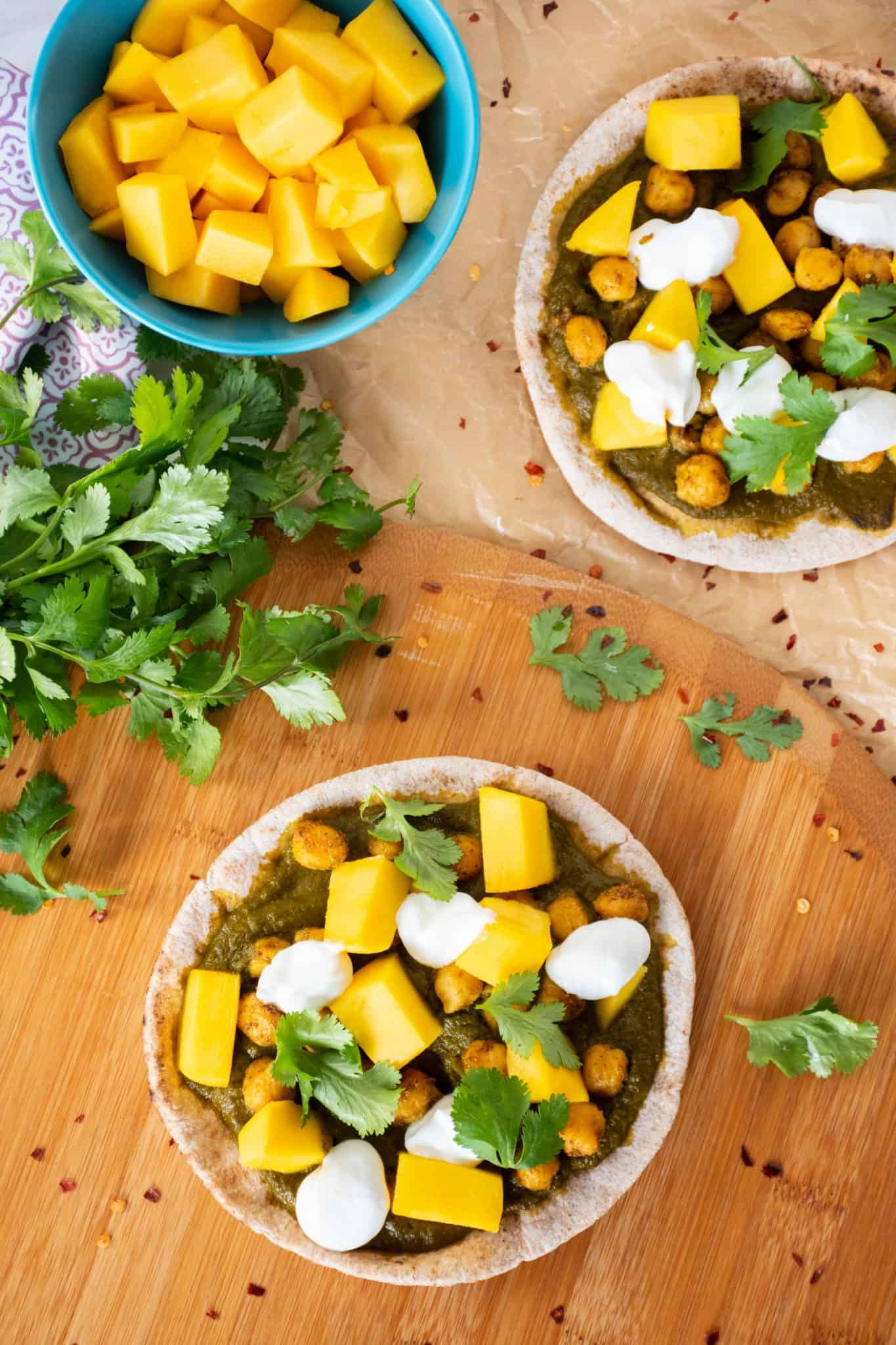
      Italian Lentil & Rice casserole

      Ingredients

      Vegetable Broth

      I make my vegetable broth from kitchen scraps and keep it in the freezer in 2 or 3 cup portions. That makes it easy to use anytime I need it, quickly.

      Making my own also means I have complete control over how much salt is in it - which is none. You can get the recipe here, or look for a vegetable broth with the lowest amount of sodium at the store you can get.

      Quick Cooking Brown Rice

      It's my go-to rice! Brown rice can take up to an hour to cook, but quick cooking brown rice takes only 20 minutes. Which is close to the same amount of time the lentils take, making it the perfect choice for this recipe!
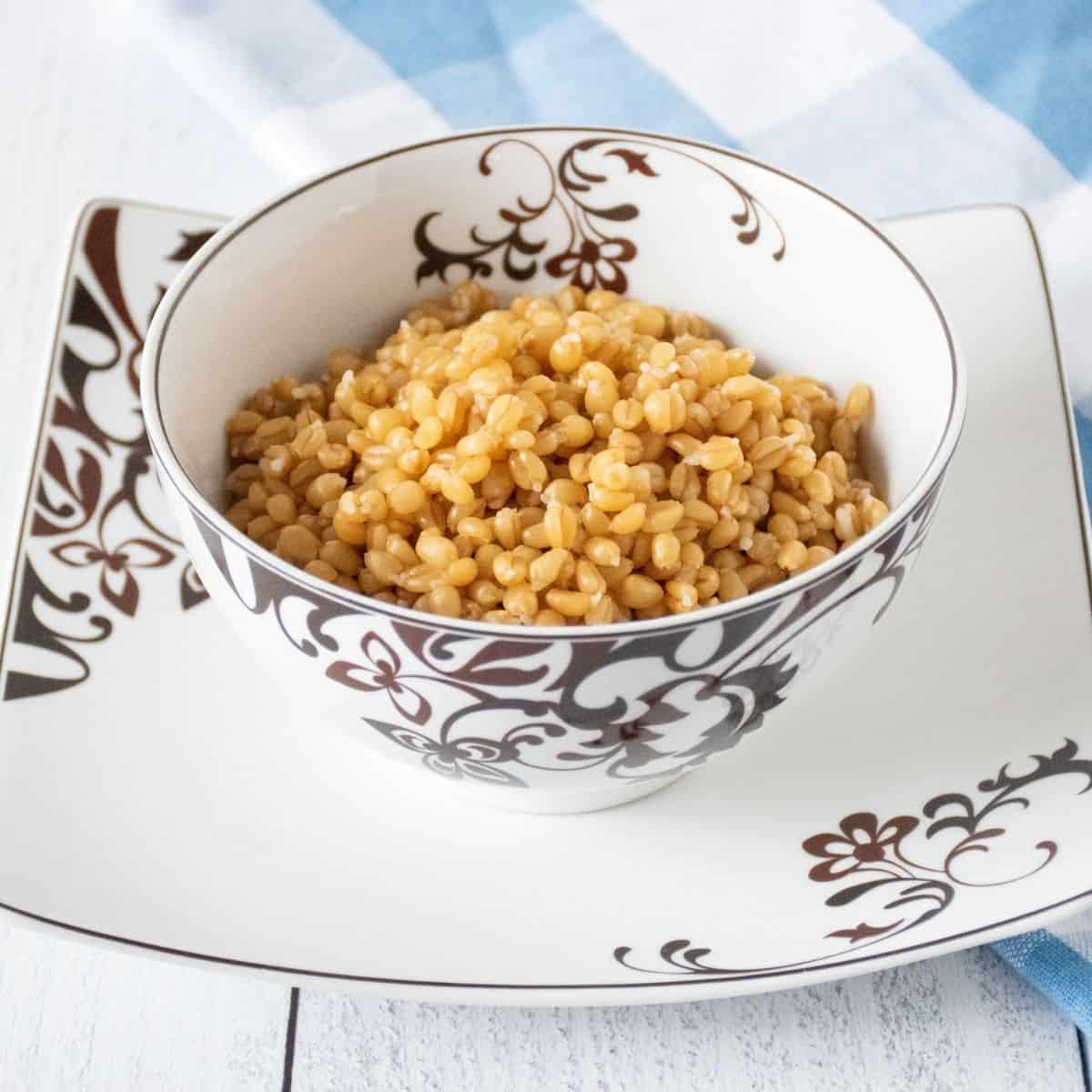
      If you have regular brown rice that does take an hour, start cooking it alone and after 30 minutes toss the lentils and other ingredients in. If you have instant brown rice, start cooking the lentils and the other ingredients and when there's about 5 or 10 minutes left, toss the rice in.

      Brown Lentils

      Brown lentils, or green lentils (you may see them called either), are a wonderful dry bean options. Some dry beans can take hours to boil, but lentils only take about 20 minutes. And they're so darn delicious!

      Beans and lentils are important to include on a heart healthy eating plan. Many studies have been conducted on the health benefits of legumes. They are known to help decrease blood cholesterol levels, and consuming ½ cup a day is associated with a 38% lower risk of having a heart attack. Another study found those who consume legumes 4 times per week have a 22% lower risk of heart disease than those who eat less than one per week.

      Canned Diced Tomatoes

      I keep these in my pantry at all times and use them in so many recipes! Look for no added salt varieties.

      Tomatoes are high in lycopene (an antioxidant), which is well known for its role in prostate health. But did you know it also protect your heart? Lycopene seems to not only lower your risk of stroke, but also lower your risk of having additional cardiac events.

      Kalamata Olives or Capers

      Okay, these are high in salt, so moderation is key. I love using ingredients like these when I need a little salt, because they also add a little fiber and additional flavor. Green olives would work here, too, if you like. Black olives may not because they are sweeter. You want something brinier. Marinated artichokes would probably be good, too!

      Nutritional Yeast

      I keep this on hand all the time, but it's optional in this recipe if you don't have it. It's got a bit of a cheesy flavor, so it complements the casserole nicely. It's high in vitamin B12, which is sometimes lacking in plant-based diets. But mostly, it's just delicious!
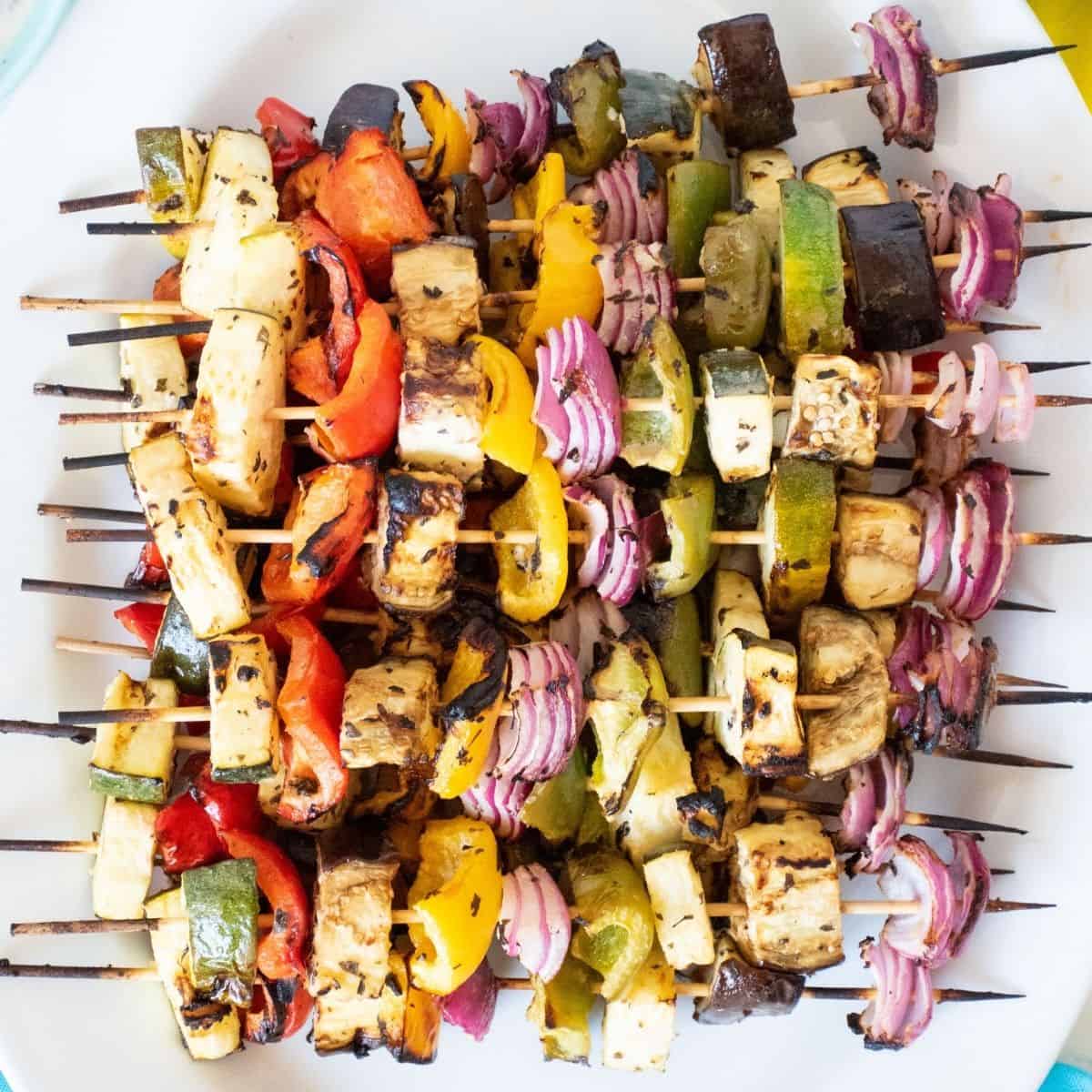
      A scoop of Italian Lentil & Rice casserole on a plate with steamed broccoli.

      How to make Italian Lentil & Rice Casserole

      Most of the time you'll spend here is hands-off time. I love that!

      First, take all the ingredients for the casserole, add them to a large pot, and boil them for about 20 minutes - unless you have a different kind of rice (see above recommendations).

      While that cooks, make the topping by combining all the ingredients and tossing together.

      Once the lentils and rice are tender, transfer to a casserole dish, and spread topping over the entire thing. Bake for about 25 minutes or so, until the topping is browned and the casserole is bubbly. Enjoy!

      Italian Lentil & Rice casserole in a casserole dish with a scoop removed.
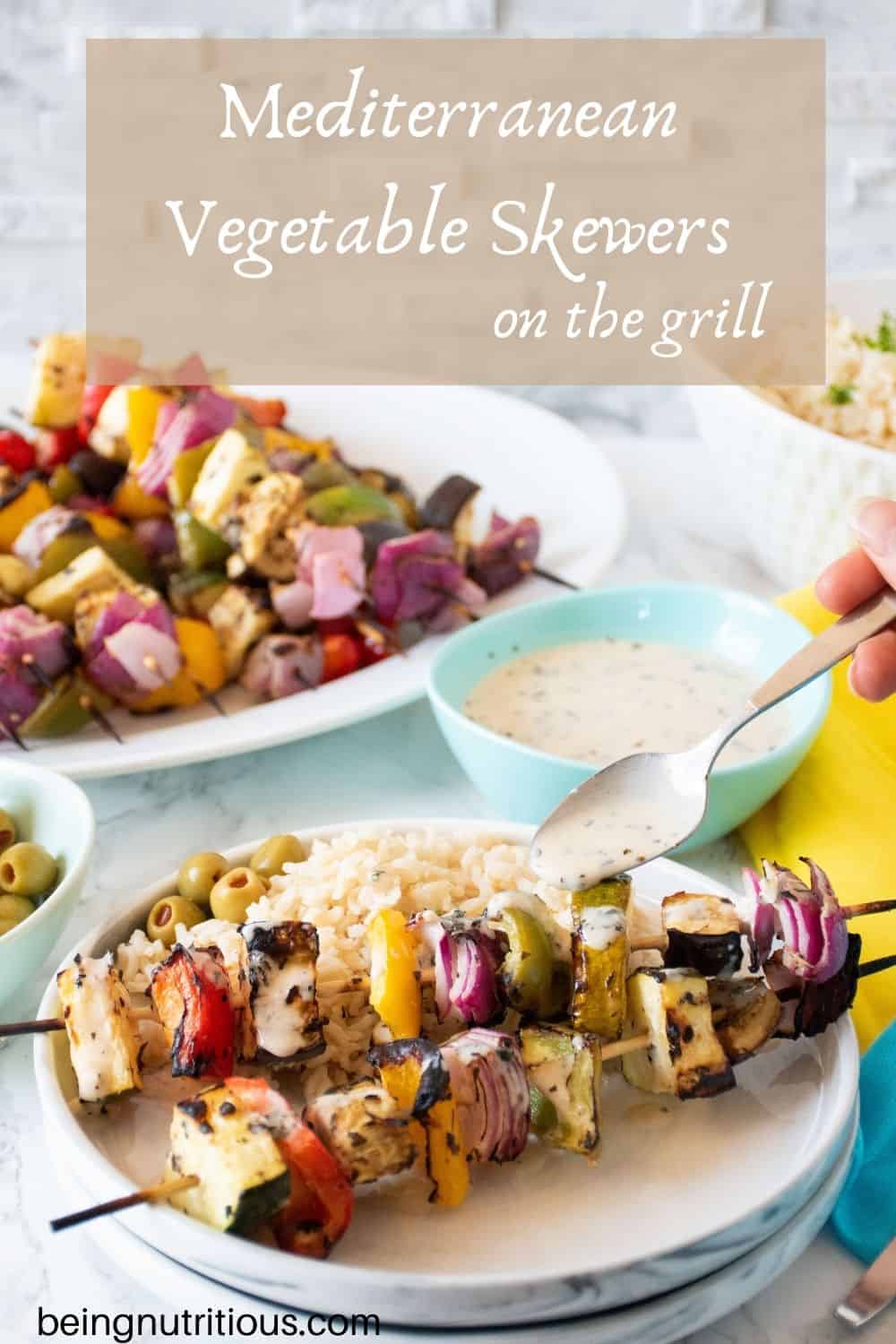
      If you make Italian Lentil & Rice Casserole, let me know!
      📖 Recipe

      Overhead image of a casserole in a casserole dish, with a bowl of steamed broccoli nearby.
      Italian Lentil & Rice Pantry Casserole

      Laura Yautz
      Easy, healthy dinner casserole that is easily customizable to what's in your pantry, and pairs great with most any vegetable for a complete meal.
      5 from 2 votes
      Prevent your screen from going dark
      Print Recipe Pin Recipe Save Recipe Saved Recipe!
      Prep Time 25 minutes mins
      Cook Time 25 minutes mins
      Total Time 50 minutes mins
      Course casserole, Main Course
      Cuisine American, Italian
      Servings 6
      Calories 304 kcal

      Ingredients
        

      Casserole Ingredients

      • 4 cups Homemade Vegetable Broth (or low sodium vegetable broth or water)
      • 1 cup Quick Cooking Brown Rice (not instant)
      • 1 cup Brown Lentils, dry
      • 15 oz can Diced Tomatoes
      • ¼ cup Kalamata Olives, chopped (or Capers)
      • 2 tablespoon Minced Garlic (about 6 cloves)
      • 2 tablespoon Dry Oregano

      Topping Ingredients

      • ½ cup Panko Bread Crumbs
      • 1 tablespoon Olive Oil
      • 1 tablespoon Nutritional Yeast, optional
      • ½ teaspoon Salt
      • Ground Pepper to taste

      Instructions
       

      • Preheat oven to 375 degrees F.
      • In a large pot, add all ingredients for the casserole and bring to a boil. Reduce heat and simmer for about 20 minutes, until lentils and rice are done or slightly al dente.
      • Meanwhile, combine the topping ingredients, and mix well.
      • When the lentil and rice mixture is ready, transfer to a lightly oiled 8X13 casserole dish. Sprinkle the topping evenly over the mixture.
      • Bake for 20-30 minutes, until bubbly and topping is slightly browned.

      Nutrition

      Serving: 0gCalories: 304kcal (15%)Carbohydrates: 54.3g (18%)Protein: 12.4g (25%)Fat: 4.7g (7%)Saturated Fat: 0.8g (5%)Polyunsaturated Fat: 1gMonounsaturated Fat: 2.6gTrans Fat: 0gCholesterol: 0mgSodium: 113.3mg (5%)Potassium: 408.2mg (12%)Fiber: 6.1g (25%)Sugar: 1.9g (2%)Vitamin A: 13.1IUVitamin C: 5.9mg (7%)Calcium: 68.6mg (7%)Iron: 3.8mg (21%)

      *Nutrition information is an estimate, and will change based on the brand and individual ingredients and amounts you use. This is provided for your convenience only.

      Keyword Casserole, Healthy Dinner Casserole, Italian Casserole, Lentil Casserole, Vegan Casserole, Vegetarian Casserole, Whole grain
      Tried this recipe?Let us know how it was!
      Italian Lentil & Rice casserole pinterest graphic with the words: made from pantry staples
      • « Previous Page
      • 1
      • 2
      • 3
      • 4
      • 5
      • 6
      • Next Page »
      Laura Yautz in her kitchen

      Hi, I'm Laura!

      I’m a Registered Dietitian and I love food and cooking, It’s my passion to help you discover how delicious and easy heart healthy eating can be! I’m glad you’re here! Take a look around. You’re going to LOVE Being Nutritious!

      About Me
      Enroll in the FREE EMAIL COURSE to make your kitchen heart healthy!
      Want to say thank you?

      Cozy Winter Recipes

      • Overhead image of a bowl of cooked red cabbage.
        Slow Cooker Red Cabbage (German Style)
      • Overhead image of baked oatmeal, still in the baking pan.
        Pecan Pie Baked Oatmeal (sweetened with dates)
      • Slices of roasted acorn squash on a plate over sage pesto with pepitas.
        Sage Pesto with Pepitas on Roasted Acorn Squash
      • Overhead image of tetrazzini in a casserole dish.
        Vegetable Tetrazzini
      • Bowl with collard greens and crusty bread, garnished with a lemon slice.
        Slow Cooker Collard Greens (Low Sodium)
      • Overhead image of chickpea breakfast skillet on a plate, with breakfast potatoes.
        Breakfast Chickpeas with Collard Greens
      • Green tortilla roll up appetizers shaped like a Christmas tree.
        Christmas Pinwheels
      • Small plate of peppermint hot cocoa bites.
        Peppermint Hot Cocoa Cookies (no-bake)

      Footer

      Sign up for free emails and updates!

      Sign me up →
      • Privacy Policy
      • Disclaimer
      • Terms & Conditions
      • Contact
      • Services
      • ↑ back to top

      As an Amazon Associate I may earn from qualifying purchases. Your purchase helps me keep the lights on, at no additional cost to you! I never recommend products that I don't love. Thanks for your support!

      Copyright © 2026 Being Nutritious. All rights reserved

      Rate This Recipe

      Your vote:


      A rating is required
      A name is required
      An email is required